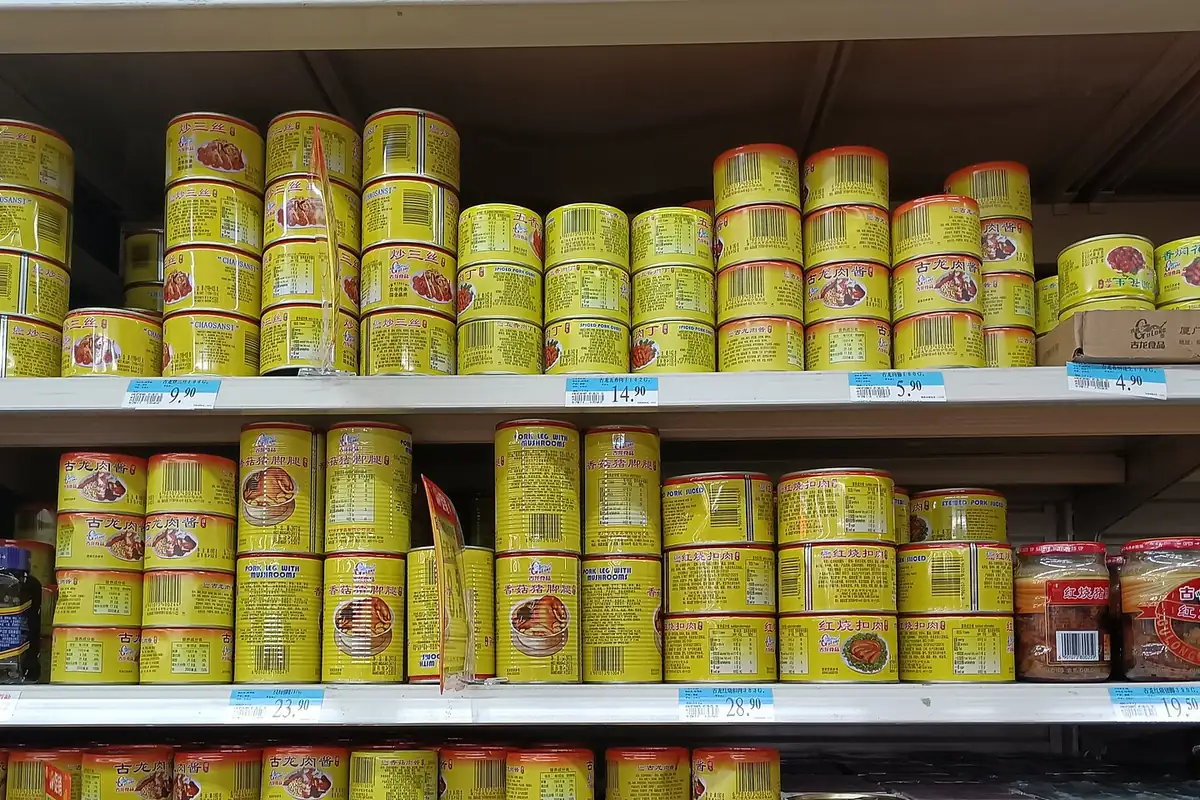

In Japan canned food is allowed in carry-on with conditions, and in checked bags.
Carry-on: Yes on domestic flights. Checked baggage: Yes.
Canned food on flights in and from Japan
On a domestic flight the 100ml liquid limit does not apply. On an international flight it does.
| Where | Allowed? | What applies |
|---|---|---|
| In the cabin | Yes, within limits | Yes on domestic flights. On international flights it depends on the liquid inside: canned vegetables, canned fruit and dessert cans are on Japan's liquids list and limited to containers of 100ml or less, while canned fish and canned meat with very little liquid, such as tuna, crab, corned beef, ham and sausage, are excepted. |
| In checked baggage | Yes | Yes. |
- Domestic flights in Japan
- The 100ml liquid limit does not apply.
- International flights from Japan
- Each container 100ml or less, all of them inside one transparent re-sealable bag of 1 litre or less, one bag per person.
Canned soup, curry and stew are on the liquids list too. The screener at the checkpoint makes the final decision on whether an item counts as a liquid.
Canned food: which tins count as liquid, and tins entering Japan
A tin is judged by what it holds and how much of that is liquid, not by the metal around it.
- Tins only the Japanese edition names
- The Japanese edition of Japan's liquids list is longer than the English one in its row for other canned food. Besides vegetables and fruit it names dessert tins such as mitsumame and anmitsu, quail eggs, canned oden and chestnuts in syrup. All of these are on the restricted side for the cabin on international flights.
- Corned beef appears in both English rows
- The English edition places Corned Beef beside canned vegetables and fruits, then repeats it among the excepted meat products with ham and sausage. The Japanese edition has it once, among livestock tins excepted when they hold very little liquid. Salmon is named among the excepted fish tins in English, where the Japanese text gives tuna, crab and fish in oil.
- Tuna changes sides at the border
- South Korea's list gives tuna, saury, soy-braised beef, perilla leaves and fruit cocktail as tins that contain liquid, so in the cabin on international flights they follow its liquids control. Australia's TravelSECURE page names tuna too, with abalone and sardines, as canned food with high liquid content. Taiwan's CAA explains that canned and jarred pickled foods mostly contain liquid.
- JAL's examples, and tins bought past security
- A travel column on JAL's shopping site lists the tins it expects to be limited on international flights: curry, stew and soup, mackerel simmered in miso, oden, and fruit in syrup. It adds that canned and jarred food or drink bought inside the airport after the security check can be carried on board even at 100ml or more.
- Bringing it into Japan: canned goods and animal quarantine
- Japan's Animal Quarantine Service states that products such as canned goods, clearly recognized as posing no risk of spreading pathogens because of how they are manufactured, are excluded from its designated items even when the material inside would otherwise be covered. Canned foods head the examples under its retort standards, Standards 3 and 4.
- Bringing it into Japan: what the standard requires of the tin
- Standard 4 describes the product it excludes: it contains liquid, is packed in an airtight container, can be stored unopened at room temperature for 12 months or longer, and was manufactured on an industrial scale. The Service does not accept zip-lock seals or metal clips as airtight. Home-made preserves fall outside the wording, which is limited to industrial products.
Canned food: the rule country by country
The carry-on answer for canned food is the same in all 7 other places we checked. The limits themselves are not identical, so read the row for the country you fly from.
| Flying from | Carry-on | Checked bag | What the authority says |
|---|---|---|---|
| JapanCivil Aviation Bureau | With limits | Yes | On international flights it depends on the liquid inside: canned vegetables, canned fruit and dessert cans are on Japan's liquids list and limited to containers of 100ml or less, while canned fish and canned meat with very little liquid, such as tuna, crab, corned beef, ham and sausage, are excepted. Source |
| United StatesTSA | With limits | Yes | Canned foods are not on the prohibited items list, but their X-ray appearance and the 3-1-1 liquids rule can mean extra screening and the can not being allowed through. TSA suggests packing them in checked bags. Source |
| European UnionEuropean Commission, EASA | With limits | — | Liquid/solid mixtures and soups count as liquids: in hand luggage, containers of 100 ml or less in one transparent re-sealable bag of one litre or less. Source |
| United KingdomUK Government | With limits | Yes | Food items in hand luggage can obstruct x-ray images and may be checked again by hand. Liquid or semi-liquid foods such as soup count as liquids: at most airports no containers larger than 100ml. Food and liquids can go in hold luggage. Source |
| South KoreaMOLIT Aviation Security 365 | With limits | Yes | Canned food is listed. Domestic: allowed in carry-on and checked baggage. International: checked the same; cans with liquid (tuna, saury, meat in sauce, fruit cocktail) follow the carry-on rule of 100ml containers in 1 clear 1L zip bag. Source |
| TaiwanCivil Aviation Administration | With limits | Yes | Canned food usually contains liquid: on international flights a can over 100 ml (100 c.c.) falls under the liquids limit and cannot be carried on board. Putting it in checked baggage is advised. Source |
| Hong KongCivil Aviation Department | With limits | Yes | Foods in sauces or with a high liquid content, and liquid-solid mixtures, are LAGs: in cabin baggage, containers of 100 ml or less in a clear re-sealable bag of 1 litre. LAGs not needed for the flight should go in hold baggage. Source |
| AustraliaHome Affairs, CASA | With limits | Yes | Canned food with high liquid content, such as abalone, sardines or tuna, is listed as a liquid on international flights: carry-on containers of 100 mL or less. The limits do not apply to checked baggage or most domestic flights. Source |
Each row comes from that authority's own page. Airlines can be stricter, and the screening officer has the final say.
If security in Japan will not let canned food through
- What to do
- Move canned food to the bag you check in before you reach security. Narita Airport states that anything given up at the checkpoint is discarded and cannot be returned.
Frequently asked questions
Can you take canned food on a plane?
On flights in and from Japan: Yes on domestic flights. On international flights it depends on the liquid inside: canned vegetables, canned fruit and dessert cans are on Japan's liquids list and limited to containers of 100ml or less, while canned fish and canned meat with very little liquid, such as tuna, crab, corned beef, ham and sausage, are excepted. In checked baggage: Yes.
Can I put canned food in checked luggage?
Yes. South Korea's list accepts canned food in checked baggage on domestic and international flights alike. JAL's shopping-site column says retort food and tins that count as liquids can travel abroad in a suitcase checked at the counter, and the TSA suggests packing canned foods in a checked bag.
Can I bring canned meat into Japan?
Canned goods are named as excluded from the items under animal quarantine. Japan's Animal Quarantine Service lists canned foods as examples under Standards 3 and 4 of its exclusion criteria, which require an airtight container and industrial manufacture. Meat that is only vacuum-packed is not in that group: the agriculture ministry's feature says vacuum-packed meat is covered.
Can I carry a small tin of food through security in Japan?
Yes, when the tin holds 100 g or less and goes in the clear bag. JAL's shopping-site column shows a packing example with a tin of 70g, and says food sold at 100ml or 100g or less can stay in its retail pack inside a clear zip bag of 1 litre or less, 1 bag per person.
Does the TSA allow canned food in carry-on bags?
Canned foods are not on the prohibited items list, but their X-ray appearance and the 3-1-1 liquids rule can mean extra screening and the can not being allowed through. TSA suggests packing them in checked bags.
What is the rule for canned food on flights from South Korea, Taiwan and Australia?
South Korea: Canned food is listed. Domestic: allowed in carry-on and checked baggage. International: checked the same; cans with liquid (tuna, saury, meat in sauce, fruit cocktail) follow the carry-on rule of 100ml containers in 1 clear 1L zip bag. Taiwan: Canned food usually contains liquid: on international flights a can over 100 ml (100 c.c.) falls under the liquids limit and cannot be carried on board. Putting it in checked baggage is advised. Australia: Canned food with high liquid content, such as abalone, sardines or tuna, is listed as a liquid on international flights: carry-on containers of 100 mL or less. The limits do not apply to checked baggage or most domestic flights.
Read more
- Coffee Culture in Japan: Kissaten, Konbini and Canned CoffeeCoffee culture in Japan, from kissaten and konbini cups to canned coffee from 1,975,200…
- Japanese Convenience Store Food: 9 Must-Try Konbini PicksStart with an onigiri, the egg sandwich and a machine coffee. Most konbini are open 24 …
- Is Japan Vegetarian-Friendly? A Vegan and Halal Food GuideYou can eat vegetarian in Japan, but dashi fish stock hides in soups and sauces. How to…
- Can You Bring Hand Warmers on a Plane? Japan’s 2026 RulesYes, you can bring disposable hand warmers on a plane in Japan: MLIT bans only oil-fill…
Sources for this page
Show all 15
- Japan Civil Aviation Bureau (MLIT) — List of liquids covered by the quantity limits (Japanese, 1 October 2015)
- Japan Civil Aviation Bureau — Items restricted in carry-on and checked baggage (updated 24 April 2026)
- Japan Civil Aviation Bureau — List and Description of LAGs Restriction (1 October 2015)
- TSA — What Can I Bring?: Canned Foods
- European Commission — Information for air travellers
- GOV.UK — Hand luggage restrictions: Liquids
- Aviation Security 365 (MOLIT / KOTSA) — Items restricted on the plane: Canned food (통조림)
- Taiwan CAA — Q&A on the new security measures for carry-on baggage (liquids, gels and aerosols)
- Civil Aviation Department (Hong Kong) — Frequently Asked Questions: Implementation of Security Controls for Liquids, Aerosols and Gels (LAGs)
- Australian Department of Home Affairs — TravelSECURE: What you can and can't bring
- JAL Shopping — Travel column: foods restricted in the cabin on international flights (Japanese)
- Animal Quarantine Service — Exclusion Criteria (articles that clearly pose no risk of spreading pathogens)
- MAFF — aff magazine, November 2023: Souvenirs need care too, the airport steps for bringing in meat and fruit (Japanese)
- Aviation Security 365 (MOLIT / KOTSA) — Items restricted on the plane: Beer (맥주)
- Taiwan CAA — Q&A on the security measures for carry-on baggage: liquids, gels and aerosols (Chinese)