Temple Stay in Japan at Koyasan, From Dinner to Dawn Prayers
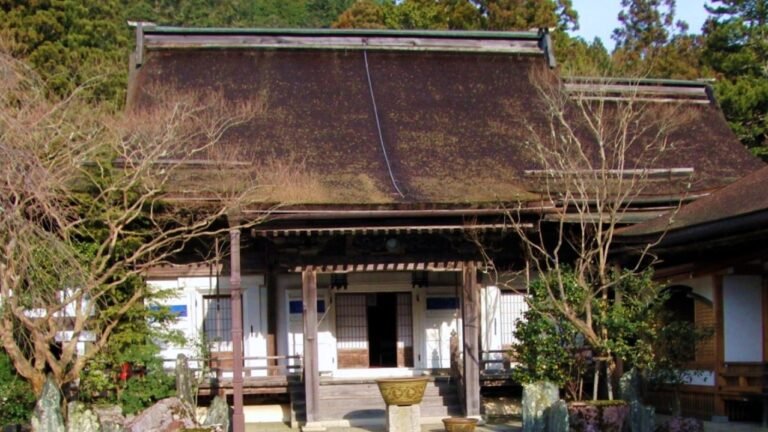
Anyone can book a shukubo. You sleep on a futon laid on tatami, eat at set times, and can join the monks for prayers at dawn. Most temples share toilets between rooms, and some take cash only.
The JNTO Koyasan Shukubo temple lodgings page counts 51 lodges offering shukubo stays on the mountain. It calls Koyasan the 1,200-year-old center of Shingon Buddhism and a UNESCO World Heritage Site. Below you will find the night’s schedule, the food, the trains from Osaka and Kansai Airport, and the winter cold.
What a shukubo is, and who can stay
A shukubo is lodging inside a temple. The JNTO overnight stay at a temple guide explains the history. Monks travelling long distances once stopped at these temples for the night. As more ordinary travellers needed a bed, the temples opened their doors to everyone.
Today you need no religious background to stay. You book a room, arrive in the afternoon, and follow the temple’s timetable until you leave the next morning. JNTO notes that many shukubo take bookings in English.
The room
Expect a Japanese-style room. You sleep on a futon, a thin cotton-filled mattress, laid on tatami mats made from rush grass and rice straw. JNTO says restrooms are generally shared, though some temples offer suites or rooms with a private bathroom. If a private toilet matters to you, ask for that room type when you book.
The room price typically includes dinner and breakfast. Some temples accept cash only, so confirm the payment method before you arrive. The GO TOKYO Shukubo in Tokyo guide adds that amenities are usually more basic than at a hotel. Bring your own comfort items, and an extra layer of clothing in the colder months.
How it differs from a ryokan
A ryokan, the traditional Japanese inn, also has tatami rooms and set meals. The difference is the setting. At a shukubo the monks are doing their daily training while you stay. JNTO asks guests to respect them and disturb them as little as possible. Meals follow Buddhist rules, and the morning starts with prayers in the main hall.
Koyasan is home to Kongobu-ji, the head temple of Shingon Buddhism, and to Okunoin, the mausoleum of the founder Kobo Daishi. Shingon is a form of esoteric Buddhism that reached Japan from China in the early 9th century. Sleeping on Koyasan means sleeping in its holiest ground.
A night at a Koyasan temple stay, step by step
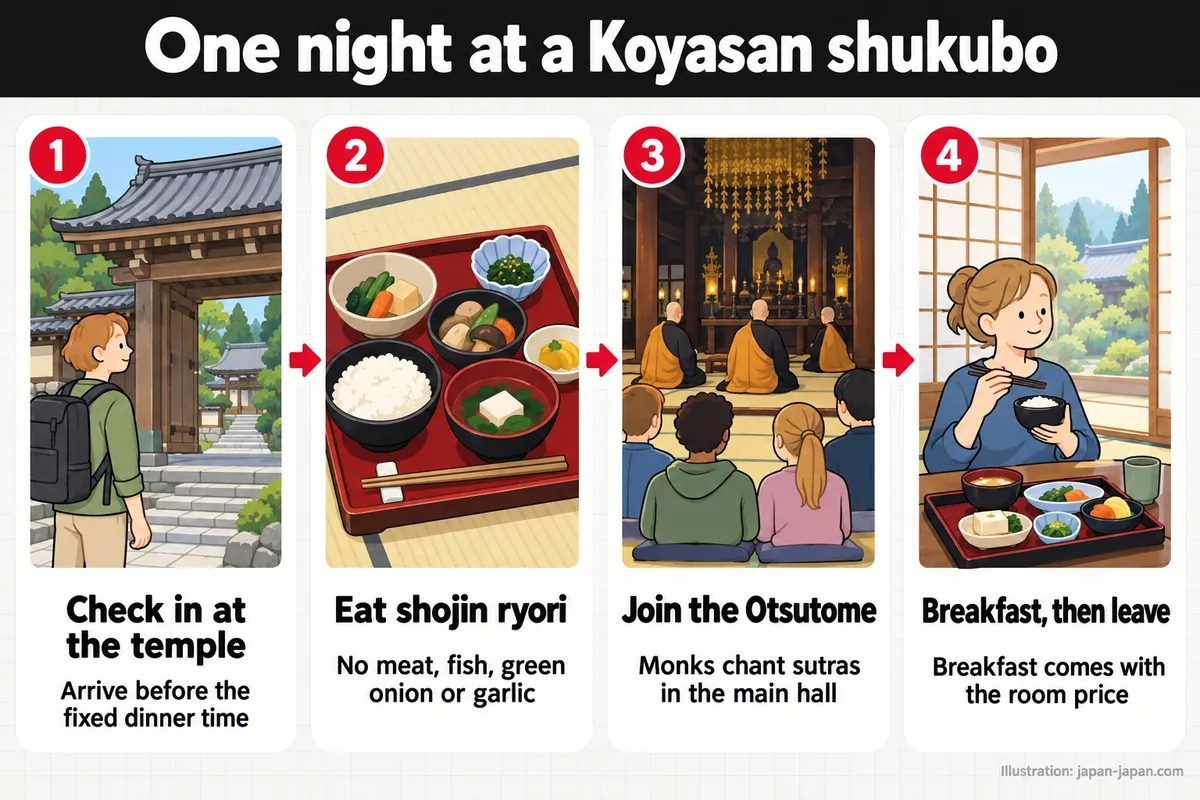
Every temple runs its own schedule, but the evening and morning follow the same pattern. The illustration below shows the four parts of a typical stay, from check-in to breakfast.
Afternoon: arrive and try a practice
Arrive early if you want to join an activity. GO TOKYO notes that some shukubo hold meditation and other sessions in the middle of the afternoon. On Koyasan, many temples offer ajikan, a meditation particular to Shingon Buddhism, led by a monk. You can also try walking meditation through the halls and gardens.
Another option is shakyo, or sutra copying. You trace over faintly printed Chinese characters with a brush. Ask at check-in which sessions run that day and what time they start.
Evening: dinner and a walk
Dinner is served at a fixed hour. The meal is shojin ryori, the vegetarian food of Buddhist temples (more on it below). After dinner, take the bath and settle in early.
If you have time before dinner or after breakfast, visit Okunoin. The photo below shows the Okunoin path, lined with stone lanterns and mossy gravestones under tall cedars.
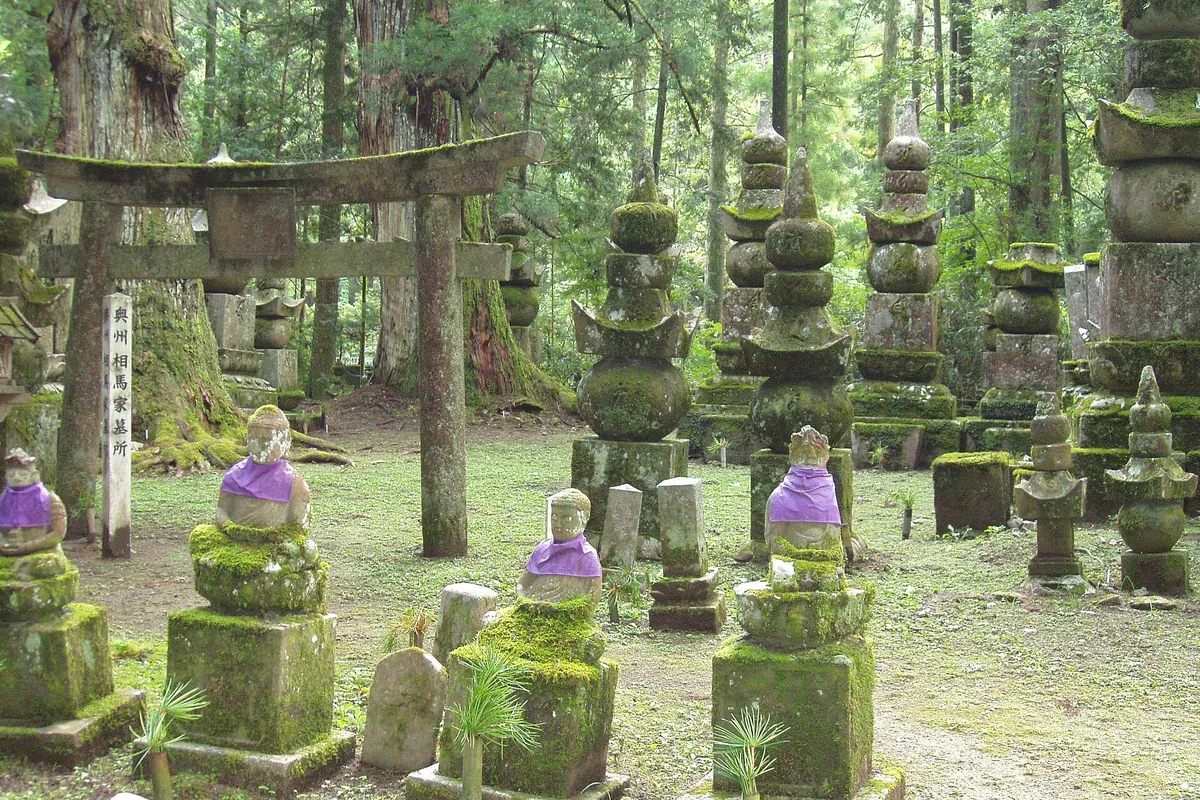
The Nankai Koyasan World Heritage Ticket page in Japanese describes the Okunoin approach as lined with the grave monuments of famous historical figures. They include Oda Nobunaga and the Toyotomi and Tokugawa families. The World Heritage Ticket below includes a 2-day pass for the Nankai Rinkan buses on the mountain.
Morning: Otsutome and breakfast
The morning ritual on Koyasan is called Otsutome. JNTO describes guests joining the monks as they chant sutras in the main hall, with incense in the air. Sit quietly and listen. You do not need to know the words.
The JNTO temple-stay guide calls the morning service gongyo. Its form depends on the temple’s sect, such as Pure Land (Jodo), Shingon or Nichiren. It may include different sutras, prayer beads or clapping. Breakfast follows, and then you check out.
Shojin ryori and house rules
Shojin ryori is the vegetarian cuisine of Buddhist temples. The JNTO Koyasan page says each meal is free of meat, fish, green onion, garlic and other stimulants. The dishes use seasonal ingredients, and vegan-friendly shojin ryori is also available.
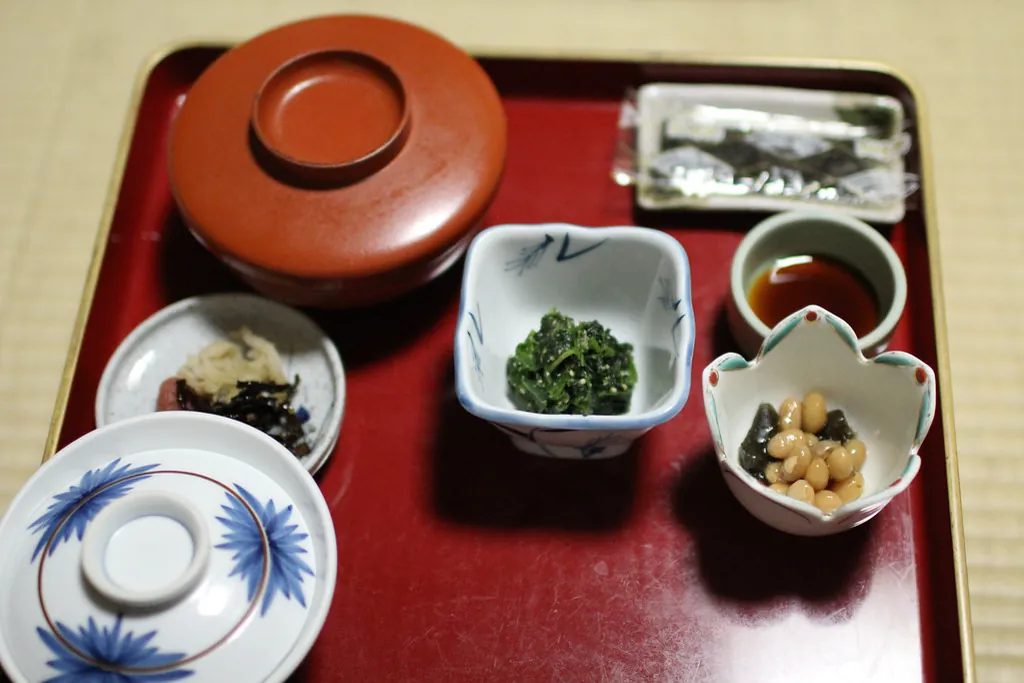
The photo above shows a typical tray meal at a Koyasan lodge, with many small dishes. The JNTO temple-stay guide states that shojin ryori uses no meat, fish, dairy or egg, and calls it very similar to vegan food. Nankai names sesame tofu, or goma-dofu, as a local speciality alongside shojin ryori.
What to tell the temple about food
Strict vegans and people with allergies should write to the temple when they book. Ask whether the meal is fully vegan on your night, and list any ingredients you cannot eat. Our guide to vegetarian food in Japan has phrases and tips for eating out once you leave the mountain.
Alcohol rules vary by temple. JNTO says some shukubo let you order alcohol as a medicinal drink, while others forbid it. If you want a drink with dinner, ask in advance.
House rules to follow
- Meal times: dinner and breakfast come at fixed times. Plan your arrival around dinner, and carry a snack if you get hungry late.
- Clothes: wear something comfortable for sitting cross-legged on the floor during meals and prayers.
- Bathing: shukubo usually have shared bathing facilities, so expect a common bath.
- Quiet: the monks are training while you stay. Keep your voice down in the halls and corridors.
- Payment: some temples take cash only. Check before you arrive.
Getting to Koyasan from Osaka and Kansai Airport
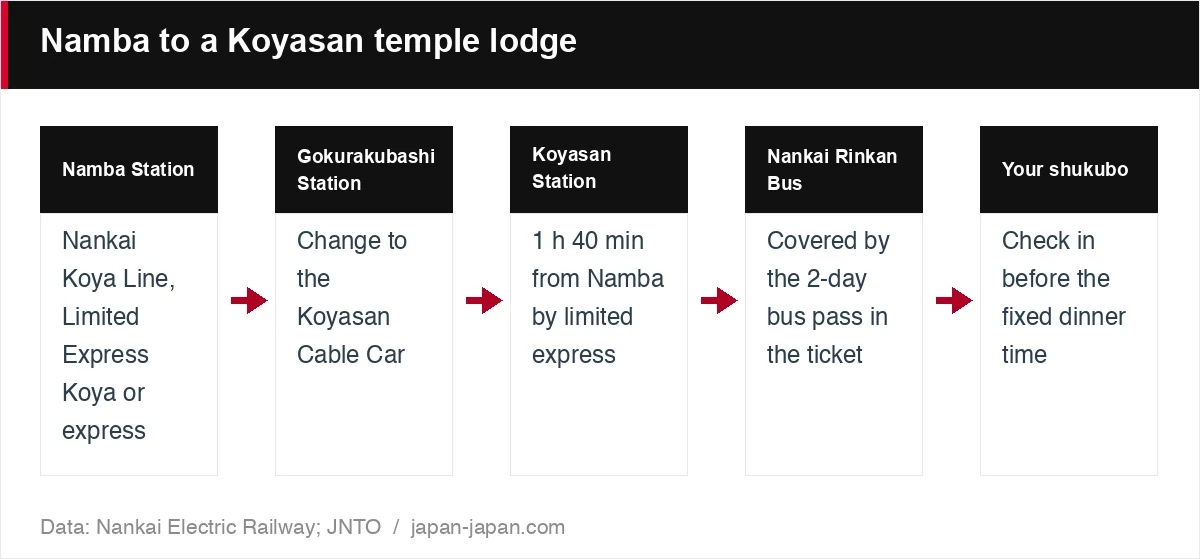
Start at Namba Station in Osaka. Take the Nankai Koya Line to Gokurakubashi Station, then change to the cable car up to Koyasan Station. From there, a Nankai Rinkan bus takes you into town and to your temple.
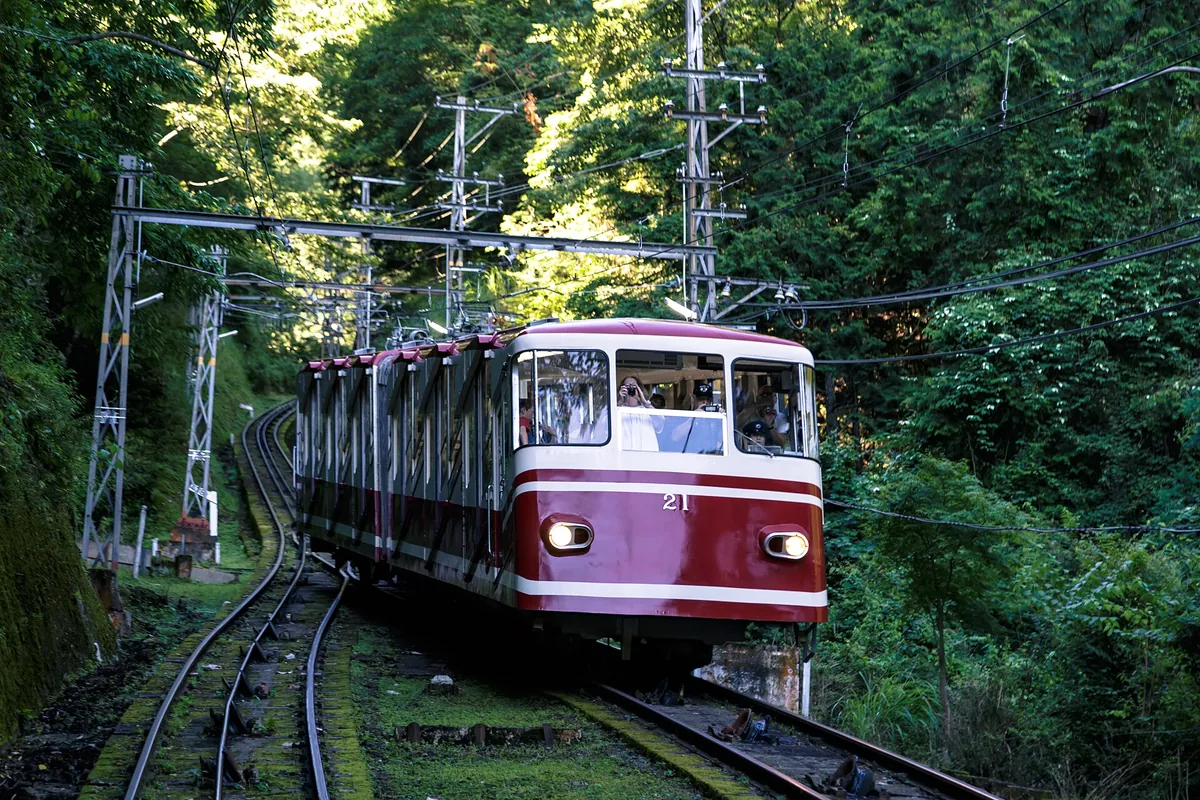
The photo above shows the cable car climbing its steep track from Gokurakubashi. JNTO notes you can also take a train from Wakayama Station to a station midway on the Nankai Koya Line.
Train times and fares from Namba
Our Osaka to Koyasan route page compares two ways up. The Limited Express Koya plus the cable car takes 1 h 40 min from Namba for 2,530 yen. An ordinary express plus the cable car takes 1 h 43 min for 1,430 yen. Our route page lists only 2 limited express trains a day, so check the timetable first.
The Limited Express Koya stops at Namba, Shin-Imamiya, Tengachaya, Sakaihigashi, Kongo, Kawachinagano, Rinkanden-entoshi, Hashimoto and Gokurakubashi. The flow chart below shows each change on the way to your lodge.
The Koyasan World Heritage Ticket
If you stay one night, the Koyasan World Heritage Ticket usually makes sense. It bundles the round trip, the buses on the mountain and discount coupons. The Nankai Koyasan World Heritage Ticket page in Japanese lists 4,210 yen for adults and 2,110 yen for children from Namba. A version with a limited express seat for the outward trip costs 5,200 yen and 2,600 yen.
| Ticket | Adult | Child | Valid |
|---|---|---|---|
| Paper ticket, train only | 4,210 yen | 2,110 yen | 2 days |
| Paper ticket with outward limited express | 5,200 yen | 2,600 yen | 2 days |
| Digital ticket, train only | 3,980 yen | 2,000 yen | 2 days |
The ticket covers three things:
- Trains: a round trip to Koyasan Station, with a limited express ticket for the outward trip in the 5,200 yen version.
- Buses: a 2-day pass for the Nankai Rinkan buses on Koyasan.
- Coupons: discounts at Kongobu-ji, the Kondo hall, the Konpon Daito pagoda and the Reihokan museum, plus some shops and restaurants.
The ticket is valid for 2 consecutive days from the first day of use, which fits a one-night stay. It goes on sale 1 month before the travel date. Nankai sells it at Namba Station (the 2F service center and the 3F limited express ticket office), Shin-Imamiya, Tengachaya, Kansai Airport and other stations. At the counter, show this name: 高野山・世界遺産きっぷ (Koyasan sekai isan kippu), meaning “Koyasan World Heritage Ticket”. A refund is possible only if every part is unused and still valid, for a 520 yen fee.
The Nankai Koyasan World Heritage Digital Ticket page sells the same bundle for your smartphone. Our Koyasan World Heritage Digital Ticket page lists it from 3,980 yen for adults and 2,000 yen for children, train only, from Namba. You hold the QR code over a designated ticket gate. The limited express seat covers the outward trip only, and you can change that train up to two times. If you get off at a station on the way, the rest of the ticket becomes invalid. Nankai cannot reissue or refund the ticket if your phone is lost, broken or out of battery.
From Kansai Airport
Ride into the city first. The Nankai Rapi:t limited express reaches Namba in 34 minutes at the fastest for 1,670 yen. The Airport Express takes about 45 minutes for 970 yen. Our Kansai Airport to Namba page compares both with the airport bus.
The Rapi:t also stops at Tengachaya and Shin-Imamiya, where the Limited Express Koya stops too. If your connection works, you can change there without going all the way to Namba.
Koyasan in winter: how cold it gets
Koyasan sits high in the Wakayama mountains, and winter there feels very different from Osaka. The Japan Meteorological Agency Koyasan climate normals for 1991-2020 put the January average at -0.3°C. The average daily low in January is -4.0°C, and in February it is -3.8°C.
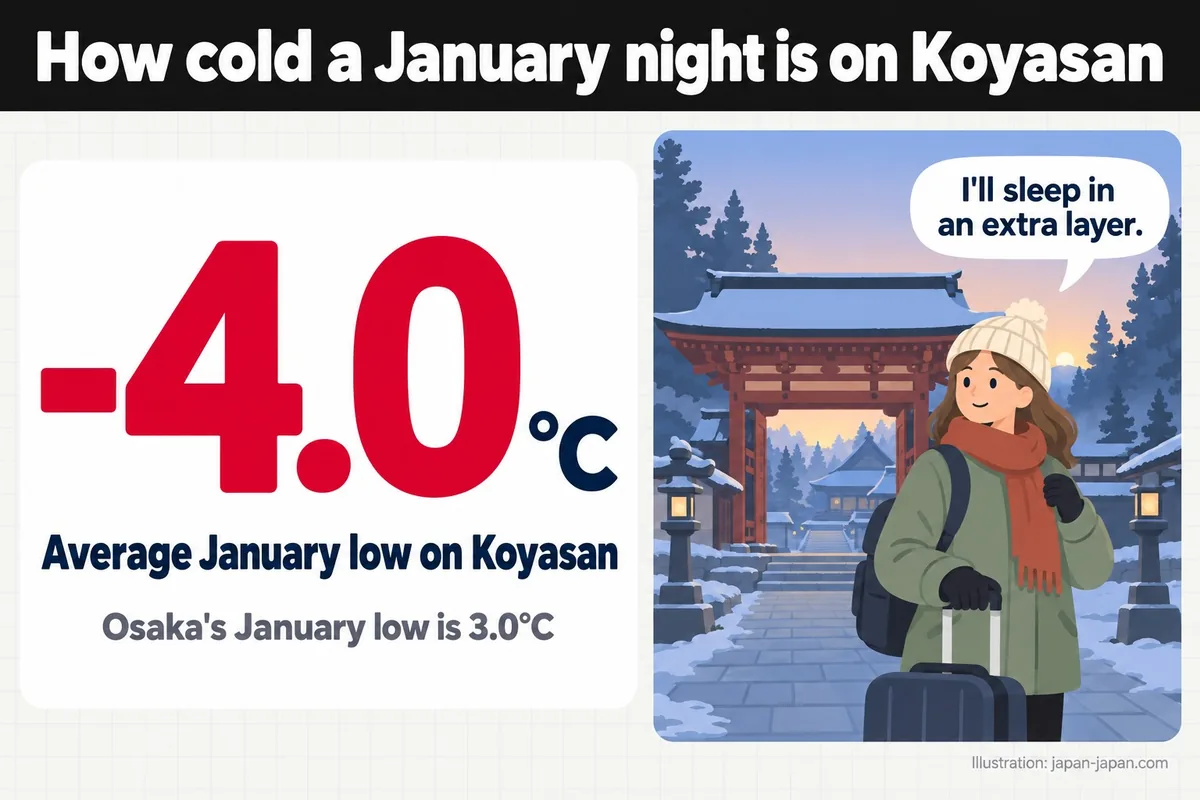
The illustration above puts the January low next to Osaka’s. The Japan Meteorological Agency Osaka climate normals give an average January low of 3.0°C in the city. That makes Koyasan about 7 degrees colder at night than the place you leave in the morning.
| Item | Value |
|---|---|
| Koyasan, Dec | -1.6 °C |
| Koyasan, Jan | -4 °C |
| Koyasan, Feb | -3.8 °C |
| Osaka, Dec | 5.3 °C |
| Osaka, Jan | 3 °C |
| Osaka, Feb | 3.2 °C |
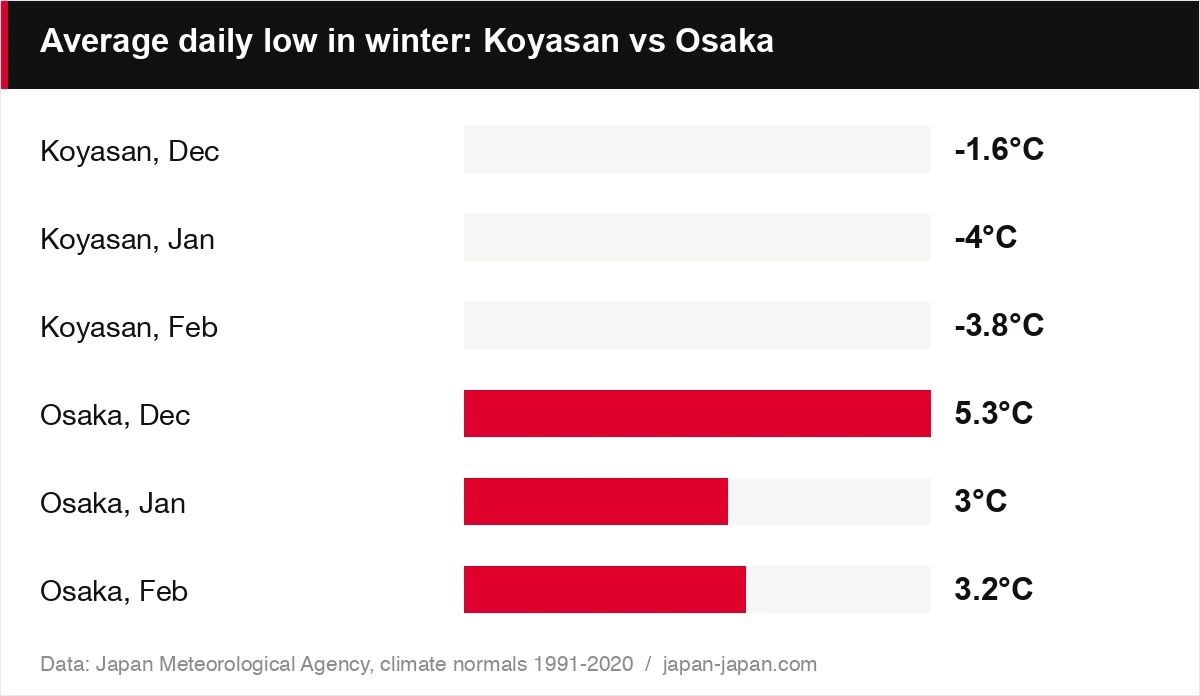
The chart compares the average daily low in each winter month. On Koyasan the lows are -1.6°C in December, -4.0°C in January and -3.8°C in February. In Osaka the same months average 5.3°C, 3.0°C and 3.2°C. Daytime highs on Koyasan stay low too: 6.3°C in December, 3.4°C in January and 4.8°C in February.
What to pack for a winter night
Pack warm layers you can sleep in, thick socks for the tatami, and a hat for the early walk to Otsutome. GO TOKYO advises an extra layer of clothing for shukubo stays in the colder months. Our Japan packing list for winter and the Osaka in January weather page help you plan clothes for both places.
New Year on the mountain
Our New Year 2026-27 holiday page lists New Year’s Day as Friday 1 January 2027. Banks close from 31 December to 3 January. Some temples take cash only, so withdraw enough yen in Osaka before you go up. JNTO already advises booking Koyasan well in advance, so reserve early for a night over New Year.
Temple and shrine stays near Tokyo: Mt Mitake
If your trip is based in Tokyo, you do not need to travel to Wakayama. The GO TOKYO guide lists shukubo on Mt Mitake in western Tokyo, inside Chichibu-Tama-Kai National Park. These lodgings line the approach to Musashi Mitake Shrine, and the final climb is by cable car.
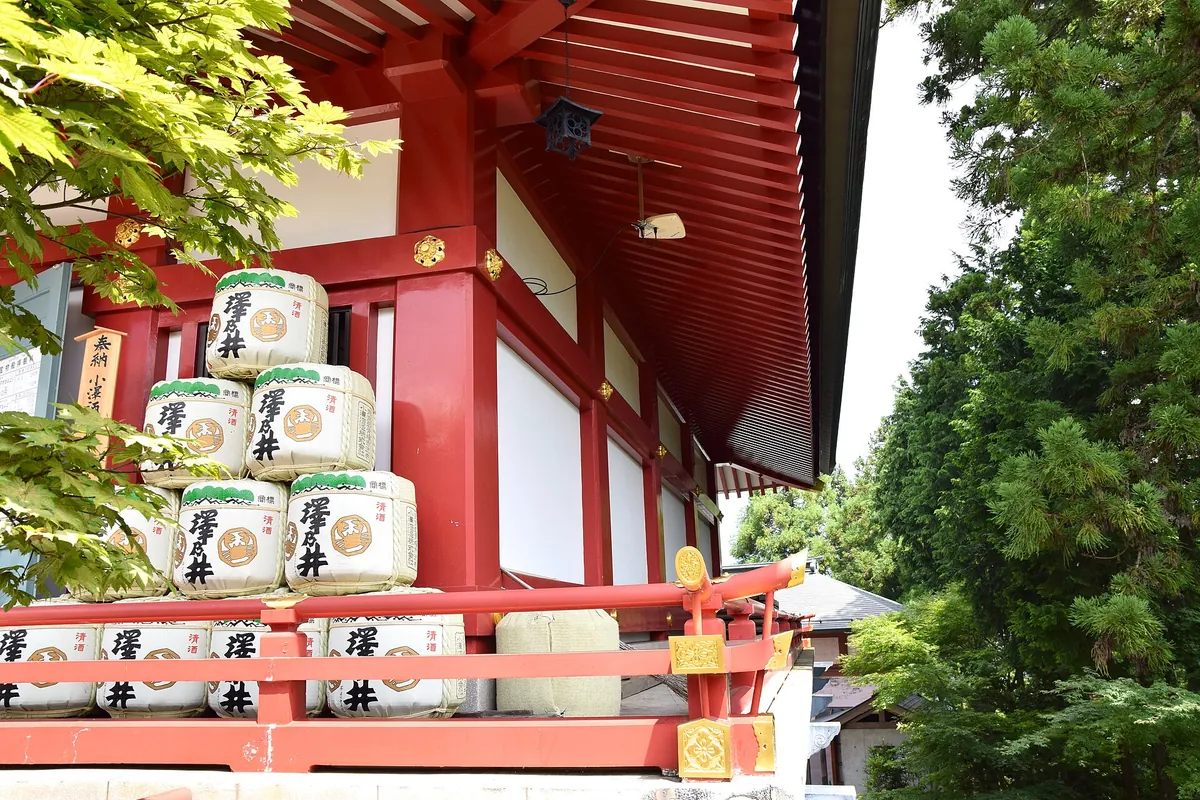
The photo above shows Musashi Mitake Shrine, which has drawn pilgrims for centuries. These lodges serve a Shinto shrine, so the morning ritual at a lodge such as Sanraku-so is shrine worship led by a priest.
Two lodges on Mt Mitake
Shukubo Seizan-so (43 Mitakesan, Ome City) has a thatched roof and sits close to many hiking trails. It offers a waterfall meditation plan at Ayahiro Falls or Nanayo Falls, depending on the season, and even a fasting plan without meals. Bring comfortable shoes and a towel. Evenings can include breathing exercises, a crystal bowl session and a performance on the sho, a bamboo wind instrument.
Shukubo Kaminoya Sanraku-so (108 Mitakesan, Ome City) is run by the head priest of Musashi Mitake Shrine and also works as a ryokan. You can join early morning worship led by an 18th-generation Shinto priest. Waterfall meditation trips leave at around 5 am. You can rent a loincloth (men) or kimono (women) to wear under the falls. The day ends with a medicinal bath of herbs from the lodge’s own garden.
A temple hotel in central Tokyo
For one night without leaving the city, GO TOKYO lists Temple Hotel Shoden-ji in Minato City. It opened in 2019 in a two-story building beside the main hall of a temple with around 400 years of history. It sits between Hamamatsucho and Tamachi stations on the Yamanote Line. You can try shakyo and, by reservation, make amulets and prayer beads.
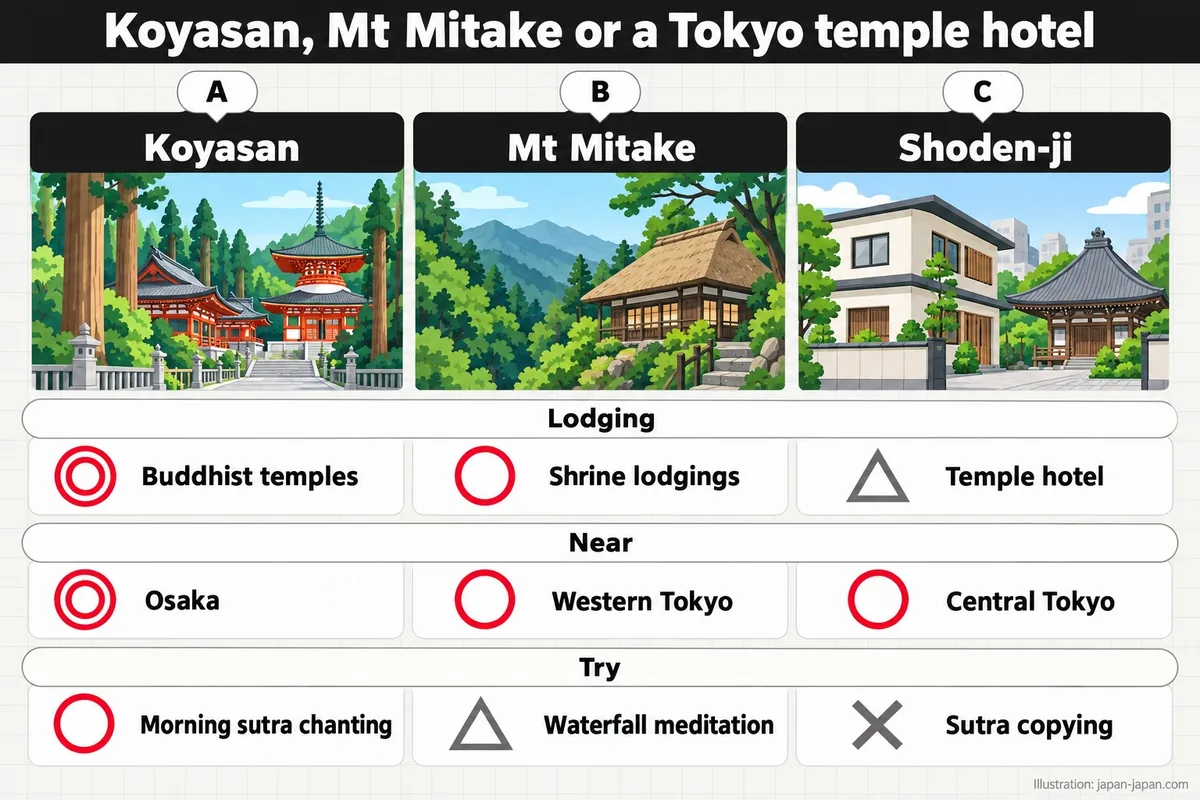
The table above sets Koyasan, Mt Mitake and Shoden-ji side by side. Choose Koyasan for the full Buddhist experience and 51 temples to choose from. Choose Mt Mitake for a mountain night with hiking and waterfalls close to Tokyo. Choose Shoden-ji if you only have one evening in the city.
How to book a temple stay
For Koyasan, book through the official websites of the Koyasan Tourist Association and the Koyasan Shukubo Association. JNTO points to both. Koyasan is the holiest ground of Shingon Buddhism and a World Heritage site, so JNTO advises booking well in advance. The JNTO temple-stay guide adds that you can book many shukubo online in English.
Tell the temple these four things
- Your arrival time. Dinner comes at a fixed hour, and some afternoon sessions start early.
- Your diet. Say if you need a fully vegan meal or have allergies.
- Your room type. Ask for a private bathroom if you need one, as most rooms share restrooms.
- How you will pay. Confirm whether the temple takes cards or cash only.
Book the room first, then the train
Book the room first. The World Heritage Ticket goes on sale 1 month before your travel date, so buy it once your night is fixed. Busy dates fill early. Check our Japan public holidays calendar before you choose a date, and avoid long weekends if you want a quiet temple. For a January trip, our guide to Japan in January covers the weather and what is open across the country.
FAQ
Can foreigners stay at a temple in Japan?
Yes. Shukubo opened to ordinary travellers long ago, and JNTO lists many that take bookings in English. On Koyasan you can reserve through the Koyasan Tourist Association and Koyasan Shukubo Association websites.
Do you have to join the morning prayers at a shukubo?
No. JNTO describes the morning service as an option for guests who want the full experience. It is the best way to see daily life at the temple. You sit quietly and listen while the monks chant.
Is the food at a Koyasan temple stay vegan?
Shojin ryori contains no meat or fish, and JNTO describes it as very similar to vegan food. Vegan-friendly shojin ryori is available on Koyasan. Tell the temple when you book, so they can confirm every dish on your night.
How cold is Koyasan in winter?
Cold. The Japan Meteorological Agency gives an average January low of -4.0°C on Koyasan, against 3.0°C in Osaka. Bring warm layers to sleep in and thick socks for the tatami.
About the author

.-_Mont_Koya.jpg)


.jpg)