Japan Temperature by Month in 6 Cities, With Rain and Snow
Every figure in this guide is a climate normal from the Japan Meteorological Agency (JMA) for 1991 to 2020. A normal is the 30-year average at one weather station. Any single year can run warmer or colder, so treat the numbers as a baseline, not a forecast.
Start with the tables to compare cities, then jump to the season you plan to travel in. Each season section gives the daily high, the daily low and the rain or snow you can expect.
Japan temperature by month in 6 cities
This guide follows six cities that cover the length of the country:
- Tokyo: the capital, on the Pacific side of Honshu.
- Kyoto: the old capital, in an inland basin.
- Kanazawa: a castle city on the Sea of Japan coast.
- Sapporo: the largest city in Hokkaido, in the far north.
- Fukuoka: the main city of Kyushu, in the southwest.
- Naha: the capital of Okinawa, in the subtropical south.
The Japan Meteorological Agency temperature terms page explains how the JMA counts. It measures air temperature 1.25 to 2.0 m above the ground. A daily mean is the average of 24 hourly readings. The monthly mean is the average of those daily means.
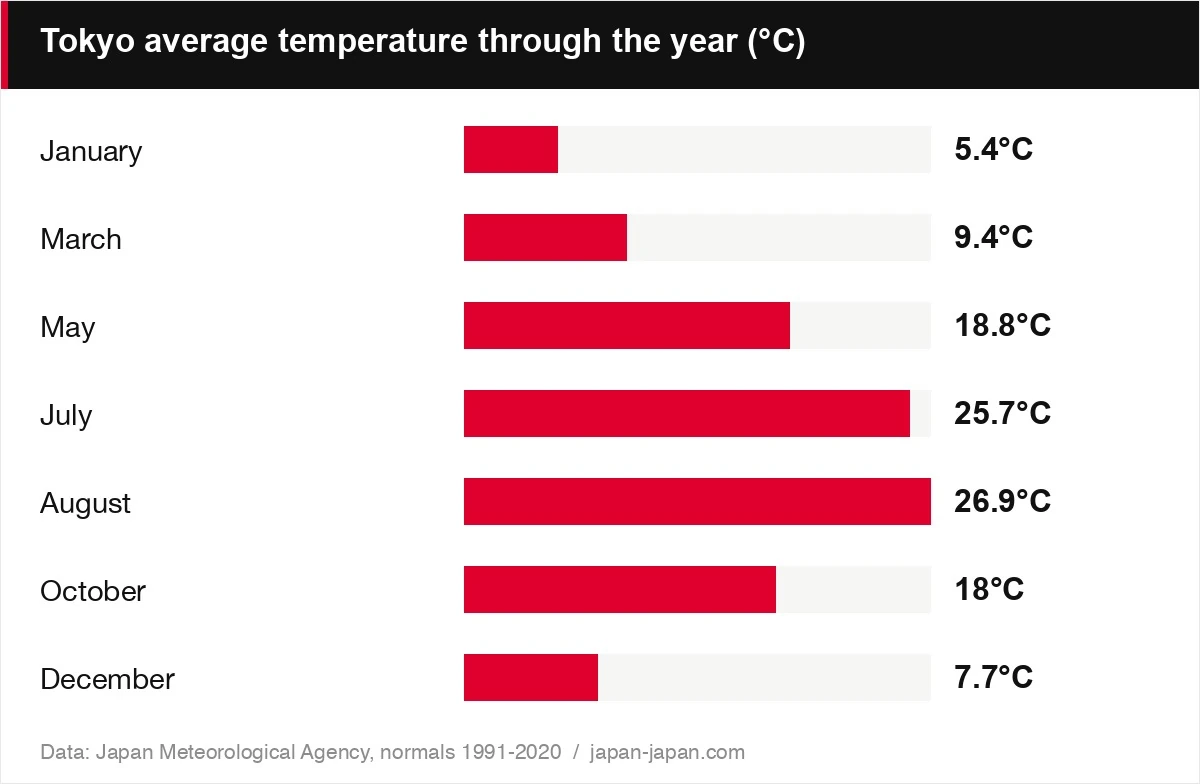
Tokyo shows the typical curve. The mean climbs from 5.4°C in January to 26.9°C in August, then falls back to 7.7°C in December. The steepest climb comes between March and April. The fastest drop comes between October and November.
| Item | Value |
|---|---|
| January | 5.4 °C |
| March | 9.4 °C |
| May | 18.8 °C |
| July | 25.7 °C |
| August | 26.9 °C |
| October | 18 °C |
| December | 7.7 °C |
The chart picks seven months from the Japan Meteorological Agency climate normals: Tokyo table. August is the peak at 26.9°C, with July close behind at 25.7°C. May and October sit almost level, at 18.8°C and 18.0°C.
The first table lists the monthly mean for the three Honshu cities. Kyoto runs hotter than Tokyo in summer and a little colder in winter. Kanazawa is the coolest of the three in every month except July and August.
| Month | Tokyo | Kyoto | Kanazawa |
|---|---|---|---|
| Jan | 5.4°C | 4.8°C | 4.0°C |
| Feb | 6.1°C | 5.4°C | 4.2°C |
| Mar | 9.4°C | 8.8°C | 7.3°C |
| Apr | 14.3°C | 14.4°C | 12.6°C |
| May | 18.8°C | 19.5°C | 17.7°C |
| Jun | 21.9°C | 23.3°C | 21.6°C |
| Jul | 25.7°C | 27.3°C | 25.8°C |
| Aug | 26.9°C | 28.5°C | 27.3°C |
| Sep | 23.3°C | 24.4°C | 23.2°C |
| Oct | 18.0°C | 18.4°C | 17.6°C |
| Nov | 12.5°C | 12.5°C | 11.9°C |
| Dec | 7.7°C | 7.2°C | 6.8°C |
The second table adds the far north and the far south. Sapporo stays below freezing on average in December, January and February. Naha never drops below 17°C on the monthly mean, and Fukuoka sits a degree or two above Tokyo all year.
| Month | Sapporo | Fukuoka | Naha |
|---|---|---|---|
| Jan | -3.2°C | 6.9°C | 17.3°C |
| Feb | -2.7°C | 7.8°C | 17.5°C |
| Mar | 1.1°C | 10.8°C | 19.1°C |
| Apr | 7.3°C | 15.4°C | 21.5°C |
| May | 13.0°C | 19.9°C | 24.2°C |
| Jun | 17.0°C | 23.3°C | 27.2°C |
| Jul | 21.1°C | 27.4°C | 29.1°C |
| Aug | 22.3°C | 28.4°C | 29.0°C |
| Sep | 18.6°C | 24.7°C | 27.9°C |
| Oct | 12.1°C | 19.6°C | 25.5°C |
| Nov | 5.2°C | 14.2°C | 22.5°C |
| Dec | -0.9°C | 9.1°C | 19.0°C |
Kyoto figures come from the Japan Meteorological Agency climate normals: Kyoto table, and Fukuoka figures from the Japan Meteorological Agency climate normals: Fukuoka table. The screenshot below shows the JMA normals page for Tokyo, which is in Japanese. Each row is one month, and the columns cover pressure, rain, temperature, humidity, sunshine and snow.
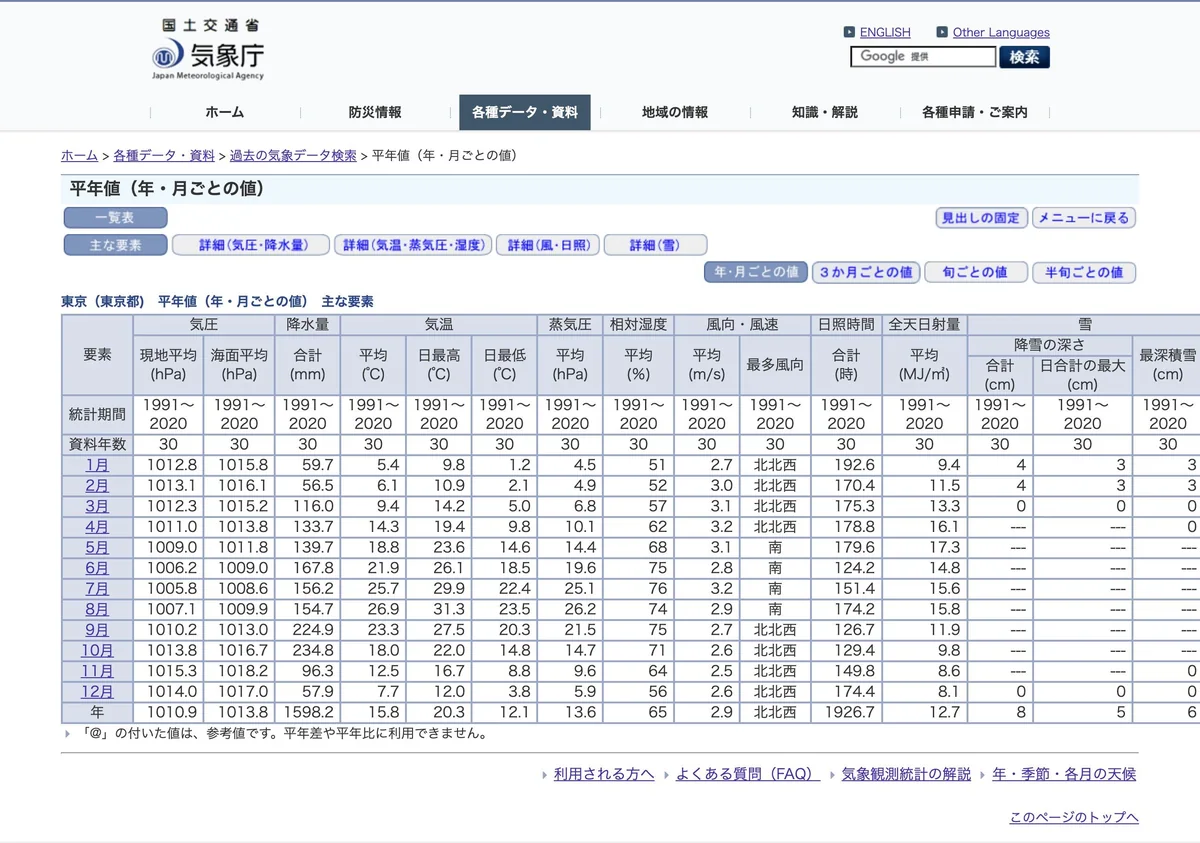
To read it yourself, find the column group headed 気温 (kion, air temperature). Under it, 平均 (heikin) is the mean, 日最高 (nichi saikō) is the daily high and 日最低 (nichi saitei) is the daily low.
Winter: cold dry Tokyo, snowy Sapporo and Kanazawa
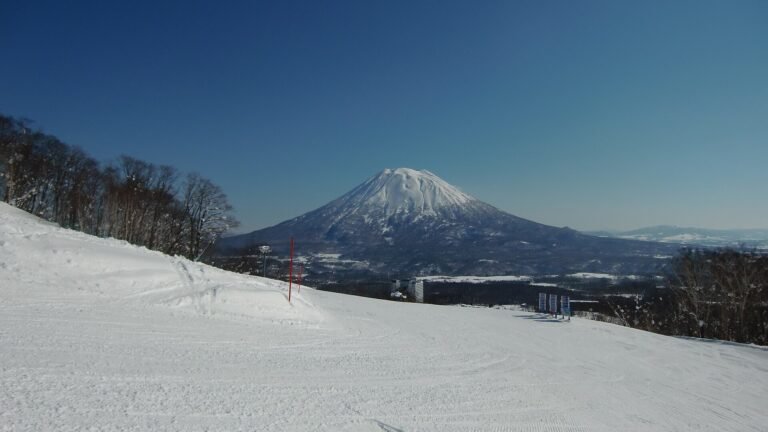
Winter splits Japan in two. Tokyo, on the Pacific side, gets bright and dry days. Kanazawa on the Sea of Japan coast and Sapporo in Hokkaido get grey skies and heavy snow. If you travel between December 2026 and February 2027, choose your base with this split in mind.
Tokyo’s January brings 192.6 hours of sunshine and only 59.7 mm of rain. Relative humidity averages 51%. The JMA calls air dry when humidity falls below about 50%, so Tokyo’s January air sits right on that line. Daily highs reach 9.8°C, and nights drop to 1.2°C.
Kanazawa sees 62.3 hours of sunshine in January and 256.0 mm of precipitation, by the Japan Meteorological Agency climate normals: Kanazawa table. December is wetter still at 301.1 mm. Much of it falls as snow: 67 cm of snowfall in January and 157 cm over a normal year.
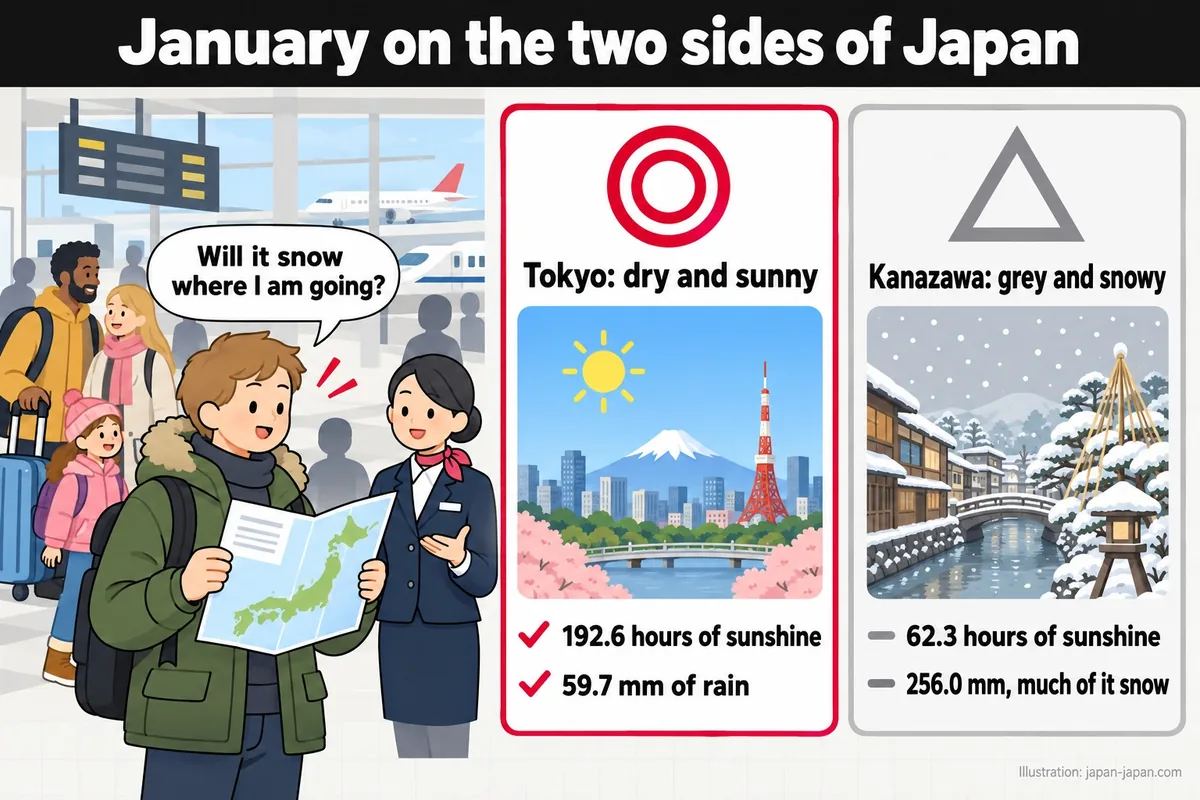
The illustration puts the two sides of the country next to each other in January. Tokyo has three times the sunshine hours of Kanazawa, and Kanazawa has more than four times the precipitation.
Sapporo is colder again. The Japan Meteorological Agency climate normals: Sapporo table gives a January daily high of -0.4°C and a daily low of -6.4°C. Snow falls on 29.1 days of a normal January. The deepest snow cover reaches 95 cm in a normal February, and the year adds up to 479 cm of snowfall.
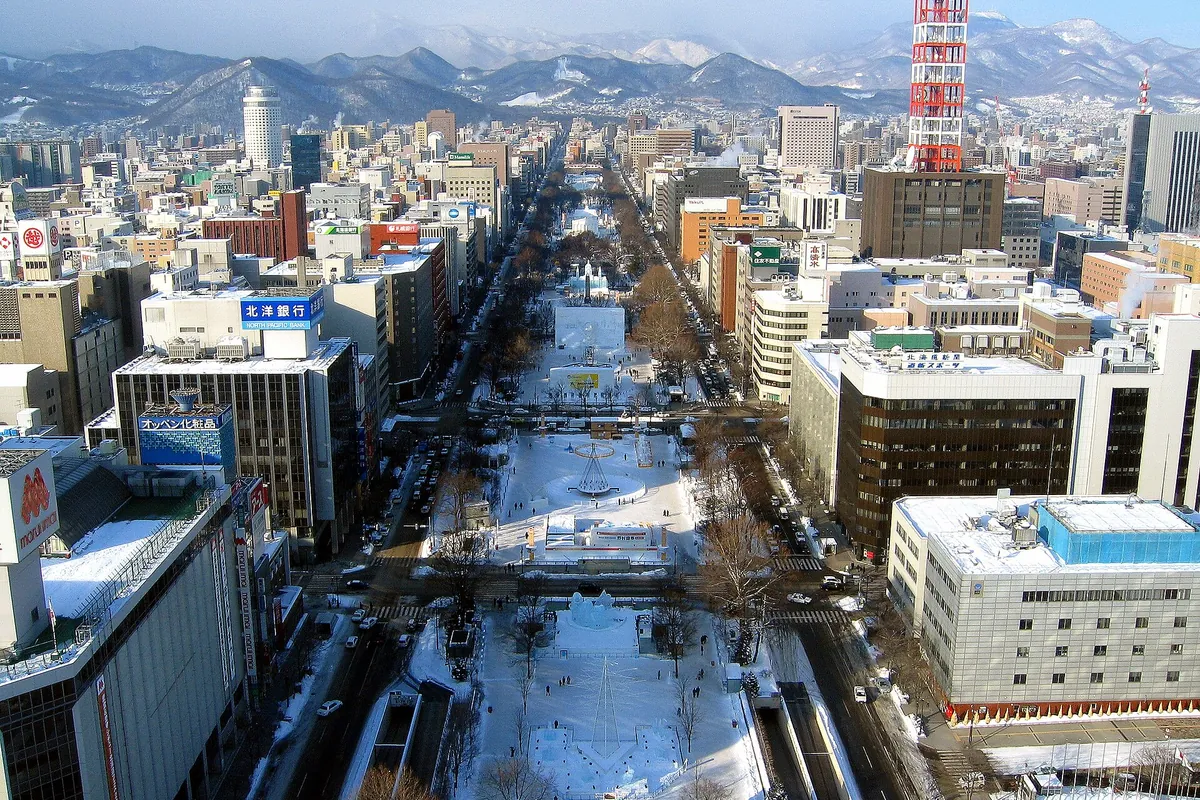
The photo shows Odori Park in central Sapporo under snow. Our Sapporo in January guide covers the Sapporo White Illumination and other events that month. For Hokkaido weather by month beyond winter, see our Sapporo by month page. It shows September as the wettest month at 142.2 mm and April as the driest at 54.6 mm.
Tokyo does get snow, but not much. A normal year brings 8 cm of snowfall over 8.5 days with snow falling, and the deepest cover is 6 cm. January and February each account for 4 cm of that total.
The table below lines up the January high, the January low and the deepest snow of a normal year for all six cities.
| City | January high | January low | Deepest snow (year) |
|---|---|---|---|
| Tokyo | 9.8°C | 1.2°C | 6 cm |
| Kyoto | 9.1°C | 1.5°C | 7 cm |
| Kanazawa | 7.1°C | 1.2°C | 32 cm |
| Sapporo | -0.4°C | -6.4°C | 97 cm |
| Fukuoka | 10.2°C | 3.9°C | 2 cm |
| Naha | 19.8°C | 14.9°C | No snow |
Kanazawa and Tokyo share the same January low of 1.2°C. The sky makes the difference. In February, the trees of Kenroku-en wear yukitsuri, snow ropes. Our Kanazawa in February guide covers them and the winter light-up. For more winter bases, read our Japan in winter guide by region.
Spring: fast warming and cool nights
Spring is when Japan warms fastest. Tokyo’s mean rises from 9.4°C in March to 14.3°C in April and 18.8°C in May. Kyoto climbs from 8.8°C to 14.4°C and then 19.5°C over the same three months.
The gap between day and night stays wide. In April, Kyoto’s daily high is 20.1°C and its daily low is 9.2°C. Tokyo’s April runs from 19.4°C in the afternoon to 9.8°C at night. Pack a warm layer for the evening, even when the afternoon feels mild.
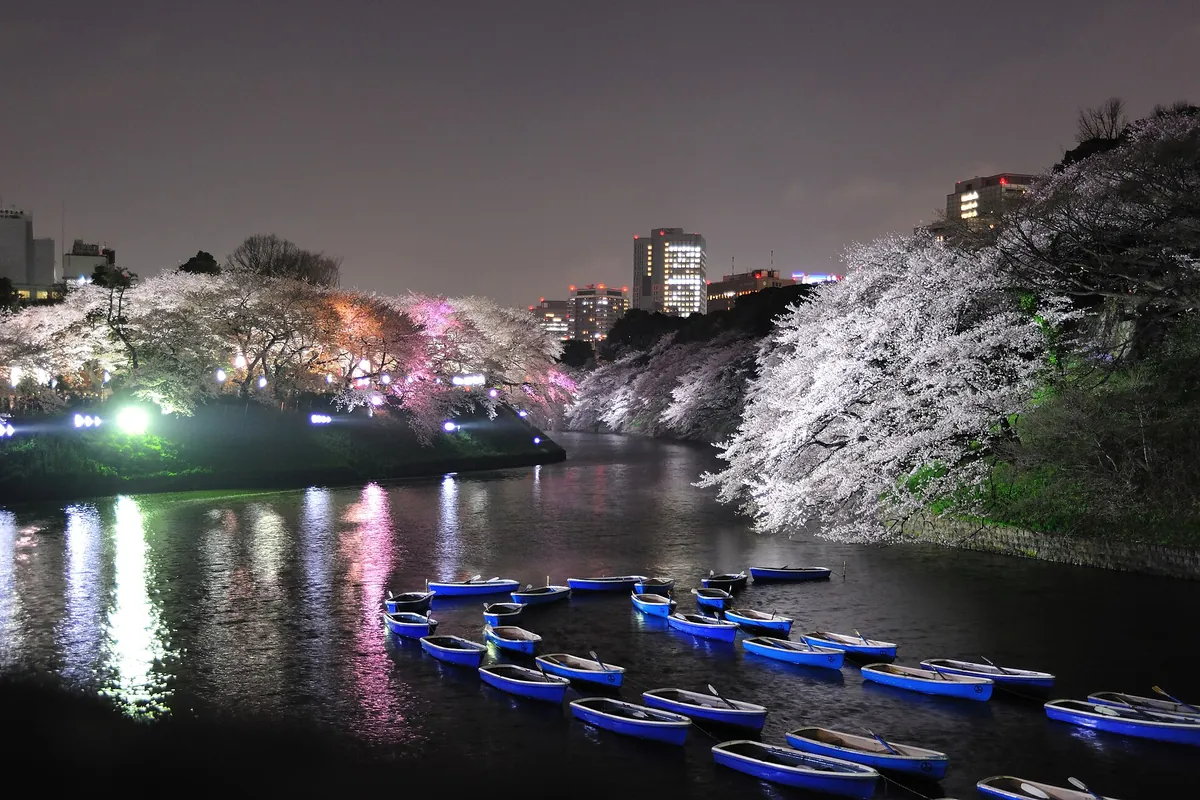
The photo shows cherry blossoms along the Chidorigafuchi moat in Tokyo. Bloom dates differ from city to city, and our cherry blossom season guide lists them for each one.
The north lags behind. Sapporo’s March mean is 1.1°C, and the daily low is still -2.4°C. Snow keeps falling too, with 74 cm in a normal March. April in Sapporo averages 7.3°C, close to Tokyo’s December mean of 7.7°C.
The south is already warm. Naha averages 19.1°C in March and 21.5°C in April. Fukuoka sits in between, at 10.8°C in March and 15.4°C in April. Rain builds through spring, and Naha gets 245.3 mm in May.
Japanese forecasts have a word for a cold snap after a warm spell: 寒の戻り (kan no modori), the return of the cold. The JMA uses it for March and April, so keep a jacket in your bag on a spring trip.
Summer: the rainy season and the heat
Summer starts wet and ends hot. The rainy season, called tsuyu, brings the dullest weeks of early summer to most of the country. Tokyo gets 124.2 hours of sunshine in June, the fewest of any month.
Rain peaks at different times in each city. Naha’s wettest month is June at 284.4 mm. Fukuoka’s is July at 299.1 mm, and Kyoto’s July brings 223.6 mm. Tokyo works differently: its wettest months are September and October, at 224.9 mm and 234.8 mm.
Sapporo stays drier through early summer. June brings 60.4 mm of precipitation there, against 167.8 mm in Tokyo. Our Japan in June guide lists the month’s festivals, such as the Sanno Festival in Tokyo.
Heat and humidity peak together in August. Kyoto’s daily high is 33.7°C, Fukuoka’s 32.5°C and Tokyo’s 31.3°C. Tokyo’s humidity averages 76% in July and 74% in August. Nights stay warm, with August lows of 23.5°C in Tokyo and 24.7°C in Kyoto.
The screenshot below is the JMA normals page for Kyoto. Its August row shows the 33.7°C daily high, the highest of the six cities in this guide.
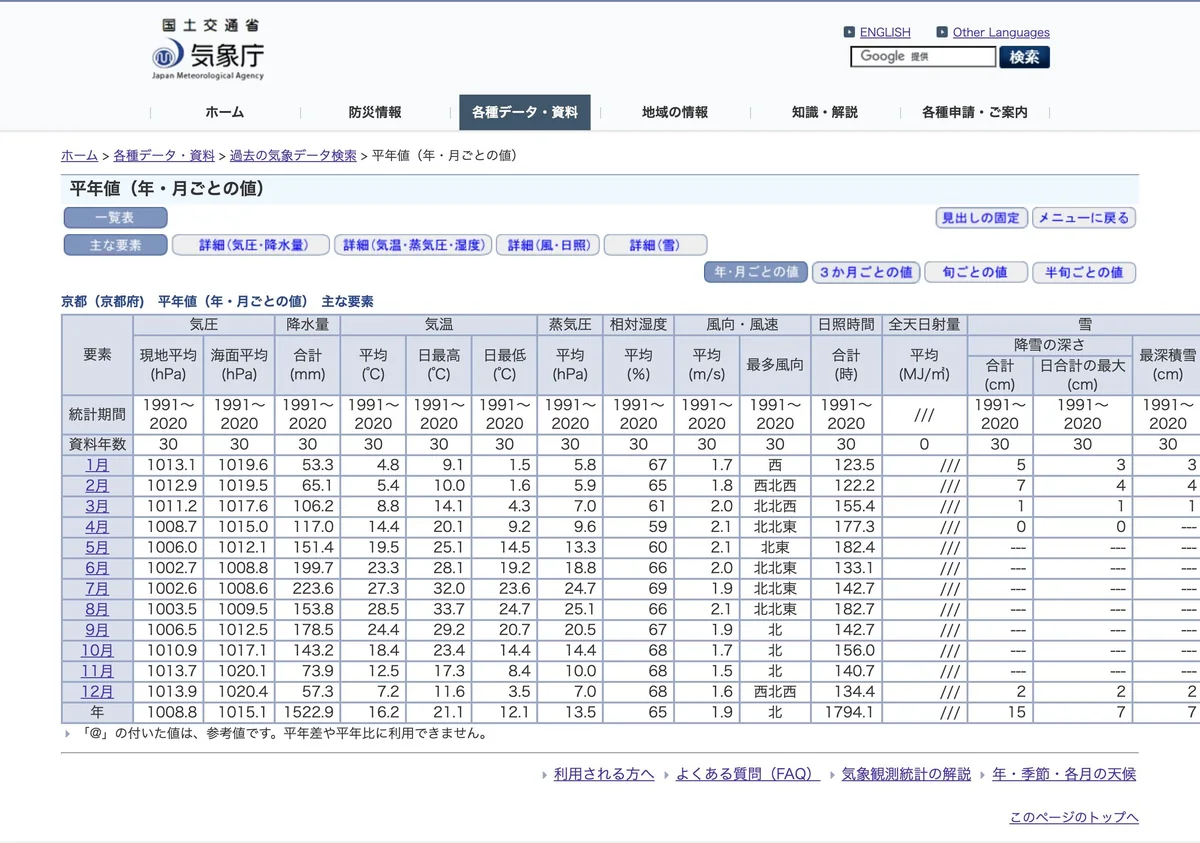
Japanese forecasts use set words for hot days. A 真夏日 (manatsubi) is a day with a high of 30°C or more. A 猛暑日 (mōshobi, extremely hot day) means a high of 35°C or more. If you see 猛暑日 on a forecast, plan museums or other indoor sights for the afternoon and walk outside early.
Sapporo is the cool choice. Its August mean is 22.3°C and its daily high 26.4°C, close to Tokyo’s June high of 26.1°C. Naha is hot but steady, with a July mean of 29.1°C and 227.0 hours of sunshine.
Autumn: November weather and the mildest months
Autumn is the most comfortable season for most visitors. The heat fades through September, and October brings means of 18.0°C in Tokyo and 18.4°C in Kyoto. October highs sit at 22.0°C in Tokyo and 23.4°C in Kyoto.
September is still warm and wet. Tokyo’s September mean is 23.3°C, and the month brings 224.9 mm of rain. Kanazawa gets 231.9 mm in September as well.
For Japan in November weather, the numbers are simple. Tokyo and Kyoto both average 12.5°C. Highs reach 16.7°C in Tokyo and 17.3°C in Kyoto, and lows fall to 8.8°C and 8.4°C. Rain drops to 96.3 mm in Tokyo and 73.9 mm in Kyoto.
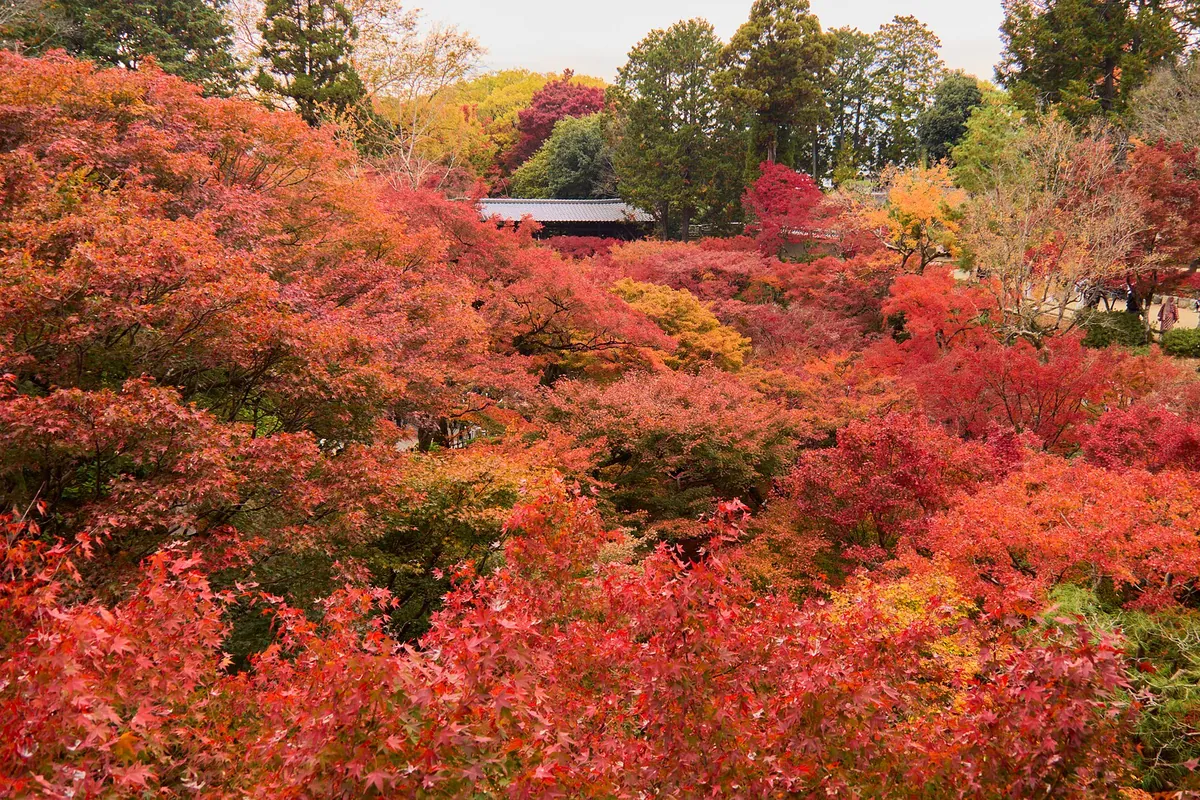
The photo shows maples at Tofuku-ji in Kyoto. Our Kyoto autumn leaves and crowds guide covers the peak and the busiest temples. The autumn leaves dates by city page lists when maples turn red across Japan.
The north turns first. The JMA’s sample maple in Sapporo turns red around 28 October in an average year, by our Sapporo autumn leaves page. Sapporo’s November mean is 5.2°C, and a normal November already brings 30 cm of snowfall.
Kanazawa turns wet early. November brings 250.8 mm of precipitation. Thunder is common there in early winter, on 8.4 days of a normal December against 0.2 days in Tokyo.
Naha stays warm into late autumn. Its November mean is 22.5°C, with a daily high of 25.0°C. Fukuoka averages 14.2°C in November, a little above Tokyo and Kyoto.
Sapporo to Naha: how far apart in each month
The gap between north and south is widest in winter. In January, Sapporo’s mean is -3.2°C and Naha’s is 17.3°C. In August the two cities sit much closer, at 22.3°C and 29.0°C.
Even Sapporo’s warmest month is only 5 degrees warmer than Naha’s coldest. Sapporo in August averages 22.3°C, and Naha in January averages 17.3°C, by the Japan Meteorological Agency climate normals: Naha table.
The chart below lines up the January daily low in all six cities.
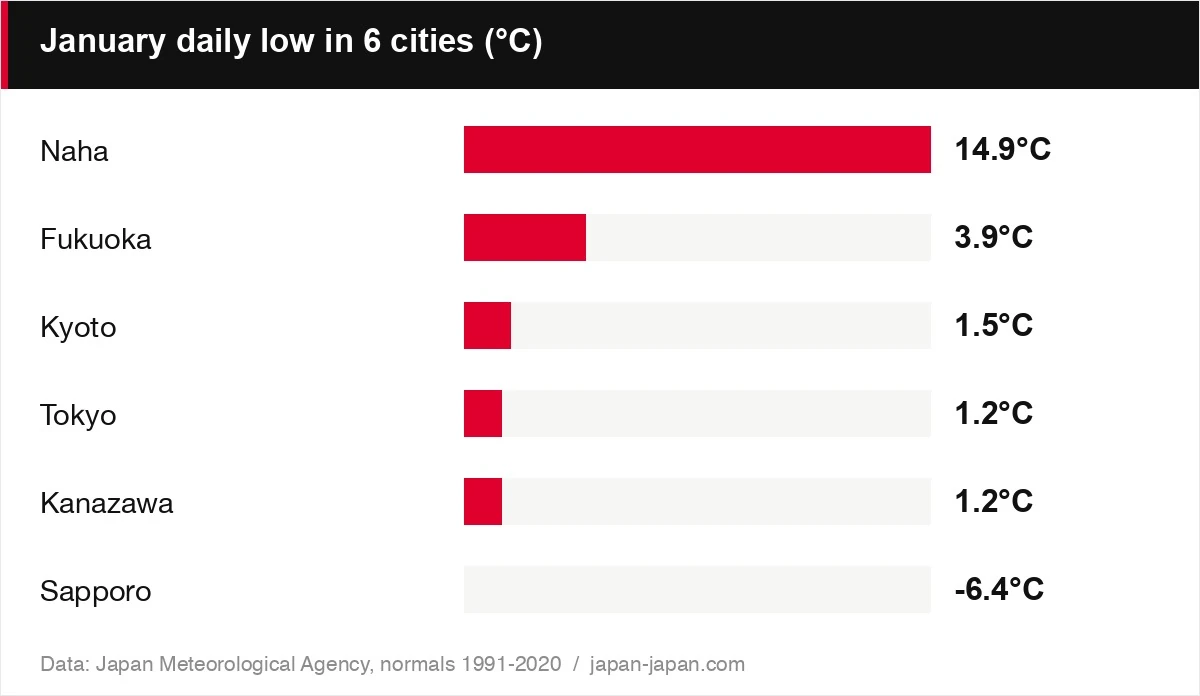
| Item | Value |
|---|---|
| Naha | 14.9 °C |
| Fukuoka | 3.9 °C |
| Kyoto | 1.5 °C |
| Tokyo | 1.2 °C |
| Kanazawa | 1.2 °C |
| Sapporo | -6.4 °C |
Sapporo’s January low of -6.4°C means most nights fall below 0°C. The JMA calls a day with a low under 0°C a 冬日 (fuyubi, winter day). Tokyo, Kyoto and Kanazawa sit between 1.2°C and 1.5°C. Fukuoka is milder at 3.9°C, and Naha’s 14.9°C low is warmer than Tokyo’s April mean of 14.3°C.
Use the gap to pick your base for each season. The lookup below sums up the choice.
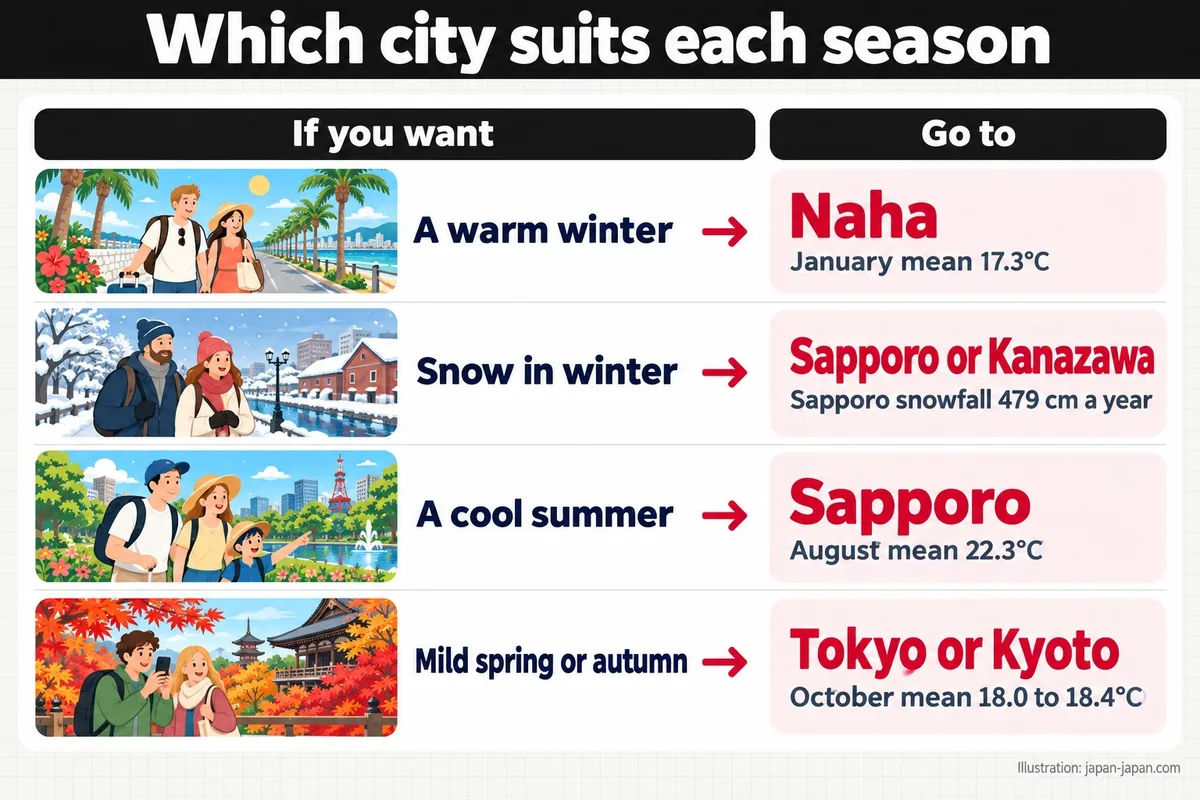
For a warm winter, Naha’s January high is 19.8°C; our Okinawa in January guide covers the Motobu Yaedake Sakura Festival that month. For snow, go to Sapporo or Kanazawa. For a cool summer, Sapporo’s August high is 26.4°C. For spring and autumn, Tokyo and Kyoto sit between 14.3°C and 18.4°C in April and October.
Okinawa also has its own rain pattern. Our Okinawa by month page shows June as the wettest month at 284.4 mm and January as the driest at 101.6 mm.
Planning by month: holidays and crowds
Weather is only half of the plan. Japan’s own holidays decide how full trains and hotels get. Two periods matter most: the New Year and Golden Week.
New Year’s Day falls on Friday 1 January 2027. Banks close from 31 December to 3 January, and JR Central makes every Nozomi reserved-seat only from 25 December 2026 to 5 January 2027. Our New Year 2026–27 page lists closures and the busiest travel days. Our January holidays page adds Coming of Age Day on Monday 11 January 2027.
Golden Week is the spring rush, when several national holidays fall close together. Tokyo’s May mean of 18.8°C makes it a pleasant time to travel, but trains and hotels fill fast. Our Golden Week 2027 page lists the dates.
To escape the winter cold, fly south. Our Tokyo to Okinawa route page lists 35 flights a day from Haneda Airport to Naha Airport, taking 2 h 30 min.
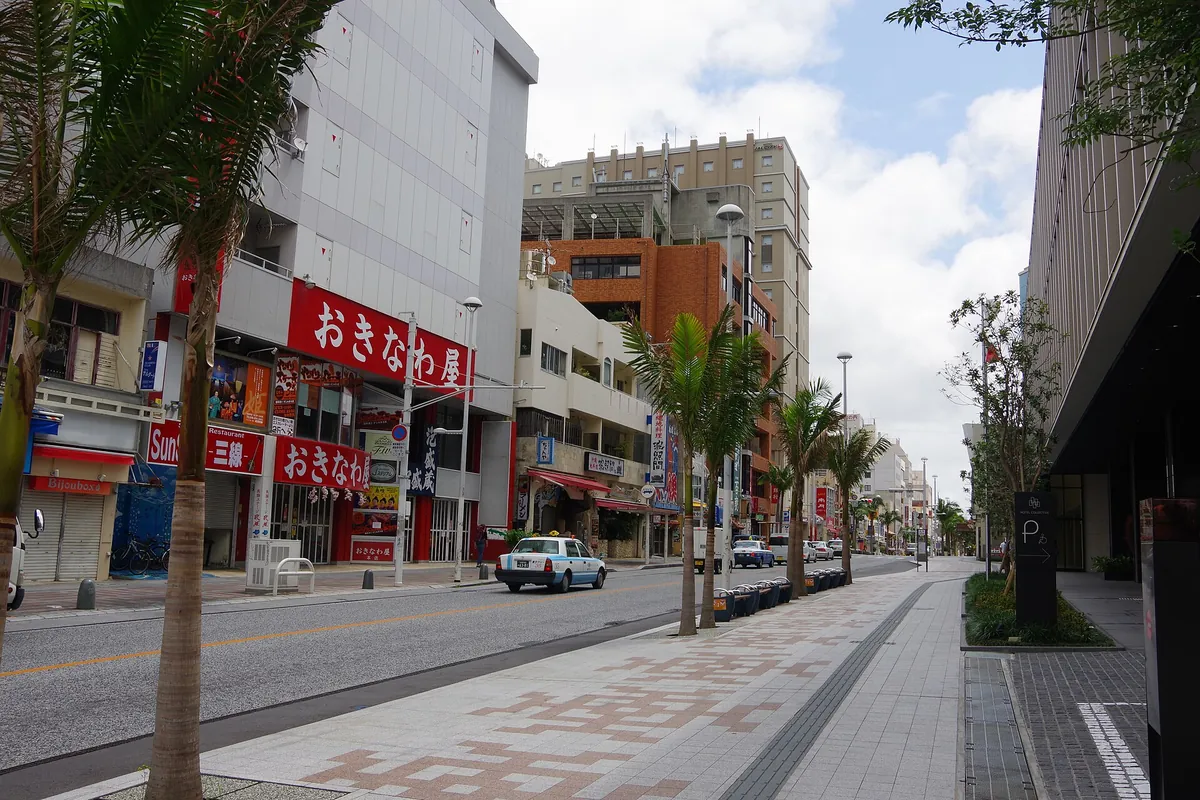
The photo shows Kokusai Street in Naha, where January highs average 19.8°C. For snow instead, fly north. Our Tokyo to Sapporo route page lists 56 flights a day from Haneda Airport to New Chitose Airport, taking 1 h 30 min. From New Chitose Airport, the train into Sapporo takes 33 min and costs 1,230 yen.
Before you book, run through four checks. The checklist below puts them in one place.
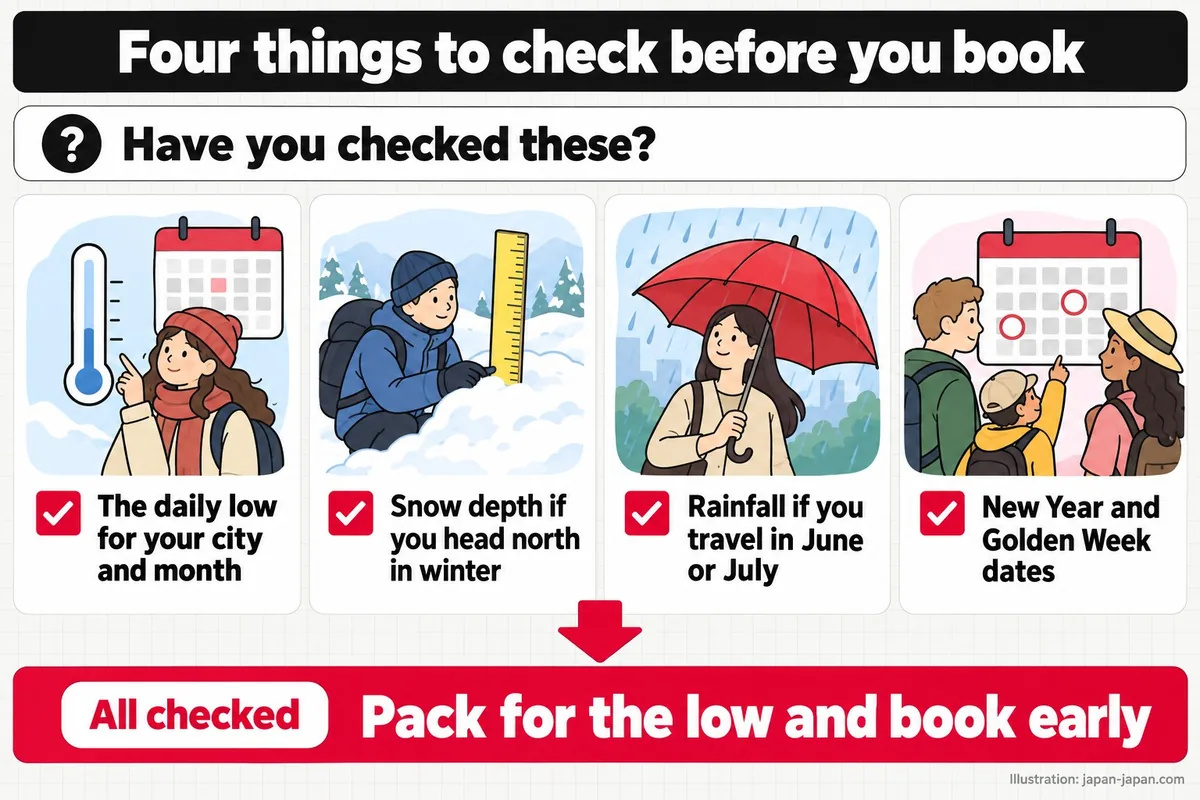
- Daily low: check the low, not only the mean, for your city and month. Sapporo’s January low is -6.4°C.
- Snow: if you head north in winter, check the snow depth. Sapporo’s deepest cover is 97 cm in a normal year.
- Rain: in June and July, check the rainfall for your city. Fukuoka gets 299.1 mm in July.
- Holidays: check the New Year and Golden Week dates before you fix the plan.
For month-by-month detail on weather, what to wear and what is on, start from our Japan by month guide. The Japan in January guide is a good first stop for a winter trip.
FAQ
What is the coldest month in Japan?
January is the coldest month in all six cities in this guide. Tokyo averages 5.4°C, Sapporo -3.2°C and Naha 17.3°C in January. In Kanazawa, February runs almost as cold, at 4.2°C against 4.0°C.
Does it snow in Tokyo in winter?
Yes, but only a little. A normal year brings 8 cm of snowfall in Tokyo, with snow falling on 8.5 days. The deepest cover in a normal year is 6 cm, and most of it comes in January and February.
When is the rainy season in Japan?
The rainy season, tsuyu, comes in early summer, and the rain peaks at different times by city. Naha’s wettest month is June at 284.4 mm, while Fukuoka peaks in July at 299.1 mm. Sapporo stays dry in June, with 60.4 mm.
Which month has the mildest weather in Japan?
May and October are the mildest months for Tokyo and Kyoto. Tokyo averages 18.8°C in May and 18.0°C in October. October is rainy in Tokyo at 234.8 mm, so November is the drier choice, at 12.5°C and 96.3 mm.
About the author