Snowboarding in Japan 2026-27: Hirafu Snow Peaks at 400 cm
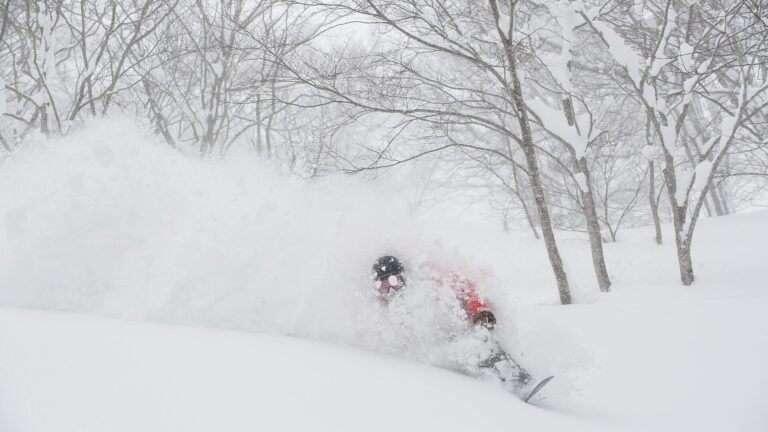
Japan snowboarding trips run on a short calendar, and February brings both the best depth and the biggest crowds. This guide covers the month to pick, where to ride, the Niseko gate rules and how to move a board.
When to go: snow depth by month
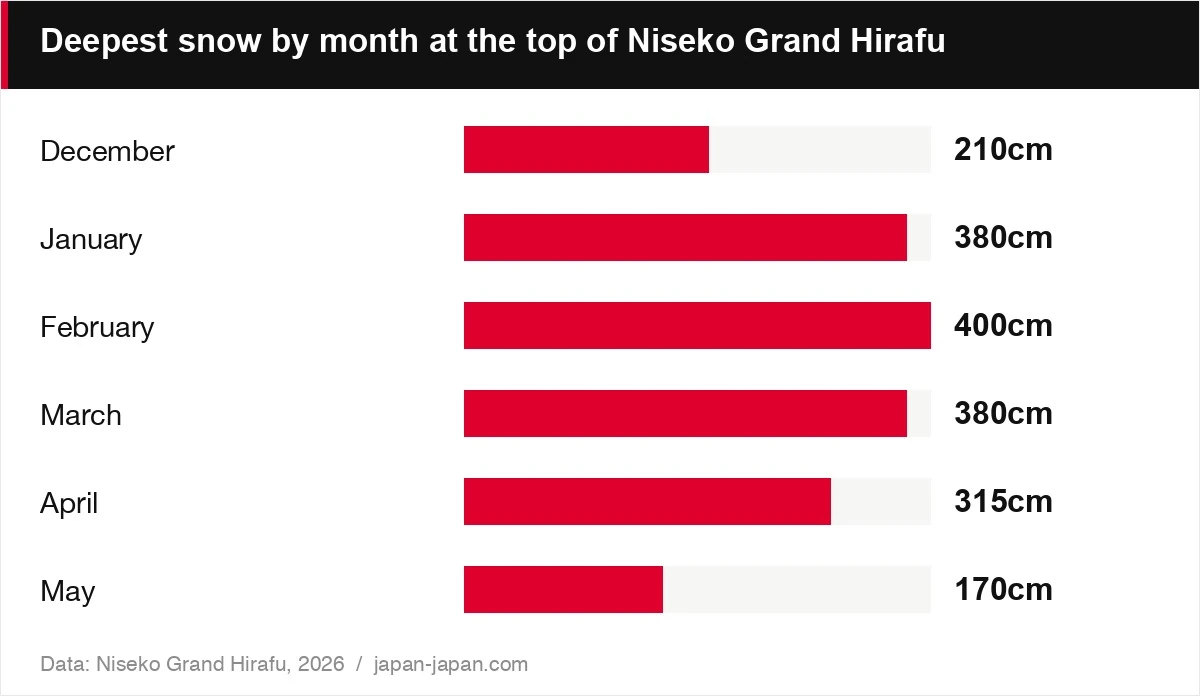
Pick February if deep snow matters most to you. The Niseko Grand Hirafu snow and season page lists the deepest snow by month, averaged over the 2020-21 to 2025-26 seasons. Hirafu measures the top on the Shirakaba course at about 850 m. There the depth averages 210 cm in December, 380 cm in January and 400 cm in February.
The base holds on well after that. The top still averages 380 cm in March and 315 cm in April, and 170 cm remains in May. At the bottom of the Holiday course, the depth peaks earlier. It averages 175 cm in January, 170 cm in February and 110 cm in March.
| Item | Value | Note |
|---|---|---|
| December | 210 cm | |
| January | 380 cm | |
| February | 400 cm | Deepest |
| March | 380 cm | |
| April | 315 cm | |
| May | 170 cm |
The chart shows the summit numbers. March is almost as deep as February, so a late trip still has plenty of cover.
In the 2025-26 season, Hirafu recorded 386 cm of snowfall in December, 620 cm in January and 263 cm in February. February had less new snow but the deepest base.
Cold keeps the powder light. On operating days, the average high at the top was -5.7°C in December, -7.4°C in January and -3.5°C in February. By March it rose to 1.5°C. That is when Hirafu sets up its snow park with kickers and other features, and the slopes get quieter.
The Burton guide to snowboarding in Japan, written by local Japanese riders, gives the same advice. It names January through February as powder season. Resorts start opening in November with help from snowmaking, more open in December, and most close by early May.
Hirafu calls the weeks from opening to mid-December the early season. The slopes are quieter before the holidays, and early-season tickets cost less. High season runs from late December to February.
You can also check the towns near other resorts. The Japan Meteorological Agency past weather data search lets you pick a station and show its monthly normals. The agency builds its normals from the 30 years of 1991 to 2020.
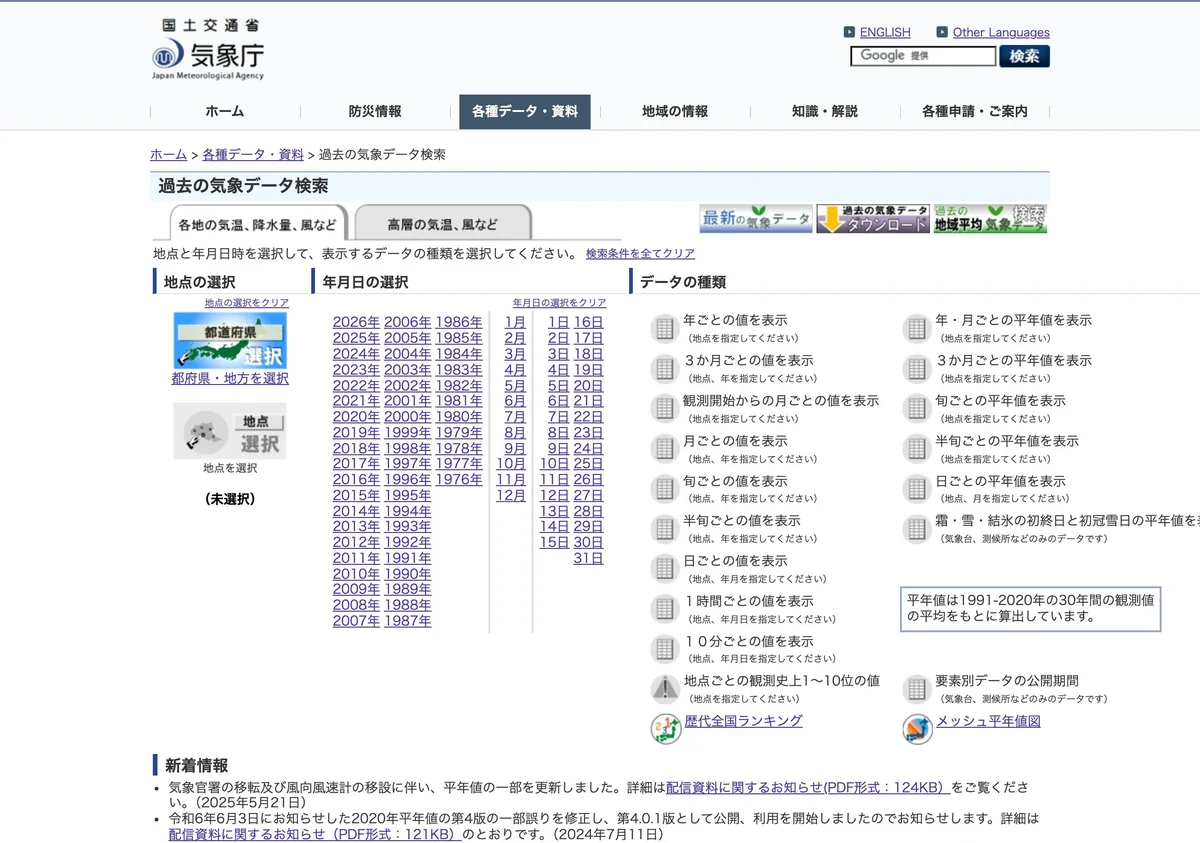
The screenshot shows that search page in Japanese. Choose a prefecture, then a station, then the button marked 年・月ごとの平年値を表示 (nen tsuki goto no heinenchi o hyoji, “show yearly and monthly normals”).
Where to snowboard: Hokkaido or Honshu
Hokkaido is the first pick for most overseas riders. Burton calls it a favourite of many top professional snowboarders, who come back for the light, dry snow. Niseko is the best-known name on the island.
It has 22 courses: 9 for beginners, 6 for intermediate riders and 7 for advanced riders. Two gondolas and seven lifts serve them. The top lift reaches 1,200 m and the base sits at 260 m, a vertical drop of 940 m across 135 ha.
The longest run is 5,300 m, and the steepest pitch is 40°. Hirafu grooms its pistes every morning but leaves some steep powder courses ungroomed. Around the 1,000 m plateau near the top, you ride above the tree line on wide open slopes.
Night riding is a big part of Hirafu. In high season the lifts run every evening, and the night season is planned from 12 December 2026 to 22 March 2027. The Ace gondola has Wi-Fi and heated seats.
| Place | Niseko Grand Hirafu |
|---|---|
| Hours | Season 28 Nov 2026 to 5 May 2027 (planned). Night riding 12 Dec 2026 to 22 Mar 2027 (planned) |
| Access | About 2 h 5 min by car from New Chitose Airport, or about 3 h 30 min by JR to Kutchan Station plus bus or taxi |
| Official site | Niseko Grand Hirafu snow and season page |
For lessons in English, GoSnow runs group and private classes. The official Hirafu school teaches groups in Japanese and private lessons in either language.
Getting to Hirafu takes time. From New Chitose Airport, the resort says the trip takes about 2 h 5 min by car. By public transport it takes about 3 h 30 min: JR via Sapporo and Otaru to Kutchan Station, then a bus or taxi. A direct bus also links the airport and Niseko in winter. Our guide to the New Chitose Airport to Niseko bus shows where it leaves from.
Flights to New Chitose take about 1 h 30 min from Haneda or Narita and about 1 h 55 min from Kansai. If you base yourself in Sapporo, take the train from the airport with our New Chitose Airport to Sapporo transfer guide. Day trips to Sapporo Teine Ski Resort start from the city.
Honshu, the main island, gives you more variety and faster trains from Tokyo. Burton sorts it into a few riding regions:
- Nagano: the Northern Alps draw backcountry riders, and the area has some of Japan’s best snow parks. See our guides to Hakuba Happoone Winter Resort and Nozawa Onsen Ski Resort.
- Niigata: wetter powder near the Sea of Japan. It is easier to ride when deep, and it builds park features early. Yuzawa and Myoko are the main names.
- Gunma: about a two-hour drive from central Tokyo, light inland powder, and easy day trips from the city.
- Tohoku: heavy snowfall, the Ou Mountains, and fewer people than Hokkaido or Nagano.
Day tickets cost more in the big-name areas. Burton’s price guide gives these adult one-day prices.
| Area | Adult 1-day lift ticket | Known for |
|---|---|---|
| Niseko, Hokkaido | ¥10,500 | Light powder, night riding |
| Hakuba Valley, Nagano | ¥9,700 | Northern Alps terrain, parks |
| Other resorts | ¥5,000 to ¥8,000 | Smaller crowds, local hills |
For this season’s opening dates and ticket prices across more resorts, read our Japan ski season 2026-27 guide. To compare snow at each resort, see the Japan ski report by month and resort.
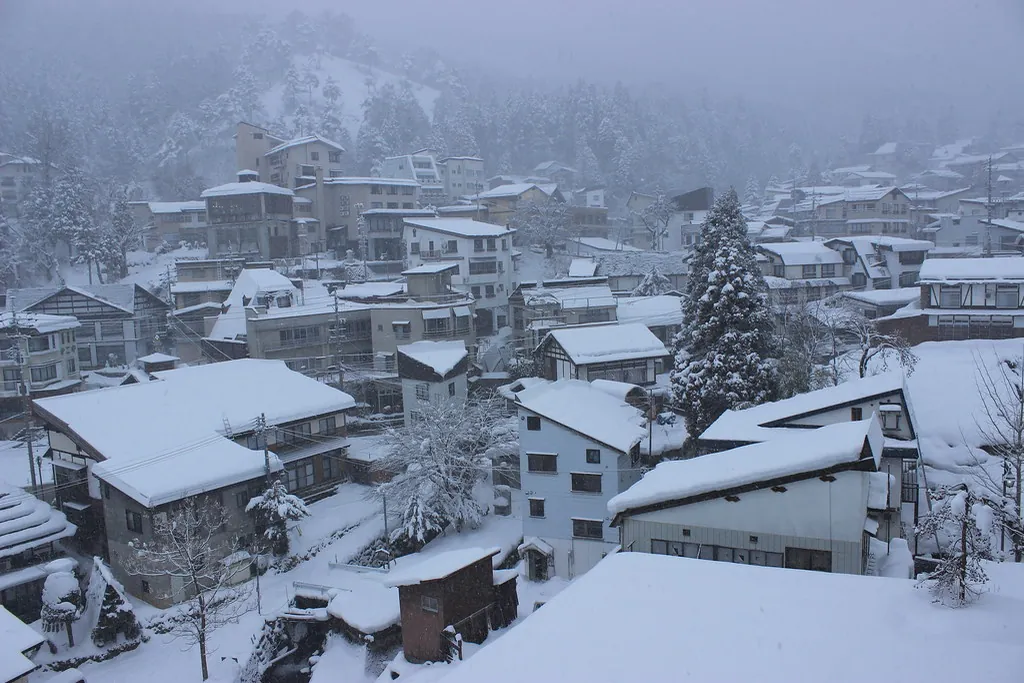
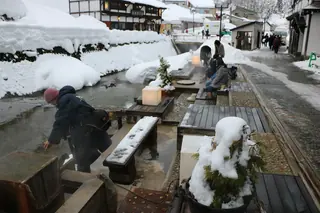
The photo shows Nozawa Onsen village in winter. Burton notes that the ski resort above it offers board tuning.
Backcountry gates and slope rules
Niseko lets you ride outside the ski area, but only on its terms. The resorts share a safety code called the Niseko Rules. You may leave the area only through an official gate, and only when that gate is open.
The patrol closes gates when the snow is unstable. Do not duck under the boundary rope anywhere else, and stay out of the zones marked as closed at all times. Riders who break the rules can lose their lift pass.
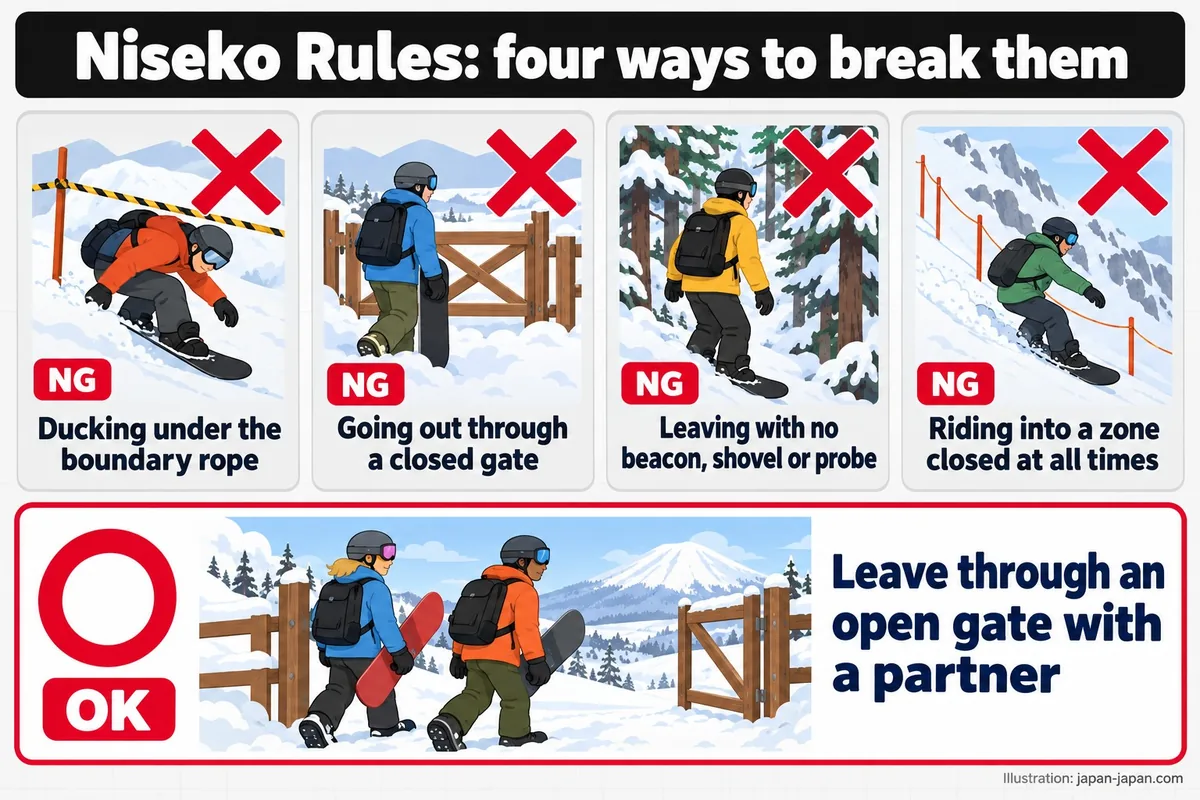
The drawing shows the four mistakes that get riders in trouble. The right way is to leave through an open gate with a partner.
Before you pass through a gate, carry a beacon, a shovel and a probe, and know how to use them. Wear a helmet and ride with at least one partner. Outside the gate, the resort does not control the snow. If the patrol or police must come and get you, you may have to pay for the rescue.
If you have no avalanche training, book a local guide for your first day out. Inside the ski area, the ungroomed powder courses at Hirafu give you deep snow with patrol nearby.
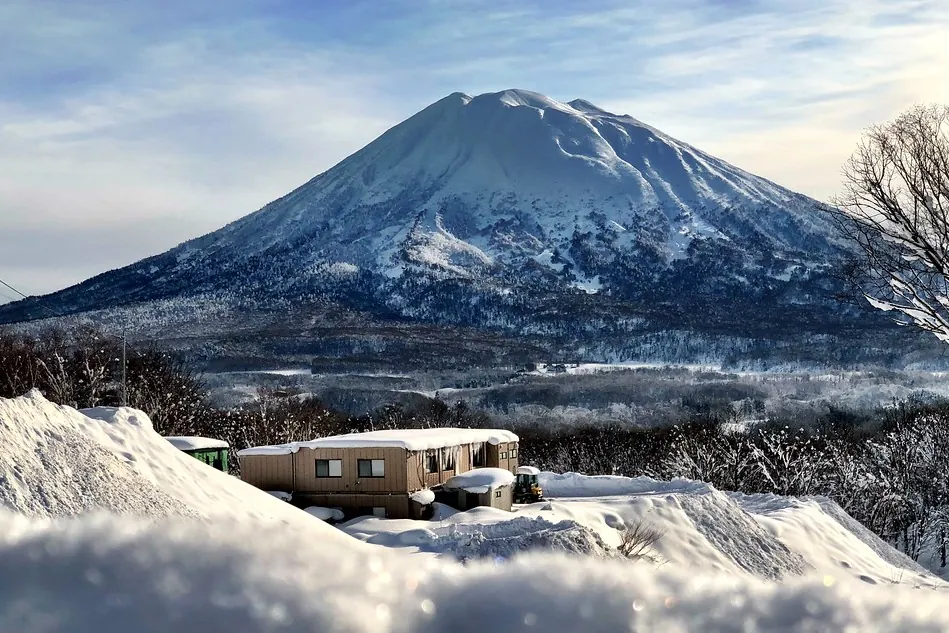
Mount Yotei, one of Japan’s 100 famous mountains, rises across the valley from Hirafu. It helps you keep your bearings on the upper slopes.
Flying with a snowboard: airline rules
A snowboard flies as checked baggage. Our skis and snowboards page explains why it cannot go in the cabin.
Wax needs care too. Solid wax is fine, but liquid, paste and powder wax and wax remover face limits. Our ski and snowboard wax page sets out what you can pack.
Size is the next check. JR Central notes that airlines carry bags up to 160 cm in total size free in the hold. It adds that the 161 to 250 cm band is close to the size that draws an oversized fee on international flights. A board bag usually adds up to more than 160 cm, so read your airline’s sports equipment rule before you pack.
The two big Japanese airlines, JAL and ANA, are full-service carriers. Their fares include checked bags, and you can check the allowance on our JAL baggage page and ANA baggage page.
Peach and Jetstar Japan are low-cost carriers. Their cheapest fares may not include a checked bag, so add the board when you book. Paying at the airport usually costs more. See our Peach baggage page and Jetstar Japan baggage page before you buy.
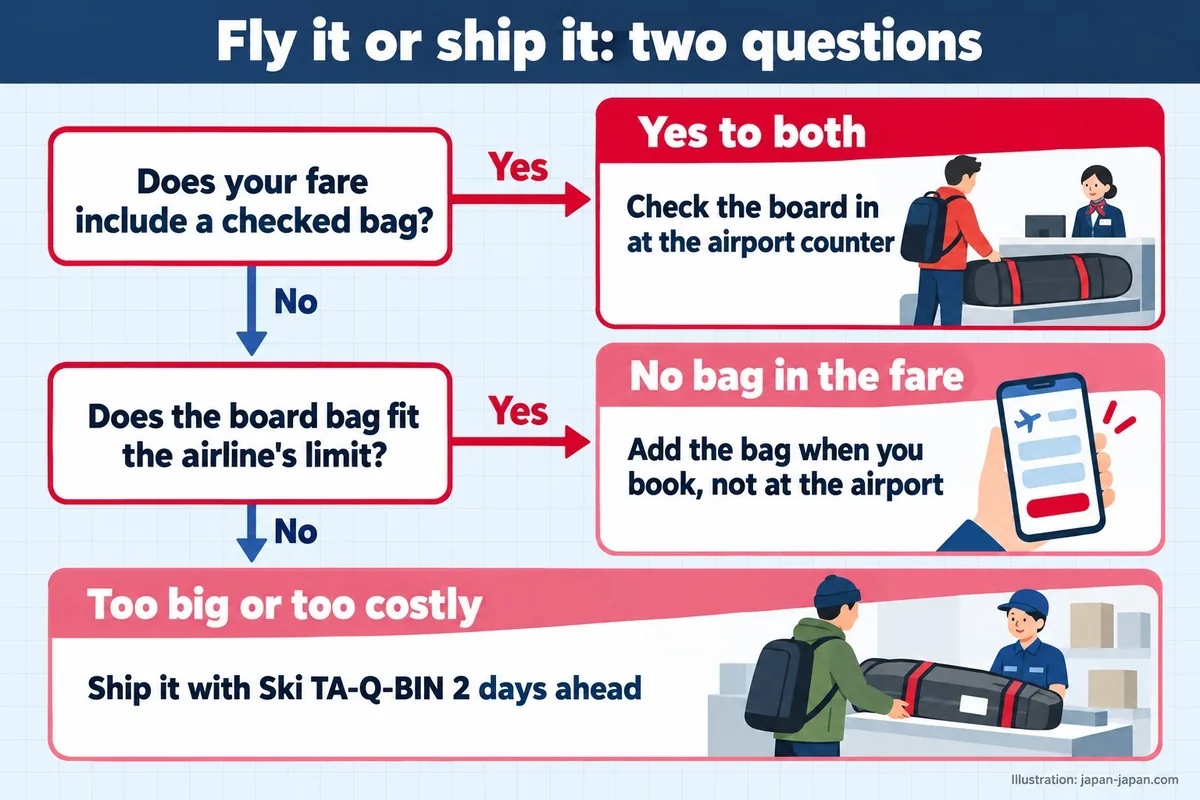
The drawing walks you through the choice in two questions. If your fare has a bag and the board fits the limit, check it in. If not, pay the extra charge at booking or ship the board with Ski TA-Q-BIN.
Taking a board on the Shinkansen and airport buses
You can take a snowboard on the Tokaido Shinkansen without a reservation. The JR Central Tokaido Shinkansen oversized baggage rules treat sports equipment apart from the oversized baggage rule. The same reservation system covers the Sanyo, Kyushu and Nishi Kyushu Shinkansen.
The basic allowance is two pieces per person, each 30 kg or less, up to 250 cm in total size and 200 cm in length. Sports equipment may go over the length limit if you can stand it in the car in its bag or case. Put the board in the overhead rack or in the baggage storage area on the deck. The racks reach back about 42 cm.
| What you carry | Where it goes | Booking |
|---|---|---|
| Bags up to 160 cm in total | Overhead rack, at your feet or deck storage | Not needed |
| Bags of 161 to 250 cm in total | Oversized baggage area behind the last row | Required, no extra charge |
| Sports equipment up to 250 cm | Overhead rack or deck storage | Not needed |
| Oversized bag with no booking | Space the conductor assigns | 1,000 yen fee |
| Bags over 250 cm in total | Not allowed on board | Not possible |
The table sums up the rules for each kind of bag. A suitcase between 161 and 250 cm needs a seat with an oversized baggage area. Bring one on without a booking, and you pay a 1,000 yen fee and leave it where the conductor tells you.
If you want the space behind the last row for your board, reserve a seat with an oversized baggage area. It costs the same as a normal reserved seat. A Nozomi has 57 of these seats, a Hikari 42 and a Kodama 17. Five passengers share each space, so book early. Seats go on sale one month in advance.
At a JR ticket office, tell the staff you want a seat with an oversized baggage area. You can also pick it at a reserved-seat ticket machine or online. Japan Rail Pass holders can ask for it at the ticket office too.
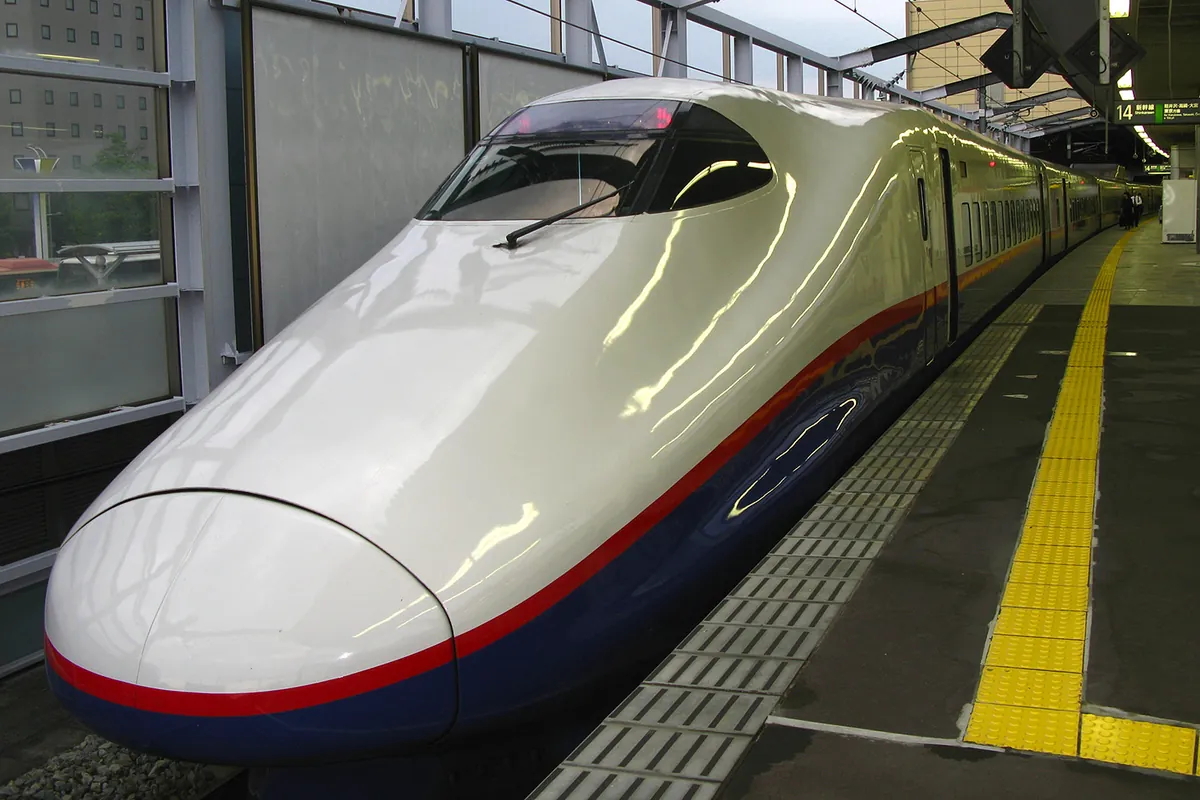
The photo shows the Hokuriku Shinkansen at Nagano Station, the rail gateway for Hakuba and Nozawa Onsen. JR East runs this line, so ask about board space at the ticket office when you book.
From New Chitose Airport to Niseko, the winter bus is the easier way with a board bag. It saves the train changes in Sapporo and Otaru.
Sending your board ahead with Ski TA-Q-BIN
Ski TA-Q-BIN lets you travel without the board. The Yamato Transport Ski TA-Q-BIN page explains the service, called スキー宅急便 (suki takkyubin) in Japanese. Yamato picks up your skis or snowboard and delivers them to the ski area.
Timing is the main rule. Send the board at least 2 days before you ride, or 3 days for some areas, and before the counter’s cut-off time. Cut-off times vary by counter. Yamato delivers to the resort the day before you ride, and you collect it at the front desk on the day.
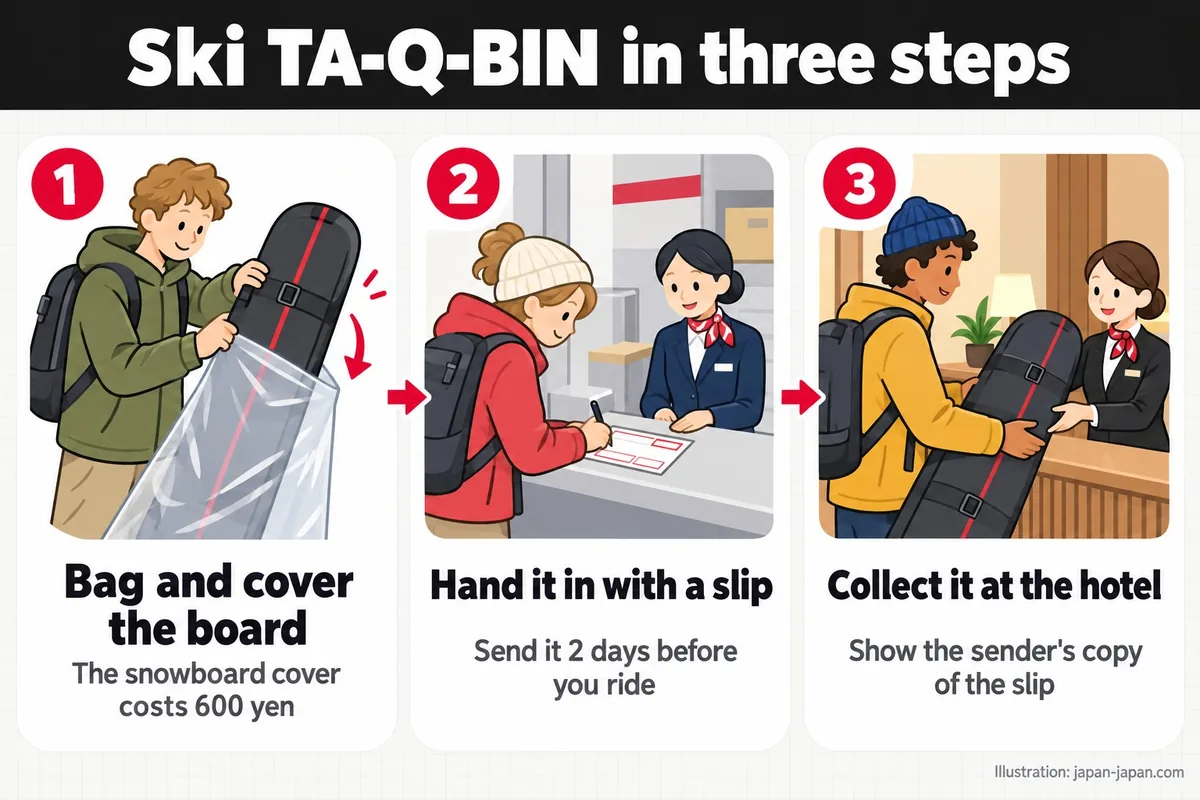
The drawing shows the three steps, from covering the board to picking it up at your hotel.
- Cover: Put the board in its own board bag, then wrap the whole bag in Yamato’s cover. The snowboard cover costs 600 yen and measures 55 × 175 cm (inside 53 × 172 cm). The ski cover costs 400 yen.
- Where to send: Hand it in at a Yamato office, where you can buy the cover, or book a pickup and the driver brings one. Convenience stores do not accept ski gear.
- Price: Yamato charges the 180 size rate for a board, prices include tax, and a drop-off at a Yamato office takes 100 yen off.
- Limits: Each parcel must weigh 30 kg or less. You cannot pack 3 or more boards together.
Keep the sender’s copy of the slip. At the hotel, show the part marked ご依頼主控 (go-irainushi hikae, “sender’s copy”). The front desk hands over the board in exchange for it.
For the trip home, book the round-trip service. You leave the board at the resort and walk away with no slip or payment to sort out. The round trip takes 200 yen off each item, and the return leg stays valid for one month after the first pickup.
The same company carries suitcases between hotels and airports. Our luggage forwarding in Japan guide lists the rates and the airport counters.
Rent or bring, and the busiest weeks
Renting saves the whole transport problem. Hirafu’s own rental shop covers boards, boots, gloves, goggles and helmets, with premium powder models for strong riders. You can rent a board alone and use your own boots. For 2026-27, Hirafu takes rental bookings with a 10% early discount.
If you stay near Hirafu and rent there, the shop keeps your board and boots overnight. Burton also delivers rental gear to your hotel, tuned and waxed. Its test ride centres are at the Burton flagship store in Sapporo and the Burton Hakuba Goryu store.
Rent if you ride one resort on a short trip. Bring your own board if you trust your setup or plan a longer trip, and ship it between stops with Ski TA-Q-BIN.
Crowds follow the holiday calendar. These are the busiest weeks.
- Christmas and New Year: the season gets going in late December, and Japanese school holidays run into early January. See our New Year holiday guide.
- Lunar New Year: it usually falls between late January and mid-February and brings many visitors from Taiwan, Hong Kong, China and Singapore. Our Lunar New Year in Japan guide lists the busiest days.
- Sapporo Snow Festival: it runs for about a week in early February and fills hotels in and around Sapporo. See our Sapporo Snow Festival 2027 guide.
- Spring break: Japanese families ride from late March to early April.
For quieter slopes, Burton suggests mid-January to early February outside the Lunar New Year, and late February to early March. Weekdays from Monday to Thursday have shorter lift lines than weekends. Our Japan in February guide lists the other events that month.
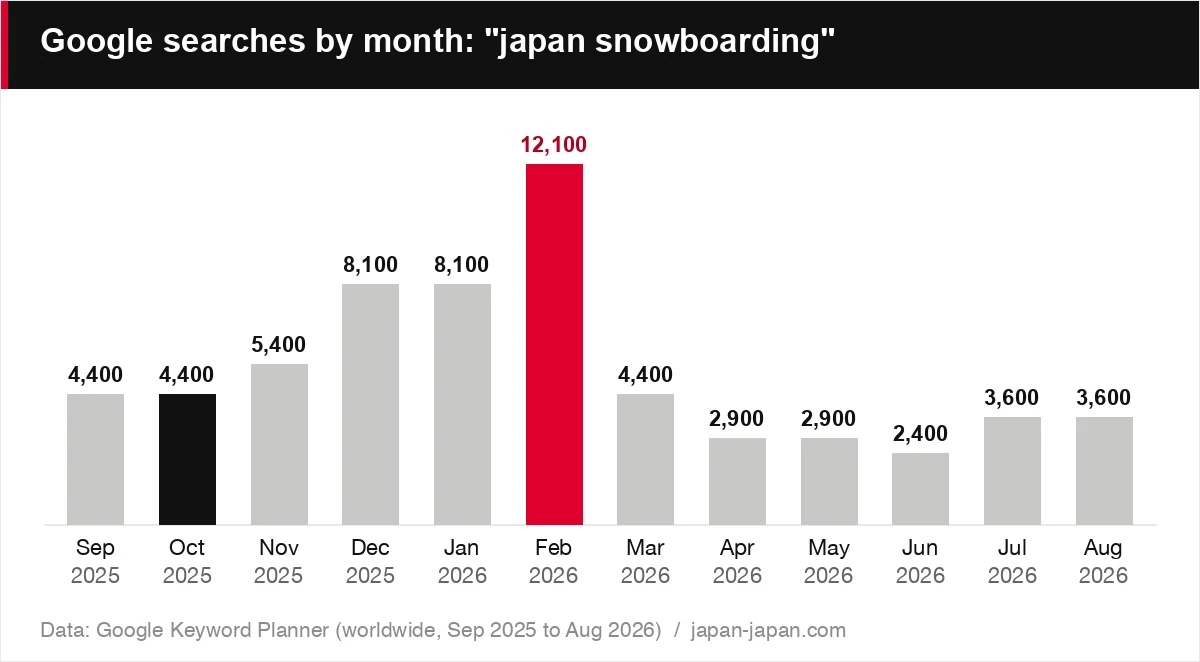
Search interest rises on the same curve. Worldwide Google searches for “japan snowboarding” grew from 4,400 in October 2025 to 12,100 in February 2026, 2.8 times as many. December and January each had 8,100.
| Month | Searches |
|---|---|
| Sep 2025 | 4400 |
| Oct 2025 | 4400 |
| Nov 2025 | 5400 |
| Dec 2025 | 8100 |
| Jan 2026 | 8100 |
| Feb 2026 | 12,100 |
| Mar 2026 | 4400 |
| Apr 2026 | 2900 |
| May 2026 | 2900 |
| Jun 2026 | 2400 |
| Jul 2026 | 3600 |
| Aug 2026 | 3600 |
The chart shows that last season’s peak came in February. People search when they plan, so rooms for February go fast. If you want a February trip in 2027, book the room, the flight and any rental now.
FAQ
When is the best month for snowboarding in Japan?
February has the deepest snow. At Niseko Grand Hirafu the top averages 400 cm that month. January brings the most new snow, with 620 cm in the 2025-26 season, so January and February are the two powder months.
Can you bring a snowboard on a plane to Japan for free?
It depends on your airline and fare. A snowboard goes in checked baggage, and full-service fares on JAL and ANA include checked bags. On low-cost fares from Peach or Jetstar Japan, you often have to add a bag. Check the size and sports equipment rules before you book.
Do you need to book oversized luggage space for a snowboard on the Shinkansen?
No, not on the Tokaido, Sanyo and Kyushu Shinkansen. JR Central exempts sports equipment from the oversized baggage rule, up to 250 cm in total size. You need a booking only if you want the space behind the last row, and that seat costs no more than a normal reserved seat.
Can you snowboard in the Niseko backcountry without a guide?
The Niseko Rules let you leave through an open gate on your own. You are then responsible for yourself, and you may pay for any rescue. Carry a beacon, shovel and probe, and book a guide if you have no avalanche training.
About the author