Okinawa Sakura 2027: Blooms 16 January, Two Months Early

These dates are Japan Meteorological Agency (JMA) averages, recorded at one fixed sample tree in each city. Real years move around. Naha’s trees opened as early as 4 January in 2021 and as late as 18 January in 2026. So treat the averages as the middle of a window, and book a few spare days on either side.
The season also lasts longer than on the mainland. In Naha, full bloom comes 19 days after the first flowers on average. In Tokyo the gap is 7 days. A trip in the last week of January or the first week of February catches Okinawa sakura in most years. A trip around 10 February still finds Miyakojima and Ishigaki at their peak.
When do cherry blossoms bloom in Okinawa?
The JMA watches cherry trees at four stations in Okinawa Prefecture: Naha on the main island, Miyakojima, Ishigaki and Minamidaito. The Japan Meteorological Agency cherry blossom opening dates page lists the first bloom for each year from 2021 to 2026, plus the 1991-2020 average. The Japan Meteorological Agency cherry blossom full bloom dates page gives the same for full bloom. The table below puts the four Okinawa stations next to four mainland cities.
| Station | Average first bloom | Average full bloom | 2026 first bloom |
|---|---|---|---|
| Naha (Okinawa) | 16 January | 4 February | 18 January |
| Miyakojima (Okinawa) | 17 January | 9 February | 9 January |
| Ishigaki (Okinawa) | 18 January | 10 February | 4 February |
| Minamidaito (Okinawa) | 20 January | 5 February | 2 March |
| Kagoshima | 26 March | 5 April | 27 March |
| Fukuoka | 22 March | 31 March | 24 March |
| Tokyo | 24 March | 31 March | 19 March |
| Sapporo | 1 May | 6 May | 18 April |
Read the table from top to bottom and the season moves north. Okinawa’s four stations open between 16 and 20 January. Kagoshima, at the south end of Kyushu, waits until 26 March. Tokyo opens on 24 March and Sapporo on 1 May. The Okinawa rows track a different tree, which the next section explains. So the gap comes from both the species and the warm winter.
Single years vary more than the averages suggest. Here is Naha, year by year, with Miyakojima’s full bloom for comparison.
| Year | Naha first bloom | Naha full bloom | Miyakojima full bloom |
|---|---|---|---|
| 2021 | 4 January | 1 February | 10 February |
| 2022 | 11 January | 1 February | 8 February |
| 2023 | 7 January | 30 January | 3 February |
| 2024 | 13 January | 5 February | 2 February |
| 2025 | 5 January | No record | 4 February |
| 2026 | 18 January | 3 February | 6 February |
| Average | 16 January | 4 February | 9 February |
Two things stand out. First, Naha’s first bloom landed before its 16 January average in five of the six years. Second, full bloom in Naha fell between 30 January and 5 February in every year with a record. If you can only pick one week, the week around 1 February has the best odds.
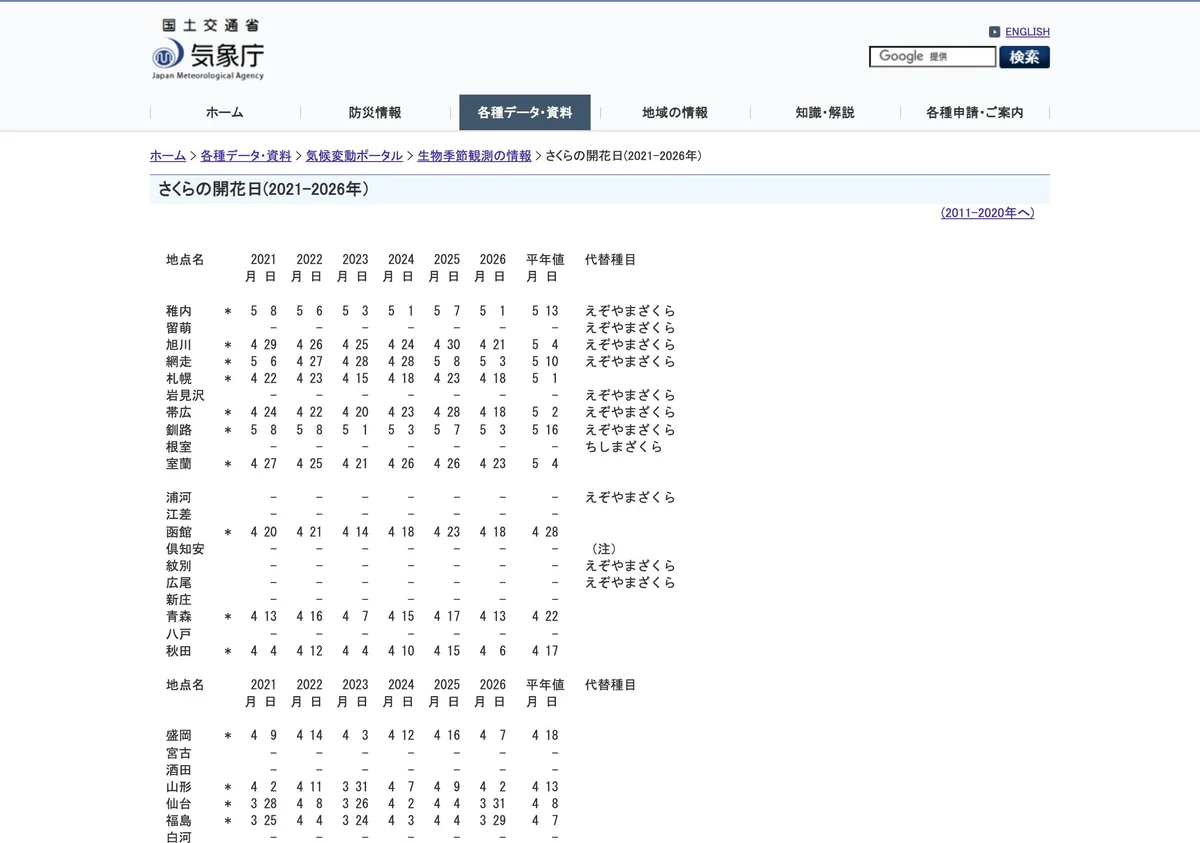
The screenshot below is the JMA opening-date table itself, in Japanese. Find the row marked 那覇 (Naha). The column 平年値 (heinenchi) is the 1991-2020 average, and the right-hand column 代替種目 shows ひかんざくら (hikanzakura), the tree the JMA watches in Okinawa.
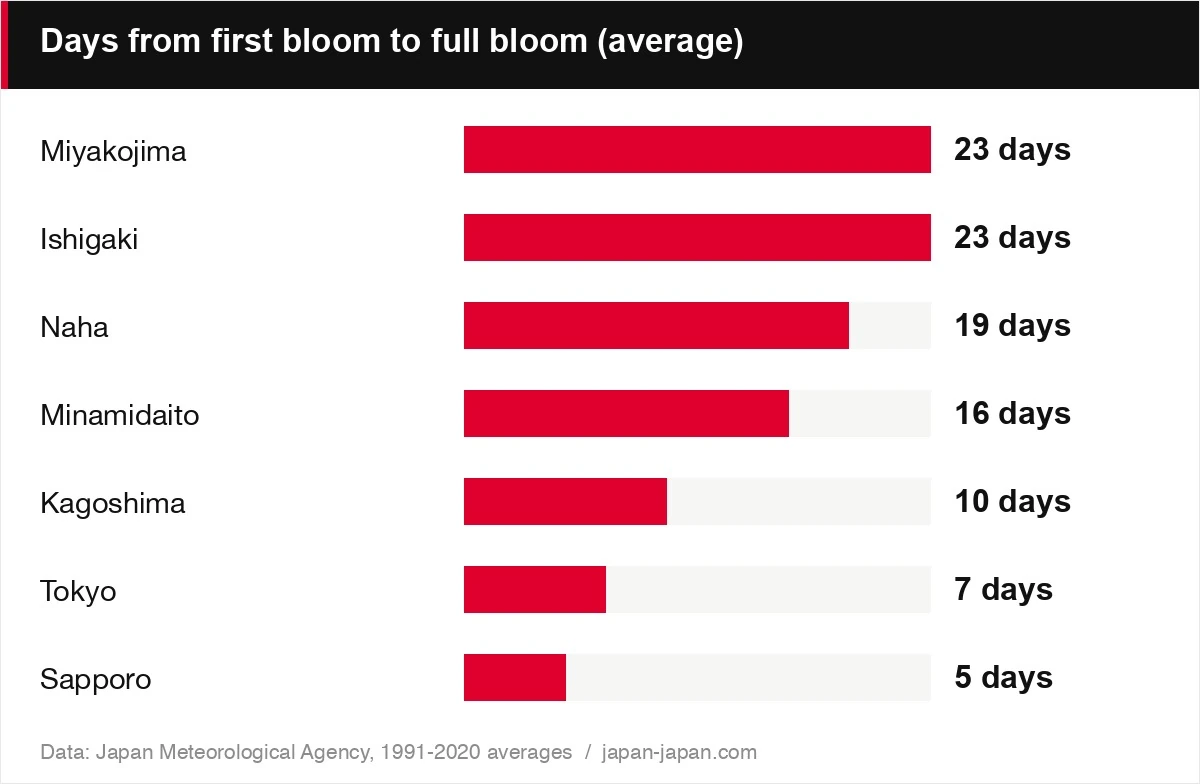
The gap between first flowers and full bloom matters for planning, because it tells you how long the trees stay pink. The chart below shows that gap in days, using the JMA averages.
| Item | Value |
|---|---|
| Miyakojima | 23 days |
| Ishigaki | 23 days |
| Naha | 19 days |
| Minamidaito | 16 days |
| Kagoshima | 10 days |
| Tokyo | 7 days |
| Sapporo | 5 days |
Miyakojima and Ishigaki take 23 days on average to go from first flowers to full bloom. Naha takes 19 days and Minamidaito 16 days. Mainland cities move much faster: Kagoshima takes 10 days, Tokyo 7 days and Sapporo 5 days. The longer Okinawa season gives you more room if a flight or the weather changes your plans.
For live updates, the Japan Meteorological Agency seasonal observation index links to this year’s bloom status pages. From December to June, the JMA updates them three times a day, at about 08:30, 11:30 and 17:30.
Kanhizakura vs Somei-Yoshino
Okinawa’s cherry is a different tree from the one in most photos of Tokyo and Kyoto. The JNTO blog on early cherry blossoms in Okinawa explains that Japan’s most common tree is the somei-yoshino, with masses of pale pink flowers. Okinawa’s trees are kanhizakura. Their flowers are a deeper pink and open at a downward angle.
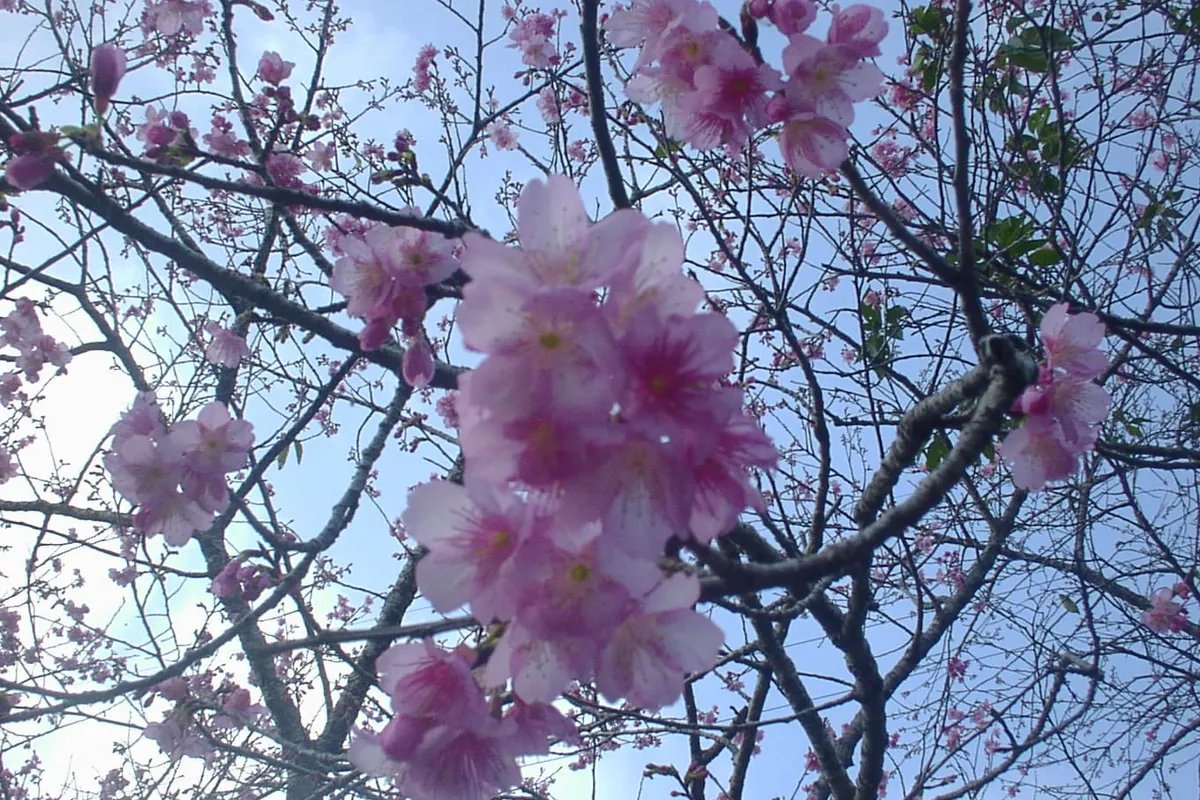
The photo above shows the typical shape: small bell-shaped flowers hanging under the branch. The JNTO travellers blog on Okinawa cherry blossom season describes them as hanging downward like pink bells. It also notes that these trees came from southern China and Taiwan, while the mainland’s sakura did not. Locals say a cold snap is what starts the buds.
The Okinawa Prefecture Kanhizakura tree profile adds the basics. Kanhizakura is a deciduous tree that grows to about 10 m. It flowers from January to February, and people plant it for viewing all over Okinawa. The local name is simply sakura.
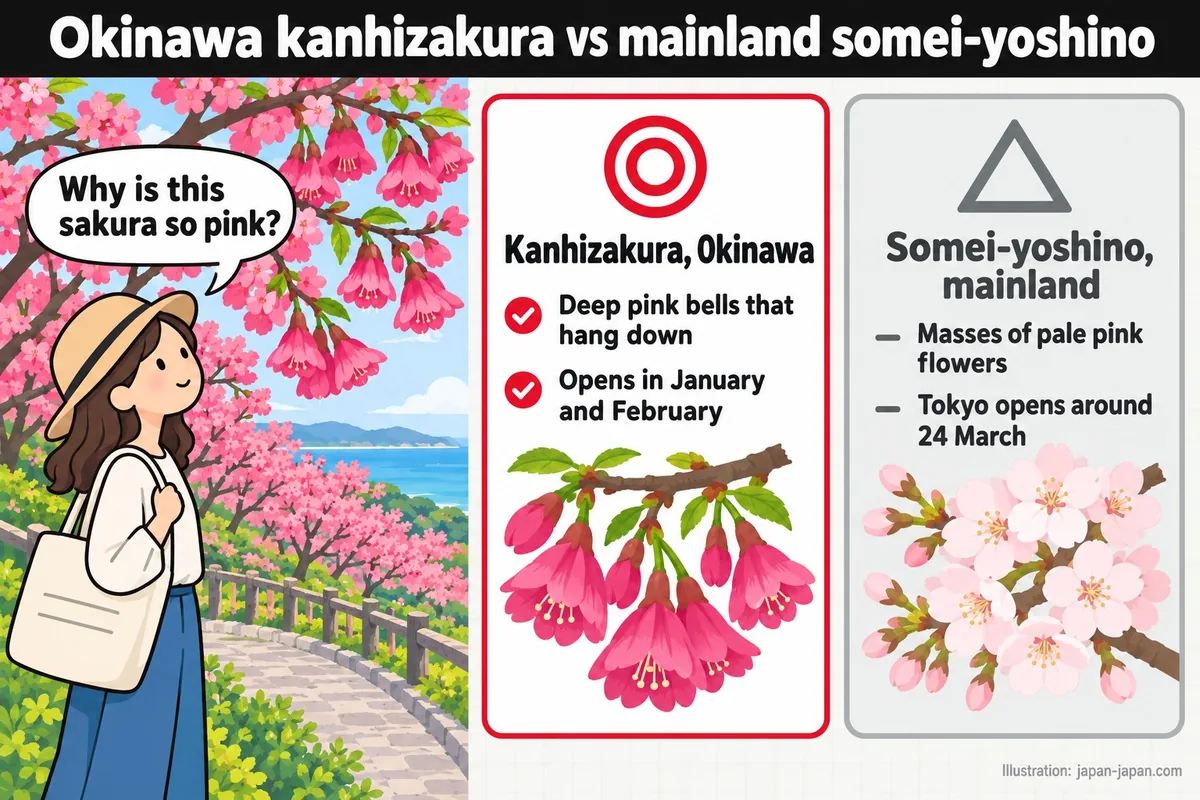
The illustration sums up the two trees side by side. On the left, the kanhizakura you see in Okinawa in January and February. On the right, the pale somei-yoshino that opens in Tokyo around 24 March.
The JMA data reflects the same split. At its Okinawa stations, the JMA records hikanzakura, another name for kanhizakura, in place of somei-yoshino. Every mainland city in the table above records somei-yoshino. So when you compare Naha’s 16 January with Tokyo’s 24 March, you are comparing two species as well as two climates.
For visitors, the difference changes how you look at the trees. The flowers face down, so stand below the branch and look up for the best view. Expect pink against green leaves and blue sky rather than a white-pink cloud. Look for small green birds too. The JNTO travellers blog points out that Japanese white-eyes (mejiro) gather in the blossoms and hold still long enough for a photo.
Where to see sakura in Okinawa
The best-known Okinawa sakura spots sit in the north of the main island, on and around the Motobu Peninsula. The JNTO travellers blog says Mt. Yaedake on the Motobu Peninsula is normally where the blossoms open first. Mt. Nago, above Nago city, follows.
Mt. Yaedake, Motobu
The Okinawa Prefecture Churashima Okinawa magazine on Motobu gives Mt. Yaedake a height of 453.4 m, the second highest peak in the prefecture. Kanhizakura line the road up the mountain, and they open around mid-January. The magazine calls it the earliest cherry blossom viewing in Japan.
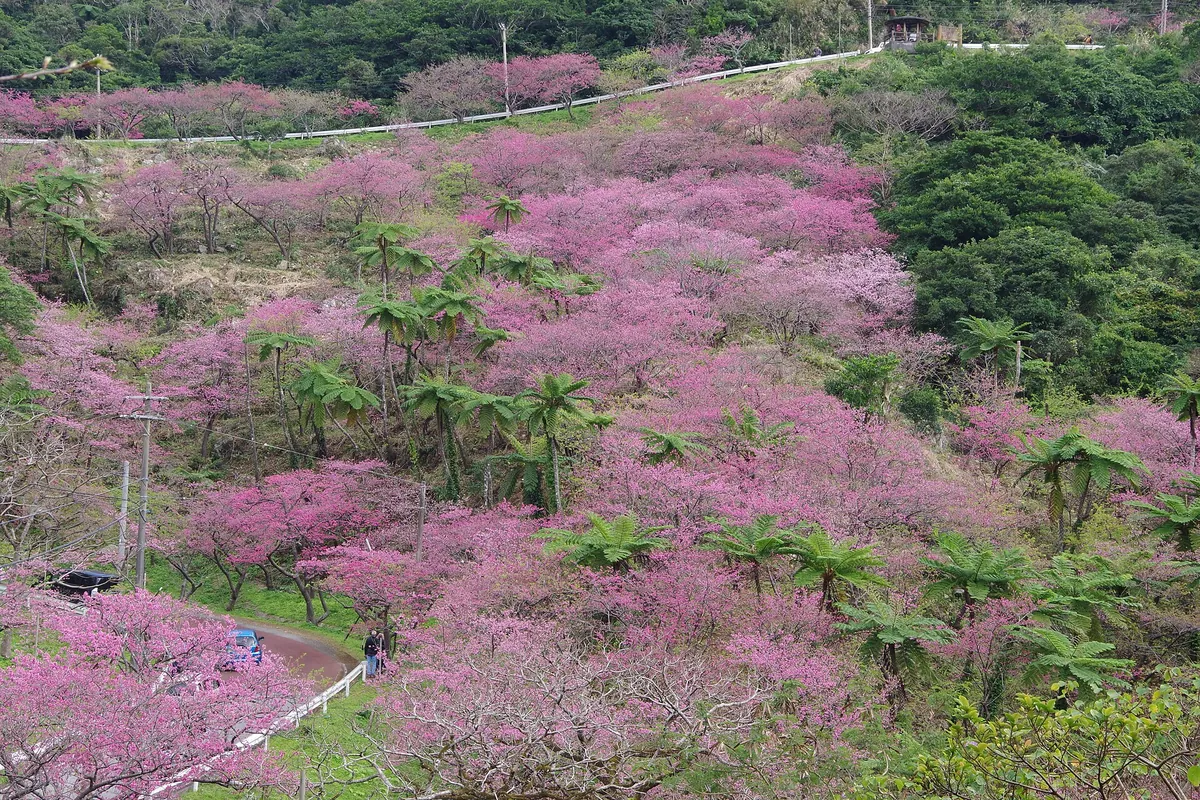
The photo shows the scene most visitors come for: a winding road under deep pink trees. JNTO counts more than 7,000 cherry trees on the mountain. You can hike, cycle or drive up the road toward the summit at 1,486 feet. About halfway up, Yaedake Sakuranomori Park has a playground and picnic areas, which makes a good stop with children.
Nakijin Castle Ruins
Nakijin Castle Ruins is the second classic spot. JNTO notes the castle was built in the 13th century and was the second largest castle in Okinawa. It is now a UNESCO World Heritage Site. Pink trees stand against the curved stone walls in the day, and the blossoms are lit up at night.
Mt. Nago and Nago city
Mt. Nago is the next place the blossoms open after Yaedake, according to the JNTO travellers blog. Stone lanterns line the stairs up the hill. The writer took one of the photos in full spring colour on 2 February, with art students sketching the view.
A sensible order from Naha is to drive north to Nago first, then on to Motobu and Mt. Yaedake, and finish at Nakijin for the evening light-up. Okinawa Prefecture notes kanhizakura are planted all over Okinawa, so you will also pass single trees in towns and by small shrines on the way.
Cherry blossom festivals in January and February
Our Okinawa in January guide and Okinawa in February guide list two festivals. They are the Motobu Yaedake Sakura Festival and the Nago Sakura Festival. The Okinawa Prefecture magazine describes the Yaedake festival as a yearly event that draws large crowds when the mountain turns pink. On posters and banners, look for 桜まつり (sakura matsuri), which means cherry blossom festival.
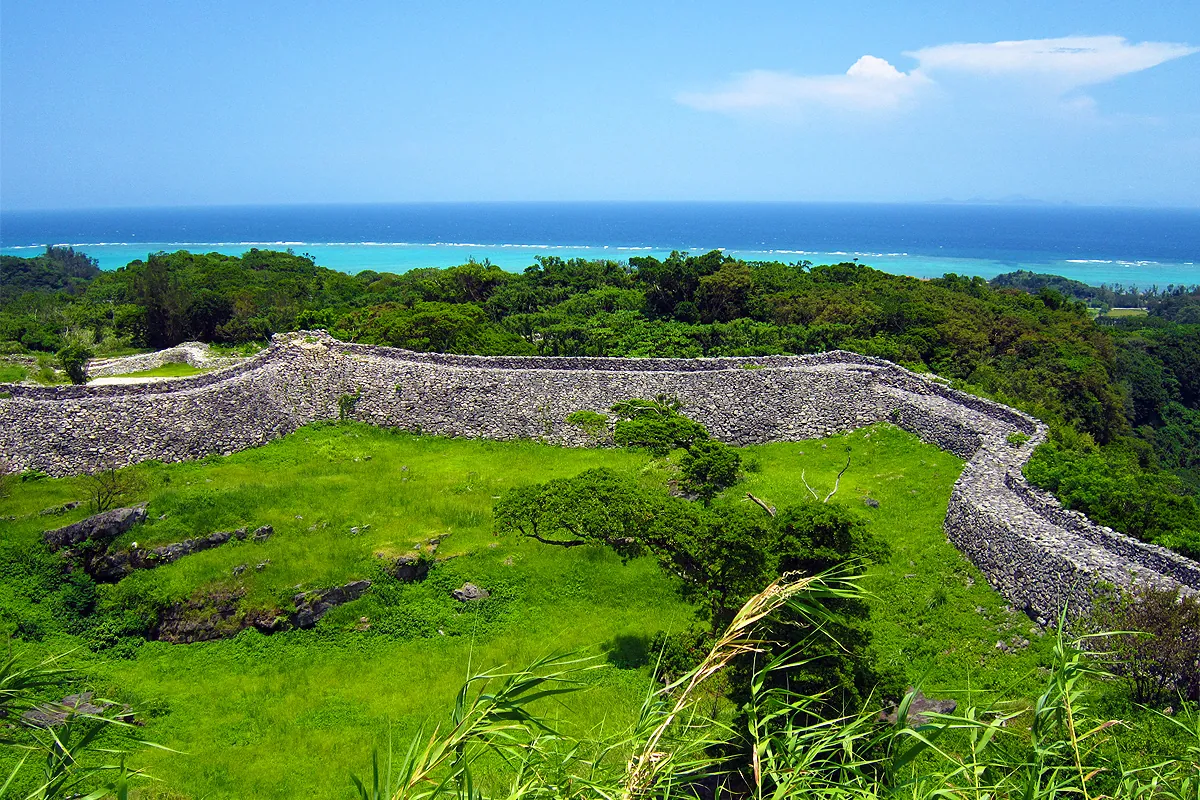
JNTO highlights the night illumination there, which lets you see the trees after a day at Yaedake. Many shrines and temples also hold events that run into the night, says the JNTO travellers blog.
The 2027 festival dates are not announced yet. Check the Motobu Town, Nago City and Nakijin Village announcements before you fix your days. Use the JMA bloom tables above to choose the week, then match the festival weekend to it once the dates appear.
Plan for busier hotels as the season moves on. Okinawa hotels were 52.5% full in January 2025 and 62.1% full in February 2025. Book early for weekends in early February, when Naha’s full bloom and the festivals overlap.
Miyakojima and Ishigaki: a later full bloom
The outer islands open at about the same time as Naha but peak later. Miyakojima’s first bloom averages 17 January and Ishigaki’s 18 January. Full bloom comes on 9 February in Miyakojima and 10 February in Ishigaki, five or six days after Naha.
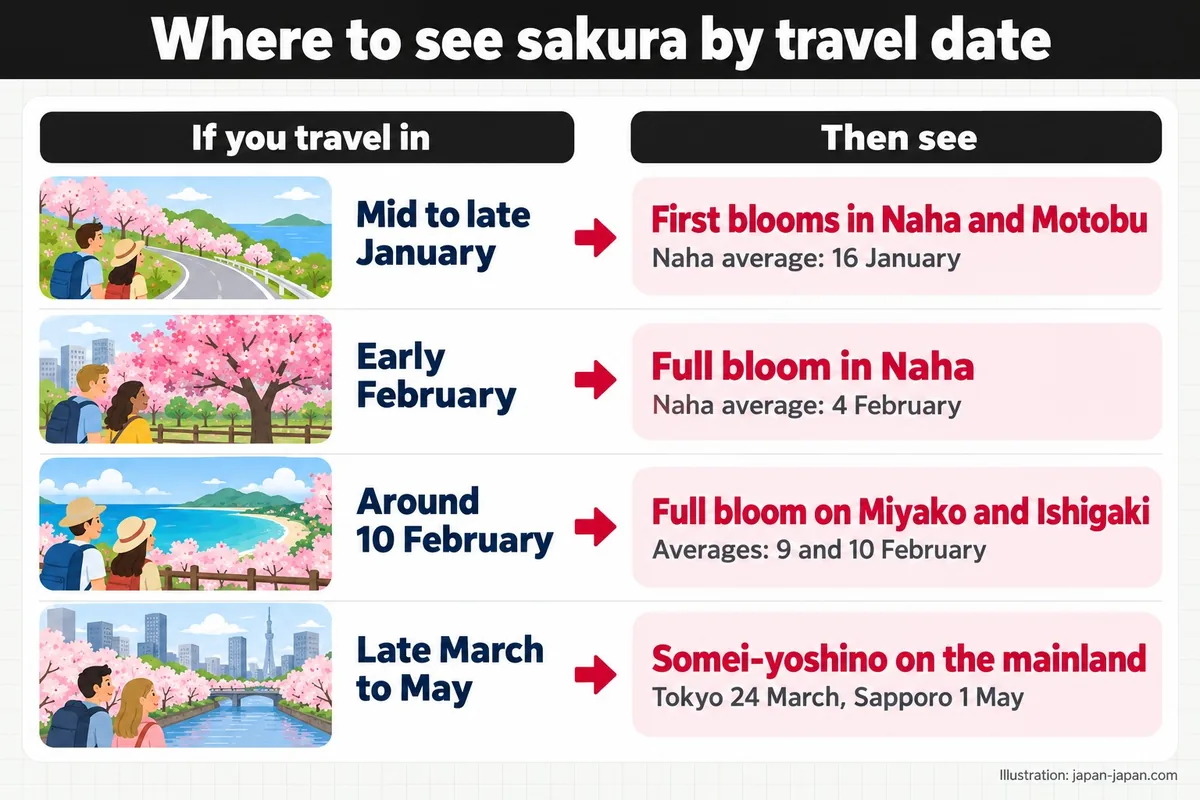
The illustration turns those dates into a simple lookup. Mid to late January suits Naha and the Motobu hills. Early February suits Naha’s full bloom. Around 10 February, head to Miyakojima or Ishigaki. Late March onward belongs to the mainland somei-yoshino.
Ishigaki varies the most. In 2026 its first bloom came on 4 February and full bloom on 18 February. In 2022 full bloom arrived on 22 February. The JMA has no full bloom record for Ishigaki in 2023, 2024 or 2025. Miyakojima runs earlier in some years: it opened on 5 January in 2024 and reached full bloom on 2 February, three days before Naha.
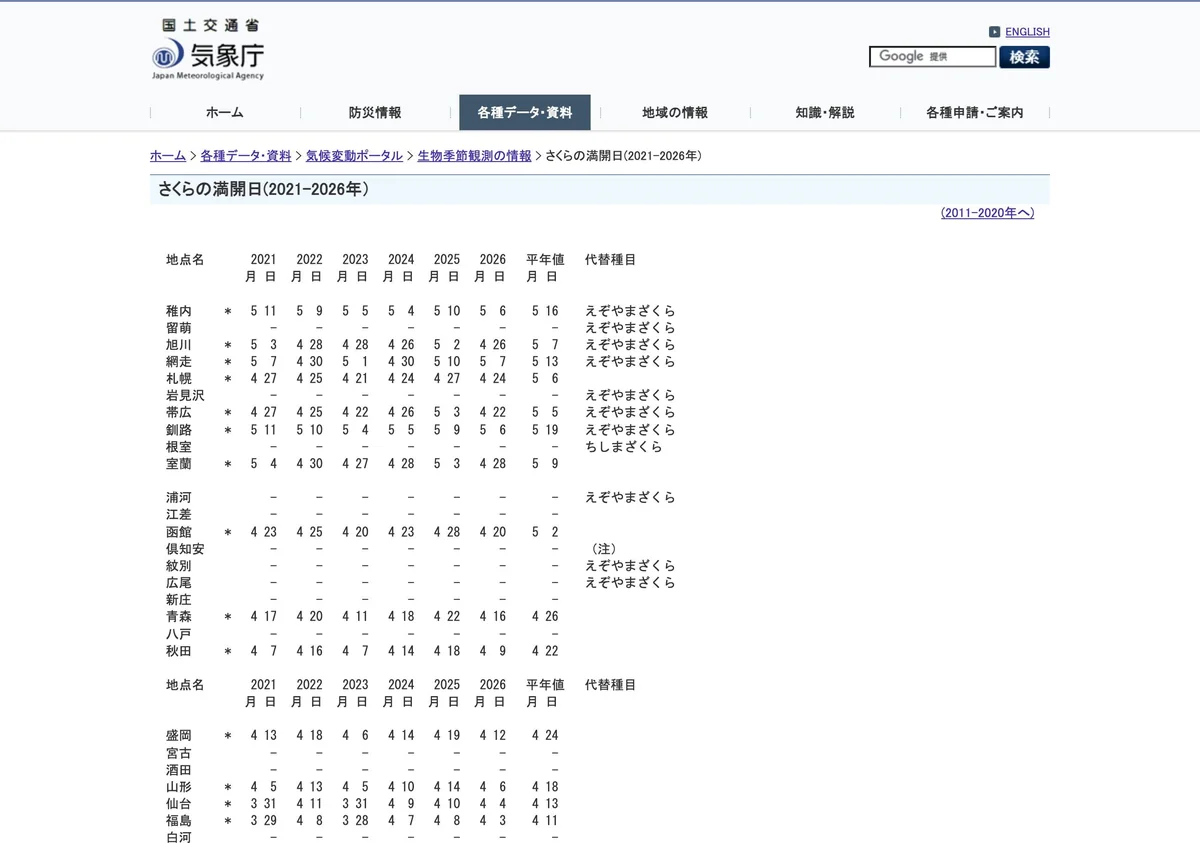
This screenshot is the JMA full bloom table (満開日, mankaibi). The Okinawa rows sit near the bottom, after 鹿児島 (Kagoshima) and 名瀬 (Nase on Amami). Minamidaito, a small island east of the main island, averages 20 January for first bloom and 5 February for full bloom. In 2025 it opened as late as 3 March.
Both islands are easy to reach once you land. From Miyako Airport, a bus reaches Hirara in 7 minutes for 250 yen. From New Ishigaki Airport, a taxi to Ishigaki City Hall takes about 20 minutes and costs about 2,800 yen. January highs average 20.6°C on Miyakojima and 21.5°C on Ishigaki. Our Ishigaki in February guide lists what else is on, including the Chiba Lotte Marines spring camp.
Getting to the sakura spots from Naha Airport
Most visitors fly into Naha. The Tokyo to Okinawa route guide lists 35 flights a day from Haneda, each 2 h 30 min. Narita adds 7 a day at 3 h. From Osaka, flights from Itami, Kansai and Kobe take 2 h 5 min.
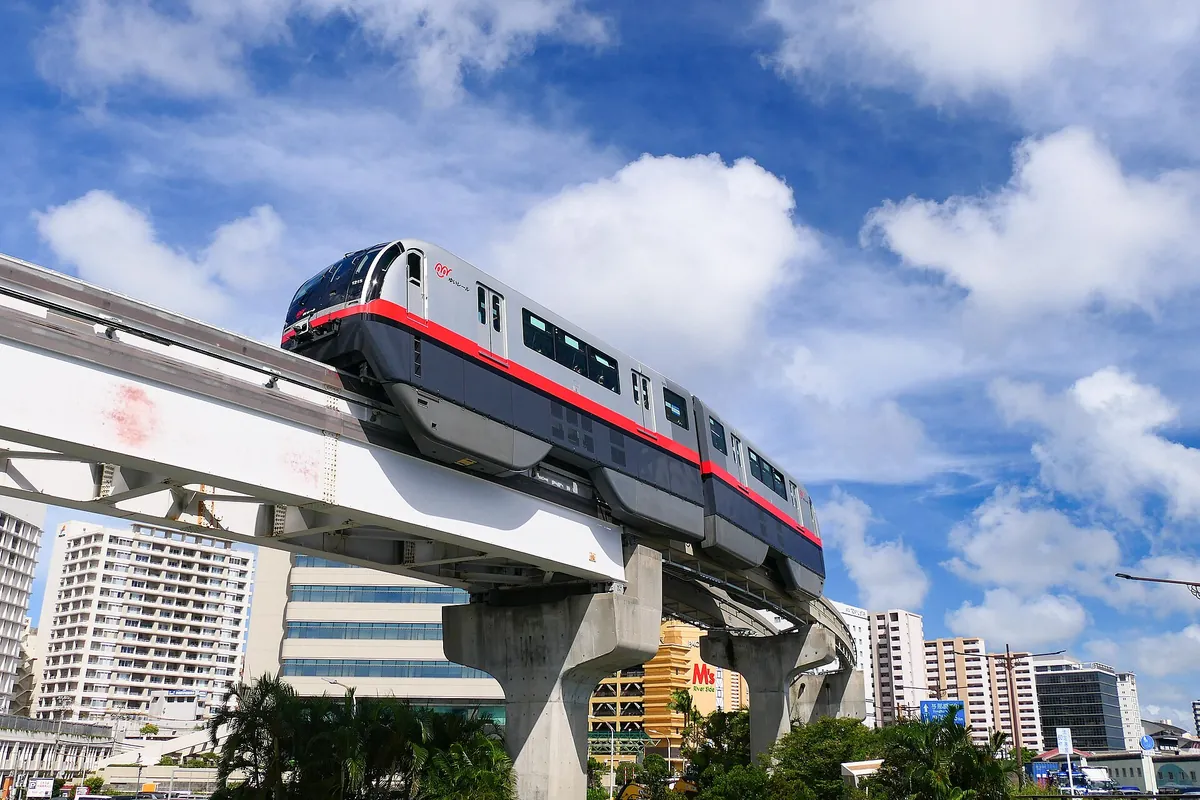
The Yui Rail monorail in the photo runs from the terminal into the city. The Naha Airport access page lists the monorail, buses, taxis and parking. Our Naha Airport to Kokusai-dori transfer page gives 13 minutes and 290 yen to Kencho-mae, the stop for Kokusai-dori. Shuri, for the castle, is 27 minutes and 360 yen.
If you stay in Naha for a day or two, the Yui Rail 1-day ticket costs 1,000 yen for adults and 500 yen for children. It gives unlimited rides for 24 hours, and a 2-day version covers 48 hours. Buy it at a ticket machine.
The monorail stays in the Naha area, so the northern sakura spots need a car or a bus. Our Naha Airport guide lists airport buses to the resort coast, such as 60 to 62 minutes for 1,700 yen to hotels in Onna. From there, the hills of Nago and Motobu are farther north. Driving gives you the most freedom: JNTO notes you can drive up the winding road on Mt. Yaedake, and there is a parking area halfway up. The JNTO travellers blog also mentions tour buses that carry visitors up the mountain.
To travel light, send your suitcase ahead. Naha Airport has an Okinawa Yamato Transport counter in the domestic arrivals hall on 1F and a staffed baggage storage counter.
Planning an Okinawa sakura trip in winter 2027
Pack for mild days and cool evenings. In January, Naha averages a high of 19.8°C and a low of 14.9°C, with rain on about 10.2 days. February averages a high of 20.2°C and a low of 15.1°C, with rain on about 9.9 days. The JNTO travellers blog suggests a light jacket, because the hills can feel chilly.
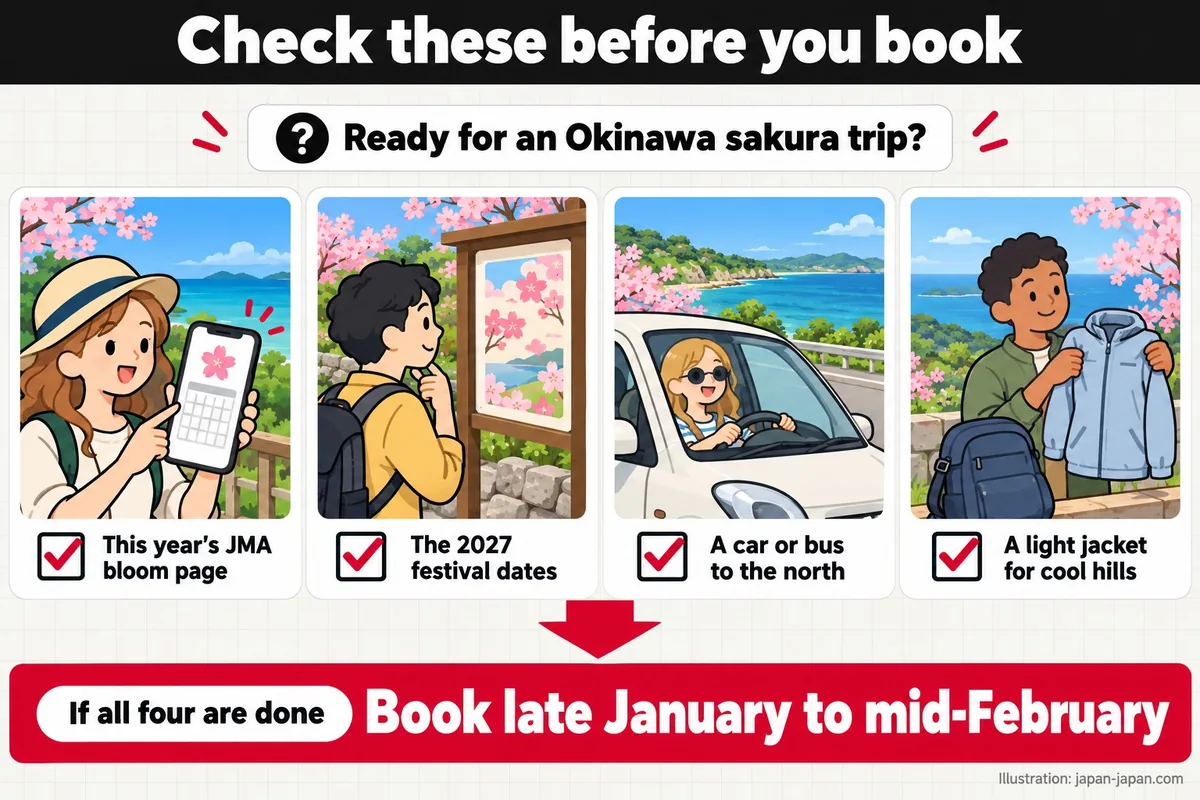
The checklist covers four things to sort out before you book. They are the JMA bloom page, the 2027 festival dates, transport to the north and layers for the weather. Tick all four and late January to mid-February is your window.
Check the public holidays too. Our February public holidays page shows 11 February, which fell on a Wednesday in 2026. Holiday weeks fill hotels faster, so look at the dates before you book.
You can also join Okinawa sakura with the mainland season. Our guide to cherry blossom season in Japan puts Tokyo’s average opening on 24 March and Kyoto’s on 26 March. The cherry blossom holiday planner follows the front north. A January trip to Okinawa and a late March trip to Tokyo cover both trees in one year.
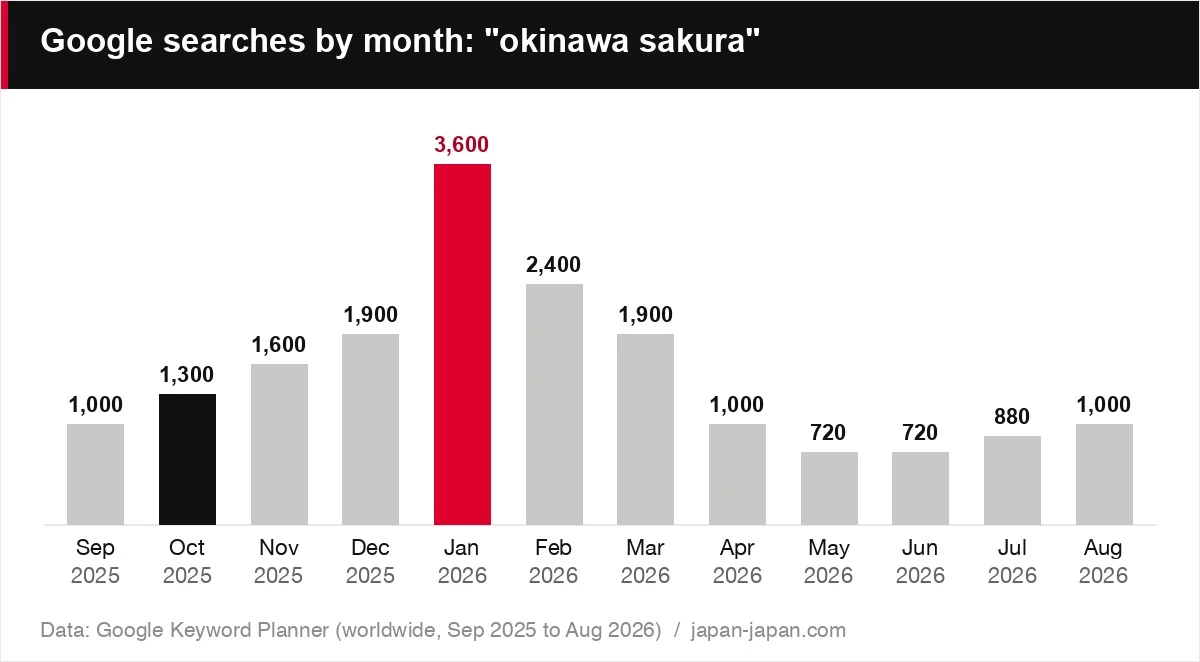
Interest in Okinawa sakura climbs well before the trees open. Last year, Google searches for “okinawa sakura” rose from 1,300 in October 2025 to 3,600 in January 2026, 2.8 times as many. They stayed high in February, at 2,400. The chart shows that curve month by month.
| Month | Searches |
|---|---|
| Sep 2025 | 1000 |
| Oct 2025 | 1300 |
| Nov 2025 | 1600 |
| Dec 2025 | 1900 |
| Jan 2026 | 3600 |
| Feb 2026 | 2400 |
| Mar 2026 | 1900 |
| Apr 2026 | 1000 |
| May 2026 | 720 |
| Jun 2026 | 720 |
| Jul 2026 | 880 |
| Aug 2026 | 1000 |
The rise starts in autumn, months before the trees open. That makes now a good time to pick your dates and check flights before the January peak.
FAQ
When is the best time to see cherry blossoms in Okinawa?
Late January to early February is the safest window for the main island. Naha’s average first bloom is 16 January and full bloom is 4 February. For Miyakojima and Ishigaki, aim for around 9 to 10 February.
Are Okinawa cherry blossoms the same as the ones in Tokyo and Kyoto?
No. Okinawa’s trees are kanhizakura, with deep pink flowers that hang downward. Tokyo and Kyoto have mostly somei-yoshino, with pale pink flowers that open from late March. The JMA even records a different species at its Okinawa stations.
Can I see cherry blossoms in Okinawa in February?
Yes. Naha’s average full bloom is 4 February, and Miyakojima and Ishigaki peak around 9 and 10 February. In 2026, Ishigaki reached full bloom on 18 February. The Yaedake and Nago sakura festivals appear in our January and February event listings.
Do I need a car to see the sakura in northern Okinawa?
A car is the easiest way, because the Yui Rail monorail stays in the Naha area. Mt. Yaedake has a road to the summit with a parking area halfway up. Without a car, use an airport bus toward the resort coast or join a tour bus.
About the author