Ekiben Guide: Where to Buy Shinkansen Bento at Tokyo Station

An ekiben is a station bento: a boxed meal sold at railway stations for eating on the train. Tokyo Station sells ekiben from all over Japan, so it is the easiest place to shop before a long ride. For a wider choice of prepared food, go to a depachika, the food hall in a department store basement. To spend less, buy a bento at a supermarket. The illustration below matches each situation with what to do.
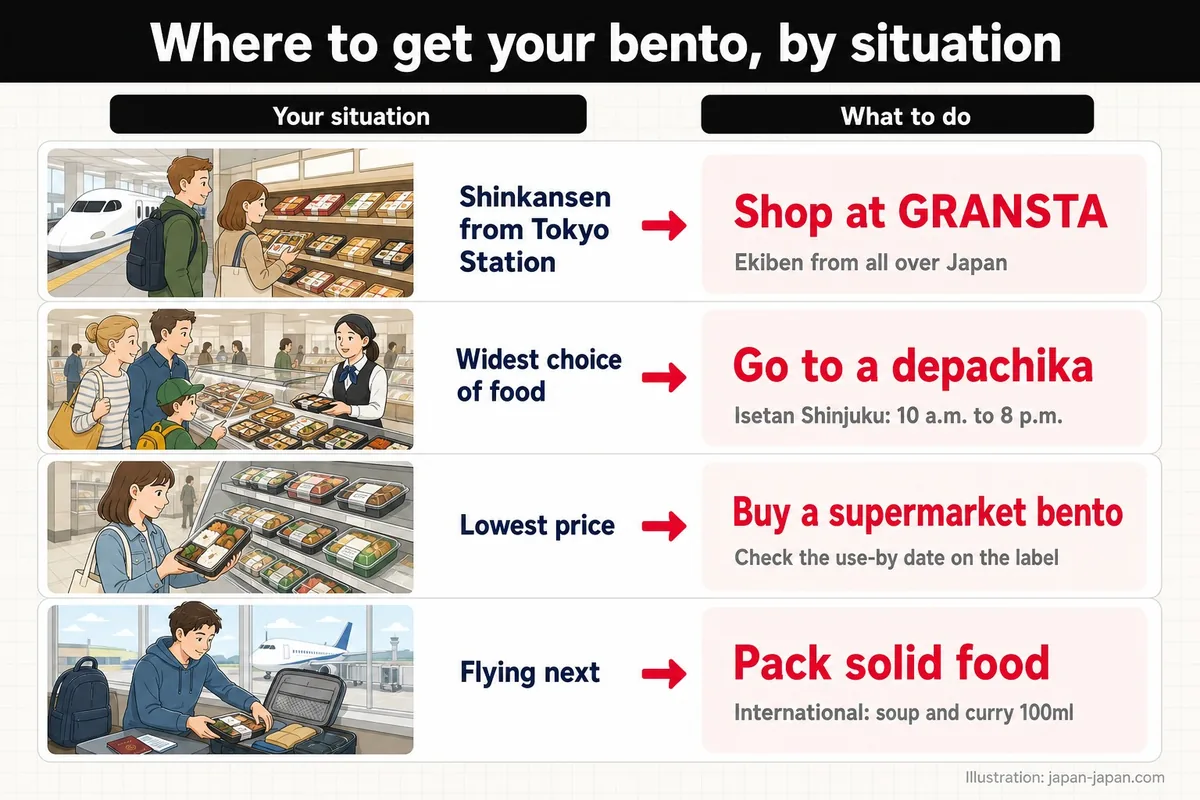
The tax depends on where you eat. Take-away food is taxed at 8%, while eating at the shop’s own tables counts as dining out and is taxed at 10%. Flying next? Solid food can go in your carry-on, but on international flights soup, curry and sauces fall under the 100ml liquid rule.
Eating on the Shinkansen: what JR Central says
You can eat and drink on the Shinkansen. JR Central, which runs the Tokaido Shinkansen between Tokyo, Kyoto and Osaka, says so in the FAQ of its English Shinkansen guide. Every seat has a fold-down table, and the guide suggests a coffee or a local ekiben while the scenery goes by. It asks only that you be mindful of the people around you.
The catch is buying the food. JR Central states that food and drink sales are not available in Standard Class, so buy your meal before boarding. Standard Class means the ordinary reserved and non-reserved cars.
Green Class works differently. On the Nozomi and Hikari, Green Class passengers can order snacks and drinks from a smartphone, and a purser brings them to the seat. Supreme Class, a private cabin above Green Class that starts in October 2026, offers a drink and a sweet as a welcome service.
The ride is long enough for a proper meal. JR Central times the trip from Tokyo Station to Shin-Osaka at 2 hours 21 minutes. For a view of Mt. Fuji while you eat, it suggests Seat E in Standard Class or Seat D in Green Class. The illustration below puts the three steps in order.

Save the meal for long-distance trains. JNTO’s ekiben guide says eating and drinking is fine on the Shinkansen and other express trains. Short-distance local trains are a different matter: they are not set up for meals, and they can get very crowded.
If you ride on a Japan Rail Pass, check your train first. JR Central notes that the pass alone does not cover the Nozomi, so you must buy a Nozomi Option Ticket before boarding. Our guide on whether the JR Pass is worth it runs the numbers.
Ekiben at Tokyo Station and other big stations
Start at Tokyo Station if you can. JNTO’s guide notes that this busy hub carries regional ekiben from all across Japan.
The main place to buy is GRANSTA, a large in-station area of shops and restaurants that stretches both inside and outside the ticket gates. The official Tokyo guide, GO TOKYO, points Shinkansen and Narita Express passengers there for ekiben with local dishes from all over Japan. Part of it sits inside the gates, so you can pass the ticket gate first and shop on the way to your platform.
Two more places are close by. Yaesu Chikagai, the underground mall at Tokyo Station, has 180 shops, and 60 of them are restaurants and cafes. Daimaru Tokyo, one of the biggest department stores in central Tokyo, is also part of the station’s shopping area.
Ekiben come sealed, so you often cannot see the food. Shops usually put photos of the contents nearby, and you can point at the one you want. Each box comes packed with everything you need to eat it. The photo below shows boxed ekiben on sale.
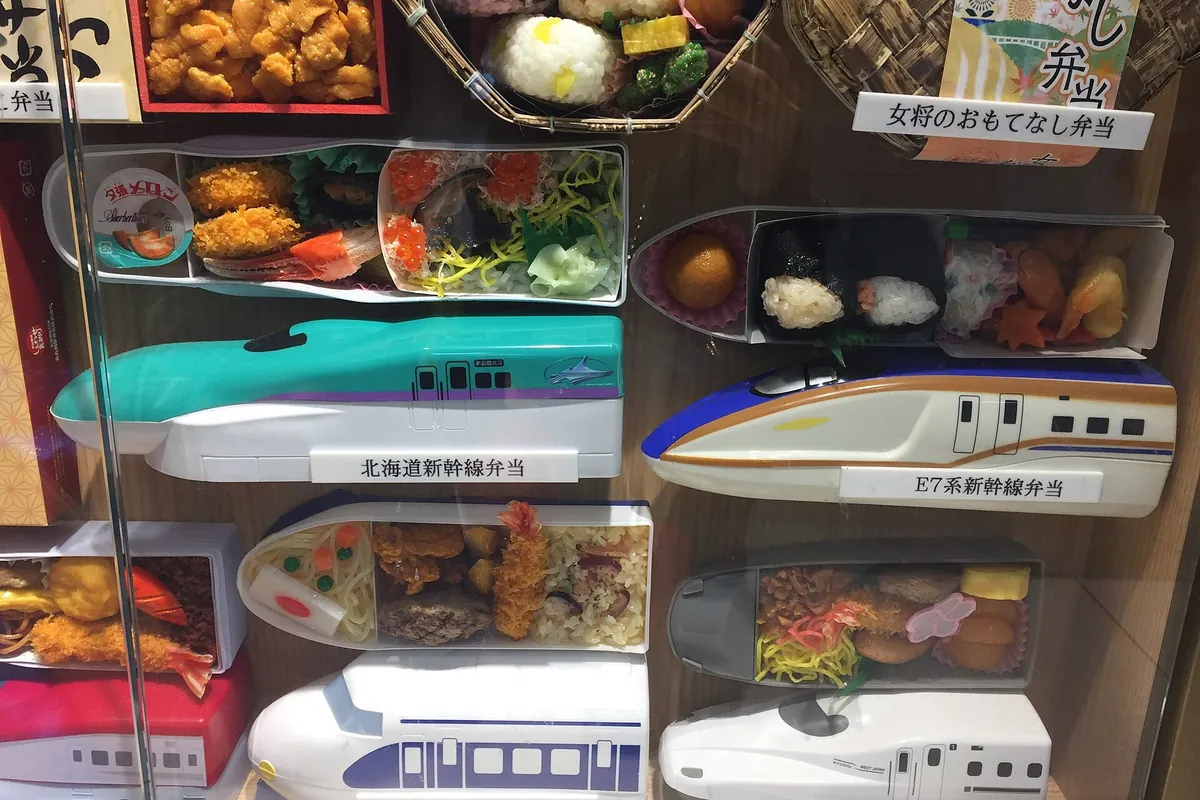
Other big stations sell their own region’s food. At Kyoto Station, JNTO points to Kyoto staples such as sushi wrapped in tofu skin and peppercorn rice. Smaller stations keep a few local specialties, usually in a glass cabinet or at a counter you pass on the way to the platform.
The habit is as old as Japan’s railways. The first line opened in 1872, between Shimbashi in Tokyo and Yokohama. Before departure, vendors walked beside the crowded trains selling lunches packed in wooden boxes. When a new line reached a new city, a new regional ekiben soon followed.
Trains have no microwaves, but some ekiben heat themselves. JNTO describes a charcoal-grilled beef tongue box from Miyagi Prefecture with a heating pouch in the base. You pull a string and wait a few minutes. Eat that kind of box on the train, because self-heating meals cannot go on a plane.
Vegetarians have fewer options. Most ekiben use beef, pork or fish as the main dish, so vegetarian, vegan and gluten-free boxes are hard to find. At Tokyo Station, look for the Vegetable Bento. Pictograms on its box show that it has no meat, fish, egg or dairy. Inside are seasonal vegetables from the Kanto region over two types of rice. Gluten-free ekiben are rare, because most include a dish cooked with soy sauce. Our guide to vegetarian food in Japan covers what to ask in shops and restaurants.
Flying in and heading straight for a Shinkansen? From Haneda, the Keikyu Line and JR reach Tokyo Station in about 33 minutes for 540 yen, with one change. Our Haneda Airport to Tokyo Station page has first and last departures and where to board. From Narita, the Narita Express runs to Tokyo Station without a change in 53 minutes at the fastest, for 3,140 yen. Our Narita Airport to Tokyo Station page also lists the AIRPORT BUS TYO-NRT at 1,500 yen.
Depachika: Japan’s department store food halls
A depachika is the food floor in a department store basement. Its counters sell bento, ready-made side dishes, and Japanese and Western sweets. Go to one when you care more about choice and quality than about speed. The photo below shows the kind of counters you will find.

Isetan Shinjuku is a good example. Its store page (in Japanese) lists opening hours of 10 a.m. to 8 p.m. and notes that hours differ by floor. The food floor is on B1 of the main building, and the page links to a weekly guide to what is on sale there. It also has a section for international guests.
Near closing time, some counters mark down bento and side dishes, so an evening visit can cost less.
Tax-free shopping changes on 1 November 2026. You pay the price including tax, and the refund comes after a customs check when you leave Japan, according to the Japan Tourism Agency. Food you eat in Japan is not refunded, and using any part of it cancels the refund for that whole receipt. Pay for your lunch separately from your gifts; our page on using tax-free goods before you leave explains the rule.
Japanese supermarket bento and the date on the label
A supermarket bento is the budget option. You give up the regional dishes and keepsake boxes of an ekiben, but you pay less. In the evening, many supermarkets put discount stickers on bento and side dishes that have to sell that day. You can take a supermarket bento onto the Shinkansen just like an ekiben.
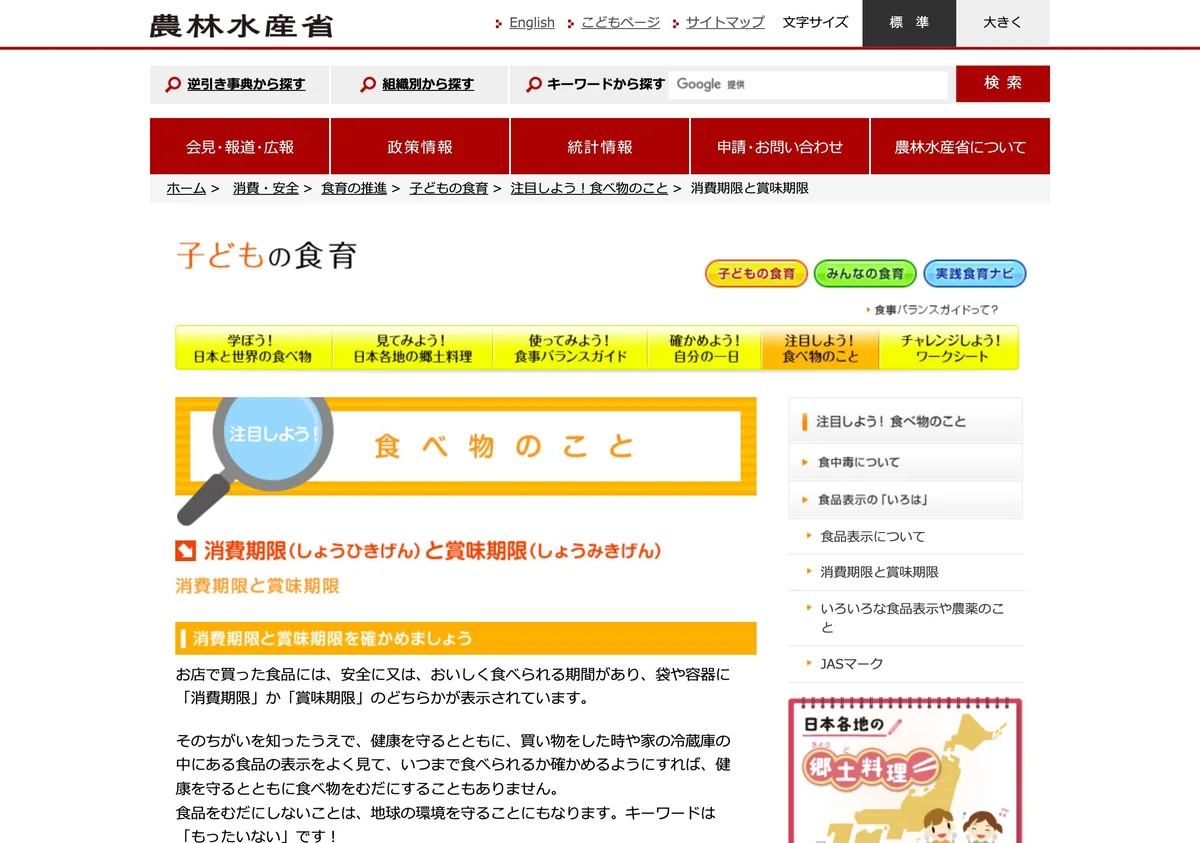
Every pack of food from a shop carries one of two dates. The Ministry of Agriculture, Forestry and Fisheries explains both on a page for children (in Japanese). Look for these words on the label.
消費期限 (shohi kigen) is the use-by date. It is the last day the food is safe to eat, if the pack stays closed and is stored as the label says. You find it on food that spoils quickly, such as bento, sandwiches, fresh noodles and cakes.
賞味期限 (shomi kigen) is the best-before date. It is the last day the food is at its best, under the same conditions. It appears on food that keeps longer, such as snacks, cup noodles, cheese, canned food and drinks in plastic bottles. Food that lasts 3 months or more after it is made may show only the year and month. Passing this date does not make food unsafe at once, but the ministry says to eat any opened pack soon, whatever the date.
For a bento, the use-by date is the one that matters. The table below sets the two labels side by side.
| Label | Meaning | Found on |
|---|---|---|
| 消費期限 Use-by (shohi kigen) | Safe to eat until this date | Bento, sandwiches, fresh noodles, cakes |
| 賞味期限 Best-before (shomi kigen) | At its best until this date; not unsafe right after it | Snacks, cup noodles, cheese, canned food, PET bottle drinks (3 months or more: year and month only) |
The screenshot below shows the ministry’s page, with both terms in its heading.
Convenience stores use the same two labels. Our guide to Japanese convenience store food covers what to pick up there, from onigiri to the egg sandwich.
Bento prices and the 8% take-away tax
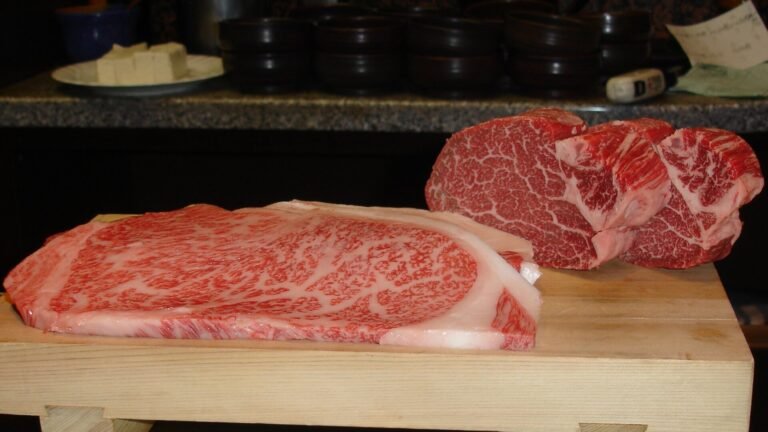
Expect to pay from under 1,000 yen to around 3,000 yen for an ekiben. JNTO’s ekiben guide puts a simple box of rice, local vegetables and a main dish under 1,000 yen. A gourmet box with Wagyu beef costs around 3,000 yen. JNTO’s Singapore office gives a range of under 1,000 yen to 2,000 yen, depending on the ingredients. It also notes that some popular ekiben sell out within minutes, so buy early if you have one in mind.
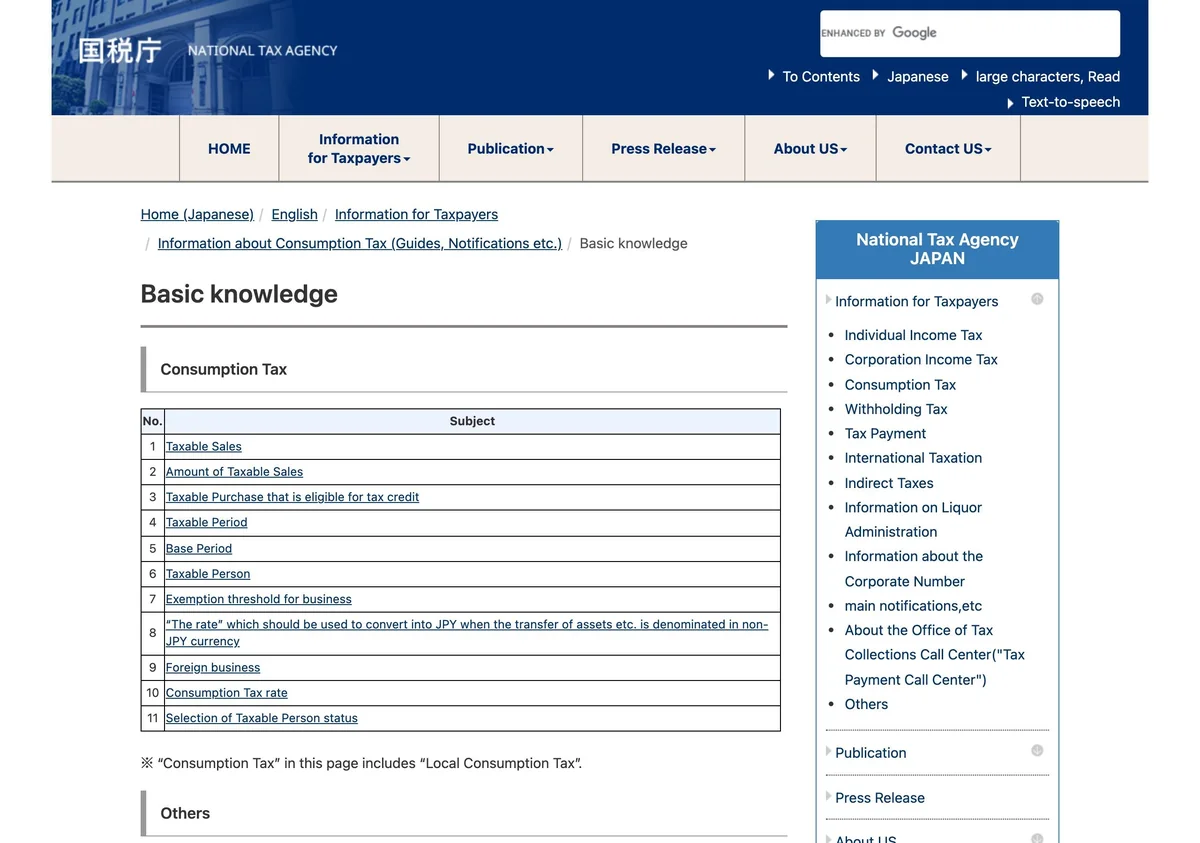
Consumption tax on food depends on where you eat it. The National Tax Agency applies a reduced rate of 8.0% to food and drink, excluding alcohol and dining out. Dining out and alcohol pay the standard rate of 10.0%.
Here is how that plays out with a bento. Buy it and eat it on the Shinkansen or at your hotel, and the rate is 8%. Eat the same bento at the shop’s own tables or eat-in corner, and it counts as dining out at 10%. A can of beer from the kiosk is taxed at 10% either way, because alcohol is excluded.
The 8% splits into 6.24% national tax and 1.76% local tax. The 10% splits into 7.8% and 2.2%. The table below sets out the three cases.
| What you buy | Total | National | Local |
|---|---|---|---|
| Food and drink to take away | 8.0% | 6.24% | 1.76% |
| Food eaten in (dining out) | 10.0% | 7.8% | 2.2% |
| Alcohol, even to take away | 10.0% | 7.8% | 2.2% |
The screenshot below shows the agency’s English page on consumption tax. Item 10 on its list, Consumption Tax rate, holds the table of rates.
Taking a bento to the airport or on a plane
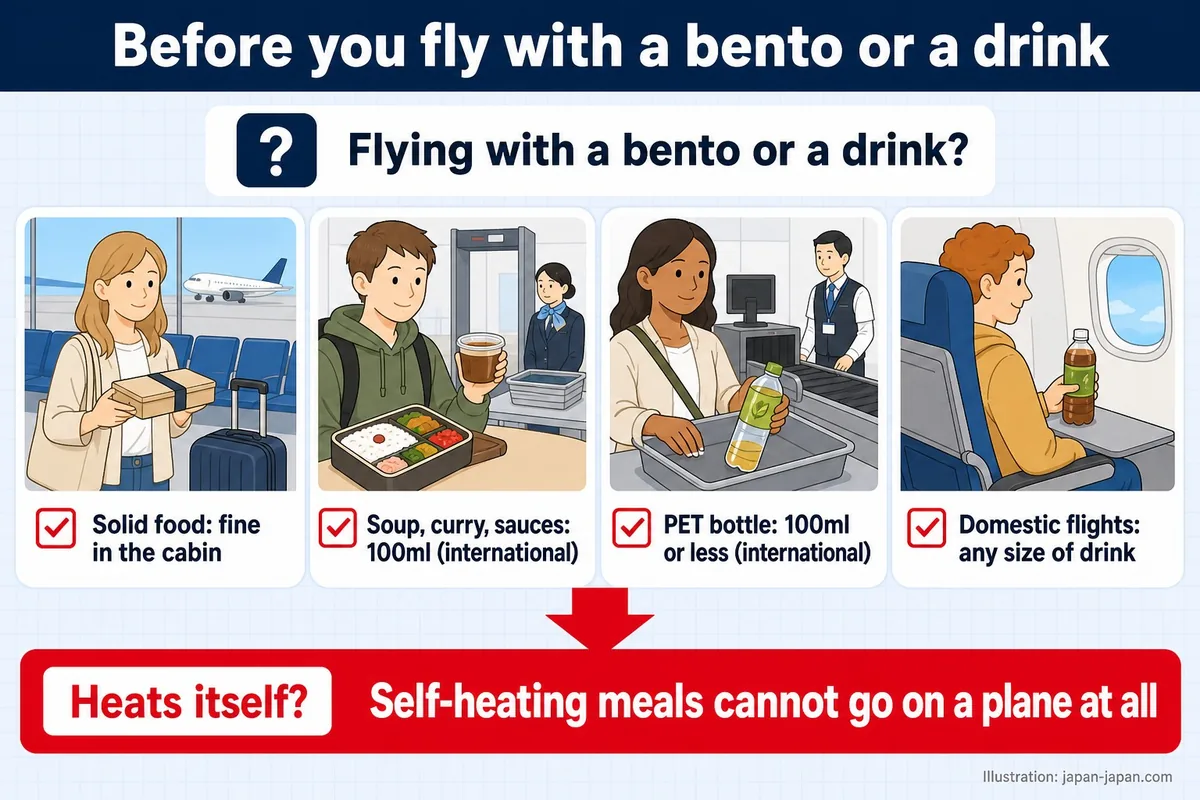
Solid food can go in your carry-on. Japan’s Civil Aviation Bureau allows it in the cabin and in checked bags, as our food and packed meals page sets out. A rice-and-fish ekiben or a depachika bento is fine to carry through security.
Liquids are where it gets strict. On international flights, liquid, gel and paste foods fall under the 100ml rule. That covers yogurt, miso, soup, curry, sauces, jam, honey, tofu packed in water, and canned fruit or vegetables. A little sauce inside a packed lunch is excepted, so the small sauce packet in a bento can stay. Curry or soup in a container over 100ml has to go in your checked bag or be finished before security.
Drinks follow the same split. On domestic flights inside Japan, a PET bottle of any size can go through security. On international flights, only containers of 100ml or less pass, all inside one transparent re-sealable bag of 1 litre or less per person. An ordinary 500ml bottle does not pass. Drinks you buy after security can be carried on, but if you change planes in another country, that airport’s checkpoint can still take them. Our bottled drinks page has the details.
One kind of ekiben cannot fly at all. Self-heating meals contain a heating agent, which counts as dangerous goods, so they are banned from carry-on and checked bags alike. That includes boxes with a heating pouch, like the Miyagi beef tongue ekiben; see our self-heating meals page.
Depachika sweets are easier. Candies, chocolate, cookies, cakes and doughnuts are not treated as liquids, so they can go in carry-on in any quantity. Pudding and ice cream are, and on international flights they fall under the 100ml rule, as our snacks and sweets page explains. The illustration below lists four checks to make before security.
FAQ
Can you eat ekiben on the Shinkansen?
Yes. JR Central says you can eat and drink on board, and every seat has a fold-down table. Standard Class on the Tokaido Shinkansen has no food sales, so buy your ekiben at the station before you board.
Where can you buy ekiben at Tokyo Station?
Go to GRANSTA, the in-station shopping area that stretches both inside and outside the ticket gates. GO TOKYO points Shinkansen and Narita Express passengers there for ekiben from all over Japan. Yaesu Chikagai, an underground mall with 180 shops, and the Daimaru Tokyo department store are also at the station.
How much does an ekiben cost?
JNTO’s ekiben guide gives a range from under 1,000 yen for a simple box to around 3,000 yen for a gourmet box with Wagyu beef. Take-away food is taxed at the reduced 8% rate. If you eat at the shop’s own tables, the rate is 10%.
Can you take a bento on a plane in Japan?
Yes. Solid food can go in your carry-on and in checked bags. On international flights, soup, curry, sauces and other liquid foods fall under the 100ml rule, though a little sauce inside a packed lunch is excepted. Self-heating meals cannot go on a plane at all.
About the author