Japan Guesthouse and Hostel Guide: Is Airbnb Legal in Japan?
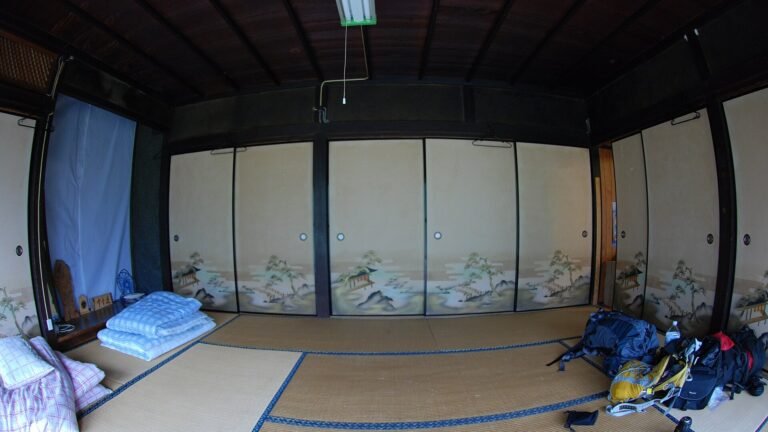
The words on the booking site matter less than the law behind the bed. Japan splits budget stays into two groups. Licensed inns run under the Hotel Business Act and can open every night of the year. Minpaku homes run under the Private Lodging Business Act, which caps how many nights a year a home can host. This guide shows which one you are booking and how to check a minpaku listing. It also covers the check-in desk and the price changes for winter 2026-27.
Guesthouse, hostel or minpaku: what the law says
Japan has three legal routes for paid stays. The Hotel Business Act (旅館業法, ryokan-gyō-hō) covers hotels, ryokan inns and simple lodging, called kan’i shukusho (簡易宿所). Most guesthouses, hostels and capsule hotels hold a simple lodging licence. The rooms are built for several guests who share them, which is why a dorm bed costs less than a private room.
The second route is the Private Lodging Business Act, which Japanese people call the new minpaku law. A host notifies the prefecture or city, gets a notification number and can then take paying guests in an ordinary house or flat. The Japan Tourism Agency Minpaku Portal explains the rules for hosts, managers and booking sites. It also has a section that asks guests to stay away from illegal listings. The third route is special-zone minpaku (tokku minpaku), which some areas allow under national strategic zone rules.
The table below puts the four common types side by side. Use it to read a listing before you pay.
| Type of stay | Law and permission | Usual room | Tokyo tax |
|---|---|---|---|
| Hotel or ryokan | Hotel Business Act, hotel and ryokan licence | Private room | Now 100 or 200 yen from 10,000 yen; 3% from April 2027 |
| Guesthouse or hostel | Hotel Business Act, simple lodging licence | Dorm bed, shared bathroom | None now; 3% from 13,000 yen from April 2027 |
| Capsule hotel | Hotel Business Act, simple lodging licence | Sleeping pod, shared bathroom | None now; 3% from 13,000 yen from April 2027 |
| Minpaku (Airbnb-style) | Private Lodging Business Act, notification number | Whole home or room | None now; 3% from 13,000 yen from April 2027 |
The split matters for you in three ways. A licensed inn has no yearly limit on nights, so it will not cancel because it ran out of days. A minpaku has to stay inside the cap set by law and any stricter local rules. Taxes also differ: Tokyo taxes hotels and ryokan today, and it adds simple lodging and minpaku from April 2027.
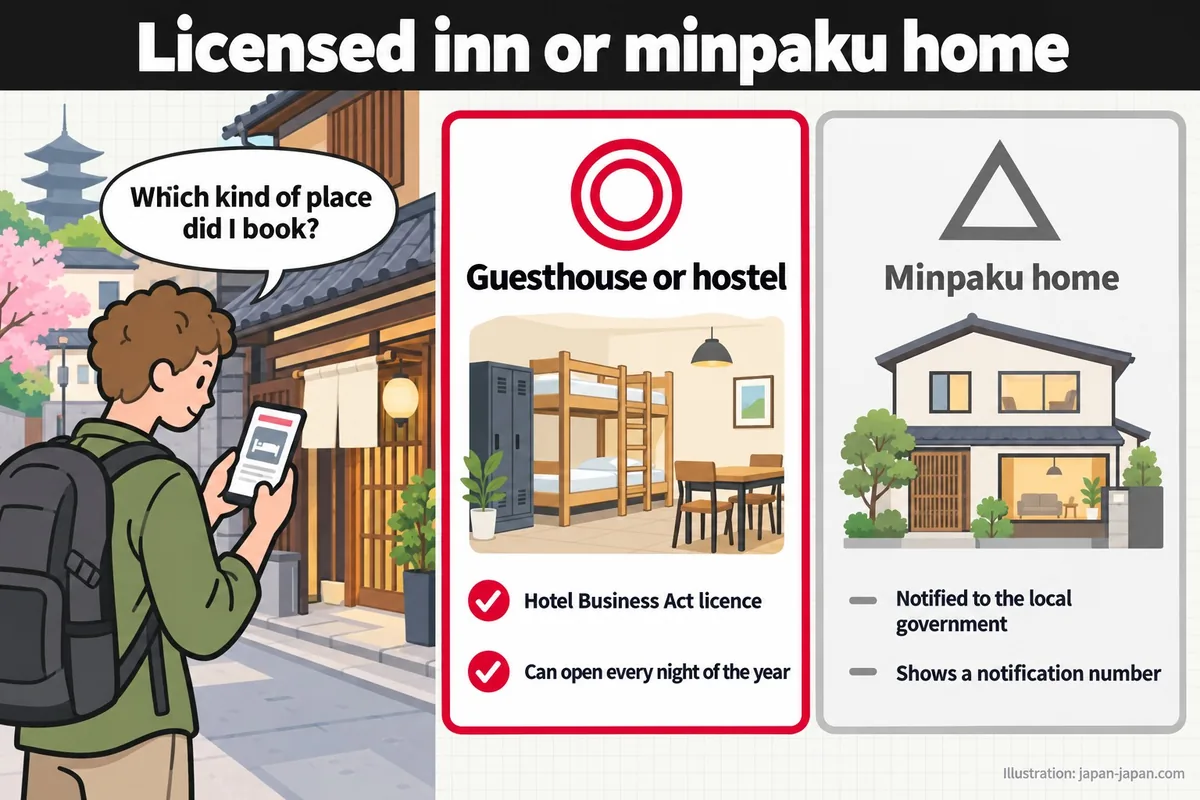
The illustration above draws that line. On one side sit guesthouses and hostels with a lodging licence and no limit on nights. On the other side sit minpaku homes, which need a notification number and must stay within the yearly cap.
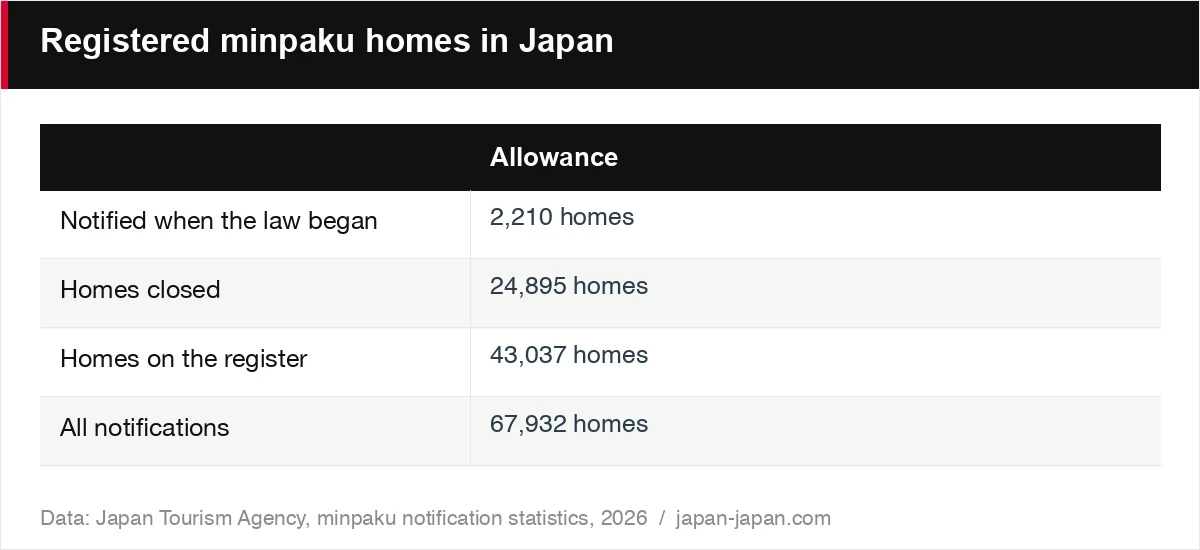
The minpaku register has grown fast. On 15 June, the day the law took effect, 2,210 homes had been notified. By 15 September 2026 the total had reached 67,932 notifications, and 24,895 of those homes had closed. That leaves 43,037 homes on the register, 967 more than in July 2026. The chart shows these four numbers from the Japan Tourism Agency minpaku notification statistics.
| Item | Value | Note |
|---|---|---|
| Notified when the law began | 2210 homes | |
| Homes closed | 24,895 homes | |
| Homes on the register | 43,037 homes | 15 Sep 2026 |
| All notifications | 67,932 homes |
The same page counts the businesses around those homes. There are 4,740 registered management companies, which run homes for owners who do not live there. There are 66 registered booking platforms, the companies that list minpaku homes for guests.
Japan hostel dorms: shared rooms and bathrooms
A Japan hostel or guesthouse usually sells beds, not rooms. You get a bunk in a dorm, a curtain or a small light, and a locker for your bag. Toilets and showers are down the hall and shared. Many guesthouses also have a lounge and a kitchen where guests cook their own breakfast.
Expect people to come in late and leave early for trains. Light sleepers should pack earplugs and an eye mask. Both can go in carry-on and checked bags on flights in Japan, so you can keep them in your day pack.
Some guesthouses also offer private rooms with a shared bathroom. Others are small houses with only a few rooms and a host who lives nearby. Capsule hotels follow the same simple lodging licence, but you sleep in a pod instead of a bunk. Many capsule hotels split floors by gender.
A ryokan is a different stay. It holds the same licence type as hotels. The room usually comes with dinner and breakfast, and you sleep on futons in a tatami room. Our ryokan inn guide covers prices, meals and onsen manners. For business hotels and city hotels, the Japan hotel guide lists room types and city taxes.
Dorm life in Japan comes with a few house rules. Staff will ask you to stay quiet in the dorm at night and to take your shoes off at the entrance. Large suitcases often go in a storage room, not under the bed. Read the booking page for the lights-out time, the towel fee and whether the kitchen is open late.
Is Airbnb legal in Japan? Check the number
Yes, Airbnb and other minpaku homes are legal in Japan when the host has notified the local government. A legal listing shows a notification number (届出番号, todokede bangō). A licensed guesthouse shows its Hotel Business Act licence instead. If a listing shows neither, treat it as illegal and book something else.
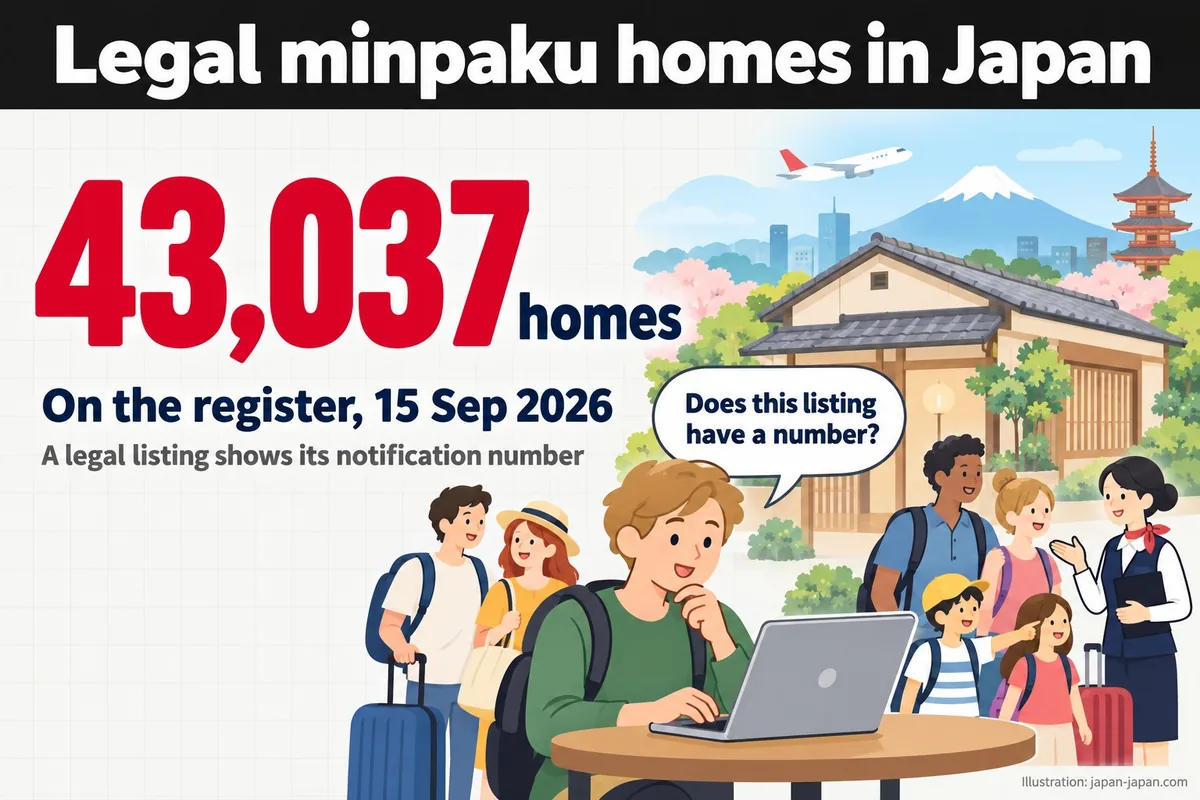
The illustration puts the size of the legal market in one number: 43,037 homes on the register on 15 September 2026. That count covers homes notified under the Private Lodging Business Act, after closed homes are taken out.
Japan takes the rules seriously. The prefectural governor can order a host to change how it runs a home. If the host breaks the law, the governor can stop the business for up to one year. If that does not work, the governor can order the business to close. Hosts must also report the nights and guests at each home every two months.
Those reports show who stays in minpaku. From 1 June to 31 July 2026, minpaku homes took 582,162 guests. Foreign guests made up 57.5% of them, or 334,689 people. The top five countries and regions were the United States, South Korea, Taiwan, China and Hong Kong. Tokyo had the most nights, 286,731, and its guests stayed 4.1 nights on average, longer than in any other prefecture.
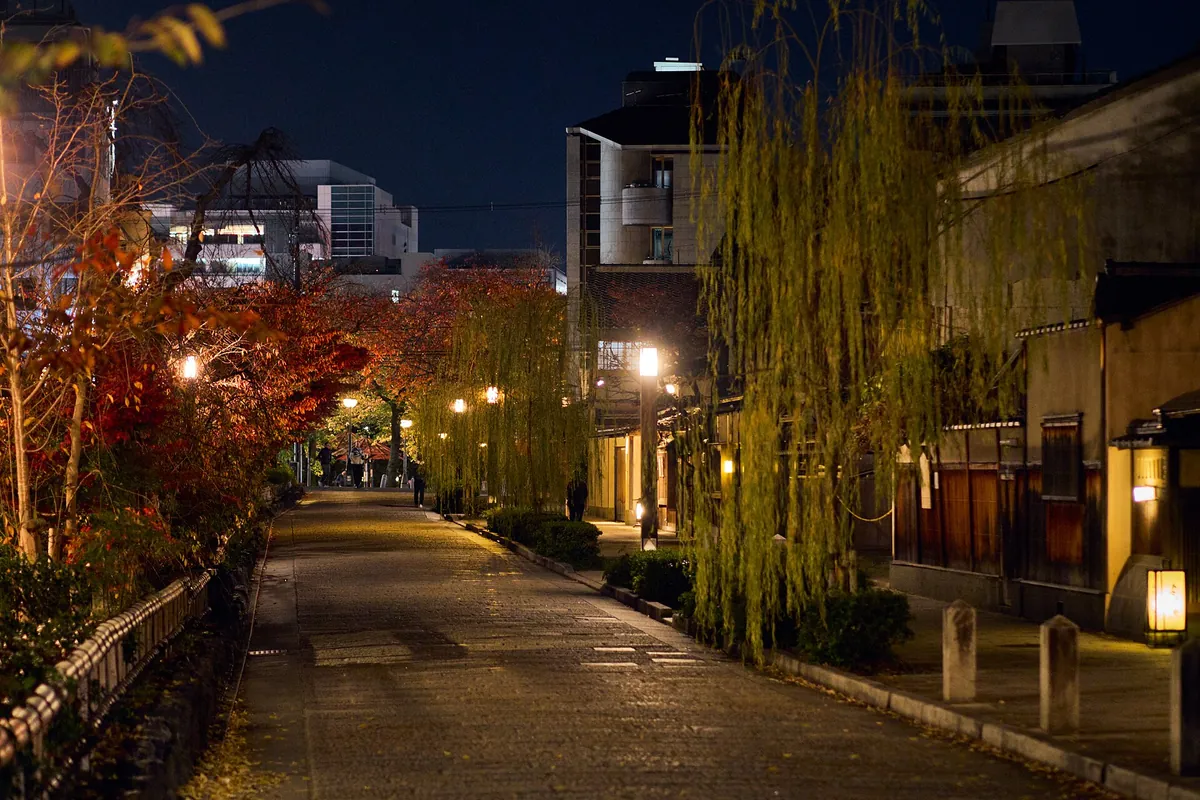
Cities can add their own rules on top of the national law. Kyoto has quiet streets of wooden machiya townhouses like the ones in the photo. The city sets local limits on where and when minpaku homes may open. The Kyoto City private lodging rules overview sets out those local rules. The national portal also lists each local government’s rules and contact desk. Before you book a minpaku in a quiet residential street, read the city page and ask the host which rules apply to the home.
Check-in at a guesthouse: passport and times
Every licensed inn keeps a guest register. If you do not have an address in Japan, the law asks for more than your name. The Ministry of Health, Labour and Welfare guest register and passport notice covers this rule. Foreign guests write their nationality and passport number, along with their name, address and contact details. The government also asks inns to see your passport and copy it.
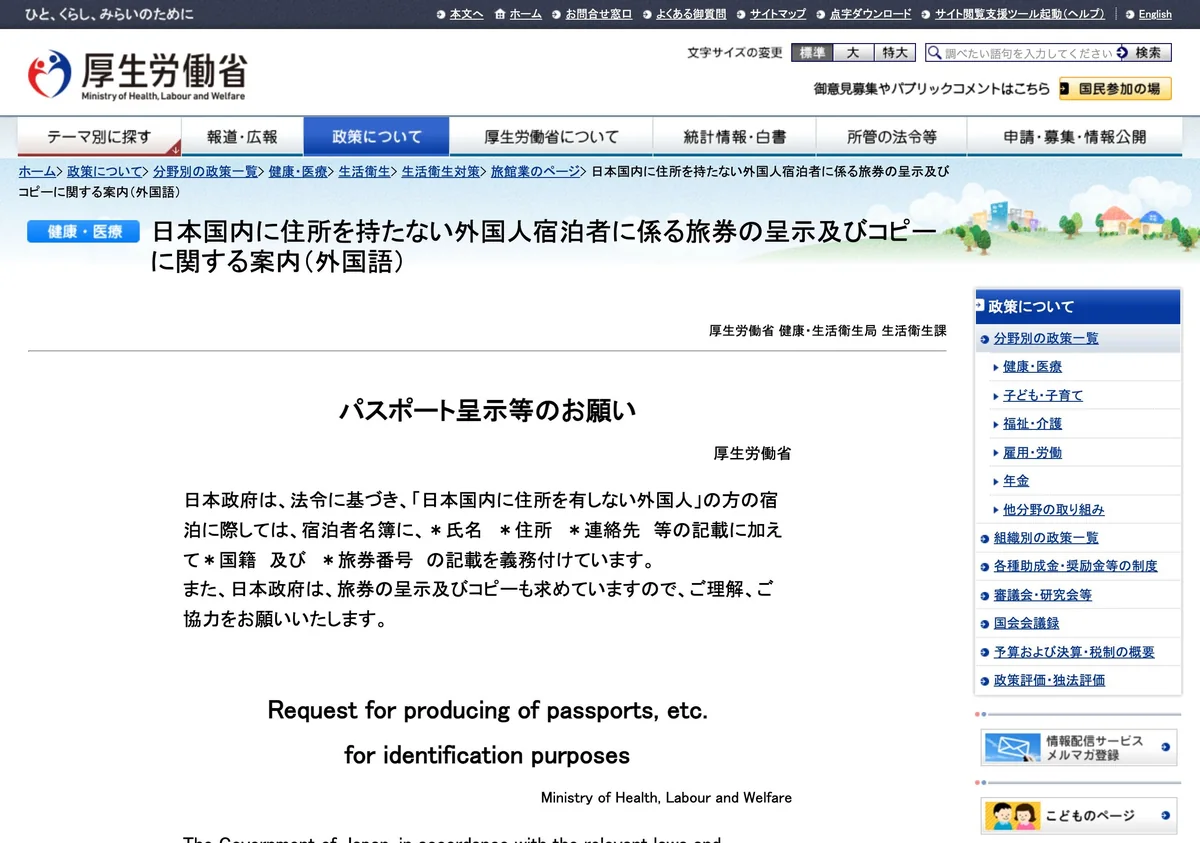
The screenshot shows that ministry page. Its Japanese title reads パスポート呈示等のお願い (pasupōto teiji tō no onegai), which means “request to show your passport”. The notice comes in Japanese, English, Korean and Chinese. Staff can show you the version you read, so you can see the rule comes from the government.
Minpaku hosts keep a guest register too, and they have to confirm who you are. A host who never meets you may ask for a photo of your passport before arrival. Keep the passport with you and the number ready.
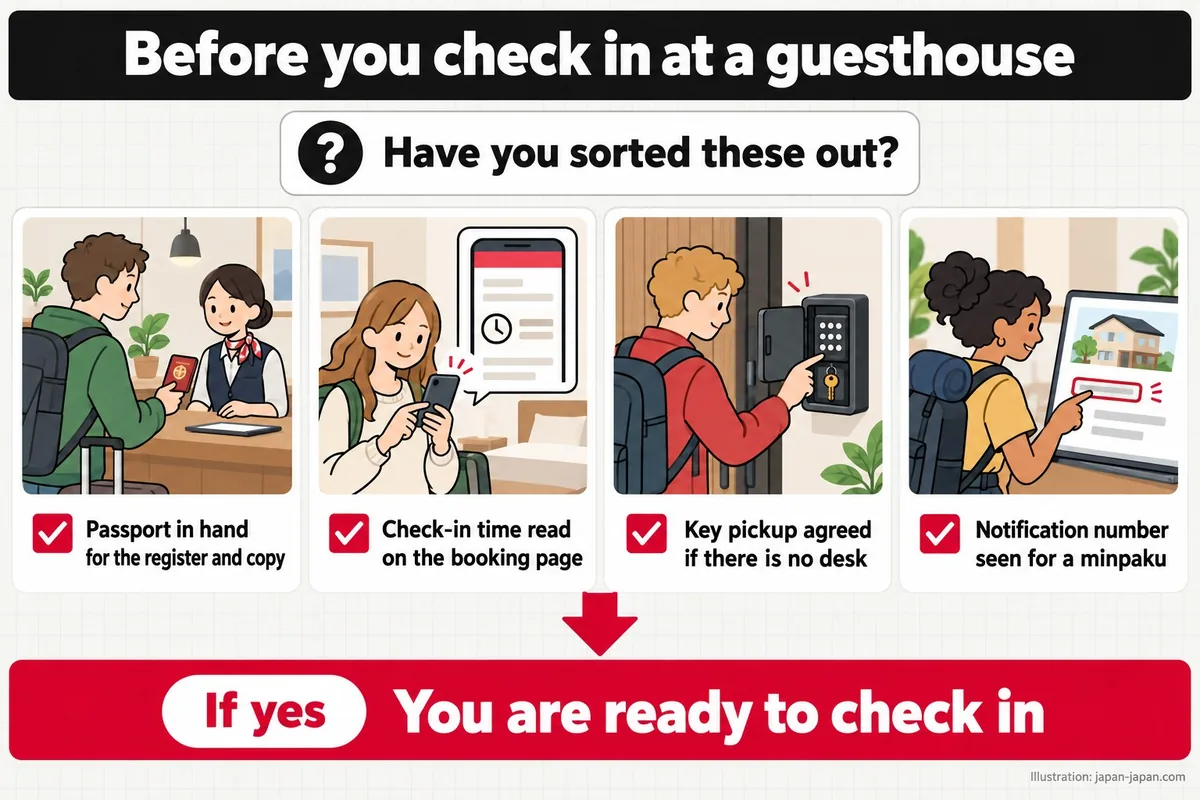
The checklist above sums up what to sort out before you arrive. Check-in times vary by place, so read your booking page rather than guessing. Small guesthouses often close the desk in the evening. If you land late, message the host and ask how to collect the key. It may be a key box, a door code or a staff member who waits.
Check-out is often earlier at guesthouses than at hotels, because staff clean the dorms in the late morning. Ask whether you can leave your bag after check-out. Most guesthouses will hold it in a storage room for the day.
Accommodation tax on a budget stay
Budget stays still pay local accommodation tax in some places, and two rules change this winter and next spring. The first is in Tokyo. The Tokyo Metropolitan Government accommodation tax announcement sets the rules for both the current system and the new one.
Today Tokyo charges the tax only to guests at hotels and ryokan. A stay under 10,000 yen per person a night pays nothing. A stay from 10,000 yen to under 15,000 yen pays 100 yen, and 15,000 yen or more pays 200 yen. Hostels, guesthouses and minpaku homes are outside the current tax.
From 1 April 2027 the tax becomes 3% of the room charge. It covers hotels, ryokan, simple lodging and both kinds of minpaku. A stay under 13,000 yen per person a night stays tax-free. A dorm bed in Tokyo will usually still pay nothing. A private guesthouse room at 13,000 yen or more will pay 3%. Japan’s Minister for Internal Affairs approved the change on 30 June 2026, and the new tax applies to nights from 1 April 2027.

The second change is in Niseko, the ski town in Hokkaido shown in the photo. The Niseko Town accommodation tax page says the town brought in its tax on 1 November 2024. From 1 November 2026 the town moves from a fixed amount to a percentage of the room charge. That switch lands just before the ski season, so it covers the whole winter of 2026-27. The town page links a leaflet with the new rates and an English summary. Hokkaido also runs its own prefectural accommodation tax, which the town page points to.
Minpaku demand in Hokkaido is high in the same season. In June and July 2026, Hokkaido homes recorded 84,684 nights, second only to Tokyo, and the most nights per home of any prefecture at 21.1. Book early and ask whether the tax is in the price or paid at the desk.
Booking a guesthouse for winter 2026-27
Budget beds fill first over New Year. New Year’s Day falls on Friday 1 January 2027, and banks close from 31 December to 3 January. JR Central makes every Nozomi bullet train reserved-seat only from 25 December 2026 to 5 January 2027. Last winter the busiest day was Sunday 4 January 2026, when 350,000 passengers headed to Tokyo. Our New Year 2026-27 page lists closures and busy trains.
The new year brings more long weekends. In 2027, Coming of Age Day falls on Monday 11 January and National Foundation Day on Thursday 11 February. The Emperor’s Birthday follows on Tuesday 23 February. Japan has 6 three-day weekends in 2027. The public holidays in 2027 calendar shows every date with its weekday.
Use the steps below each time you book a minpaku. They take a minute and keep you away from listings that may be cancelled.
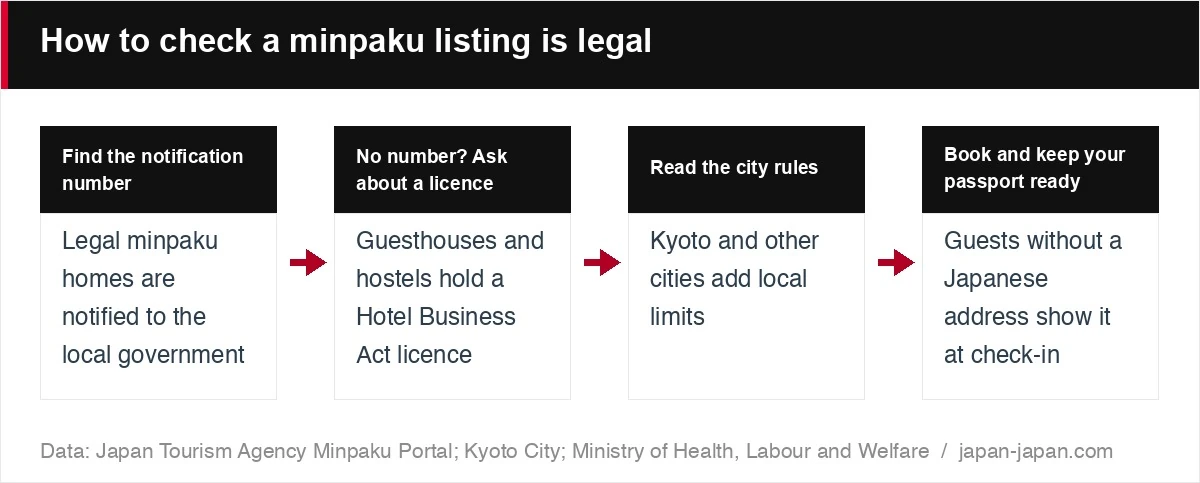
Start with the notification number on the listing. If there is no number, ask whether the place holds a Hotel Business Act licence, as most guesthouses and hostels do. In Kyoto and other cities with local limits, read the city rules for the dates you want. Then book, and keep your passport ready for check-in.
Three more tips help in winter. Pick a place near a station, because you will carry a suitcase in the cold. Check that the dorm has heating and that the shower room is warm. If you plan to ski in Niseko, add the new percentage tax from 1 November 2026 to your budget.
From the airport to your guesthouse
Many guesthouses in Tokyo sit in Asakusa and Ueno, and many in Kansai sit in Kyoto. Plan the airport leg before you book, because a late arrival can miss a guesthouse desk.

Asakusa, home of the Kaminarimon gate in the photo, has direct links from both Tokyo airports. From Haneda, Keikyu Line trains run through onto the Toei Asakusa Line, and our Haneda Airport to Asakusa route gives the time and fare. From Narita, the Narita Airport to Asakusa route compares the Airport Limousine bus with the trains. At Narita Terminal 1, Narita Airport Station is on B1F under the terminal. The Narita Airport page covers the other terminals.
For Kyoto, fly into Kansai Airport. The JR Haruka limited express reaches Kyoto in about 75 minutes without a change. Visitors with a foreign passport can buy the HARUKA One-way Ticket, which costs 2,200 yen to Kyoto. The Kansai Airport to Kyoto route lists the options, and the Haruka airport express page explains the ticket and stops.
Send the host your arrival time once you know it. If your flight lands in the evening, ask for the key code before you leave home.
FAQ
Is a guesthouse in Japan the same as a hostel?
Mostly, yes. Both usually hold a simple lodging licence under the Hotel Business Act and rent beds in shared rooms with shared bathrooms. A guesthouse is often smaller and may also have private rooms. A hostel tends to be larger, with more dorms and a lounge.
Is Airbnb legal in Japan in 2026?
Yes, if the host has notified the local government under the Private Lodging Business Act. A legal listing shows a notification number, and 43,037 homes were on the register on 15 September 2026. Listings without a number or a hotel licence are illegal, so book something else.
Do guesthouses in Japan ask for my passport?
Yes. If you have no address in Japan, you must write your nationality and passport number in the guest register. The Ministry of Health, Labour and Welfare also asks inns to see and copy your passport. Minpaku hosts have to confirm your identity too.
Do hostels in Japan charge accommodation tax?
It depends on the town. In Tokyo, hostels and guesthouses are outside the tax until 31 March 2027. From 1 April 2027 they pay 3% when a stay costs 13,000 yen or more per person a night. Niseko moves to a percentage tax from 1 November 2026.
About the author

.jpg)


