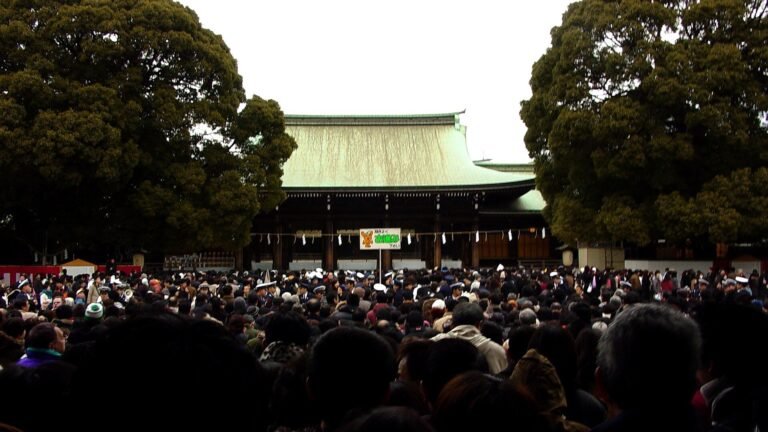
New Year in Japan 2026-27: Traditions and What Is Open
New Year's Day 2027 is a Friday. Banks close 31 Dec to 3 Jan, many shops shut on 1 Jan and sales start around 2 Jan. Plus hatsumode and the palace greeting.
New Year in Japan: the short answer
New Year in Japan (shogatsu) brings 3 days off from Friday 1 January 2027. Banks close from 31 December to 3 January and many shops shut on 1 January, but many convenience stores stay open 24 hours.
It is one of Japan’s three big holiday seasons. New Year’s Day is the only national holiday, but most companies also close for the year-end and for 1 to 3 January. People call those three days shogatsu sanganichi.
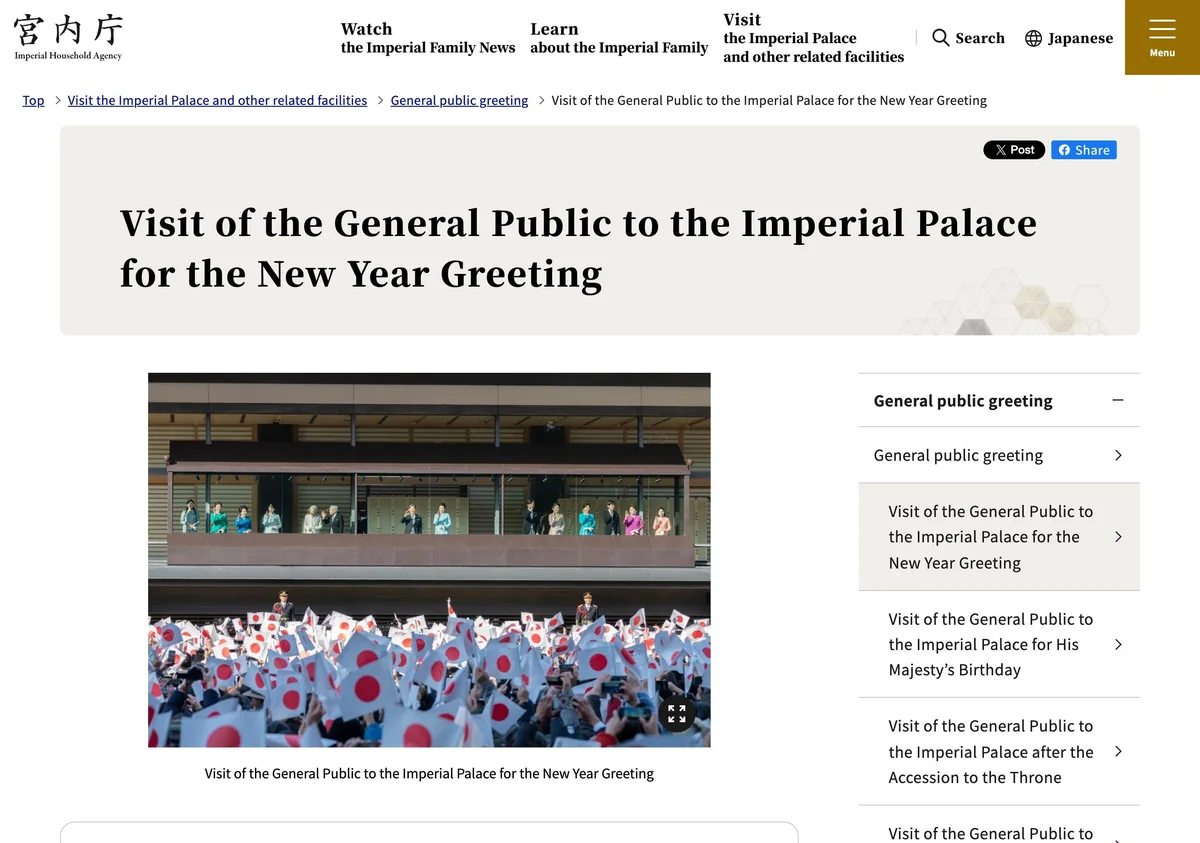
The customs start on New Year’s Eve. Families eat soba, temples ring their bells near midnight, and crowds pray at shrines for hatsumode. On 2 January, the Imperial Palace opens its grounds for the New Year Greeting. The Imperial Household Agency posts the gate and the appearance times on its own page, shown below.
Department stores start their New Year sales, with fukubukuro lucky bags, from around 2 January. Travel inside Japan peaks, and JR Central makes every Nozomi bullet train reserved-seat only from 25 December 2026 to 5 January 2027. The sections below cover what opens and closes, the customs, the palace greeting, the sales and tax-free refund, then trains, hotels and weather.
Japan New Year holidays: what is open and closed
Many shops close on 1 January, and banks close from 31 December to 3 January. The table sums up what to expect over New Year 2026-27.
| What | Open or closed | When |
|---|---|---|
| Banks | Closed | 31 Dec 2026 to 3 Jan 2027 |
| Most companies | Closed | Year-end and 1 to 3 Jan |
| Convenience stores (7-Eleven, FamilyMart, Lawson) | Many open | 24 hours, even on national holidays |
| Department stores | Many closed on 1 Jan | Sales from around 2 Jan |
| Meiji Jingu | Open | All night on 31 Dec |
| Imperial Palace East Gardens | Closed | 2 Jan, greeting day (2026 notice) |
| Nozomi bullet trains | Reserved seats only | 25 Dec 2026 to 5 Jan 2027 |
Closed. Banks shut for four days and open again on Monday 4 January 2027. Over shogatsu sanganichi, many restaurants and facilities close, and those that open may shorten their hours, says JNTO’s New Year guide. In Tokyo, GO TOKYO warns that many stores close on 1 January.
Open. Many convenience stores, such as 7-Eleven, FamilyMart and Lawson, open 24 hours a day, even on national holidays, according to JNTO. Some chain restaurants and discount stores do the same. On 1 January, a convenience store is often the easiest place to buy breakfast or a hot drink. Our guide to Japan convenience store food lists what is worth buying.
Shrines and temples stay open, and Meiji Jingu in Tokyo stays open all night on 31 December. Department stores reopen on 1 or 2 January, each on its own sale date.
Museums, gardens and other sights close on different days, so check our New Year 2026-27 holiday page before you plan a museum day. December has no national holiday in 2026 or 2027, as our December page shows, so Christmas Day is a normal working day. Our Japan Christmas guide covers the week before.
New Year in Japan traditions: soba, bells and osechi
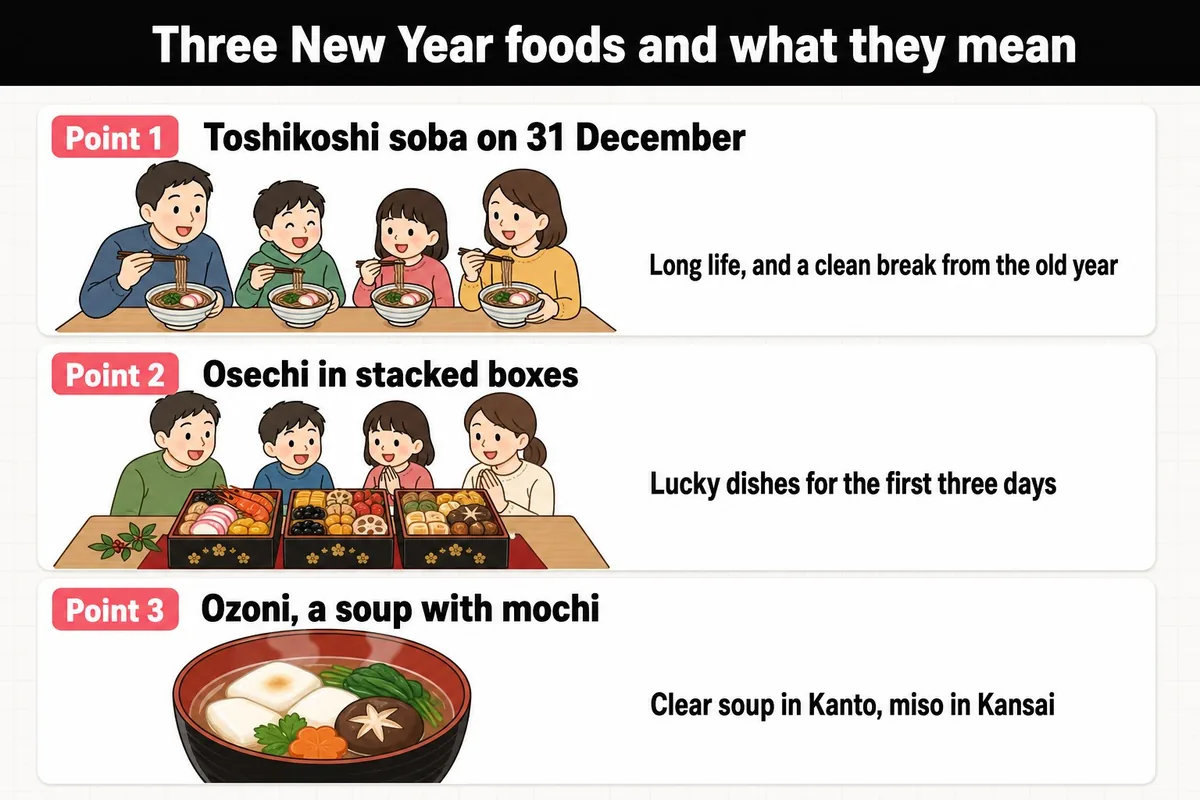
31 December: toshikoshi soba. On New Year’s Eve, people eat toshikoshi soba, which means year-end soba. JNTO traces the custom to the Edo era. The long noodles stand for a long life, and buckwheat, which survives harsh weather, stands for strength. Soba also breaks easily as you eat it, which symbolises cutting off the old year.
Eat it hot, or cold as zaru soba, with toppings such as tempura or abura-age, a fried tofu. Soba restaurants fill up at dinnertime on 31 December, so go early. In Tokyo, JNTO points to Jindaiji, the city’s second-oldest temple, for its historic soba restaurants.
Midnight: the temple bells. In the last moments of 31 December, Buddhist temples ring their bells 108 times, once for each of the 108 worldly passions. People call this joya no kane, and some temples let visitors take a turn. JNTO suggests Zojo-ji, the temple next to Tokyo Tower, as a place to see the year out.
1 to 3 January: osechi. Families eat osechi, a set of lucky dishes packed in a jubako, a stack of boxes. Most of the dishes come simmered. People eat osechi over the first three days, with chopsticks tapered at both ends: one end for people, one for the gods. The photo below shows osechi in its boxes.
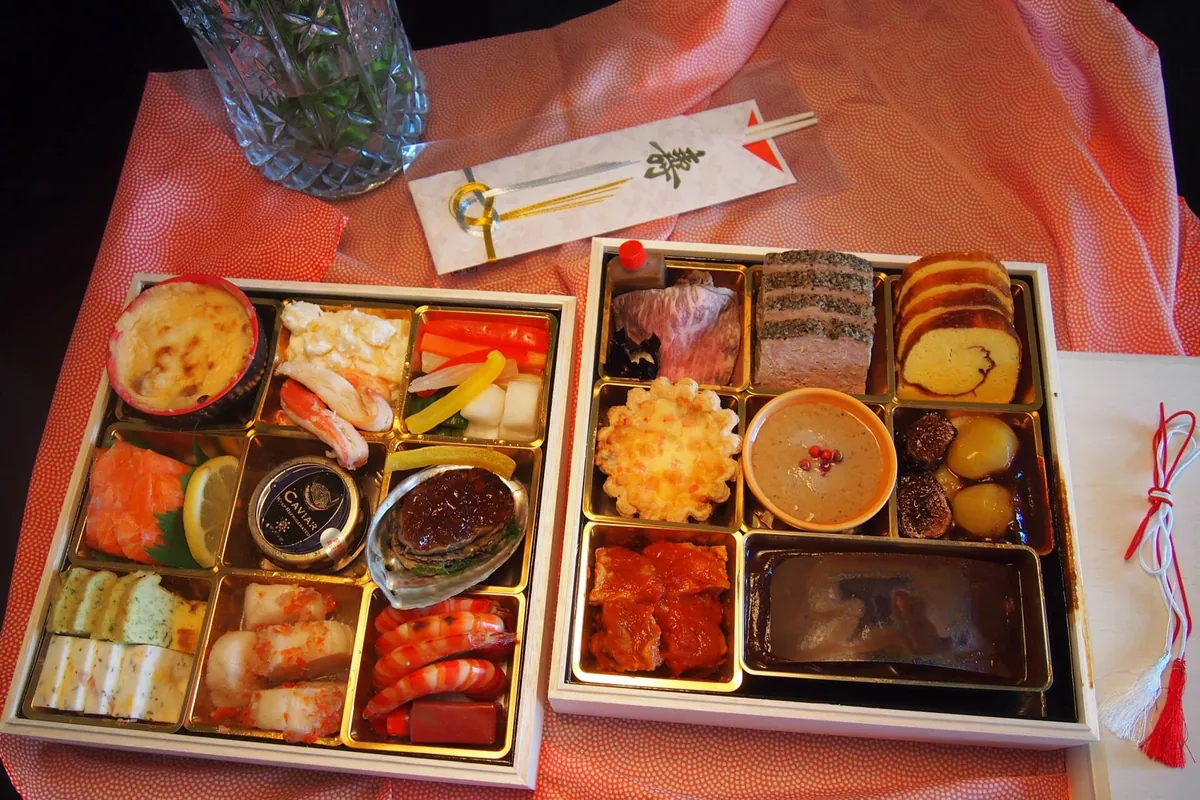
Each dish has a meaning, often a pun on its name:
- Kuromame (black soybeans): mame sounds like the word for good health.
- Konbu maki (herring rolled in seaweed): konbu plays on a word meaning to be happy.
- Kazunoko (herring roe): its many tiny eggs stand for a big harvest and fertility.
- Kohaku kamaboko (red and white fishcake): red guards against evil, and white means purity.
Many families now order a ready-made set from a department store, a restaurant or a convenience store, but the order sites are in Japanese only. For visitors, a ryokan or hotel is easier: JNTO notes that many serve osechi in the first three days, by reservation only. Our ryokan guide explains how meals and bookings work.
Ozoni. This soup goes with osechi. Its main ingredient is mochi, a stretchy rice cake that stands for long life. Most regions use a clear soy sauce soup, but the Kansai region uses miso. Each area adds its own ingredients.
- Kanto: chicken, carrot and leafy greens in clear soup, with yuzu peel on top.
- Osaka: boiled mochi with grilled tofu, radish and carrot in white miso soup.
- Niigata: a fish-based soy sauce soup with salmon slices and salmon roe.
- Tottori: a clear soup with only red beans and mochi.
The illustration below sums up the three dishes and what they mean.
The firsts. New Year is also a season of firsts, or hatsu. Since the Meiji era, people have prayed to hatsuhinode, the first sunrise. They watch it from the Pacific coast, from Mt. Fuji or from tall buildings like Tokyo Tower. People also believe that hatsuyume, the first dream of the year, hints at what lies ahead.
Hatsumode: the first shrine visit and where to go
Hatsumode is the first prayer of the year at a shrine or temple. In Japanese it is written 初詣 (hatsumode); hatsu means first, so the word means the first visit. Many people go late on 31 December and pray as the clock passes midnight. Others go on 1, 2 or 3 January, according to GO TOKYO.
People pray for health and luck, buy new charms and draw paper fortunes. Many come in kimono. Food stalls called yatai line the streets outside the big shrines and sell hot drinks, udon and yakisoba.
Where to go in Tokyo. GO TOKYO names Meiji Jingu and Sensoji as the city’s two top hatsumode spots. Meiji Jingu draws several million people between New Year’s Eve and 3 January, says its GO TOKYO listing. According to JNTO, it sees more than 3 million visitors every hatsumode. You may wait a couple of hours to pray at the main hall.
Meiji Jingu is 1 minute on foot from Harajuku Station on the JR Yamanote Line and from Meiji-jingumae Station on the Tokyo Metro. JNTO’s tip for a shorter queue is to go at around four in the morning, when the crowd thins out.
Sensoji in Asakusa is the other big name, and one of the places where you can draw a fortune in English. The photo below shows New Year visitors at Sensoji.
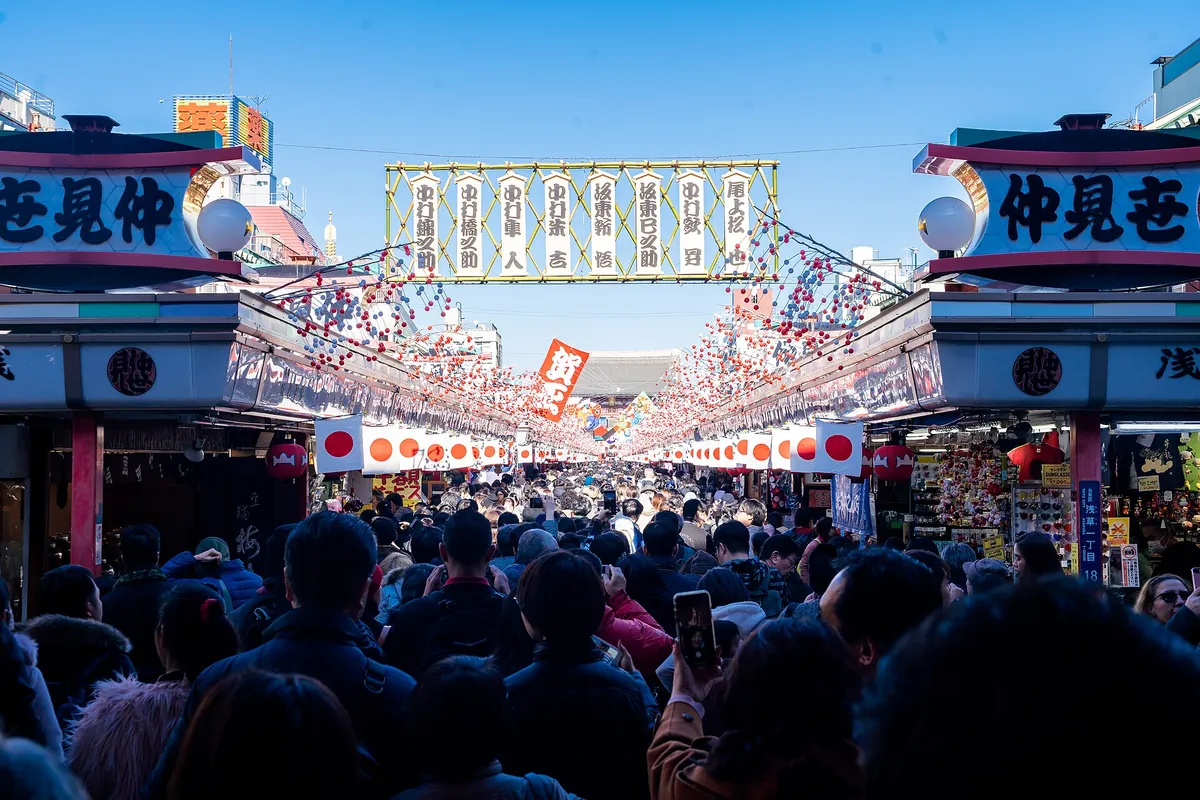
Outside Tokyo, JNTO counts over 2 million hatsumode visitors at Atsuta Jingu in Nagoya; see our Nagoya in January guide. For Kyoto, our Kyoto in January guide lists Okera Mairi at Yasaka Shrine.
How to pray. First, tell a shrine from a temple. A shrine has a red torii gate, two pillars and a crossbeam. A temple has a sanmon, a roofed wooden gate. Bow once before you step through a torii, and walk at the side of the path, because the centre is for the gods.
At the hall, ring the bell and drop a coin into the offertory box. Then bow twice, clap twice, pray, and bow once more. At a temple, pray without clapping. The illustration below shows the four steps.
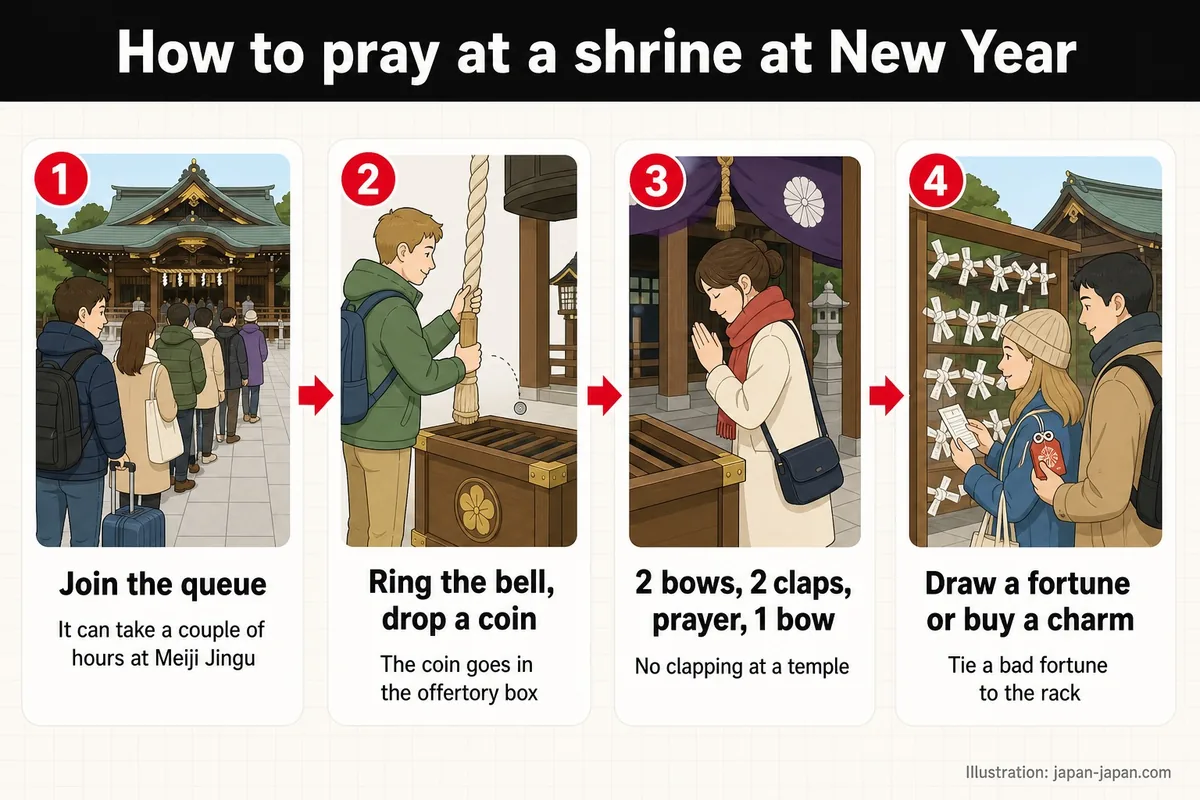
Fortunes and charms. After you pray, draw an omikuji, a paper fortune. JNTO lists English omikuji at Sensoji in Tokyo, Nishiki Tenmangu in Kyoto and Kushida-jinja in Fukuoka. Keep a good fortune with you. Tie a bad one to the rack set aside for it, so the bad luck stays at the shrine.
New Year is also the time to buy omamori, charms for wishes from good health to business. Some people bring last year’s charm back for the shrine to dispose of. You can also buy an ema, a wooden plaque painted with the year’s zodiac animal. Write your wish on it and hang it on the rack.
Imperial Palace New Year Greeting on 2 January
The Imperial Palace opens its grounds to the public every year on 2 January. GO TOKYO calls it a unique chance to see the Emperor, the Empress and other members of the Imperial Family. In Japanese the event is Shinnen Ippan Sanga.
These details come from the Imperial Household Agency’s notice for 2 January 2026.
- Way in: the Main Gate (Nijubashi) only, from 9:30 a.m. until 2:10 p.m.
- Appearances: five, on the balcony of the Chowa-Den Hall, at around 10:10 a.m., 11:00 a.m., 11:50 a.m., 1:30 p.m. and 2:20 p.m.
- Where you stand: the Totei, or East Court, below the balcony.
- Ways out: the Sakashita-mon, Kikyo-mon, Ote-mon or Inui-mon Gate.
The gate closes at 2:10 p.m., so only people already inside see the fifth appearance. The photo below shows Nijubashi, where the line goes in.
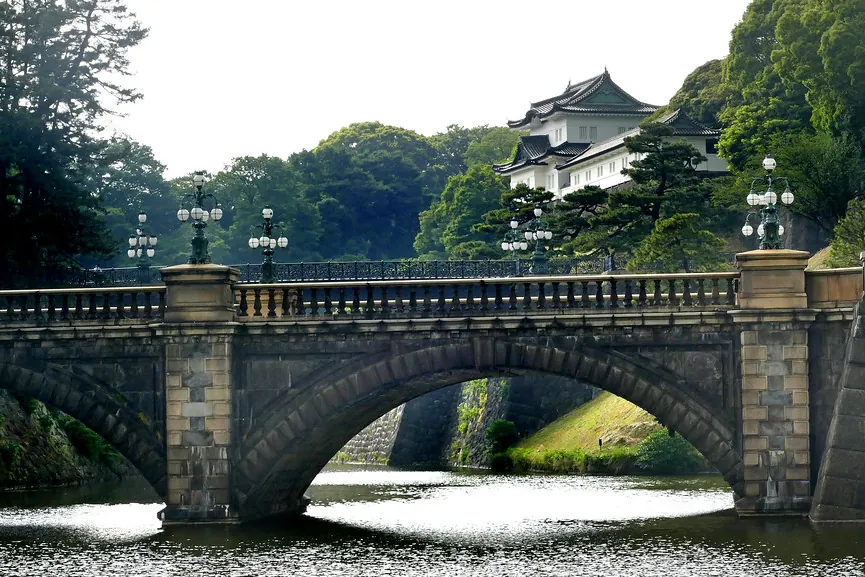
Check the same agency page for the 2027 times before you go.
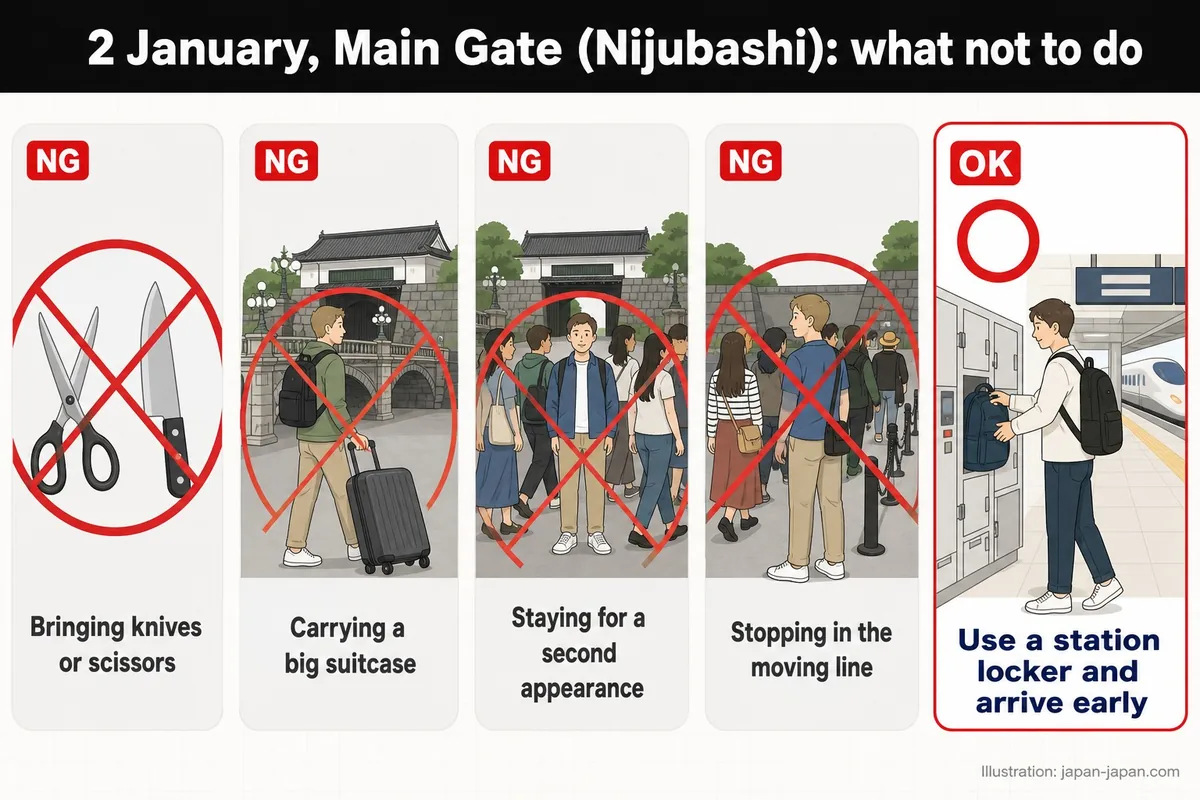
Bags and security. Every visitor goes through a baggage inspection at the gate, so arrive well before it closes. Leave suitcases and big bags in a station locker and carry as little as you can. Do not bring sharp objects such as knives or scissors. The agency also turns away animals other than guide dogs, flagpoles, drones and large luggage.
Inside. You walk in a line that forms before the gate. Stay in it, keep moving and follow the staff. So that as many people as possible get in, watch one appearance and then leave. Leave selfie sticks, tripods and stepladders at home, and do not smoke or drink alcohol. The illustration below shows four things to avoid.
On the day. The courtyard is gravel and the grounds have slopes, so wear shoes you can walk in, not high heels. The East Gardens close for the day, but on the way out you can walk through them and leave by the Ote-mon Gate. Heavy snow or other bad weather can cancel the event. There is no parking, so come by public transport.
There are no rental wheelchairs, so bring your own. The Totei has spaces set aside for wheelchair users.
New Year sales, fukubukuro and the tax-free refund
Hatsuuri means the first sale of the year. JNTO says most department stores open again on 1 or 2 January, and each store sets its own sale date. In Tokyo, GO TOKYO puts the start at around 2 January, with the lowest prices of the year.
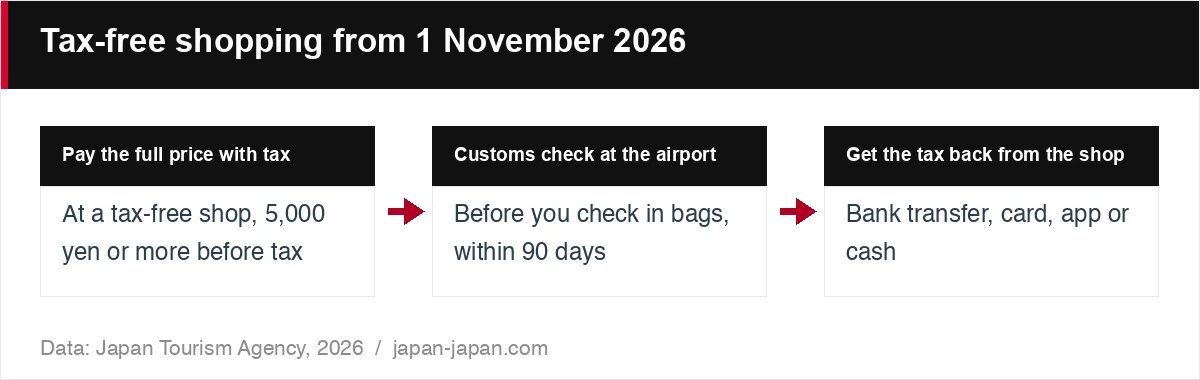
Tax-free shopping has new rules. From 1 November 2026, Japan uses a refund method. You pay the full price with consumption tax. The shop refunds the tax after customs confirms at the airport that the goods are leaving Japan. The Japan Tourism Agency’s page for travellers sets out the rules.
- Minimum: 5,000 yen or more before tax, in the same shop on the same day. This does not change. For goods taxed at 10%, that is 5,500 yen at the till.
- Upper limit: none in yen, but you can only buy what you can carry out of Japan yourself.
- Deadline: pass the customs check when you leave, within 90 days of the purchase.
- Where: a tax-free kiosk in the departure lobby, before you check in your bags. You show your passport there.
- Refund: the shop or its refund operator pays it, by bank transfer, card, app or cash at the airport, depending on the shop.
At the kiosk, the screen tells you whether customs wants to inspect your goods. Green means you are done, and red means you take them to the inspection area. At Narita, Haneda, Kansai, Chubu, Fukuoka, New Chitose and Naha, you can also use Visit Japan Web online in the departure lobby, before security.
Three mistakes can cost you the refund. You cannot do the check after you check in your bags, and the airline will not hand a bag back for it. Customs checks each receipt as one unit, so one missing item cancels the refund for everything on that receipt. The sealed bags for food and cosmetics are gone, but if you eat or use any of them in Japan, you lose the refund. The diagram below shows the three steps.
Our guides explain what changed on 1 November 2026, what you can buy and how the refund is paid.
Fukubukuro. The best-known sale item is the fukubukuro, a lucky bag of mystery items. JNTO says a bag sells for only about one-third of the total value of what is inside. You cannot see the contents, which is the gamble. The photo below shows lucky bags on sale.
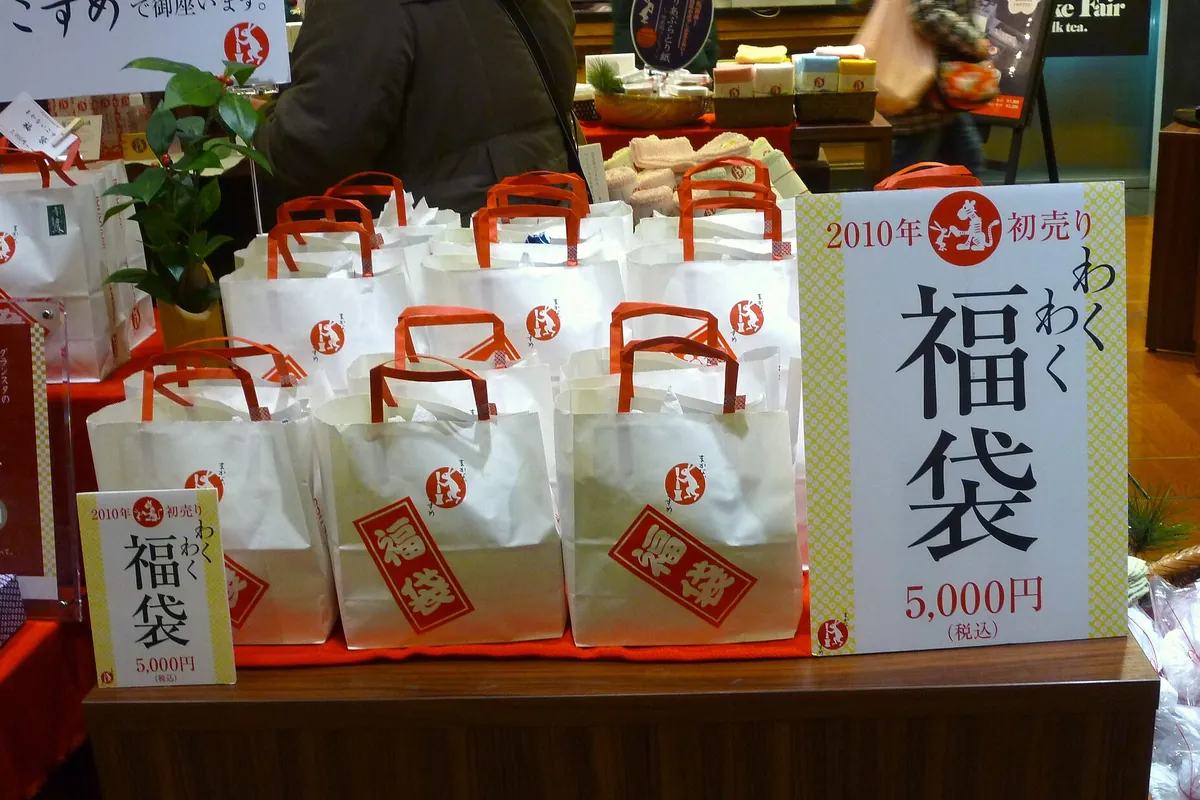
At popular stores the bags can sell out in minutes, so regular buyers check each store’s start time and queue early. JNTO singles out Mitsukoshi and Isetan, whose bags hold anything from clothes, cosmetics and jewellery to food and even furniture.
Trains, hotels and weather at New Year 2026-27
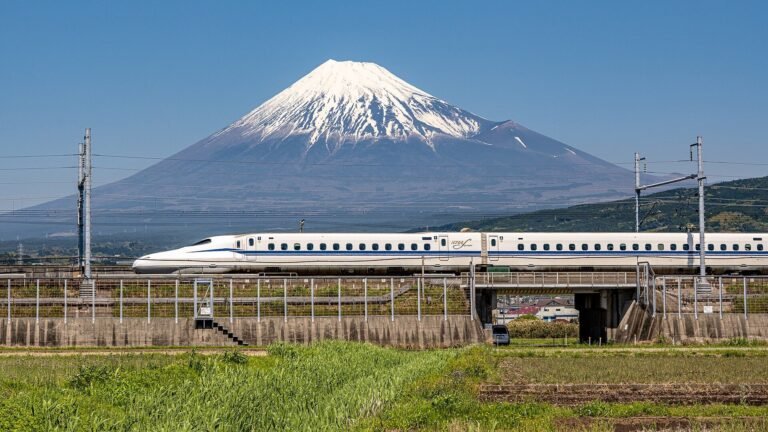
Travel inside Japan peaks over New Year, and JNTO warns that some services may be reservation-only. JR Central makes every Nozomi reserved-seat only from 25 December 2026 to 5 January 2027, so book a seat before you go to the station. Our ekiben guide shows where to buy a bento before you board.
The busiest day last winter came at the end of the break. On Sunday 4 January 2026, 350,000 passengers headed to Tokyo, according to our holiday data. In 2027, Monday 11 January is Coming of Age Day, which gives January a second 3-day weekend. Our January holidays page and 2027 calendar list every date.
JNTO’s older guides describe trains running all night on 31 December in big cities. For 2026-27, ask at your hotel, check the rail company’s website or use Google Maps. Most trains otherwise run from around 5:00 a.m. to midnight.
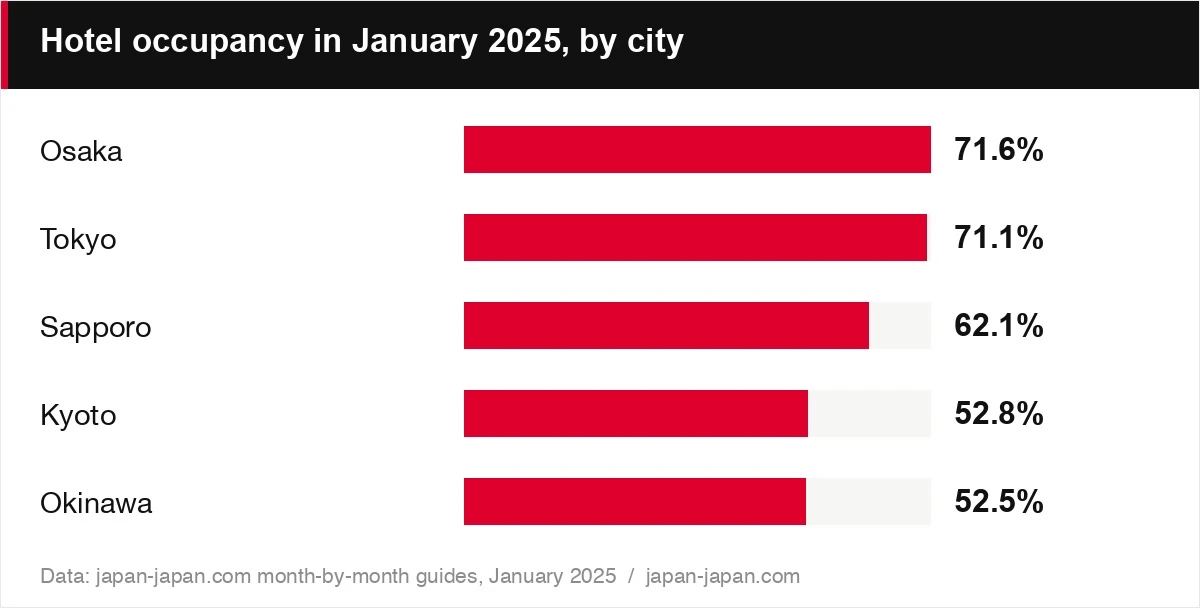
Japan welcomed 3,781,629 visitors in January 2025, the third-highest month of the year. That month, hotels were 71.6% full in Osaka and 71.1% in Tokyo, against 52.8% in Kyoto and 52.5% in Okinawa. The chart below compares five cities.
| Item | Value |
|---|---|
| Osaka | 71.6 % |
| Tokyo | 71.1 % |
| Sapporo | 62.1 % |
| Kyoto | 52.8 % |
| Okinawa | 52.5 % |
Sapporo sat in the middle at 62.1%. Book early if you want Osaka or Tokyo, and see our Japan hotel guide for room types and city taxes.
Weather. January is cold almost everywhere except Okinawa. These are Japan Meteorological Agency averages for 1991–2020, from our month-by-month guides.
| City | Average high | Average low | Wet days |
|---|---|---|---|
| Tokyo | 9.8°C | 1.2°C | 4.5 |
| Kyoto | 9.1°C | 1.5°C | 6.4 |
| Osaka | 9.7°C | 3.0°C | 5.6 |
| Sapporo | −0.4°C | −6.4°C | 18.3 |
| Okinawa (Naha) | 19.8°C | 14.9°C | 10.2 |
GO TOKYO says Tokyo is particularly cold from mid- to late January. Sapporo is the snowy choice: snow covers the ground on 31.0 days on average, and the deepest snow averages 76 cm. From New Chitose Airport, the fastest train reaches Sapporo in 33 minutes for 1,230 yen. Naha stays mild, with an average high of 19.8°C. Each city’s January page covers what to wear and what is on.
FAQ
What do people do for New Year in Japan?
On 31 December, people eat toshikoshi soba, and temples ring their bells 108 times near midnight. From 1 January, families eat osechi over the first three days and visit a shrine or temple for hatsumode. Many also watch the first sunrise and shop the New Year sales.
Are shops open on New Year’s Day in Japan?
Many are not. In Tokyo, many stores close on 1 January, and department stores reopen on 1 or 2 January for their sales. Many convenience stores, such as 7-Eleven, FamilyMart and Lawson, stay open 24 hours, even on national holidays. Banks stay shut from 31 December to 3 January.
Can visitors see the Emperor at New Year in Japan?
Yes. On 2 January, the Imperial Palace holds its New Year Greeting, open to the public. In 2026, the Main Gate (Nijubashi) let visitors in from 9:30 a.m. to 2:10 p.m. The Emperor and Empress appeared five times on the balcony of the Chowa-Den Hall. Check the Imperial Household Agency’s page for the 2027 times.
What is a fukubukuro, and when can you buy one?
A fukubukuro is a lucky bag of mystery items, sold for about one-third of the total value of its contents, according to JNTO. Department stores sell them at their New Year sales, which start around 2 January in Tokyo. Popular bags can sell out in minutes, so queue before the store opens.
Photo: Meiji Jingu 2006 (89218803).jpg by 顔なし (CC BY-SA 2.0, cropped), via Wikimedia Commons.

.jpg)

.jpg)