Hokkaido Jingu Shrine: Free Entry and Hatsumode 2027 Hours
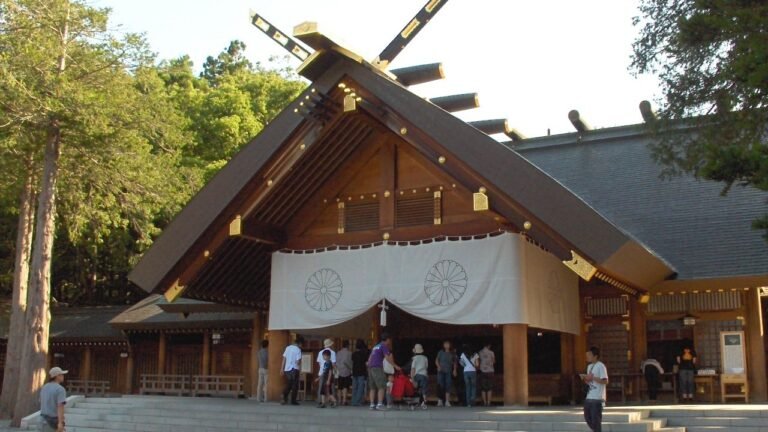
Hokkaido Jingu enshrines four deities, one of them Emperor Meiji. It stands at 474 Miyagaoka in Chuo-ku, on the west side of the city centre. Maruyama Park and Maruyama Zoo are right next to it, so one trip covers all three.
For hatsumode, the first shrine visit of the year, go by subway and plan around the special New Year hours. In winter, wear boots with grip and leave before the gates close at 16:00.
Hatsumode at Hokkaido Jingu: New Year hours and crowds
Hatsumode means the first shrine visit of the new year. At Hokkaido Jingu it changes the shrine’s daily schedule for a full week.
The Hokkaido Official Tourism Site Hokkaido-jingu Shrine page lists the regular hours and adds that opening hours differ from 31 December to 7 January. It also says closing times may vary. Before you go that week, open the shrine’s own website from that page and check the times for your day. From 8 January the winter hours of 7:00 to 16:00 apply again.
For New Year 2026-27, New Year’s Day is Friday 1 January 2027. It is the only national holiday in the break. Banks close from 31 December to 3 January, and government offices close from Tuesday 29 December 2026 to Sunday 3 January 2027. Our New Year 2026-27 holiday calendar shows how a day off on Monday 28 December gives up to 9 days in a row from Saturday 26 December.
The next long weekend comes soon after. The Cabinet Office national holidays page lists Coming of Age Day on Monday 11 January 2027. Expect the most visitors on New Year’s Day and the days after it, while offices and banks are still closed.
Interest in the shrine peaks in January. Google searches for “hokkaido jingu” ran at 33,100 a month in October 2025. They rose to 60,500 in December and reached 110,000 in January 2026, 3.3 times the October level. February stayed high at 90,500. The chart below shows the full year.
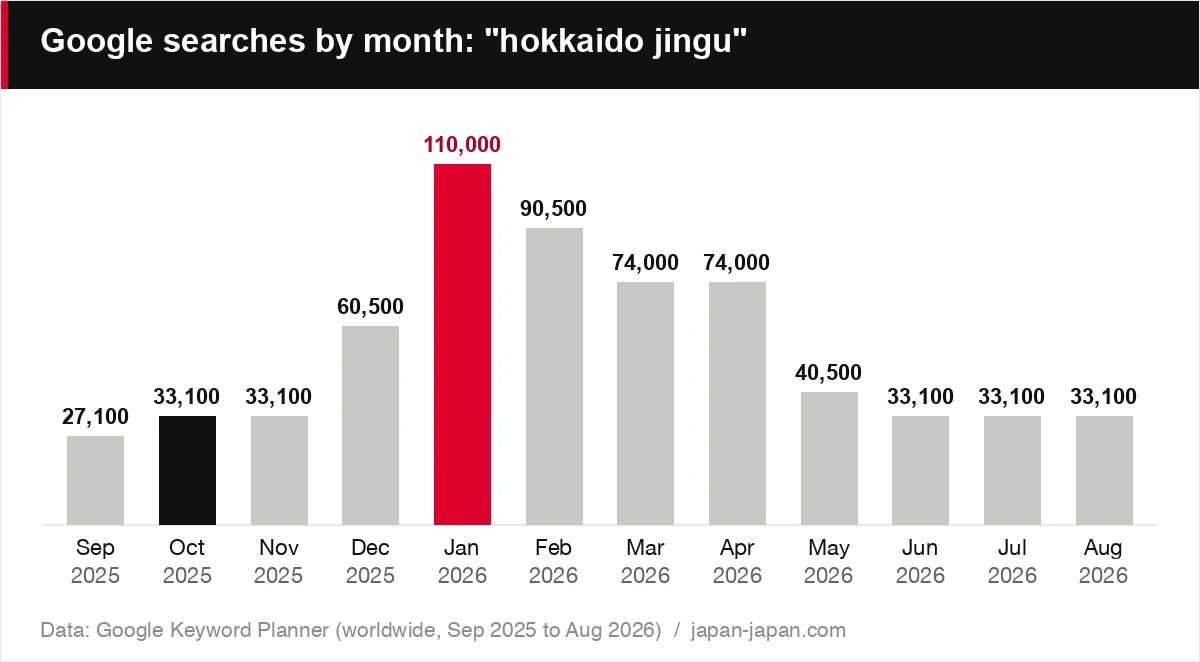
| Month | Searches |
|---|---|
| Sep 2025 | 27,100 |
| Oct 2025 | 33,100 |
| Nov 2025 | 33,100 |
| Dec 2025 | 60,500 |
| Jan 2026 | 110,000 |
| Feb 2026 | 90,500 |
| Mar 2026 | 74,000 |
| Apr 2026 | 74,000 |
| May 2026 | 40,500 |
| Jun 2026 | 33,100 |
| Jul 2026 | 33,100 |
| Aug 2026 | 33,100 |
The car park has 230 spaces and is free. That is small for a January crowd, so take the subway and walk the last 15 minutes. If you want a quieter visit, come after 8 January, when the regular 7:00 opening returns.

Our guide to New Year in Japan explains what is open over the break and how hatsumode works at other shrines. Use it if your trip covers more than Sapporo.
Getting there from Sapporo Station and New Chitose Airport
From Sapporo Station, the trip has three steps. Ride the subway for two minutes to Odori. Change to the Tozai Line and ride seven minutes to Maruyama-koen Station. Then walk for 15 minutes to the shrine.
Those times come from the JNTO Hokkaido-jingu Shrine spot page, which also suggests a taxi for the last stretch. By car, the shrine is about 15 minutes from JR Sapporo Station. Show the driver the name in Japanese: 北海道神宮 (Hokkaido Jingū, Hokkaido Shrine).
The address is 474 Miyagaoka, Chuo-ku, Sapporo. Entry is free, and the gates are open every day of the year. The box below sums up the hours and the walk.
| Place | Hokkaido Jingu Shrine |
|---|---|
| Price | Free admission and worship |
| Hours | 8 Jan-Feb and Nov-Dec 7:00-16:00; Mar 7:00-17:00; Apr-Oct 6:00-17:00; special hours 31 Dec-7 Jan |
| Access | About 15 minutes on foot from Maruyama-koen Station (Tozai Line); 230 free parking spaces |
| Official site | Hokkaido Official Tourism Site Hokkaido-jingu Shrine page |
From New Chitose Airport
Take the JR Rapid Airport to Sapporo Station. It takes 33 minutes and costs 1,230 yen. That is the quickest and cheapest way on our New Chitose Airport to Sapporo comparison. The New Chitose Airport access by JR page puts the ride at about 30 minutes with no transfer.
The JR station is on B1F of the terminal building. The ticket office there is open from 6:30 to 22:00. Airport buses to central Sapporo take 63 or 74 minutes and cost 1,500 yen. Our New Chitose Airport guide also lists coin lockers from 400 yen a day, which helps if you go to the shrine before hotel check-in.
Tickets for the subway and train
Kitaca is the IC card of JR Hokkaido. You tap it at the gate instead of buying a ticket. It costs 2,000 yen, made up of 1,500 yen of stored fare and a 500 yen deposit. You can buy one at the JR ticket counter at New Chitose Airport Station.
If you will ride the subway many times in one day, the Sapporo One-Day Ticket for Subway Use gives unlimited rides on the city subway. On weekends and holidays, the Sapporo Donichika Ticket does the same job. A shrine visit, the zoo and an evening in Odori or Susukino can add up to several rides.
Flying in from Tokyo, Haneda to New Chitose takes 1 h 30 min, with 56 flights a day on our Tokyo to Sapporo route page.
Visiting in winter: snow, ice and what to wear
Sapporo stays below freezing for most of the winter. The Japan Meteorological Agency Sapporo climate normals for 1991 to 2020 give a January average of −3.2°C. Daily highs reach only −0.4°C, and nights drop to −6.4°C.
February is close behind at −2.7°C on average. December averages −0.9°C, and March climbs to 1.1°C. Our month guides for Hokkaido in December, Hokkaido in January and Hokkaido in February compare Sapporo with the rest of the island.
Snow matters more than cold on the walk in. An average January in Sapporo brings 137 cm of snowfall, and JMA counts snow on 29.1 days of the month. Snow cover is deepest in February, at 95 cm on average. Expect packed snow and ice on the pavement from the station and on the shrine paths.
The photo below shows the shrine under snow, the way you will find it in January and February.
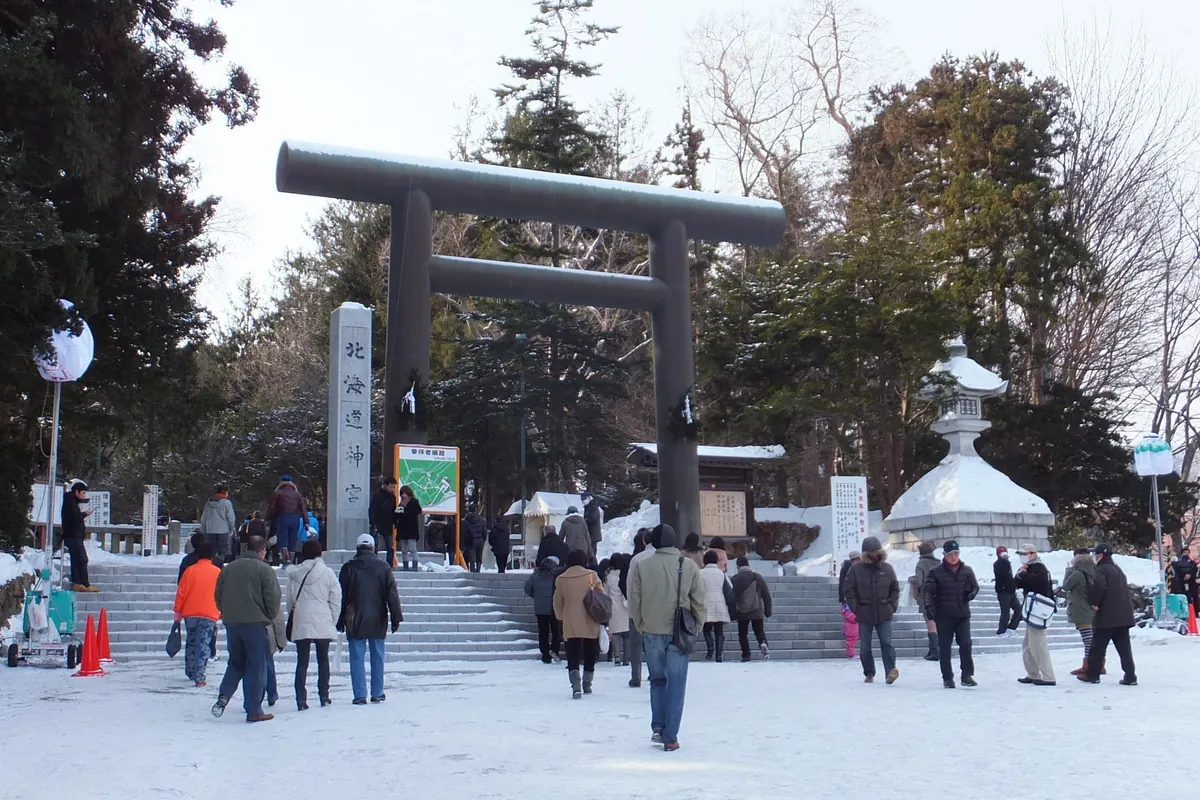
Wear boots with grip soles and take short steps on slopes and stairs. Put a warm layer under your coat and bring gloves and a hat, because you will stand still in line at New Year. Our Japan packing list for winter covers what to wear in Sapporo and what you can carry on the plane.
Watch the clock as well. From 8 January to February the gates close at 16:00, and the walk back to the station takes about 15 minutes. In January, leave the car at the hotel and use the subway.
Shrine etiquette: how to pray and what to buy
Hokkaido Jingu asks for a few simple manners. Most of them start at the torii, the large gate at the entrance.
Walk through the torii at the left or right side. JNTO explains that the centre is the causeway of the gods, so visitors keep to the edge. The same rule applies to photos: take pictures of the torii from the side, not from the middle of the path.
At the main hall, keep your prayer short and quiet. When you finish, step aside so the next person can reach the front. At New Year this matters, because the line behind you can be long.
JNTO lists two things not to miss. One is writing your wish on a wooden plaque, called an ema, and hanging it at the shrine. The other is buying a lucky charm, called an omamori, which you take home. Buy them before the gates close: 16:00 in winter and 17:00 from March to October.
Who is enshrined here
The shrine dates from the early years of modern Hokkaido. In 1871 the government abolished the feudal system and took control of the land. By imperial decree of Emperor Meiji, three gods were chosen to watch over the reclamation of Hokkaido.
Those gods are Okunitama, Onamuchi and Sukunahikona. They were enshrined at Sapporo-jinja, which later became Hokkaido-jingu Shrine. The fourth god enshrined here is Emperor Meiji himself. The shrine burned down in 1974 and was restored in 1978.
Hokkaido Jingu through the year: cherry blossoms and the June festival
Hokkaido Jingu opens earlier in the warm months. These are the regular hours on the Hokkaido Official Tourism Site.
- 8 January to February: 7:00 to 16:00.
- March: 7:00 to 17:00.
- April to October: 6:00 to 17:00.
- November and December: 7:00 to 16:00.
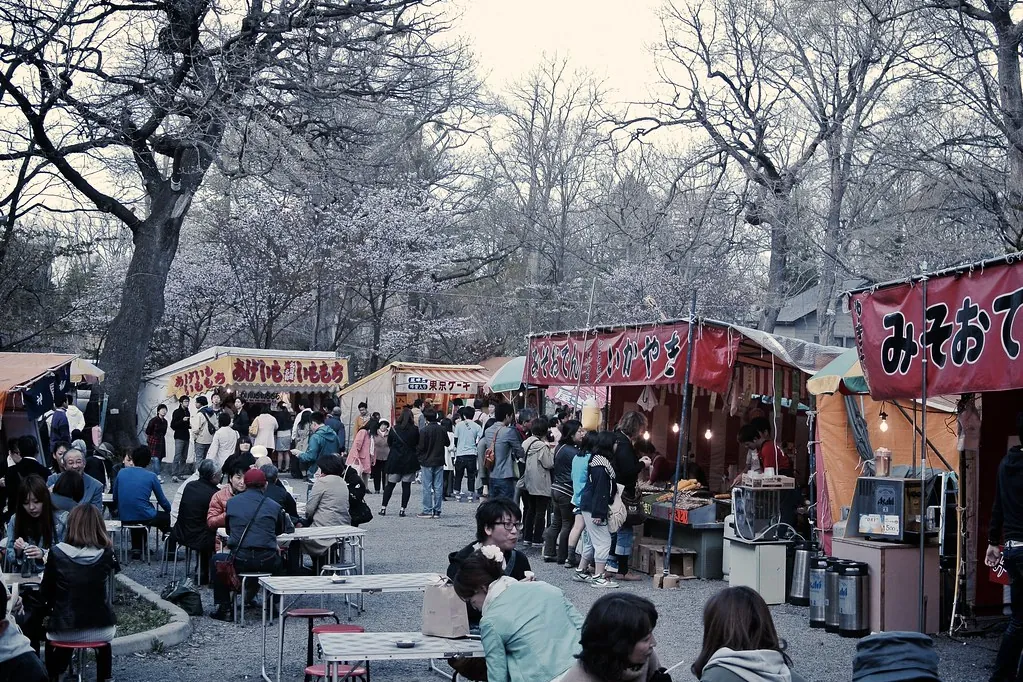
Spring is the cherry blossom season. JNTO calls Hokkaido Jingu one of the best places to view cherry blossoms in northern Japan. The grounds open at 6:00 from April, so you can see the trees before the crowds arrive. The photo below shows cherry trees in bloom in Maruyama Park, next to the shrine.
The biggest event of the shrine year comes in mid-June. The Hokkaido Jingu Annual Festival, also known as the Sapporo Festival, has a history of more than 100 years. More than 1,000 citizens dress in costumes inspired by Heian period picture scrolls.
They parade through the city with eight floats, centred on four portable shrines that carry the god of Hokkaido Jingu. The Hokkaido Government Ishikari Bureau Hokkaido Jingu Annual Festival page lists it as a mid-June event. Check the shrine for the parade route before you go.
In autumn, combine the shrine with Hokkaido University’s Ginkgo and Poplar Avenues, which the Hokkaido Official Tourism Site lists among nearby sights. In February, the shrine grounds lie under snow while the Snow Festival fills the city centre.
Maruyama Park and Maruyama Zoo next door
The shrine sits inside a green belt on the west side of Sapporo. JNTO lists Maruyama Park and Maruyama Zoo as the closest sights, followed by the Winter Sports Museum, the Okurayama Ski Jump Stadium and the Okurayama Observatory.
Maruyama Park lies between Maruyama-koen Station and the shrine, so the walk from the subway passes through it. In spring, the park and the shrine grounds become one large cherry blossom spot.
Sapporo Maruyama Zoo is run by the City of Sapporo at 3-1 Miyagaoka, Chuo-ku, a short walk from the shrine. The City of Sapporo Maruyama Zoo official site sells e-tickets in advance and offers a digital map of the zoo for your phone. It also posts notices about animal exhibits and bird flu measures, so check it on the morning of your visit.
A half day works well in this order. Visit the shrine first, when the gates open and the paths are quiet. Walk to the zoo for the late morning, then return through the park to Maruyama-koen Station.
The Hokkaido Official Tourism Site also lists the Hongo Shin Memorial Museum of Sculpture, the Hokkaido Museum of Modern Art and the Sapporo Mt. Moiwa Ropeway nearby. For lunch, the Sapporo Central Wholesale Market Outer Market is on the same list.
Fitting the shrine into a Sapporo winter trip
In February, pair the shrine with the Sapporo Snow Festival. The Sapporo Snow Festival official 2027 dates announcement sets the 77th festival for Thursday 4 February to Thursday 11 February 2027, 8 days in all. The last day is National Foundation Day, a national holiday.
The festival uses three sites. The Odori site runs from West 1-chome to West 11-chome, with five large snow sculptures at its centre. The Susukino site covers Ekimae-dori from Minami 4 to Minami 6, and the third site is at the Tsudome sports centre.
The photo below shows snow sculptures at the Odori site.

A related event, Sapporo Snow Sports Park 2027, follows from 12 to 14 February at the Premist Dome. The Sapporo International Art Festival 2027 also takes a block of the Odori site. The table below collects the key dates for the season.
| Date | What happens | Details |
|---|---|---|
| 29 Dec 2026 to 3 Jan 2027 | Government offices closed | Banks closed 31 Dec to 3 Jan |
| 31 Dec 2026 to 7 Jan 2027 | Special New Year hours at the shrine | Check the shrine website for times |
| Fri 1 Jan 2027 | New Year’s Day | National holiday, hatsumode |
| From 8 Jan 2027 | Winter hours return | 7:00 to 16:00 |
| Mon 11 Jan 2027 | Coming of Age Day | National holiday |
| 4 to 11 Feb 2027 | Sapporo Snow Festival (77th) | Odori, Susukino and Tsudome sites |
| 12 to 14 Feb 2027 | Sapporo Snow Sports Park 2027 | Premist Dome |
| Mid-June 2027 | Hokkaido Jingu Annual Festival | More than 1,000 people parade |
A two-day plan works well. On day one, reach the shrine at 7:00, walk through Maruyama Park, and take the Tozai Line back to Odori for the snow sculptures. On day two, ski at Sapporo Teine or take a slow morning before the 33-minute train to New Chitose Airport.
Snow depth also shapes the choice of month. The chart below compares average snowfall in Sapporo from December to March.
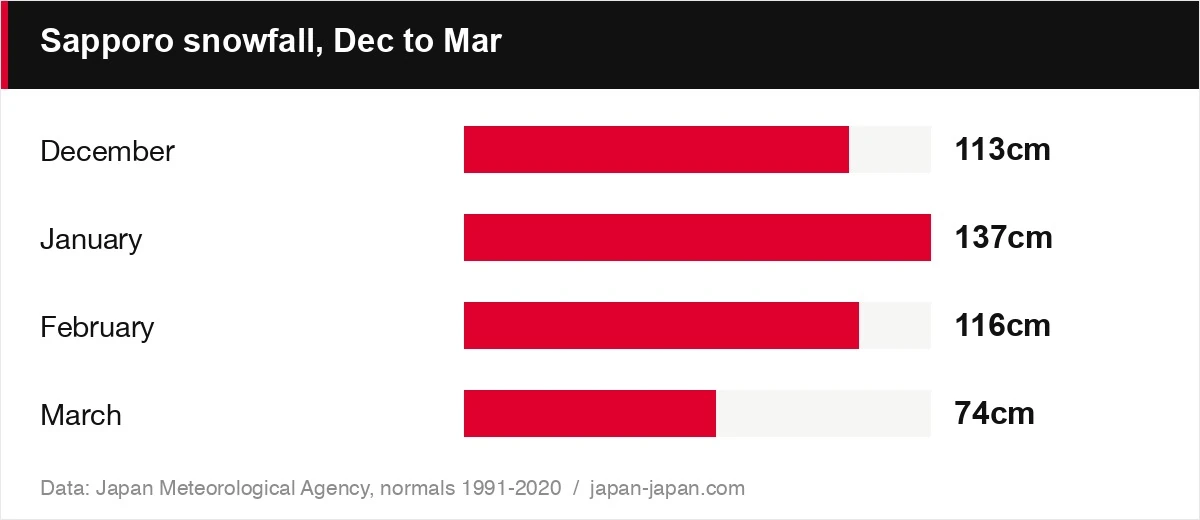
| Item | Value |
|---|---|
| December | 113 cm |
| January | 137 cm |
| February | 116 cm |
| March | 74 cm |
January has the most snowfall at 137 cm, and February follows at 116 cm. December brings 113 cm, and March drops to 74 cm. If you fly from Osaka, Itami to New Chitose takes 1 h 45 min, with 10 flights a day.
FAQ
Is Hokkaido Jingu free to visit?
Yes. Admission and worship are free, and the shrine is open all year round. The car park has 230 spaces and is also free. You pay only for items such as charms and wooden plaques.
What time does Hokkaido Jingu open on New Year’s Day?
The shrine runs special hours from 31 December to 7 January, so the usual 7:00 opening does not apply on 1 January. Check the times on the shrine’s own website, linked from the Hokkaido Official Tourism Site, before you go. From 8 January the gates open 7:00 to 16:00.
How long does it take to walk from Maruyama-koen Station to Hokkaido Jingu?
About 15 minutes on foot. From Sapporo Station, add a two-minute subway ride to Odori and a seven-minute ride on the Tozai Line. In snow, allow extra time and wear boots with grip.
Can you visit Hokkaido Jingu in the snow?
Yes. The shrine is open every day, and the snowy grounds are part of the appeal. January in Sapporo averages −3.2°C with 137 cm of snowfall, so dress in layers. Go before 16:00, when the gates close in winter.
About the author