Conveyor Belt Sushi in Japan 2026: Prices and How to Order
Conveyor belt sushi plates typically start at 100 yen, and at 120 yen at Sushiro. Order on the touch panel, never put a plate back, and pay at the end.
Conveyor belt sushi in Japan: the short answer
Conveyor belt sushi in Japan typically starts at 100 yen a plate. At Sushiro, plates start at 120 yen including tax. Take plates off the belt or order on a touch panel, never put a plate back, and pay at the end.
Kaitenzushi, sometimes called sushi-go-round, serves sushi on a conveyor belt that winds past every seat. JNTO’s sushi guide calls it a great introduction to sushi and a lot of fun for kids. Most kaitenzushi restaurants are cheap, though mid-range ones exist too. The photo below shows how it looks: plates move past the counter, and you lift off whatever you want.
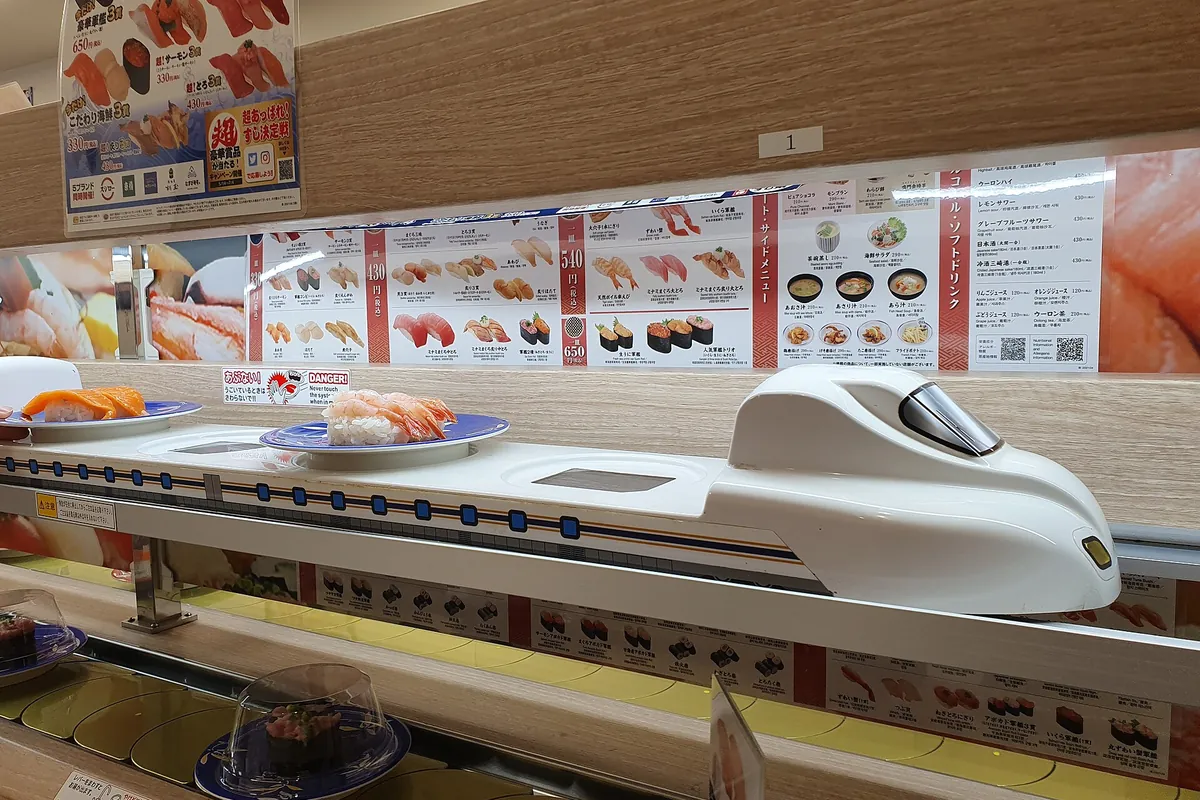
Each plate colour has its own price. Note the colour before you take a plate, because the bill adds up the plates you collect.
At Sushiro, the menu runs to more than 100 kinds of sushi and side dishes, from 120 yen a plate including tax. Items and prices vary in some stores. The touch panel works in English, Chinese (simplified) and Korean, so you can order without speaking Japanese.
Drinks are simple. JNTO says kaitenzushi restaurants typically stock only green tea, domestic draft beer and inexpensive sake. Sushiro’s English menu, for example, lists a glass of draft beer and a namachozo-shu sake. Five habits cover your first visit.
- Take or tap. Lift a plate off the belt, or order on the touch panel and wait for it to arrive.
- Read the plate colour. The colour tells you the price.
- Never put a plate back. Once you take a plate off the belt, it stays at your seat.
- Make your own tea. Green tea is usually self-service at your table or counter.
- Pay at the end. When you finish, the restaurant counts your plates. At Kura Sushi a small camera and AI do the counting.
Kaiten sushi: how to order, from check-in to the bill
Kura Sushi has a guide for first-time diners. The chain runs more than 500 restaurants across Japan, and its first-visit guide follows a meal from booking to payment. Here is each step.
- Book if you like. Reserve a time on your phone in the Kura Sushi app, or on the website with no app at all.
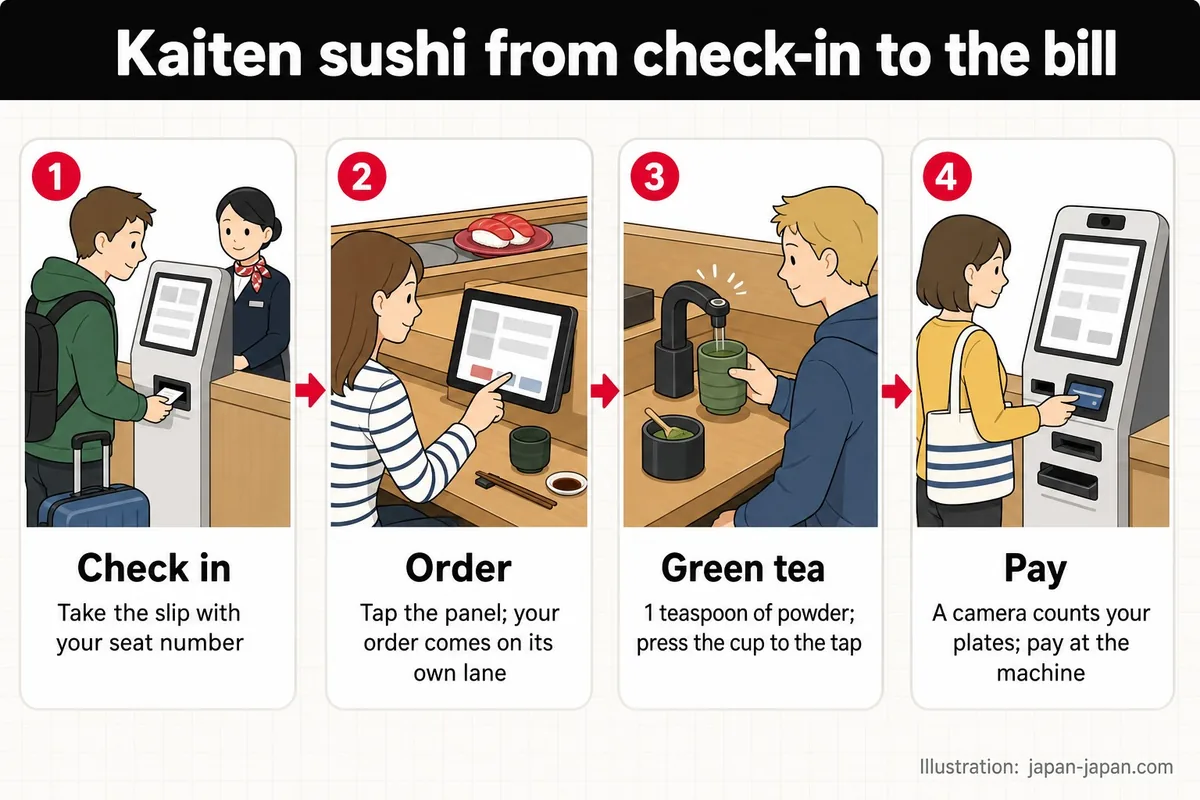
- Check in at the machine. Use the automatic reception machine by the entrance, and enter your reservation number if you booked. Take the slip printed with your seat number and walk to that seat.
- Find the basics at your table. Chopsticks, soy sauce, a sweet sauce and powdered green tea are all stored at the table.
- Make green tea. Put about 1 teaspoon of powdered tea in a cup. Press the cup firmly against the hot water tap, and hot water comes out.
- Take sushi from the belt. Plates travel under antibacterial covers. Press the button and the cover opens.
- Order on your phone or the touch panel. Scan the code shown on the screen to open the order page on your phone. Your order arrives quickly on a separate order lane.
- Feed empty plates into the slot. Each set of 5 plates starts a game called Bikkura Pon on the touch panel. A win drops a capsule prize.
- Check the plate count. A small camera and AI count your plates without staff. Press the button to go to checkout, confirm all the plates are in, then confirm and pay.
- Pay at the self-checkout. Hold your seat slip over the reader, check your points and choose how to pay. The guide lists credit cards, electronic money and smartphone pay apps.
The illustration below sums up the four moments that matter most: check-in, ordering, tea and paying.
Sushiro handles payment differently. It accepts all kinds of credit cards and QR code payments, but it takes no electronic money. A few stores accept only certain QR services. The Universal Citywalk Osaka store, for example, takes PayPay only. You can also book a table or order takeout in the Sushiro app.
At some seats you can skip the belt. A conveyor belt restaurant may have a counter with a chef in front of you, and JNTO says you can order directly from that chef.
Conveyor belt sushi, standing sushi bar or omakase?
Kaitenzushi is only one way to eat sushi in Japan. JNTO’s guide lays out the range, from a supermarket pack to omakase, where the chef chooses for you.
At the cheap end, any supermarket in Japan sells fresh makizushi (rolled sushi) for under 600 yen. A low-key neighbourhood sushi bar is a good next step. JNTO describes these as mom-and-pop shops that double as local hangouts, with prices still at the lower end.
If you are in a hurry, look inside the big stations. Many major train stations have small, standing-room-only sushi bars for a quick nibble, JNTO notes.
Omakase sits at the top. You give the chef full control of your meal, and JNTO calls it the most expensive way to eat sushi. Bookings are a must. Restaurants listed in famous European guidebooks often have few seats, only eight at the counter in JNTO’s example. Walking in on the same day without a reservation tends to be difficult, so check availability while you plan your trip.
Edomae sushi also centres on the counter. You sit facing the chef, and the chef slices the fish and forms each nigiri after you order, then serves it straight away. The table below compares the four main ways to eat sushi.
| Style | Where | How it works | Price and booking |
|---|---|---|---|
| Supermarket makizushi | Any supermarket | Pick up a pack of fresh rolls | Under 600 yen; walk in |
| Kaiten sushi | Restaurants with a conveyor belt | Lift plates off the belt or order on a touch panel | From 100 yen a plate (120 yen at Sushiro); book in the Sushiro or Kura Sushi app |
| Standing sushi bar | Many major train stations | A quick nibble at a small standing-room-only counter | Walk in when you are in a hurry |
| Omakase | Higher-end sushi restaurants | The chef chooses everything you eat | The most expensive style; book while you plan your trip |
How to eat sushi: etiquette at the belt and the counter
Sushi etiquette in Japan is simple. JNTO’s guide comes down to a few habits with chopsticks, soy sauce and plates.
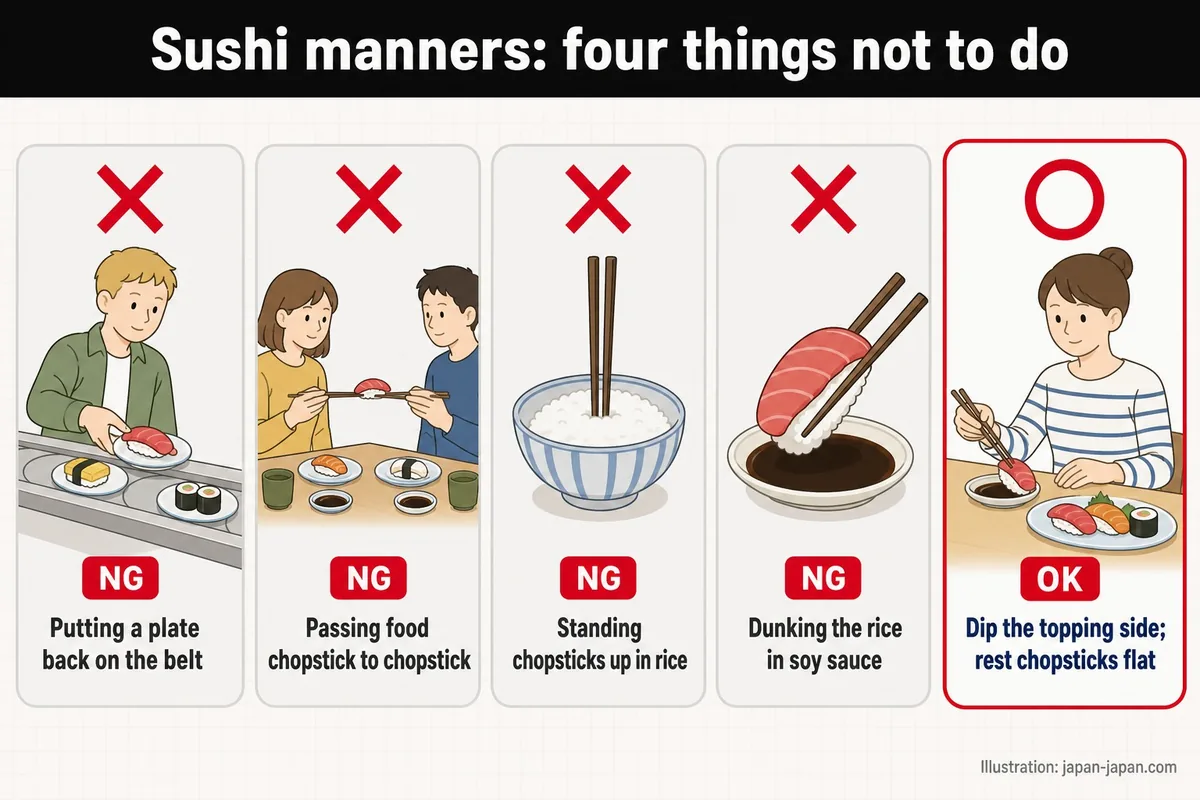
- Chopsticks. Never pass food from your chopsticks to someone else’s chopsticks. Never stand them upright in your bowl. Lay them flat across the bowl or on a chopstick rest.
- Soy sauce. Dip the topping (neta) first and keep the rice (shari) out of the dish. Rice dunked in soy sauce soaks up too much, overwhelms the sushi and can break the rice apart.
- Hands. Chopsticks are the usual tool, but hands are perfectly acceptable, especially at higher-end restaurants.
- Ginger. If pickled ginger comes with your sushi, eat it between orders to refresh your palate. Leave it off the sushi itself.
- Plates. At kaitenzushi, take any plate you like from the belt, but never put one back.
Kura Sushi adds a tip for its own tables. Tilt the soy sauce bottle slightly and press the top. The chain suggests 1 to 2 drops straight onto the sushi, plus a pinch of wasabi if you want it. The illustration below shows the four moves to avoid.
For drinks, the classic match is hot green tea or genmaicha, green tea blended with roasted brown rice. Sake pairs well too. JNTO suggests a chilled, less dry sake in the hot summer months and a heated, dry sake in winter. Your server can help you choose. For a night of sake after sushi, see our izakaya guide.
Vegetarians have a few options. JNTO lists traditional vegetarian sushi such as umeshiso maki, a roll filled with perilla leaf and salted plum paste. Sushiro’s English menu includes a cucumber roll, a natto (fermented soybean) gunkan roll and fried bean curd sushi. Whether a dish uses fish stock is a separate question, and our guide to vegetarian food in Japan explains what to ask.
Tsukiji sushi: eating at the Outer Market
The Outer Market’s official site calls Tsukiji the place for sushi. The wholesale inner market has moved to a new location, but the Outer Market remains a gathering place for food professionals. You can shop, eat and learn how to cut fish there.
Go in the morning. The site says the morning is the best time to visit, but professional buyers get priority until 9:00 a.m. On the Outer Market’s calendar page, 6:00 to 9:00 is set aside for professional buyers and 9:00 to 14:00 for the general public. After 14:00, opening hours are flexible.
The calendar follows that of the Tokyo Central Wholesale Market, the body that also runs Toyosu Market. Each shop also keeps its own business schedule, so check the shop you want before you go.
The Outer Market’s guide to enjoying Tsukiji suggests a short itinerary. Start at 9:00 at Plat Tsukiji, the information centre. Pick up a map there and ask where to shop and eat. At 9:15, visit Namiyoke Inari Shrine to see its big lion head. The diagram below lays out the whole morning.
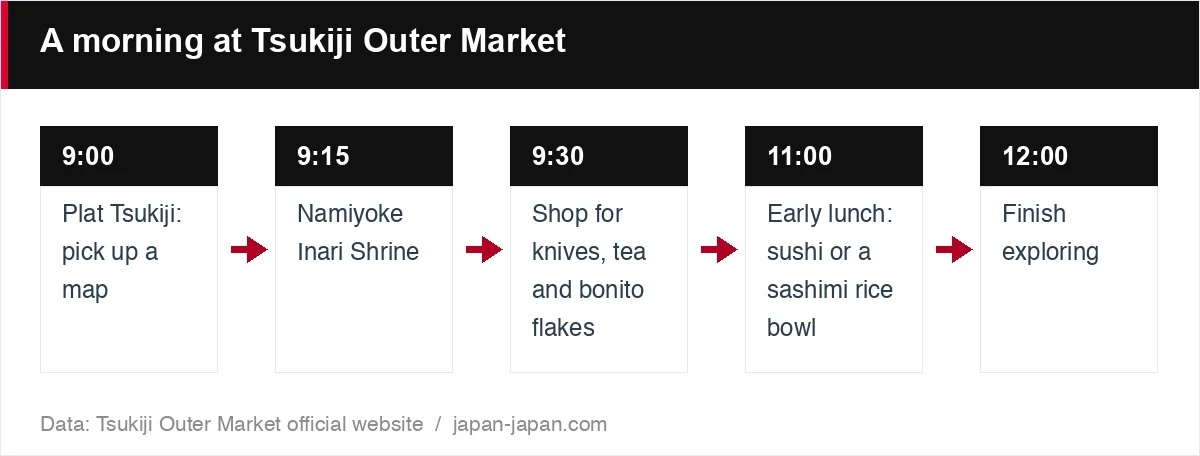
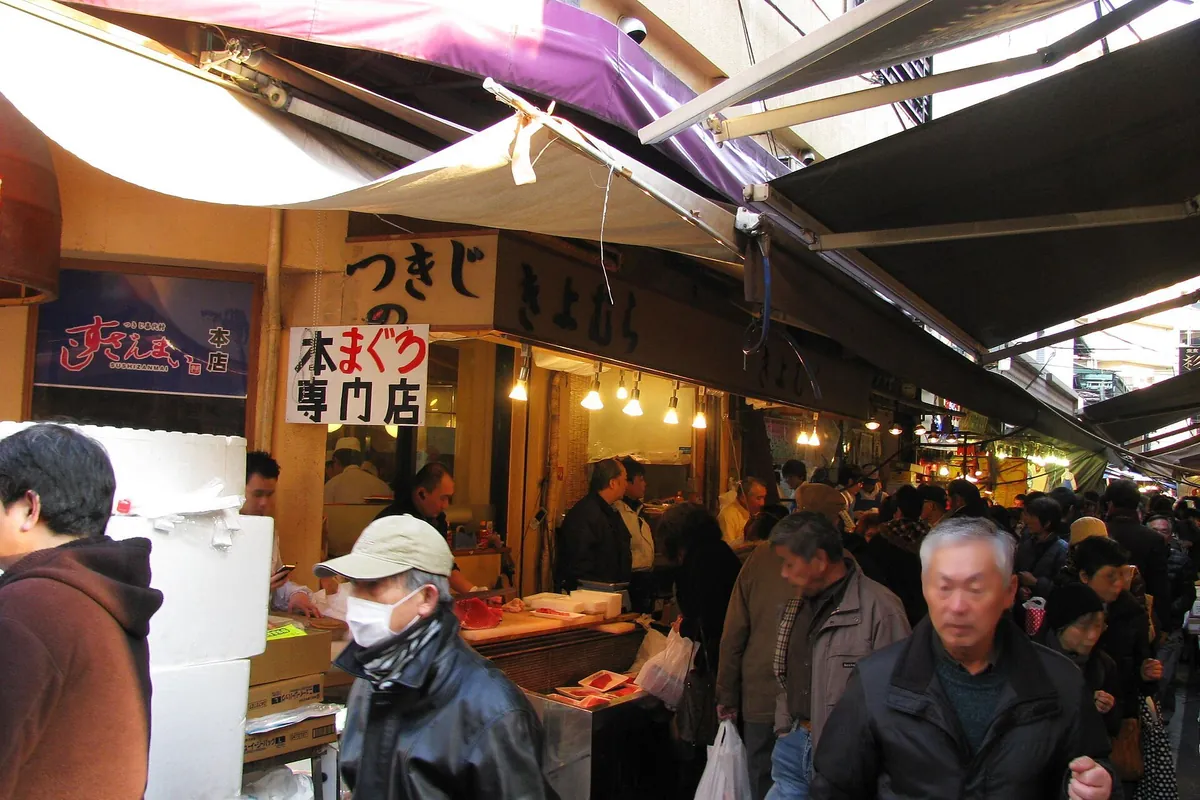
From 9:30, stroll and shop. Popular buys include knives, cooking utensils, dried bonito flakes, tea, tsukudani (Japanese preserved food) and tamagoyaki (pan-fried rolled egg). Even the narrowest streets are lined with shops, so keep the map handy.
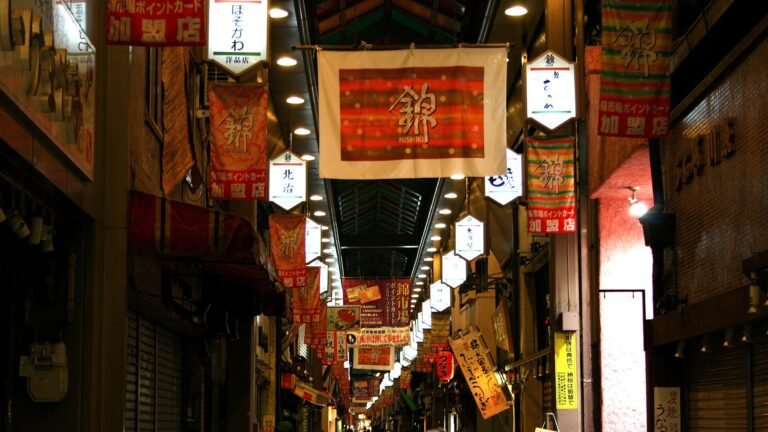
Eat lunch slightly early, at 11:00. Typical choices are sushi, a sashimi rice bowl or a set meal, and many eateries have menus in English and Chinese. By 12:00 the short itinerary is done. The photo below shows the kind of shop-lined street you will walk.
The official site lists eight manners for visitors.
- Let professional buyers go first until 9:00 a.m., and keep out of their way.
- Eat inside the eatery or in a space set aside for eating, and avoid walking while you eat.
- Store large bags in a coin locker. Plat Tsukiji keeps strollers for 500 yen each.
- Move in small numbers, and hold your child’s hand.
- Ask the shopkeeper before you photograph a shop. Some shops ban photography.
- Keep your hands off the food, especially raw food. Ask the shopkeeper if you need to check something.
- Skip the bargaining. Goods sell at wholesale prices.
- Smoke only in designated areas.
Two stations serve the market: Tsukiji Station and Tsukiji-shijo Station on the Toei Oedo Line. The official site has videos of the walk from each. If you stay in Ginza, you can ride from Haneda Airport without changing trains. Keikyu through trains run onto the Toei Asakusa Line and reach Higashi-Ginza Station in about 29 minutes for 550 yen. Our page on Haneda Airport to Ginza compares the other routes. From Narita, the Airport Limousine bus reaches hotels in Hibiya and Ginza in 90 to 115 minutes for 3,600 yen. Our page on Narita Airport to Ginza has the first and last buses and where to board.
Toyosu Market: tuna auction viewing and closed days
The Tokyo Metropolitan Government runs Toyosu Market as one of its central wholesale markets. Visitors can walk a set route, eat in its restaurants and, with luck in a lottery, watch the tuna auction.
Viewing the early-morning tuna auction takes an advance application. A lottery decides who gets a place, so the order you apply in makes no difference. The tuna auction viewing page carries the schedule for fiscal 2026, with links to the application page and an FAQ. The page was last updated on 2 September 2026.
Next, check the hours. According to the visitor information page, the visitor walkway opens from 5 a.m. to 5 p.m., and that includes the restaurant and shopping area. The Toyosu Market PR corner opens from 8:30 a.m. to 2:30 p.m., closing at 11:30 a.m. on Saturdays. The rooftop garden opens from 5 a.m. to 11 p.m., even on market holidays.
On market holidays, the PR corner and the visitor walkway close. On Sundays, public holidays and other market holidays, you cannot enter Toyosu Market at all, restaurants and shops included.
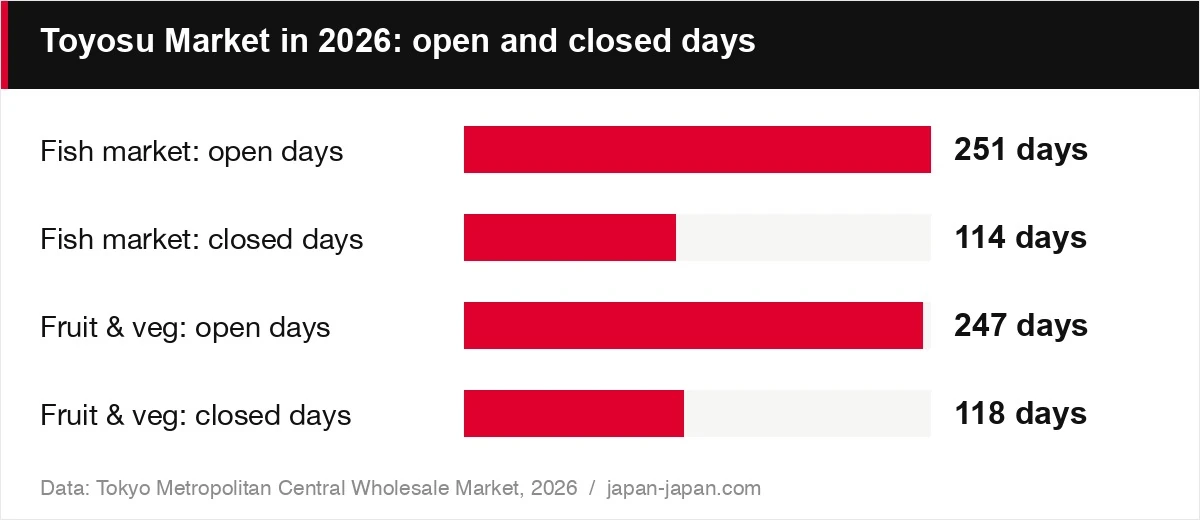
The 2026 market calendar gives the fish markets (Toyosu, Ota and Adachi) 251 open days and 114 closed days. The chart below sets those days against the fruit and vegetable calendar, which also covers Toyosu.
| Item | Value | Note |
|---|---|---|
| Fish market: open days | 251 days | Toyosu, Ota and Adachi |
| Fish market: closed days | 114 days | Toyosu, Ota and Adachi |
| Fruit & veg: open days | 247 days | Toyosu and other Tokyo markets |
| Fruit & veg: closed days | 118 days | Toyosu and other Tokyo markets |
The calendar page is in Japanese. Its downloadable version marks closed days 休市日 (kyūshibi, market holiday), and any day without that label is an open day. If your trip includes a public holiday, such as Sports Day on Monday 12 October 2026, look up that date first. Our list of public holidays in 2026 has every date.
Inside, you may not eat or drink in the walkways, benches included. Some restaurants and shops close before the visiting hours end. The intermediate wholesale area sells to businesses that buy in bulk, such as supermarkets, fish shops and restaurants. Members of the public cannot buy there.
Enter from the pedestrian deck at one of 3 entrances, one for each block. There is no car park or bicycle parking for visitors, so come on a route bus or the Yurikamome line. The illustration below gathers the checks to make before you set out.

Taking fish, nori and knives home
Tsukiji’s shops sell knives, dried bonito flakes, nori, green tea and himono (dried fish). The airport rules differ for knives, dried food and fresh fish.
A kitchen knife cannot go in your carry-on. Under Japan’s rules for knives on a plane, knives go in checked baggage. The only exception is something like a butter knife with a blunt tip that the screener judges cannot be used as a weapon. Pack a new knife in your checked bag before you reach the airport.
Dried food is easier. Solid food can go in the cabin. On international flights, liquid, gel and paste foods fall under the 100ml liquid limit. That covers items such as miso, sauces, jam, honey and tofu packed in water. Bonito flakes, nori and tea leaves are solid, so they can go in your carry-on. Our page on food on a plane has the full list.
Fresh fish needs to stay cold. If you pack it with dry ice, Japan’s rules for dry ice allow up to 2.5kg per person, in the cabin or in checked baggage. Use it only to cool something that is not dangerous itself, such as perishable food. The package must let the carbon dioxide gas escape. Narita Airport notes that airlines may set a different limit or require a label, so ask your airline.
Flying into Japan is a separate check. Dried fish and other fish products without livestock meat or eggs fall outside Animal Quarantine Service inspection. An officer may still check on arrival that they contain no meat; see fish and seafood. Your own country sets the rules for what you can bring home. Our guide to Japanese snacks to bring home covers the United States, the United Kingdom and Australia.
FAQ
How much does conveyor belt sushi cost in Japan?
Plates typically start at 100 yen, according to JNTO, and the colour of each plate shows its price. At Sushiro, plates start at 120 yen including tax, and prices vary in some stores. For comparison, a fresh supermarket makizushi pack costs under 600 yen.
Can I order in English at kaiten sushi?
Yes, at Sushiro, where the touch panel works in English, Chinese (simplified) and Korean. Kura Sushi lets you order on your own phone by scanning the code on the screen, and its first-visit guide comes in English. At a counter seat with a chef, you can also order directly from the chef.
Can you eat sushi with your hands in Japan?
Yes. JNTO says chopsticks are the preferred utensil most of the time, but hands are perfectly acceptable, especially at higher-end restaurants. Whichever you use, dip the topping into the soy sauce and keep the rice out of it.
Can I watch the tuna auction at Toyosu Market?
Yes, if you win a place. Viewing the early-morning tuna auction needs an advance application, and a lottery decides who gets in. Check the market calendar as well, because the fish markets close on 114 days in 2026, including Sundays and public holidays.
Photo: Conveyor belt sushi by MissionControl in Kyoto.jpg by MissionControl from Kyoto (CC BY-SA 2.0), via Wikimedia Commons.