Narita and Haneda to Tokyo 2026: Cheapest and Fastest Ways
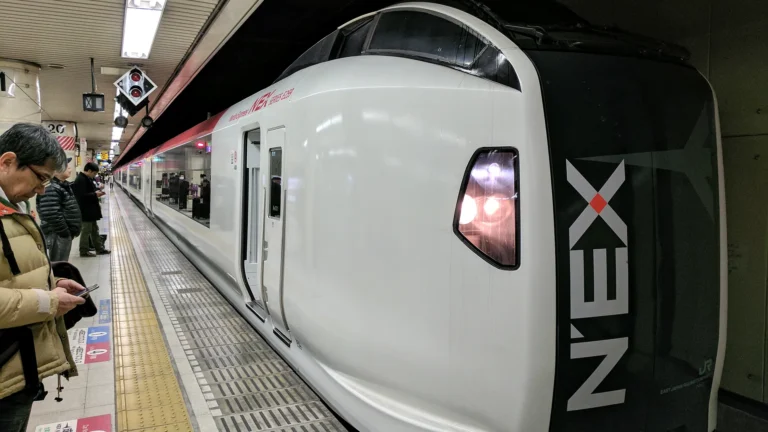
For Tokyo Station itself, Haneda is the quicker airport. Haneda Airport’s own estimate is about 30 minutes by train, and its bus page gives about 35 minutes by airport bus. From Narita, the Narita Express (N’EX) takes just under an hour, according to JNTO, and the airport bus takes 75 minutes, per our Narita Airport guide.
From Haneda
The monorail and the Keikyu line both run into central Tokyo in well under half an hour for a few hundred yen. There is no scenario where you need anything else, unless you land after the last train.
That short ride takes you to Shinagawa or Hamamatsucho. Haneda Airport puts Shinagawa about 15 minutes away on the Keikyu line and Hamamatsucho about 20 minutes away on the monorail. Tokyo Station, with one change, is about 30 minutes.
JNTO calls Haneda the closest airport to Tokyo, around 30 minutes by train from the centre. It has three terminals, and Terminal 3 is the international one. Free shuttle buses link all three, and every terminal has a direct link to both the train and the monorail.
The Tokyo Monorail runs from all three terminals to Hamamatsucho. Our Haneda Airport guide lists the quickest monorail at 13 minutes for 520 yen, while JNTO gives around 20 minutes as the usual ride.
At Hamamatsucho you change to the JR Yamanote Line for Tokyo, Shibuya and Shinjuku stations. The guide’s route table lists the monorail, the Keikyu line and the airport buses, each with its destination and the airport’s own time.
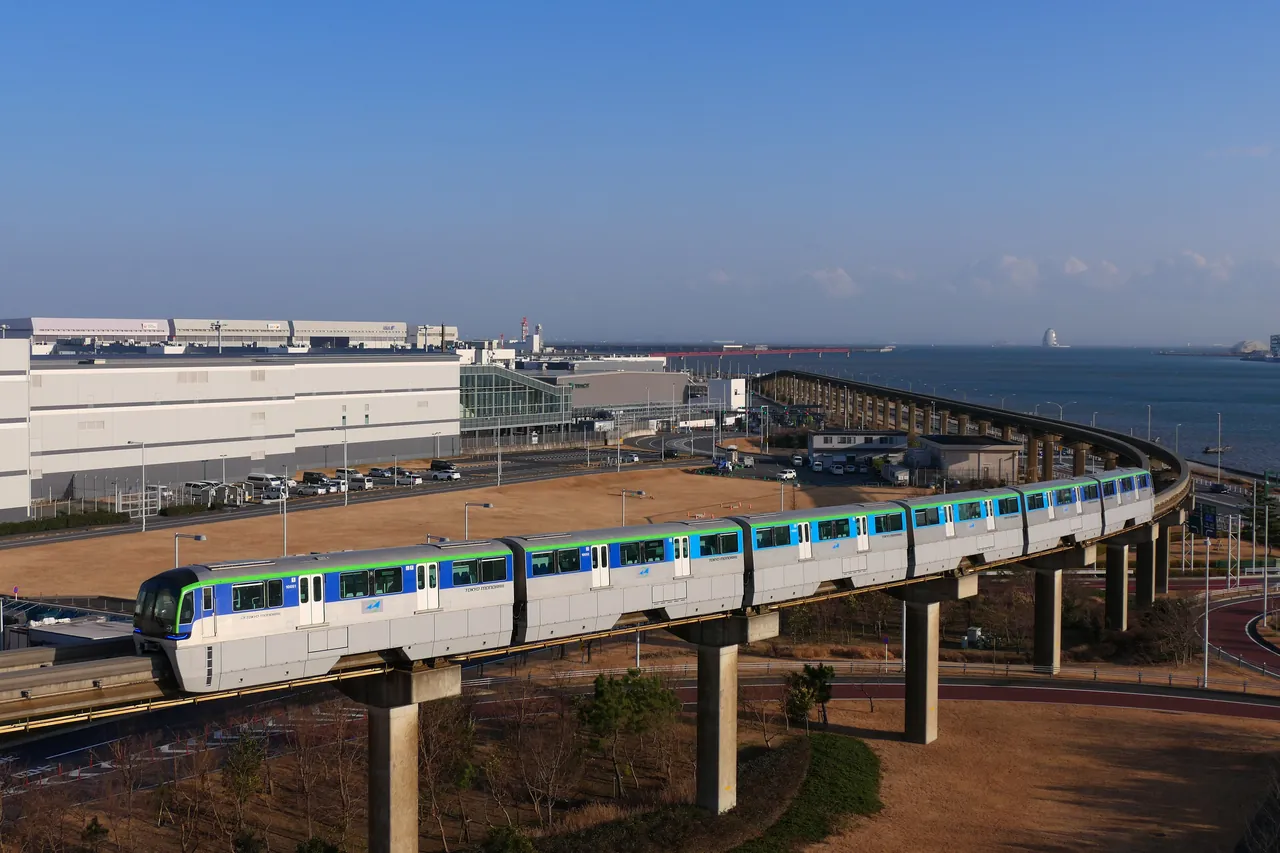
The Keikyu line runs from all three terminals straight to Shinagawa. Haneda Airport’s train page puts Shinagawa about 15 minutes away, while JNTO says around 20. Keikyu is also your line for Yokohama, about 30 minutes from the airport. Keikyu’s airport stations sell TOURIST PASMO, an IC card for international visitors, so you can buy one before your first ride.
In Terminal 3, read the signs before you pick a gate. The Keikyu gates for central Tokyo and Yokohama are in the 2nd floor Arrival Lobby. The Keikyu gates on B2F are for Terminals 1 and 2.
The monorail has gates in the 2nd floor Arrival Lobby and the 3rd floor departure lobby. In Terminals 1 and 2, both lines leave from a platform on B1F.
If you have a Japan Rail Pass to collect, the JR East Travel Service Center is next to the monorail ticket gate in the Terminal 3 arrivals area. The chart below gives Haneda’s own times to the main stations.
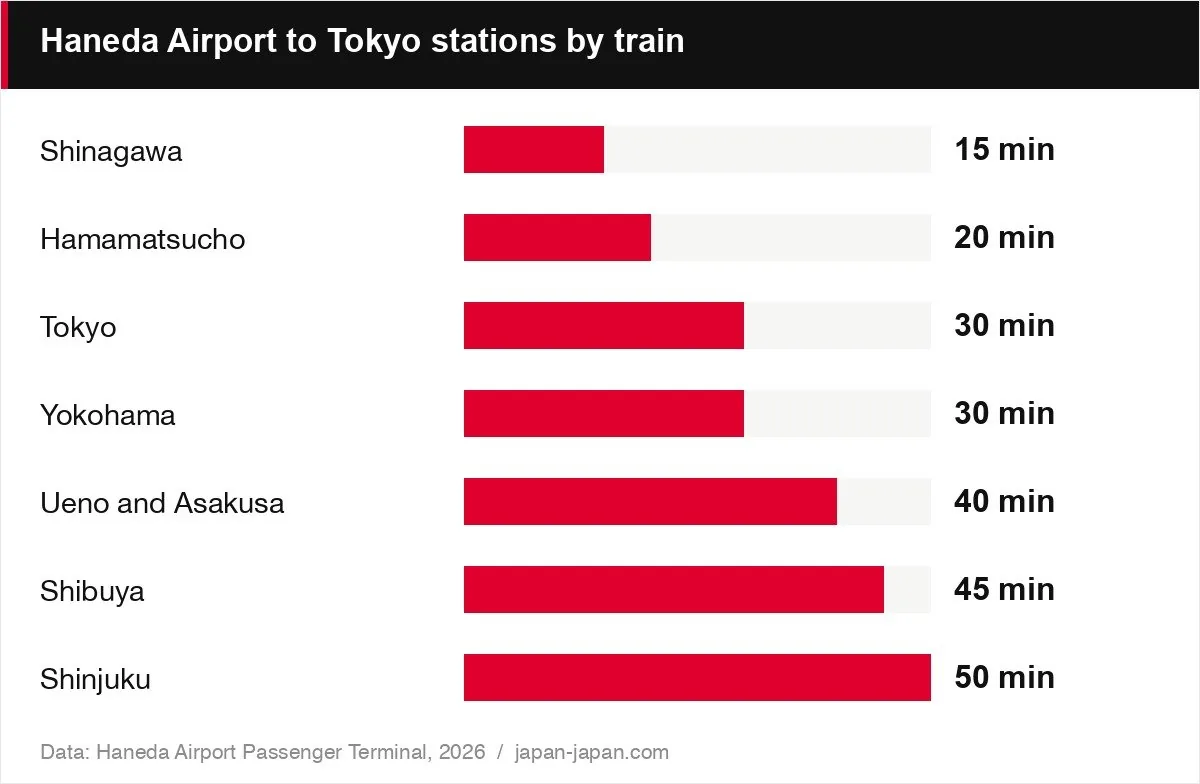
| Station | From Haneda |
|---|---|
| Shinagawa | 15 min |
| Hamamatsucho | 20 min |
| Tokyo | 30 min |
| Yokohama | 30 min |
| Ueno and Asakusa | 40 min |
| Shibuya | 45 min |
| Shinjuku | 50 min |
Haneda gives these times as estimates and points you to each rail company for timetables and fares.
Buses are the easier choice with a lot of luggage. Airport Limousine and Keikyu Limousine buses pick up at every terminal.
Haneda’s bus page gives about 35 minutes to Tokyo Station, about 35 minutes to the west exit of Shinjuku Station, about 40 minutes to Shibuya Station and about 55 minutes to the west exit of Ikebukuro Station. Buy the ticket before you board.
In Terminal 3 you can use a bus ticket machine or the bus ticket counter, and in Terminals 1 and 2 there are ticket machines. From Terminal 3, follow the bus signs from the 2nd floor access hall down to the 1st floor.
The same page marks several city routes as suspended, including the buses to Ginza and to Roppongi. Check the current list before you count on a bus to your hotel’s door. On these buses, Haneda asks you to keep power banks with you on board, not in the luggage hold, because lithium-ion batteries can catch fire from heat or impact.
From Narita
- Narita Express — direct to Tokyo, Shinjuku and Yokohama. Comfortable, reserved seats, the most expensive.
- Keisei Skyliner — fastest to Ueno, cheaper than the Narita Express.
- Airport bus — direct to major hotels, no stairs with luggage, slow if traffic is bad.
- Local trains — cheapest by a wide margin, and roughly twice as long.
Our Narita Airport guide puts the airport’s own figures on the first three. The Skyliner takes 36 minutes to Nippori and Keisei Ueno. The N’EX costs 6,280 yen return to Tokyo Station and 6,660 yen return to Shinagawa, Shibuya or Shinjuku.
The airport bus takes 75 minutes to Tokyo Station. Our Narita Airport to Tokyo Station page compares the train and bus times and fares side by side.
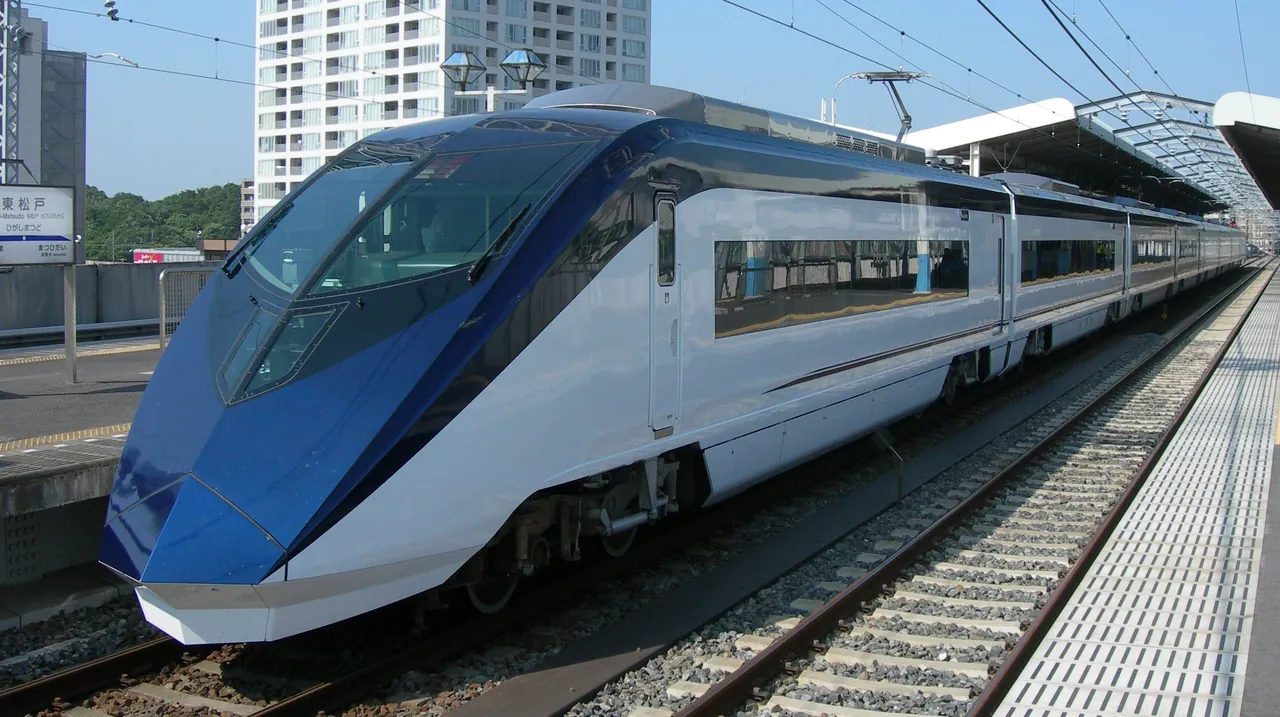
Narita sits in Chiba Prefecture, about 60 kilometres east of central Tokyo, according to JNTO. Most international flights use Terminal 1 and Terminal 2. Most low-cost carriers use Terminal 3, which has no rail station of its own.
Narita Airport’s rail page puts Terminal 1 a 5-minute walk from Narita Airport Station. Terminals 2 and 3 share Airport Terminal 2 Building Station, a 5-minute walk from Terminal 2 and a 10-minute walk from Terminal 3. A free yellow shuttle bus also runs between the three terminals.
The Skyliner stops at Nippori and Keisei Ueno, and some trains also call at Aoto and Shin-Kamagaya. JNTO gives around 40 minutes to Nippori and Ueno, a little more than the 36 minutes in our guide. At Nippori or Ueno you can change to the JR Yamanote Line, which circles central Tokyo.
The Skyliner is not a JR train, so a Japan Rail Pass does not cover it. Buy tickets at the Skyliner Ticket Counter or the Skyliner & Keisei Information Center near the ticket gates under Terminals 1 and 2, or at the machines by the station entrance.
The Narita Express runs about twice an hour in the daytime and reaches Tokyo Station in just under an hour, per JNTO. Narita Airport lists its major stops as Narita, Chiba, Tokyo, Shinagawa, Shibuya, Shinjuku, Yokohama and Ofuna.
Besides reserved seats, there are unassigned-seat tickets that fix only the date and the section you ride, not the train or the seat. With a Japan Rail Pass, your N’EX ticket is issued free of charge. Buy tickets, or collect a pass, at the JR East Travel Service Center near the ticket gates under Terminals 1 and 2.
Narita Airport’s rail page also lists the slower lines. The Access Express and the Keisei Main Line both run to Nippori and Keisei Ueno, and JR lines reach Tokyo, Shinagawa, Yokohama and many other stations.
Keisei and Airport Limousine buses pick up at each terminal, and you buy tickets at the bus ticket counter in the arrivals hall. JNTO notes that the bus network reaches major hotels, sightseeing areas and transport hubs across the city, and that there are direct buses to Tokyo Disney Resort.
Send your suitcase instead
Both airports have luggage delivery counters. On a crowded train at rush hour this is worth every yen.
At Haneda, Yamato Transport has counters on Terminal 1 1F, Terminal 2 1F and 2F, and Terminal 3 2F. At Narita, JAL ABC, Sagawa Express and Yamato Transport have counters on Terminal 1 1F and 4F, Terminal 2 1F and 3F, and Terminal 3 1F.
Plan for the suitcase to arrive the next day. Our airport guides say a bag sent from the airport reaches most of the country the next day.
Narita and Haneda also run a same-day service to hotels in central Tokyo, but only if you drop the bag off before late morning. If you land in the afternoon, pack for one night without it. The checklist below covers what to sort out before you reach the counter.
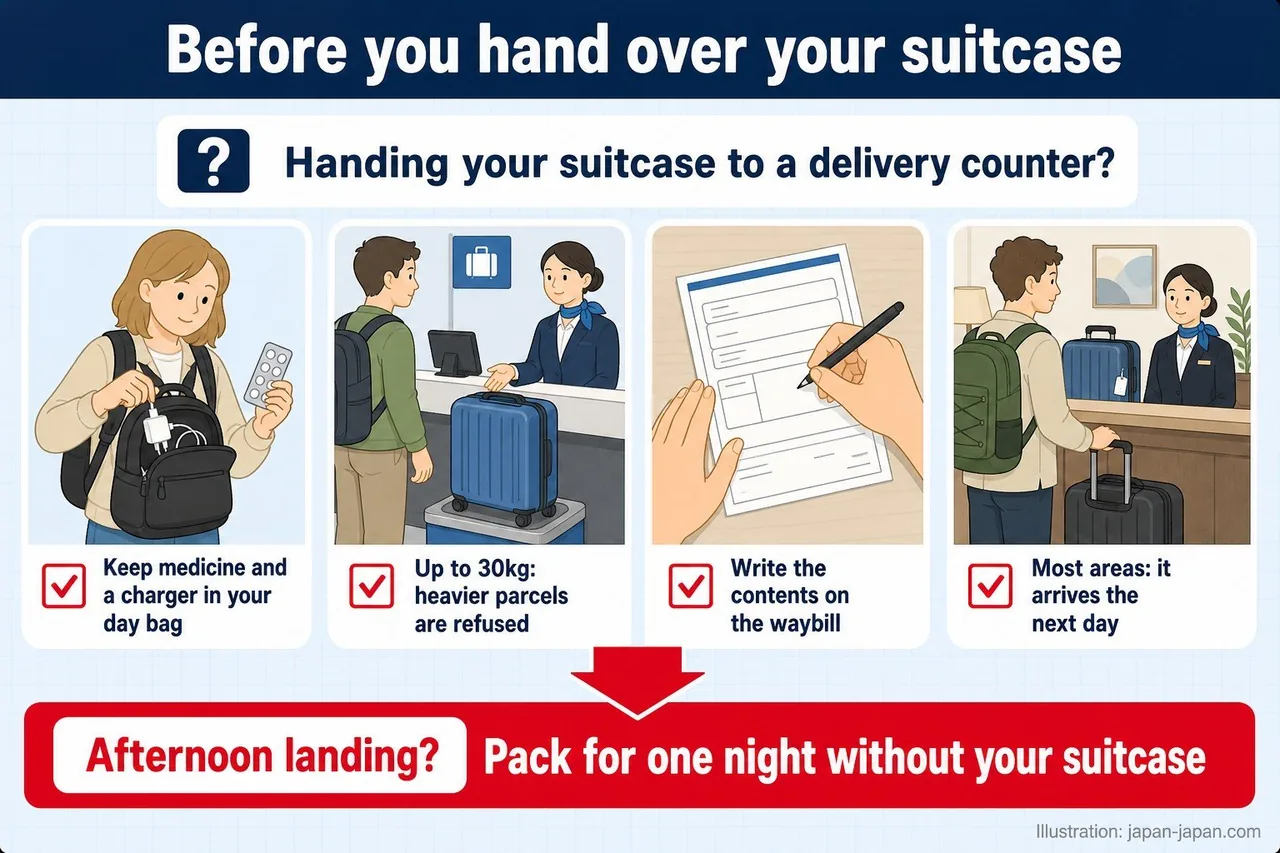
Before you hand the suitcase over, move tonight’s essentials into your day bag: medicine, a phone charger and a change of clothes. Write the contents in detail on the waybill. Yamato says that if it cannot tell what is inside, the delivery may be late or impossible.
Yamato’s Airport TA-Q-BIN has firm limits. It does not accept parcels heavier than 30kg. Size is the width, length and height added together, and the largest band, Size 200, covers up to 200cm and 30 kg.
No single side can be longer than 170 cm. Each parcel is insured up to 300,000 JPY.
The service also runs the other way when you leave. Drop the bag off by two days before your departure date, or three days in some areas.
Yamato delivers to all major Japanese airports by the day before you fly, and you collect the bag at the airport counter by handing over the Sender Receipt from the waybill. The rates for parcels sent to an airport include a 660 JPY airport fee.
If you only need to leave a bag for the day, use a coin locker. Both airports have lockers from 400 yen a day: Haneda in five sizes and Narita in three.
At Narita, the locker day ends at midnight rather than 24 hours after you start. Haneda also has a staffed baggage storage counter.
Tokyo Station and other hotel areas compared
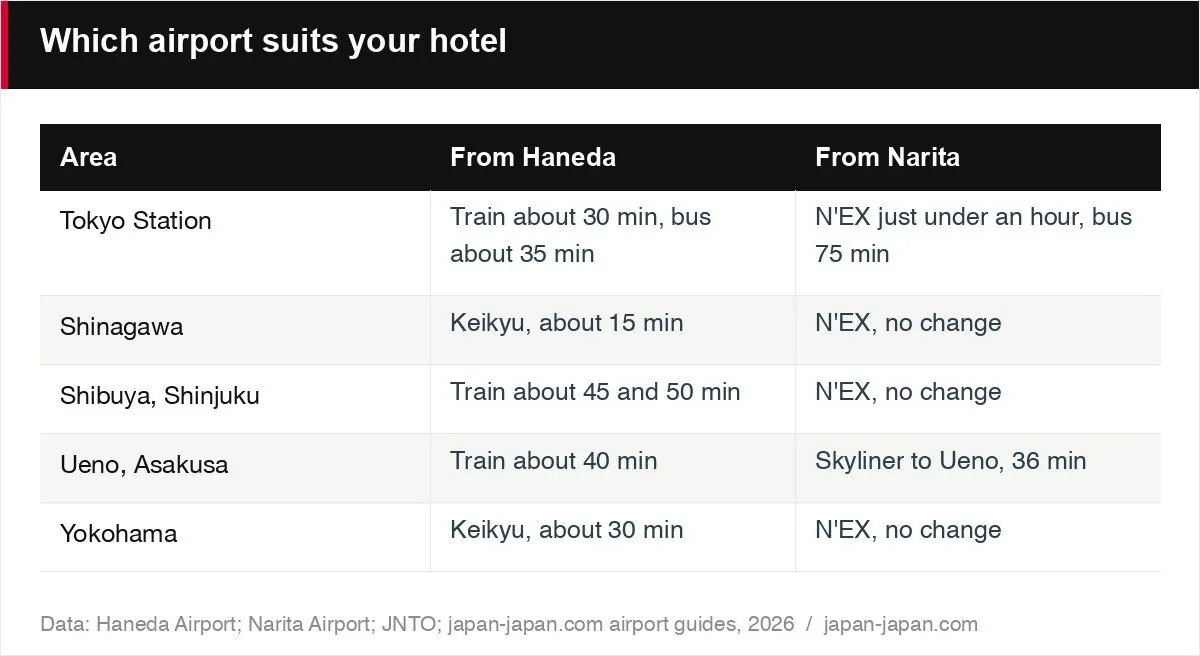
Choose the airport by the station nearest your hotel. The table below sets five common hotel areas against the ride from each airport, with Tokyo Station first.
| Area | From Haneda | From Narita |
|---|---|---|
| Tokyo Station | Train about 30 min, bus about 35 min | N’EX just under an hour, bus 75 min |
| Shinagawa | Keikyu, about 15 min | N’EX, no change |
| Shibuya, Shinjuku | Train about 45 and 50 min | N’EX, no change |
| Ueno, Asakusa | Train about 40 min | Skyliner to Ueno, 36 min |
| Yokohama | Keikyu, about 30 min | N’EX, no change |
Tokyo Station is the easiest place to compare the two. From Haneda it is about 30 minutes by train or about 35 minutes by bus. From Narita, the N’EX takes just under an hour and costs 6,280 yen return, and the bus takes 75 minutes.
Ueno and Asakusa favour Narita. The Skyliner runs straight to Keisei Ueno, and Narita Airport lists Keisei as the way to Asakusa, Ueno, Nippori and Ikebukuro.
Shibuya and Shinjuku work from either airport: the N’EX stops at both with no change, while from Haneda you change at Hamamatsucho. Shinagawa and Yokohama favour Haneda, where the Keikyu line gets you there in about 15 and 30 minutes.
If you land after the last train
Check your arrival time against the last train before you book. JNTO says the last train leaves Haneda around midnight.
For Narita, JNTO gives the last N’EX from the airport before 10 p.m. and the last Skyliner around 11:00 p.m., with the Airport Limousine bus on a similar schedule to the Skyliner. A late landing leaves you more options at Haneda, as the illustration below sets out.
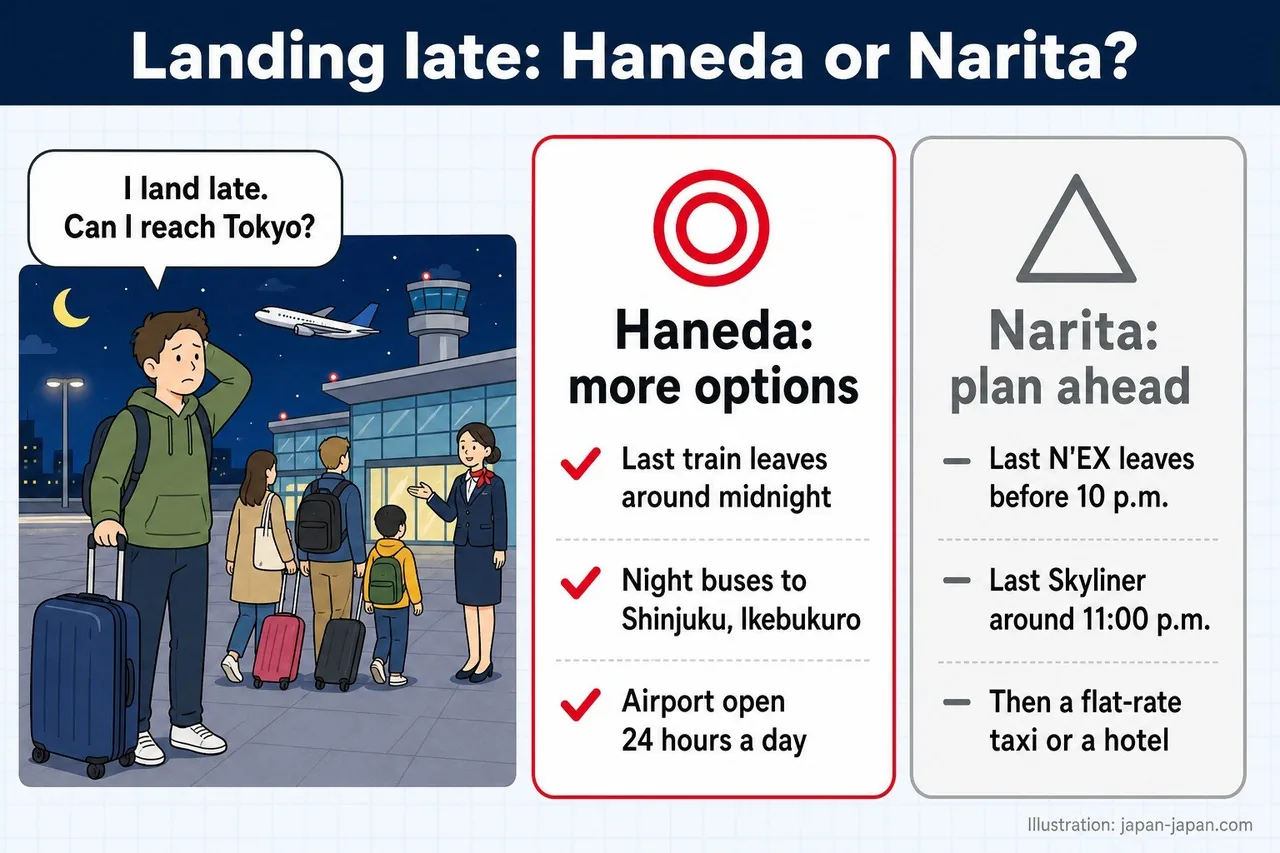
After the trains stop, Haneda still has buses. Haneda’s bus page lists a late-night and early-morning access bus to Shinjuku and Ikebukuro. From Terminal 3 it leaves at 00:20, 01:00, 01:40 and 02:20, from stop 3.
Terminal 1 has one departure at 00:10 and Terminal 2 one at 00:05. A Keikyu bus to Yokohama Station (YCAT) and Sakuragicho leaves Terminal 3 at 01:20, from stop 7. Haneda warns that these times can change with flight schedules, so check with the bus company before you rely on one.
Haneda is also open 24 hours a day. The Royal Park Hotel Tokyo Haneda connects directly to the Terminal 3 departure lobby, and two Villa Fontaine hotels in the HANEDA AIRPORT GARDEN complex also connect to Terminal 3.
At Narita, the fallback is a flat-rate taxi. Narita Airport’s taxi page sets one fare per zone of Tokyo, with two prices: one via the Keiyo Road and one via the Shuto Expressway Bayshore Route. You do not need to book.
Tell the driver at the taxi rank, and you may choose which taxi to take. Highway tolls are extra, and so are the late-night and early-morning surcharge (22:00 to 5:00) and the Aqua-Line fee. The flat fare assumes the expressway, and on ordinary roads the meter runs instead.
| Zone | Wards and cities | Via Keiyo Road | Via Bayshore Route |
|---|---|---|---|
| A | Edogawa, Katsushika, Adachi | 23,500 yen | 26,500 yen |
| B | Koto, Sumida, Odaiba (Minato), Higashi-Yashio (Shinagawa) | 28,000 yen | 28,000 yen |
| C | Chuo, Chiyoda, Taito, Bunkyo, Arakawa | 29,000 yen | 31,000 yen |
| D | Shinjuku, Toshima, Nakano, Shibuya, Meguro, rest of Minato, rest of Shinagawa, Ota | 31,500 yen | 32,500 yen |
| E | Itabashi, Kita, Nerima | 34,000 yen | 36,000 yen |
| F | Setagaya, Suginami, Mitaka, Musashino | 35,500 yen | 38,500 yen |
Tokyo Station sits in Chiyoda and Chuo wards, which are in Zone C: 29,000 yen via the Keiyo Road or 31,000 yen via the Bayshore Route, before tolls. Shinjuku and Shibuya are in Zone D, at 31,500 yen or 32,500 yen.
JNTO calls the taxi more expensive than other options, but a reasonable choice for a group. The other fallback is a bed near the airport: the Nine Hours capsule hotel connects directly to Terminal 2, and several hotels sit within a 10-minute free shuttle bus ride.
From the gate to the train
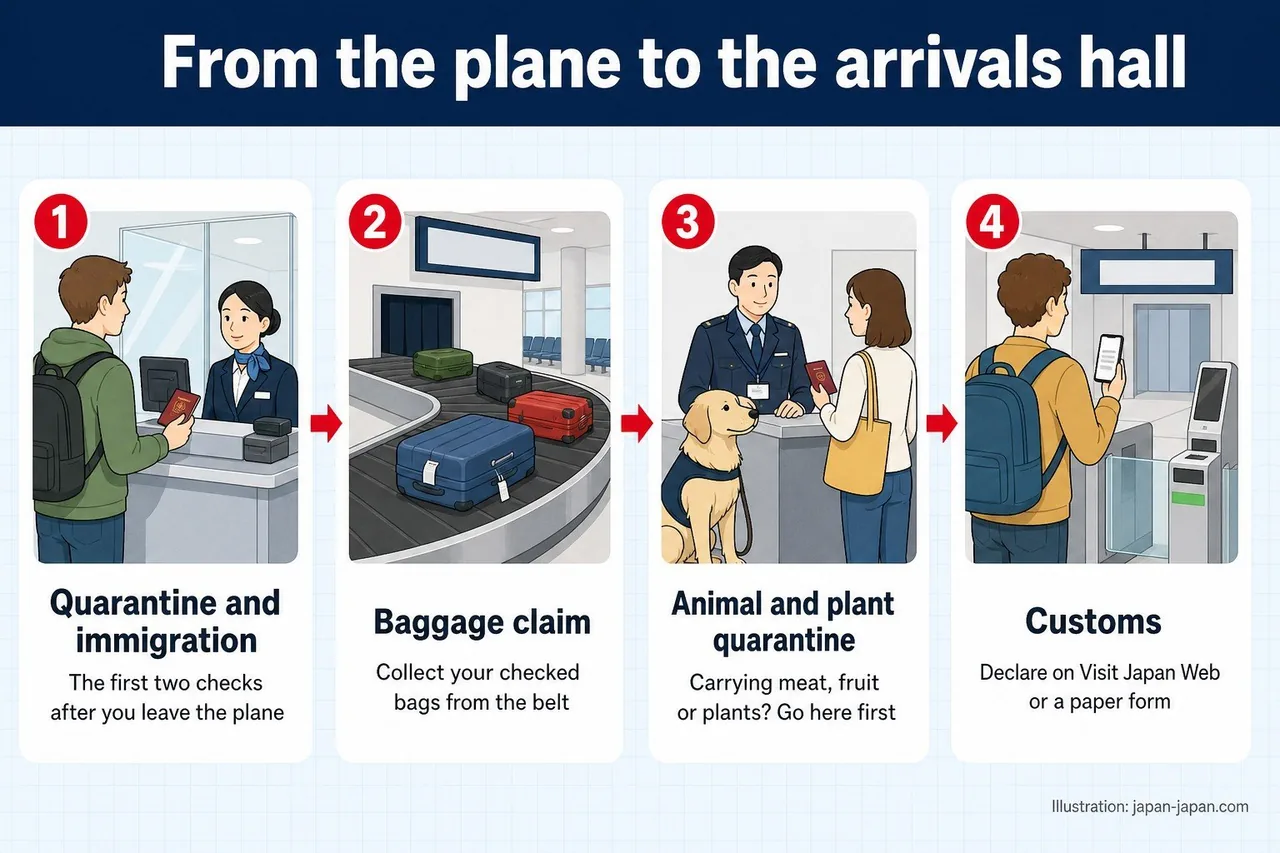
Arrival runs in a fixed order. Our airport guides list it as quarantine, immigration, baggage claim, animal and plant quarantine, then customs. The animal and plant counter comes before customs, so if you carry meat, fruit or plants, go there first.
Deal with food before you leave the plane. A leftover in-flight meal cannot leave the aircraft if it contains meat, fresh fruit or vegetables, and that includes cut fruit and sandwiches from the meal tray.
Meat and meat products cannot enter Japan at all, however they are packed or cooked. Bringing meat in without declaring it can mean up to three years in prison or a fine of up to 3 million yen.
Every passenger entering Japan has to declare their belongings, according to Japan Customs. The screenshot below is the top of its English page for arriving passengers, with that rule and the green and red channels.
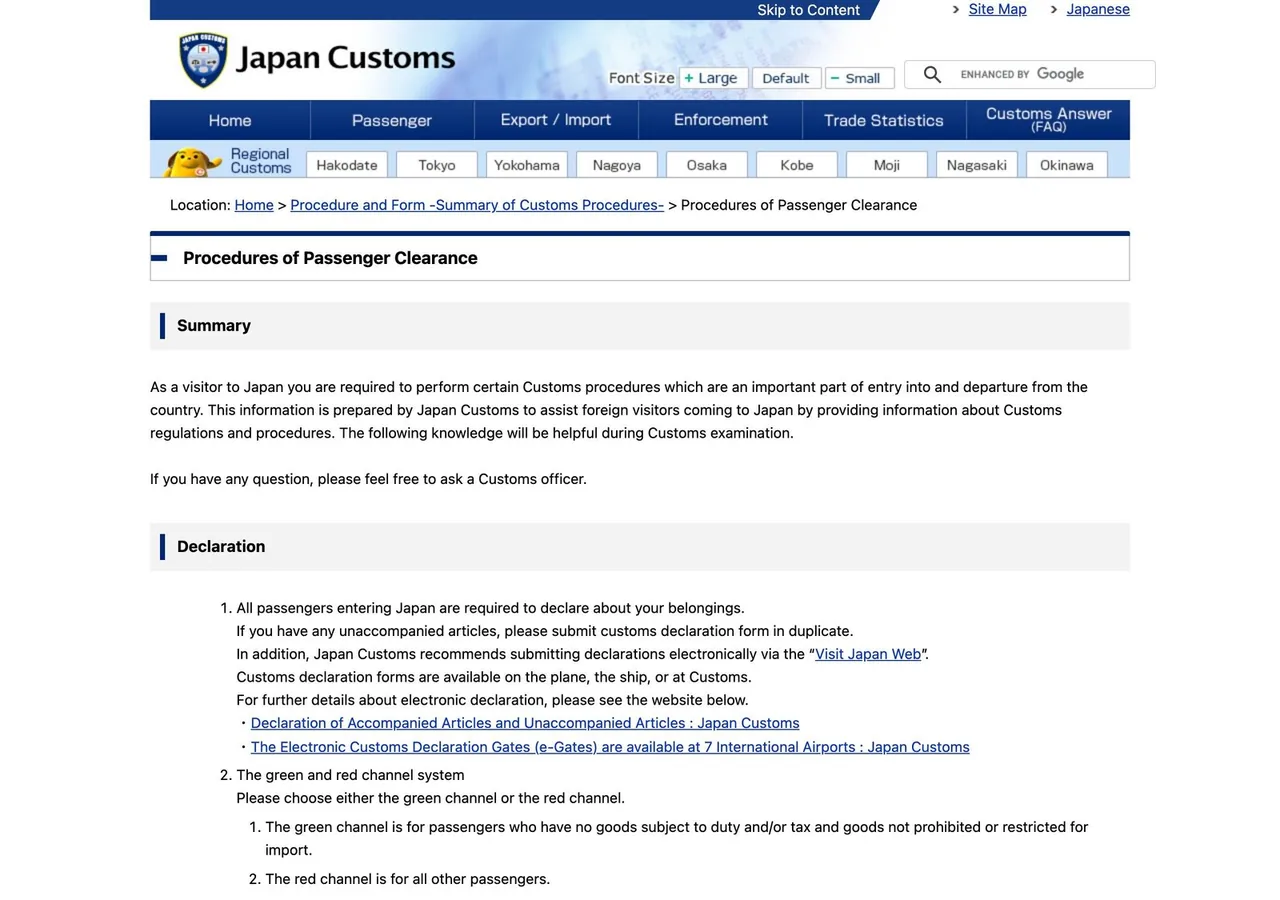
Customs recommends declaring electronically through Visit Japan Web, and paper declaration forms are available on the plane or at Customs.
In the customs hall, take the green channel if you carry nothing dutiable and nothing prohibited or restricted. Everyone else takes the red channel. Cash or other means of payment over 1 million yen must be declared.
After customs you come out into the arrivals hall, where the delivery counters and the bus ticket counters are. The illustration below puts the whole walk in order, from the plane to that hall.
Between Narita and Haneda
If you land at Narita and fly on from Haneda, you cross the whole of Tokyo. You also clear immigration and customs at Narita, the first airport you land in, so the connection has to cover that queue as well as the transfer.
By train, Haneda Airport gives about 1 hour 45 minutes from Haneda to Narita Airport Station, and JNTO says to take a Keisei Line or Keikyu Line express service.
By bus, Haneda’s bus page gives about 1 hour 15 minutes from Haneda to Narita, and JNTO lists a direct bus to Narita Airport. Both are Haneda’s estimates for the trip in that direction.
At Haneda, find your domestic terminal before you set off. Terminal 1 is the JAL domestic hub and also serves Skymark and StarFlyer.
Terminal 2 serves ANA domestic flights, Air Do and Solaseed Air. Free shuttle buses run between all three terminals.
Check your bags for the domestic leg too. Our airline baggage guide shows that JAL, ANA, Skymark, Solaseed, StarFlyer and AIRDO allow 10kg of cabin baggage across both pieces, and low-cost carriers allow 7kg. Domestic flights within Japan have no liquid limit.
Haneda or Narita: what 98 people in Japan chose
On 13–14 October 2026, japan-japan.com ran an online survey of people living in Japan about 32 travel choices. 130 people answered. We removed answers that looked machine-written, one from outside Japan and most of those that contradicted themselves, which left 98. Shares below are of the 98 respondents unless a smaller group is named; they describe these people, not all travellers in Japan. See all 32 comparisons and how we asked.
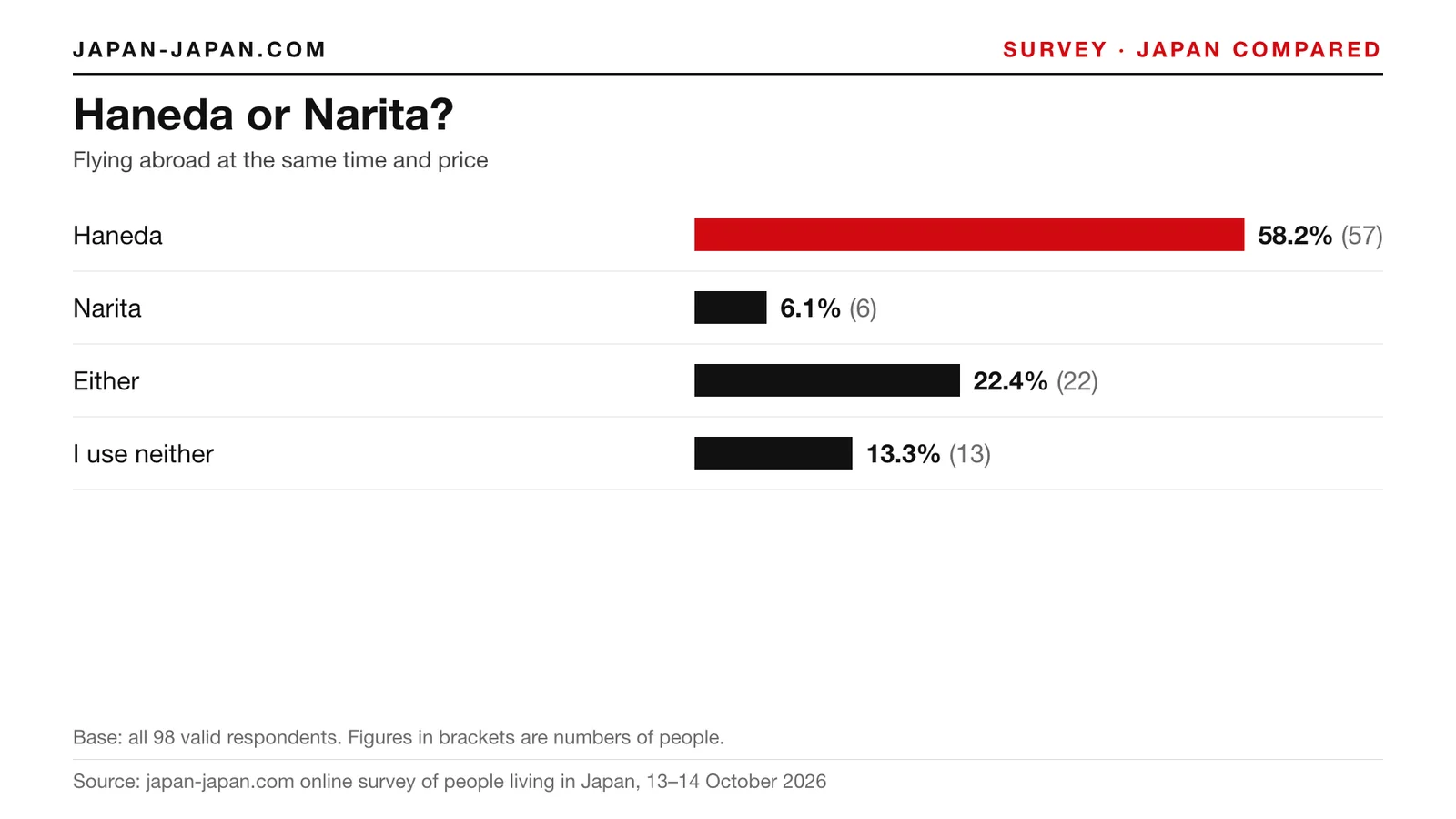
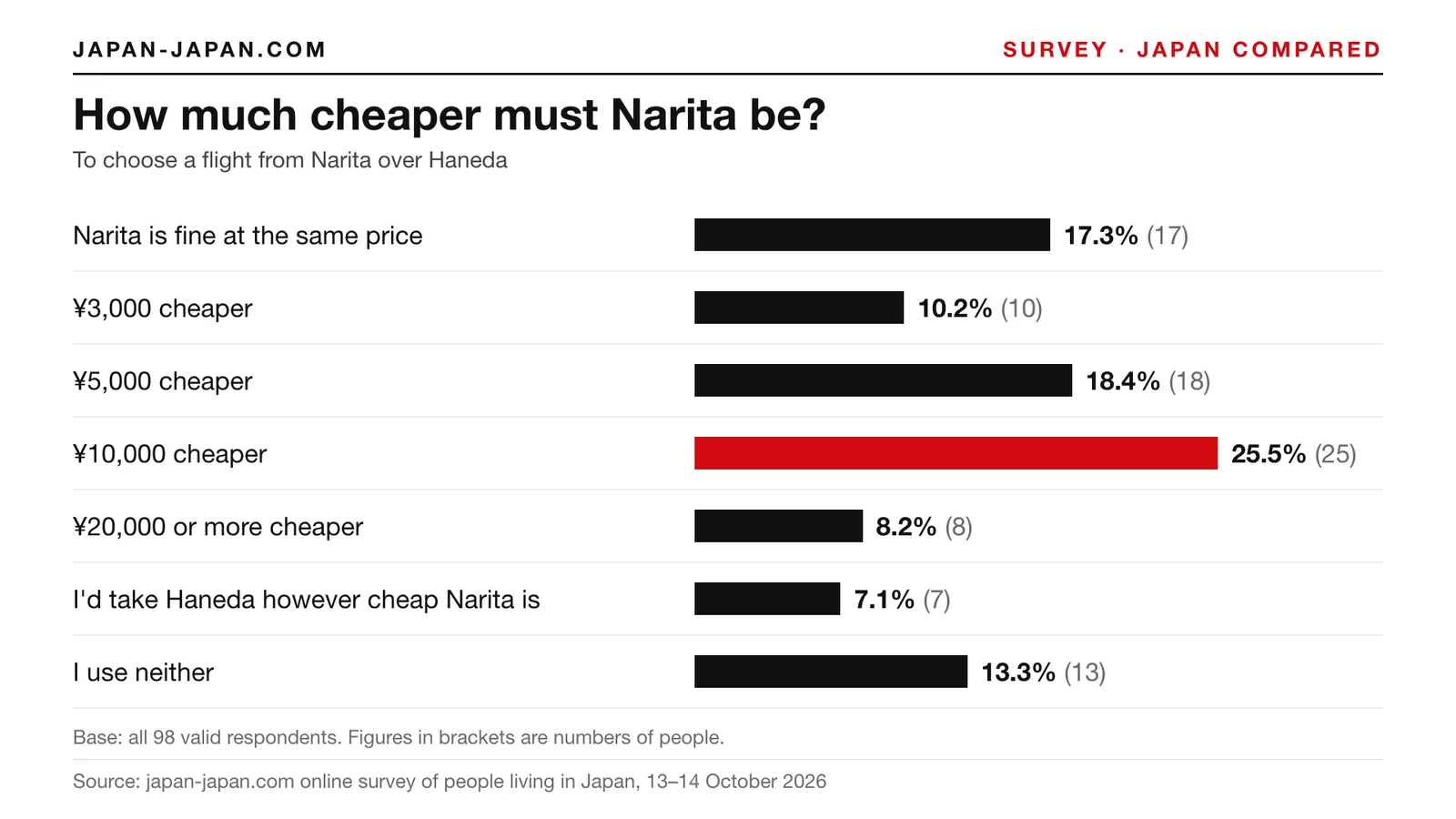
Flying abroad at the same time and the same price, 58.2% (57 people) would rather leave from Haneda and 6.1% (6 people) from Narita; 22.4% (22 people) said either. Asked how much cheaper a Narita flight would have to be, 45.9% (45 people) would choose Narita if it were ¥5,000 cheaper or less, and 40.8% (40 people) would need ¥10,000 or more, or would take Haneda anyway.
From Narita into central Tokyo, 32.7% (32 people) mostly use JR trains and 20.4% (20 people) Keisei trains; the single most used was the Narita Express (29.6%).
“To us in Japan, Narita and Haneda are obviously two different places, but to people from abroad “Narita” and “Haneda” both end in the same character, 田 (“rice field”), so now and then someone mixes them up.”
— Woman in her 50s, Kanto (outside Tokyo). Original Japanese (excerpt): 「私たち日本人にとっては”別物”と瞬時に判断が可能だと思いますが、海外の方にとっては”NARITA””HANEDA”と語尾”田”なので、まれに混乱し間違える方もいらっしゃるようです。」
“For getting into central Tokyo, Haneda, no contest.”
— Man in his 60s, Tokyo. Original Japanese (excerpt): 「都心へのアクセスの良さで羽田一択。」
FAQ
How long does it take from Narita Airport to Tokyo Station?
Just under an hour on the Narita Express, which runs about twice an hour in the daytime, according to JNTO. The airport bus takes 75 minutes, per our Narita guide. The Skyliner takes 36 minutes to Nippori and Keisei Ueno, where you can change to the JR Yamanote Line.
How long does it take from Haneda Airport to Tokyo Station?
About 30 minutes by train, by Haneda Airport’s own estimate. JNTO’s route is the monorail to Hamamatsucho and a change to the JR Yamanote Line. The airport bus takes about 35 minutes with no change, which helps if your bags are heavy.
How much is a taxi from Narita Airport to Tokyo Station?
Tokyo Station is in Zone C of Narita’s flat-rate taxi fares: 29,000 yen via the Keiyo Road or 31,000 yen via the Bayshore Route. Highway tolls are extra, and so is the late-night and early-morning surcharge from 22:00 to 5:00. You do not need to book.
Can I send my suitcase from the airport to my hotel the same day?
Sometimes. Narita and Haneda run a same-day service to hotels in central Tokyo if you drop the bag off before late morning. Otherwise the bag reaches most of the country the next day, so keep one night’s essentials in your hand luggage.
About the author