Haneda Airport Limousine Bus: Fares, Stops and Last Buses
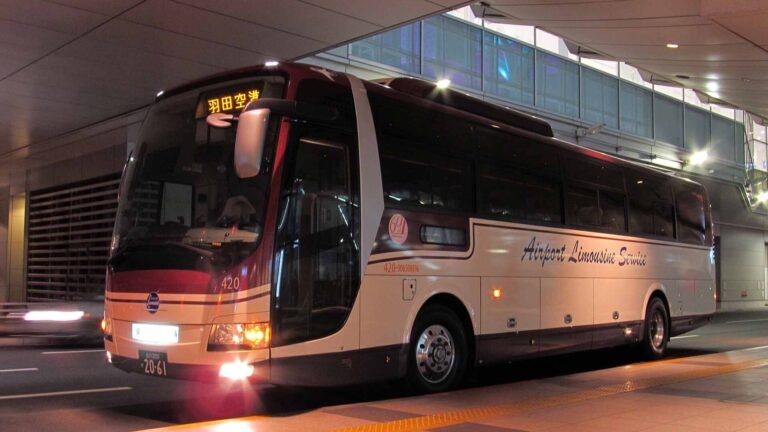
The Airport Limousine is the orange and white bus run by Airport Transport Service. It links Haneda and Narita with stations and big hotels across Tokyo. The operator revised its timetable on 1 October 2026. Fares, times and departures here follow that timetable, as listed on our Airport Limousine bus fares and stops page.
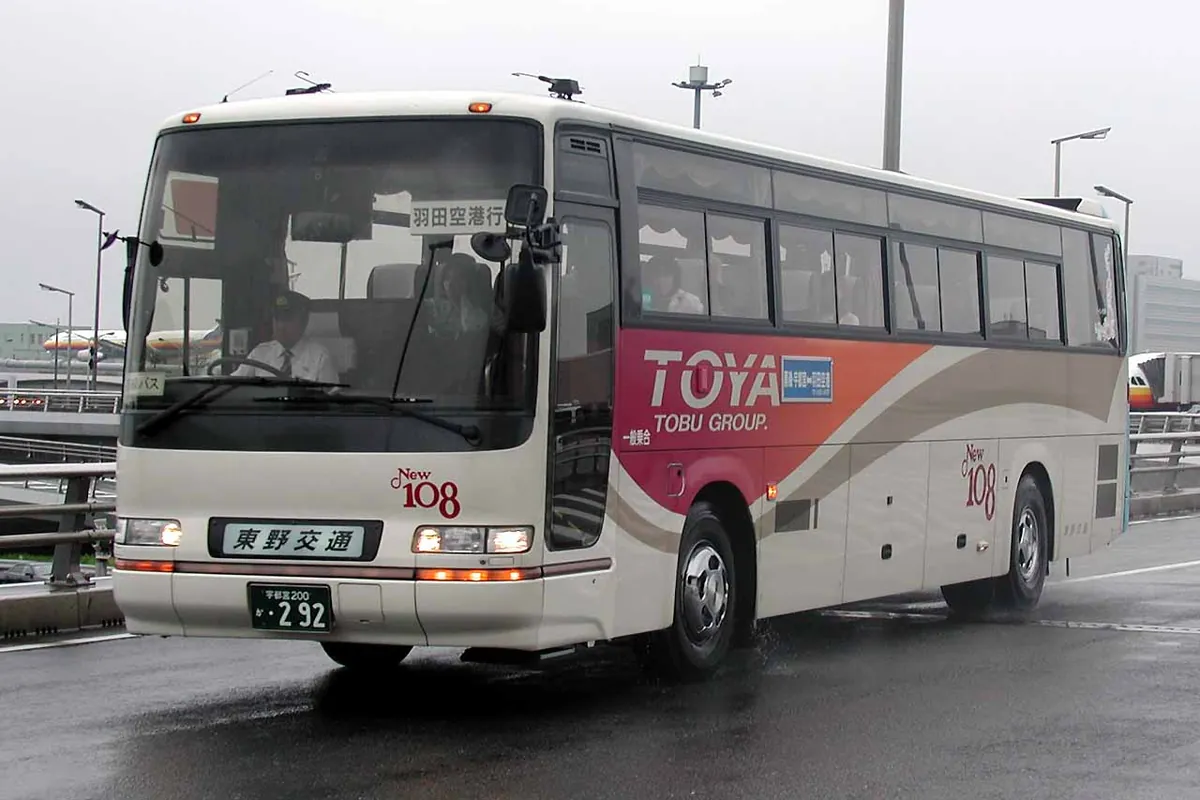
The bus in the photo is the one you are looking for at the curb. Other companies also run airport buses from Haneda, including Keikyu Bus and Tokyu Bus, and several routes are shared. This guide covers the routes most visitors use from the international terminal.
Haneda limousine bus routes and fares
Each Haneda limousine bus route has a set adult fare from the airport, listed in the operator’s timetable. From Terminal 3, the main routes cost between 1,000 yen and 3,600 yen. Pay before you board, not on the bus.

| Item | Value |
|---|---|
| T-CAT (Hakozaki) | 1000 yen |
| Tokyo Station | 1200 yen |
| Shibuya | 1300 yen |
| Tokyo Disney Resort | 1300 yen |
| Shinjuku | 1400 yen |
| Ikebukuro | 1400 yen |
| Narita Airport | 3600 yen |
The chart shows the adult fare to each main destination. T-CAT, the Tokyo City Air Terminal at Hakozaki, is the cheapest at 1,000 yen. The bus to Narita Airport is the most expensive at 3,600 yen. Most city routes sit between 1,200 yen and 1,400 yen.
- Shinjuku: 1,400 yen, 40 to 55 minutes. The bus stops at the west exit of Shinjuku Station and then at the big hotels. See Haneda Airport to Shinjuku for each stop.
- Shibuya: 1,300 yen, 49 to 69 minutes, to Shibuya Station (Mark City) and two hotels beside it. Details are on Haneda Airport to Shibuya.
- Ikebukuro: 1,400 yen, 50 to 70 minutes, to the west exit of Ikebukuro Station and the hotels around Sunshine City. See Haneda Airport to Ikebukuro.
- Tokyo Station: 1,200 yen, 55 minutes, to the Yaesu side of the station. Check Haneda Airport to Tokyo Station before you plan on it.
- T-CAT (Hakozaki): 1,000 yen, 35 to 60 minutes. Hakozaki is a short way east of Nihombashi, covered on Haneda Airport to Nihombashi.
- Tokyo Disney Resort: 1,300 yen, 40 minutes, to Tokyo Disneyland, Tokyo DisneySea and the resort hotels. See Haneda Airport to Tokyo Disney Resort.
- Narita Airport: 3,600 yen, 85 to 95 minutes, airport to airport. Compare it with the train on Haneda Airport to Narita Airport.
Kichijoji, in western Tokyo, also has a direct bus. The Haneda Airport express bus and route bus page gives about 1 hour 15 minutes for the ride. Our Haneda Airport to Kichijoji page lists the times and where the bus stops.
Yokohama is on the list too. Keikyu Bus runs to Yokohama Station (YCAT) in about 30 minutes. It leaves from stop 7 at Terminal 3, stop 11 at Terminal 2 and stop 10 at Terminal 1.
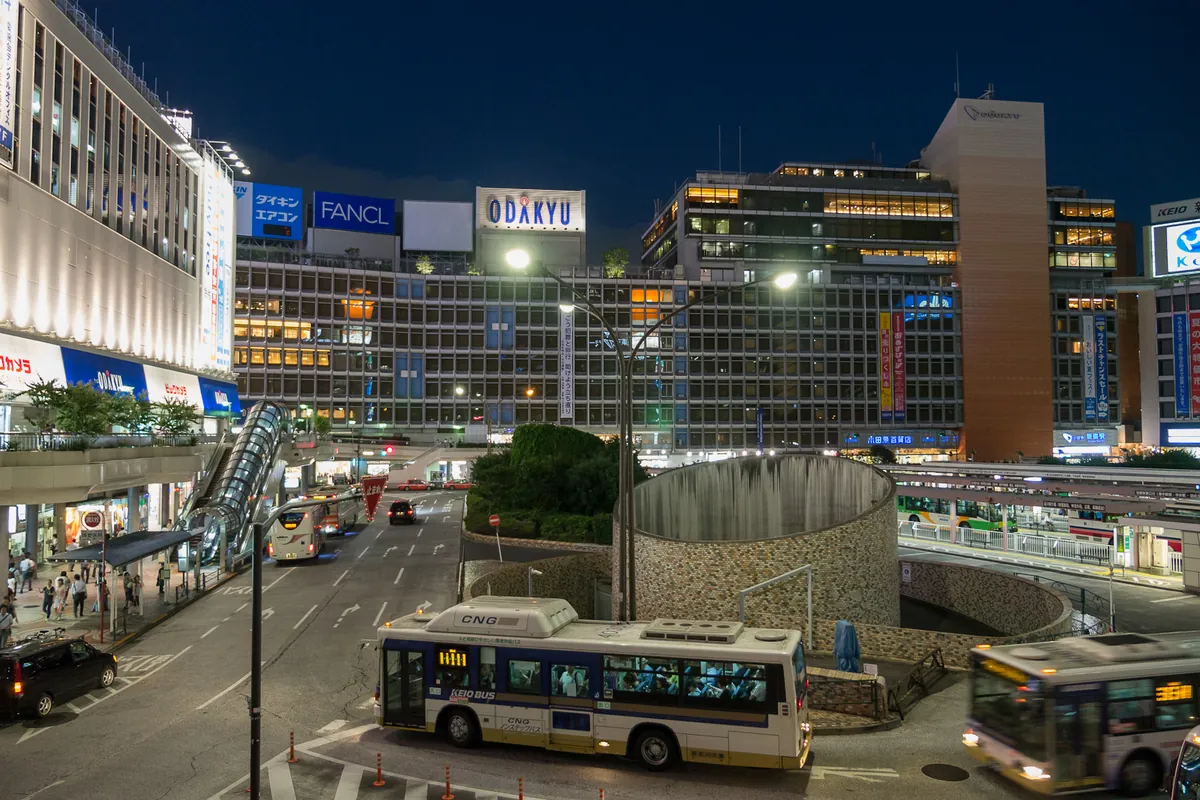
The photo shows the west exit area of Shinjuku Station, where the Shinjuku bus arrives first. The airport page gives about 35 minutes to Shinjuku Station West Exit. The operator’s timetable allows 40 to 55 minutes, so plan around the timetable when you have a dinner booking or a check-in time.
Haneda limousine bus schedule: first, last and late-night buses
The Haneda limousine bus schedule varies a lot by route. Shinjuku has 67 departures a day from Terminal 3. Tokyo Station has only 6, and the last one leaves at 16:00.
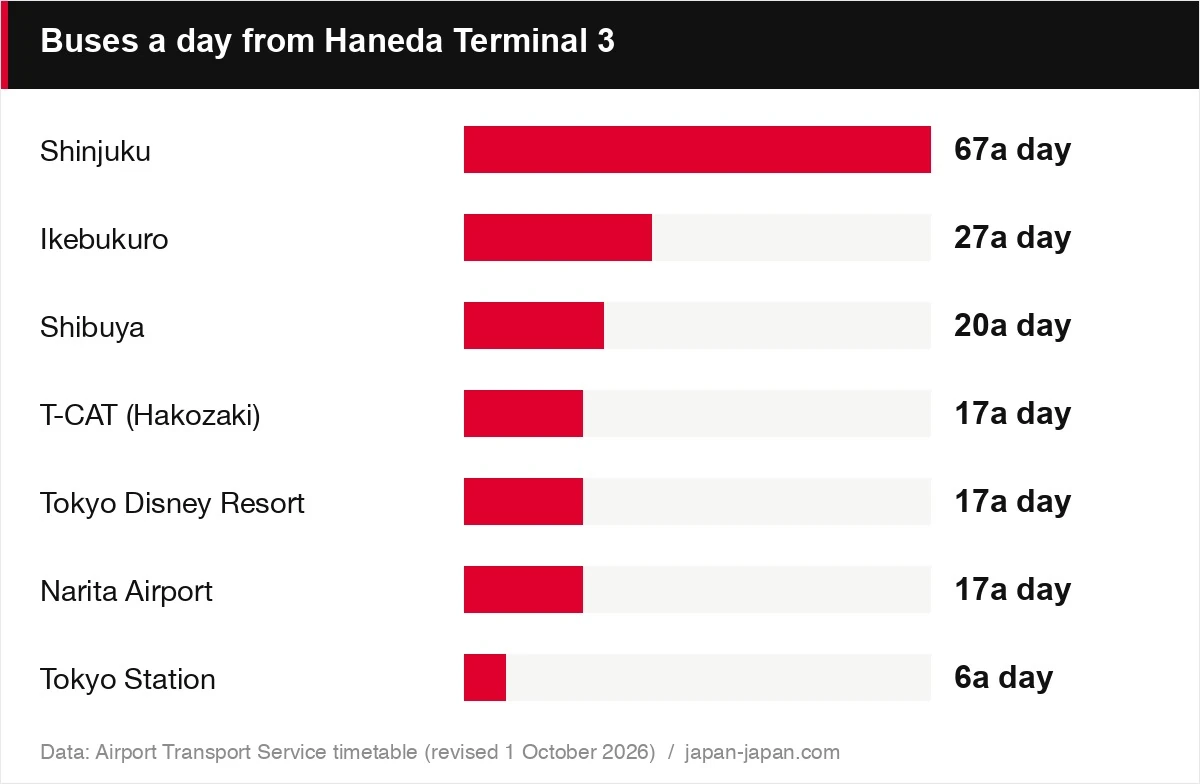
| Item | Value |
|---|---|
| Shinjuku | 67 a day |
| Ikebukuro | 27 a day |
| Shibuya | 20 a day |
| T-CAT (Hakozaki) | 17 a day |
| Tokyo Disney Resort | 17 a day |
| Narita Airport | 17 a day |
| Tokyo Station | 6 a day |
The chart counts the buses a day from Terminal 3 on each main route. After Shinjuku come Ikebukuro with 27 and Shibuya with 20. T-CAT, Tokyo Disney Resort and Narita Airport each have 17.
| From Terminal 3 to | First bus | Last bus |
|---|---|---|
| Shinjuku | 06:15 | 23:40 |
| Shibuya | 07:40 | 22:35 |
| Ikebukuro | 08:30 | 22:40 |
| T-CAT (Hakozaki) | 11:25 | 23:15 |
| Tokyo Disney Resort | 07:35 | 18:50 |
| Narita Airport | 06:40 | 18:10 |
| Tokyo Station | 08:00 | 16:00 |
Read the last column before you book a late flight. If you land at 18:00 and head to Tokyo Station, the bus has already stopped for the day. The Disney bus ends at 18:50 and the Narita bus at 18:10. Shinjuku, T-CAT, Ikebukuro and Shibuya run late into the evening.
Late-night buses after midnight
A separate late-night and early-morning service runs to Shinjuku and Ikebukuro after the regular buses stop. From Terminal 3 it leaves at 00:20, 01:00, 01:40 and 02:20. It also calls at Terminal 1 at 00:10 and Terminal 2 at 00:05.
At Terminal 3 the late-night bus uses stop 3. A Keikyu Bus to Yokohama Station (YCAT) and Sakuragicho leaves Terminal 3 at 01:20 from stop 7. The JNTO Haneda Airport access page sums it up: the last limousine bus leaves Haneda at 2:20 a.m. with limited stops, and the earliest one reaches the airport at 4:25 a.m.
The airport notes that these night times may change with the flight schedule. Check them on the day you fly, not weeks before.
Haneda Airport limousine bus stops at Terminals 1, 2 and 3
Each route has its own stop number, and the number changes by terminal. The Shinjuku bus leaves from stop 3 at Terminal 3, stop 5 at Terminal 2 and stop 4 at Terminal 1. Go to the wrong stop and you will watch your bus leave from the next one.
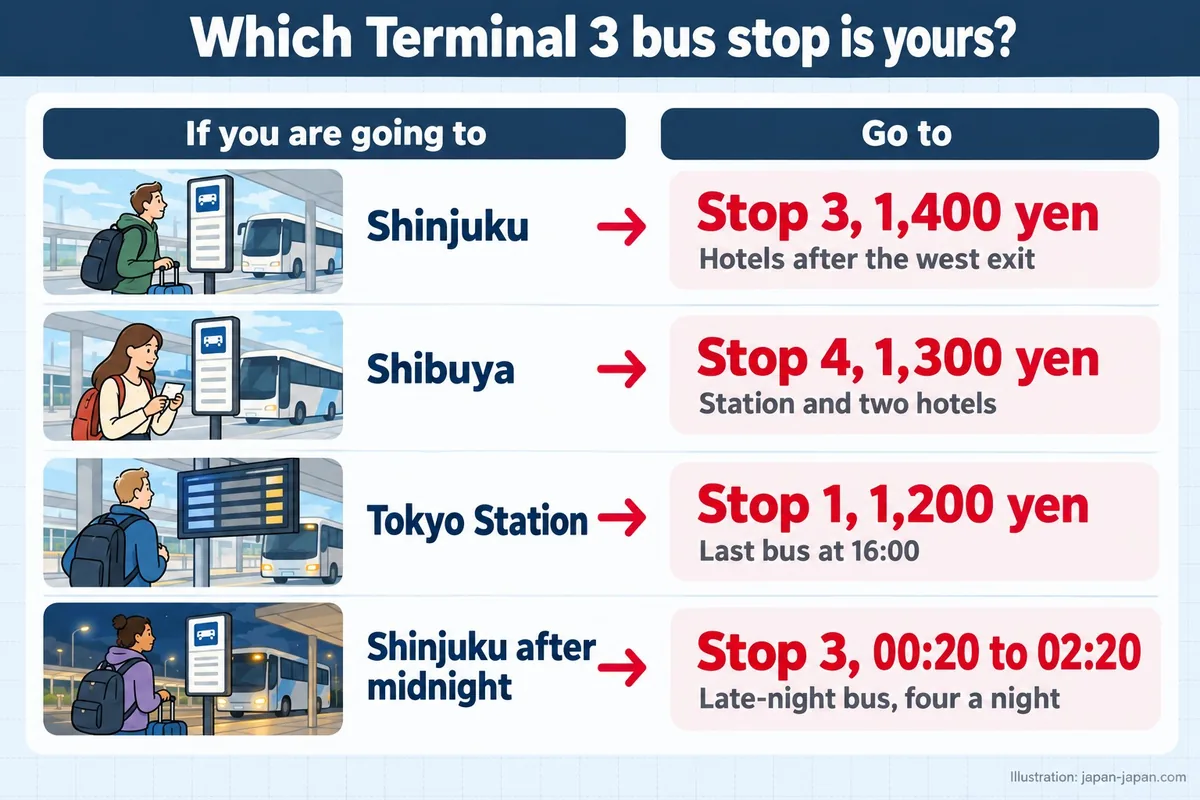
The illustration works as a quick lookup for Terminal 3. Find your destination, then walk to that number. Shinjuku is stop 3 for 1,400 yen, and Shibuya is stop 4 for 1,300 yen.
| Destination | Terminal 1 | Terminal 2 | Terminal 3 |
|---|---|---|---|
| Shinjuku | Stop 4 | Stop 5 | Stop 3 |
| Shibuya and Kichijoji | Stop 9 | Stop 10 | Stop 4 |
| Ikebukuro and T-CAT | Stop 7 / 6 | Stop 8 / 7 | Stop 2 |
| Tokyo Station | Stop 3 | Stop 4 | Stop 1 |
| Tokyo Disney Resort | Stop 5 | Stop 6 | Stop 5 |
| Narita Airport | Stop 6 | Stop 7 | Stop 5 |
At Terminal 3, the international terminal, you leave arrivals on the second floor. Follow the bus signs from the 2F Access Hall down to lane 3 on the first floor. Stops No. 1 to No. 11 line that lane, and stops 3 and 7 also serve the late-night and early-morning buses.
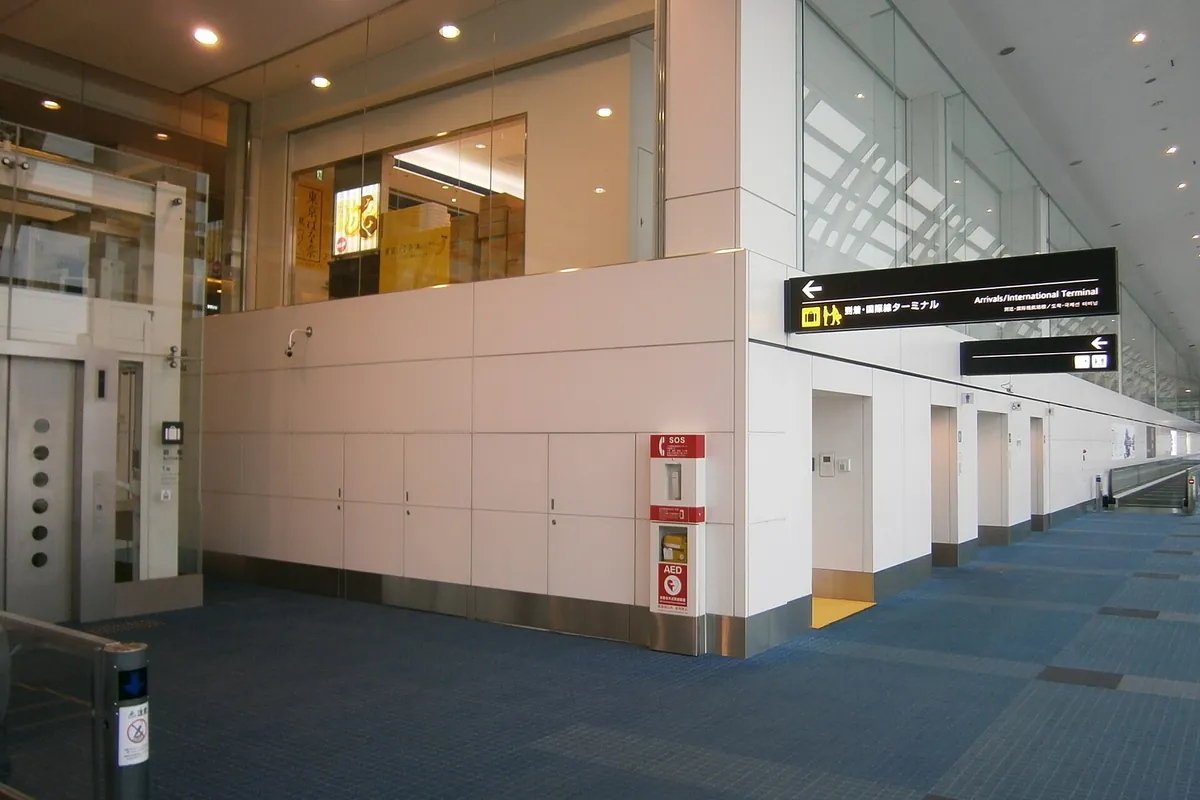
The photo shows the Terminal 3 arrivals lobby, where you start that walk. At Terminals 1 and 2, the domestic terminals, the bus stops are on the first floor of each building.
The signs you follow say バス乗り場 (basu noriba), which means “bus stops”. The Haneda Airport bus access page in Japanese uses the same words, so you can show it to staff if you get lost. Our Haneda Airport guide covers the terminals, trains and lockers in one place.
Buying tickets and reserving a seat
Buy your ticket before you board. At Terminals 1 and 2 you use the automatic bus ticket machines. At Terminal 3 you can use a machine or the bus ticket counter.
The counter is the easier choice on your first trip. The GO TOKYO Haneda Airport access guide says multilingual staff sell tickets there. They also confirm which terminal your bus leaves from and where it stops.

The four steps in the illustration are the whole process. Buy the ticket, check your stop number, queue at that stop and get off near your hotel. Large suitcases ride in the luggage space under the bus.
Keep one item out of that hold. The airport asks you not to put power banks in luggage that goes under the bus. Keep them with you inside the vehicle, because lithium-ion batteries may catch fire or break with heat or impact.
The Airport Limousine website shows timetables and takes reservations. Booking helps when you want a set departure on a busy day, such as the year-end holidays. On ordinary days, most visitors buy at the airport after they collect their bags.
Haneda to Shibuya by bus or train
For Haneda to Shibuya by bus, you pay 1,300 yen and ride 49 to 69 minutes with no change. By train, the Keikyu Line and JR cost 540 yen and take about 37 minutes, with one change at Shinagawa. The same pattern holds for Shinjuku and Tokyo Station.
| Destination | Airport Limousine bus | Keikyu Line and JR | Tokyo Monorail and JR |
|---|---|---|---|
| Shibuya | 1,300 yen, 49–69 min | 540 yen, 37 min | 780 yen |
| Shinjuku | 1,400 yen, 40–55 min | 590 yen, 43 min | 780 yen |
| Tokyo Station | 1,200 yen, 55 min | 540 yen, 33 min | 720 yen |
| Ikebukuro | 1,400 yen, 50–70 min | 680 yen, 49 min | 870 yen |
The table puts the three routes side by side. The train is cheaper and usually faster. The bus saves you from carrying bags through Shinagawa or Hamamatsucho at rush hour.
Keikyu Line trains leave from every terminal toward Shinagawa on the JR Yamanote Line. GO TOKYO gives 11 minutes from Terminal 3 to Shinagawa by Rapid Express. The Tokyo Monorail takes 13 minutes at the shortest from Terminal 3 to Hamamatsucho, another Yamanote Line station.
The illustration asks two questions. Do you have a large suitcase? Is your hotel or station on a bus route? If both answers are yes, take the bus. If not, take the Keikyu Line or the Tokyo Monorail.
On weekends, holidays and some peak dates, the Monorail sells a cheaper ticket. The Tokyo Monorail Yamanote Line discount ticket page sets it at 590 yen to any Yamanote Line station. That is down from the ordinary 780 yen to Shibuya or Shinjuku. Buy it from the ticket machines at the airport station on the day you travel.
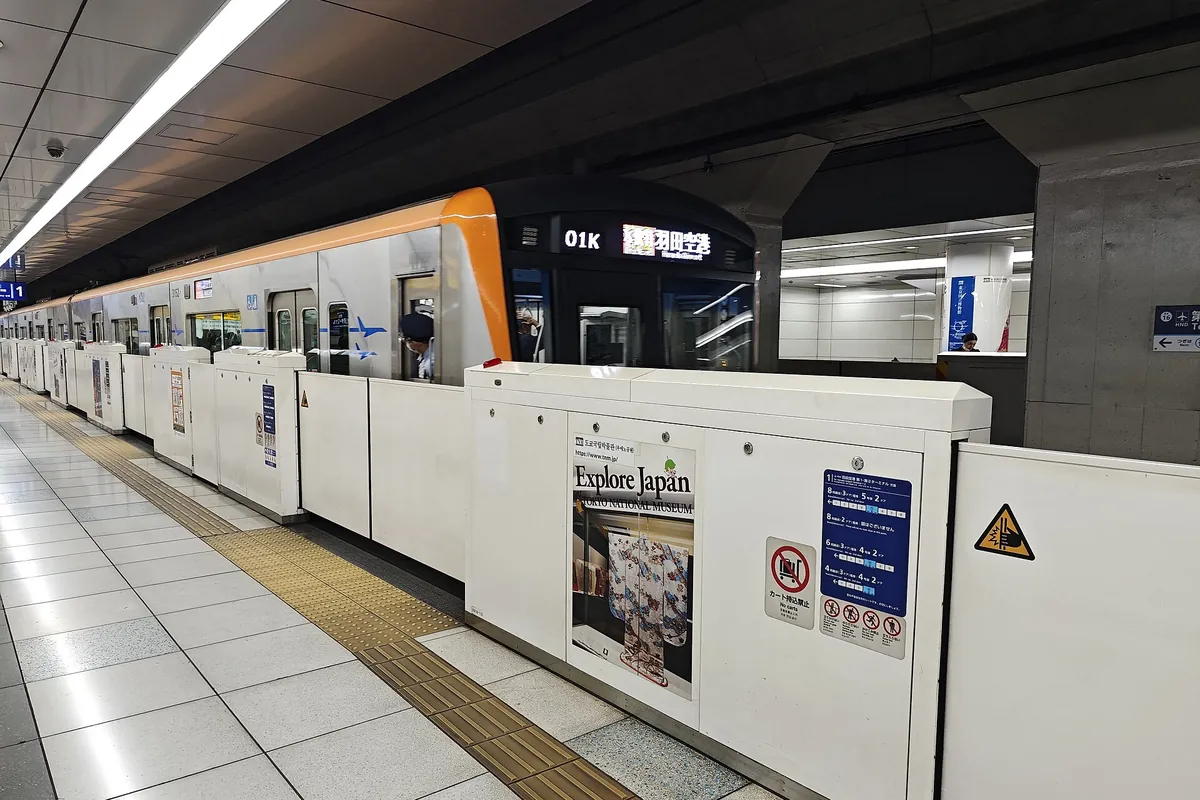
The Haneda Airport train and monorail access page shows where to go at Terminal 3. The Keikyu gates for downtown Tokyo are in the 2nd floor Arrival Lobby. The train makes sense when you travel light or land after the last bus to your area.
Children, luggage and busy holiday dates
If you travel with children, ask at the Terminal 3 bus ticket counter for the child fare before you buy. If you take the train instead, a child aged 6 to 11 pays 290 yen on the Monorail discount ticket.
If you want to drop bags before you head into town, Terminal 3 has temporary baggage storage open 24 hours. The Haneda Airport baggage storage page lists the rates per item for 24 hours. S (less than 120cm) costs 800 yen, M costs 1,000 yen and L costs 2,000 yen. Bags can stay up to two weeks, with a limit of 300 cm in total size and 30 kg.
Roads around Tokyo get busy at the year-end and New Year, and bus times can run past the timetable. The Monorail discount ticket is on sale every day from December 26, 2026 to January 3, 2027. See New Year 2026–27 in Japan for what closes and when. On those dates, leave extra time if you have a train or flight to catch after the bus.
Other ways from Haneda and where to go next
A taxi is the door-to-door option and works out well for a group splitting the fare. Trips between 22:00 and 5:00 usually carry a surcharge, and flat-rate taxis need a reservation. Our guide to taxi fares in Japan has the numbers.
If you would rather not ride with a suitcase at all, send it ahead. Luggage forwarding in Japan explains rates and airport cut-off times. Then you can take the train with only a day bag.
Flying into Narita instead? Read Narita and Haneda to Tokyo to compare both airports. For a switch between the two airports, the Keikyu, Toei and Keisei through train costs 1,810 yen against 3,600 yen by bus.
If you take the train, you need a ticket or an IC card. IC cards at Haneda Airport shows where to buy TOURIST PASMO and other cards before you reach the gates.
FAQ
How much is the limousine bus from Haneda to Shinjuku?
An adult ticket from Terminal 3 to Shinjuku costs 1,400 yen. The timetable allows 40 to 55 minutes. The bus stops at the west exit of Shinjuku Station and then at the big hotels.
What time is the last limousine bus from Haneda Airport?
The last regular bus to Shinjuku leaves Terminal 3 at 23:40. After that, late-night buses to Shinjuku and Ikebukuro leave Terminal 3 at 00:20, 01:00, 01:40 and 02:20 from stop 3. Other routes stop earlier, and the Tokyo Station bus ends at 16:00.
Do I need to reserve the Haneda limousine bus in advance?
On most days you can buy a ticket at the airport before you board. Use a ticket machine at Terminals 1 and 2, or a machine or the counter at Terminal 3. Book online if you want a fixed departure on busy dates.
Is the bus or the train better from Haneda to Shibuya?
The train is cheaper and faster: 540 yen and about 37 minutes by Keikyu Line and JR, with one change at Shinagawa. The bus costs 1,300 yen and takes 49 to 69 minutes, but you sit the whole way with your bags. Choose the bus if you carry a large suitcase.
About the author