Full-Service vs Low-Cost Airlines in Japan: 7 kg or 10 kg?

The three groups are this guide’s way of sorting the nine airlines by baggage rules and airports. The airlines do not use these labels themselves. Fares change by the day, so this guide compares what a ticket includes, not what it costs.
Nine domestic airlines side by side
The table below puts JAL and ANA, the four mid-size airlines and the three low-cost airlines in one view. Every cell comes from the airline’s own published rules, which we keep in our airline baggage database. Read it from left to right: the carry-on limit drops from 10 kg to 7 kg, and the free bag turns into a paid add-on.
| Item | JAL and ANA | Skymark, AIRDO, Solaseed Air, StarFlyer | Peach, Jetstar Japan, Spring Japan |
|---|---|---|---|
| Carry-on | 115 cm (55 × 40 × 25 cm), 10 kg | 115 cm (55 × 40 × 25 cm), 10 kg | 115 cm or 56 × 36 × 23 cm, 7 kg |
| Free checked bag, standard fare | JAL: 20 kg in total. ANA: 23 kg each, up to 2 bags | Skymark: 20 kg in total. Others: 23 kg each, 2 bags | Peach Standard: 1 bag, 20 kg. Spring: 20 kg |
| Cheapest fare | ANA: 0 to 2 bags by fare | Tour fares: 1 free bag (AIRDO, Solaseed Air, StarFlyer) | No free bag (Minimum, Jetstar Japan, Lucky Spring) |
| Haneda domestic terminal | JAL T1, ANA T2 | Skymark and StarFlyer T1, AIRDO and Solaseed Air T2 | None (Peach flies only international from T3) |
| Narita and Kansai | Narita: JAL T2, ANA T1. Kansai: T1 | StarFlyer: Kansai T1 | Peach: Narita T1, Kansai T2. Jetstar Japan: Narita T3, Kansai T1. Spring Japan: Narita T3 |
| Power banks | 2 per person, 160Wh or less, not used on board | 2 per person, 160Wh or less, not used on board | Same; Jetstar Japan approves over 100Wh |
Two details stand out. The carry-on size is the same 115 cm on all nine airlines, so weight is what really changes. Jetstar Japan caps each side at 56 × 36 × 23 cm instead. Those three sides still add up to 115 cm.
Power banks follow one rule across the group. You may carry two per person, each 160Wh or less, in the cabin only, and you may not use them on board. Jetstar Japan also asks you to get its approval for a power bank over 100Wh. Our power bank guide explains the rule in force since 24 April 2026 and how to pack the batteries.
ZIPAIR, a fourth low-cost airline in our database, is left out of this comparison. The Narita Airport ZIPAIR Tokyo airline page lists only international flights from Terminal 1 North Wing. JAL Group counts ZIPAIR Tokyo, Spring Japan and Jetstar Japan as its low-cost airlines, so a JAL Group link does not mean JAL’s baggage rules.
JAL and ANA share one carry-on limit: 115 cm (55 × 40 × 25 cm) and 10 kg. That covers one bag plus one personal item. They differ on checked bags. The JAL domestic flights checked baggage page allows up to 20 kg per passenger, with no limit on the number of bags. The ANA domestic free baggage allowance page allows two bags of up to 23 kg each in Economy, depending on the fare. Our JAL baggage page and ANA baggage page show both airlines in full.
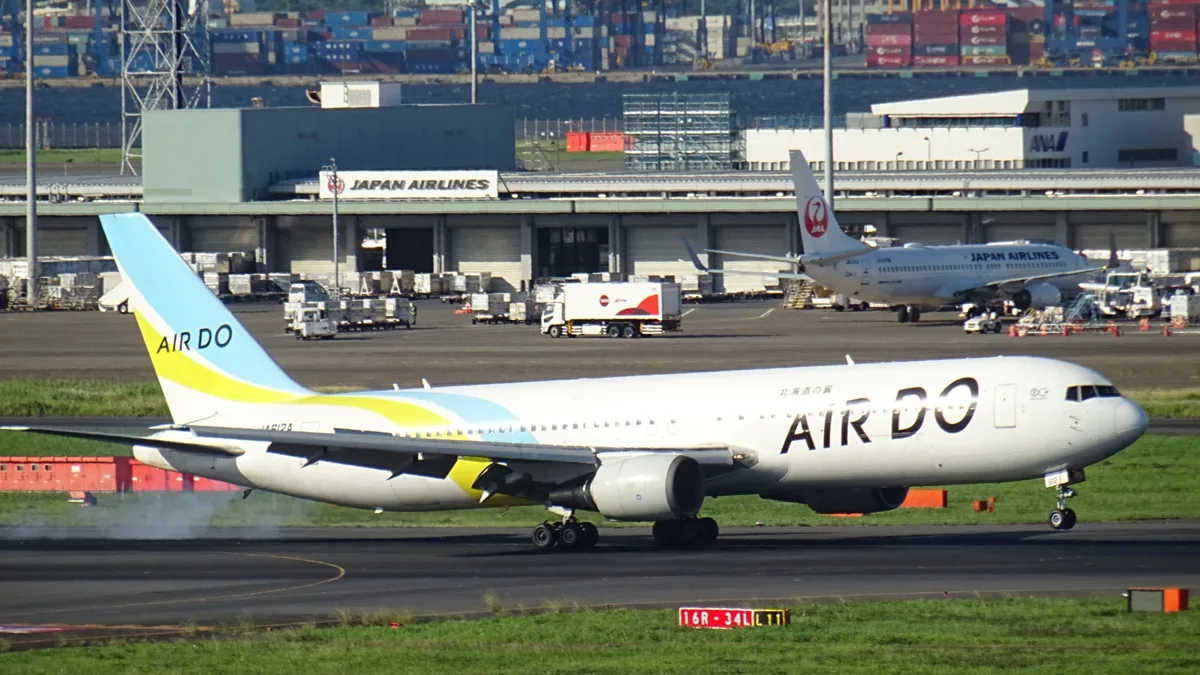
Carry-on: 10 kg or 7 kg
Six airlines let you bring 10 kg into the cabin: JAL, ANA, Skymark, AIRDO, Solaseed Air and StarFlyer. Peach, Jetstar Japan and Spring Japan allow 7 kg. These are the limits each airline sets for its domestic flights.
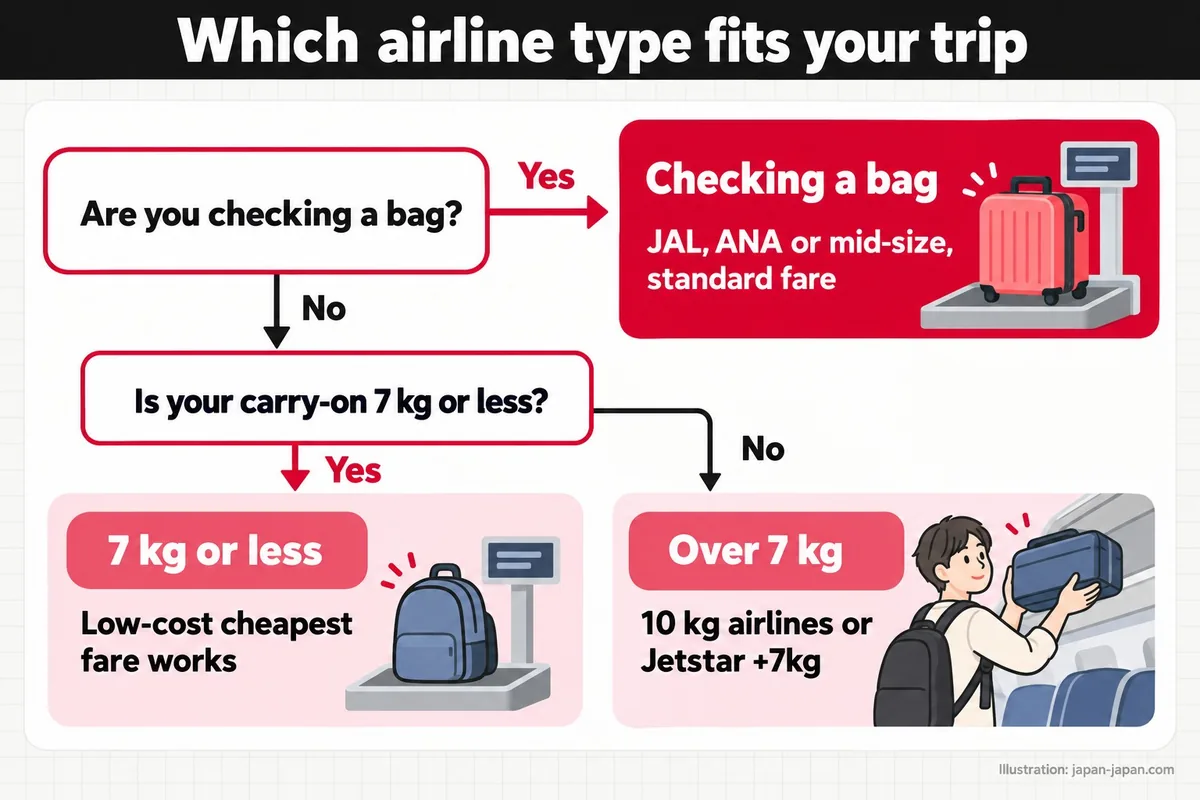
On all nine, the weight covers two items: one bag plus one personal item such as a handbag. JAL’s rule reads: “The total weight of both items must not exceed 10kg (22lbs)”. StarFlyer allows one bag plus personal items such as a handbag, camera or umbrella. The illustration below shows the two sides of the split.
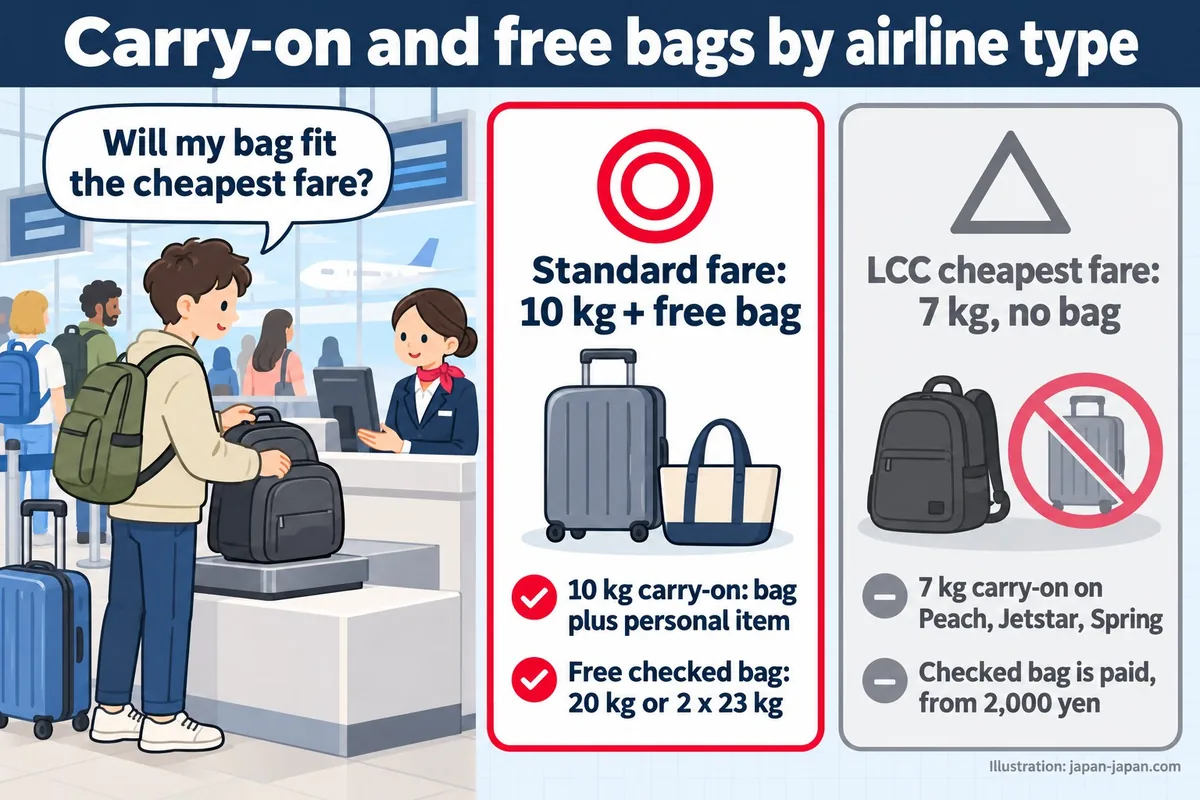
The bag size is the same on the 10 kg airlines: 115 cm in total, or 55 × 40 × 25 cm. ANA, AIRDO and Solaseed Air also set the personal item at 40 × 30 × 20 cm. On ANA aircraft with fewer than 100 seats, the bag shrinks to 100 cm in total, at most 45 × 35 × 20 cm.
The low-cost airlines measure size in two ways. Peach adds up the three sides and allows 115 cm. Jetstar Japan sets each side at 56 × 36 × 23 cm. Spring Japan gives both numbers: 115 cm, or 56 × 36 × 23 cm.
Jetstar Japan is the one low-cost airline that sells extra cabin weight. Some fares and its paid +7kg option raise the limit to 14 kg in total, with no single piece over 10 kg. Buying the extra 7 kg at the airport costs 5,000 to 7,000 yen at the counter and 5,500 to 8,000 yen at the gate.
Peach staff may check the size, weight and number of your bags by sight or by measuring them. A bag over the limit must go to the baggage counter as a paid checked bag. Peach may refuse boarding if you do not agree. A bag that fits the size rule but not the overhead bin also has to be checked in, as our Peach baggage page explains.
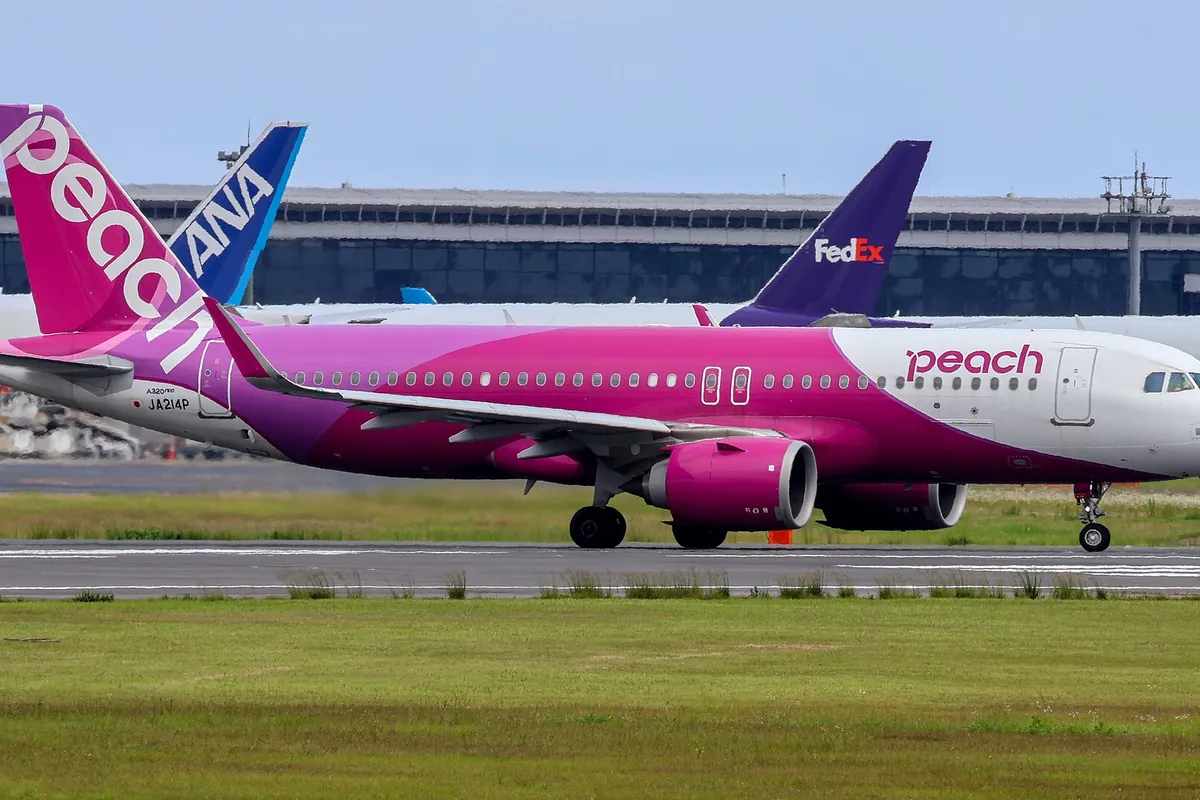
The photo above shows a Peach aircraft, where the 7 kg limit applies. For every airline that flies to Japan, our carry-on size table lists the same three numbers: total size, each side and weight.
Checked bags: two free allowances and paid bags
Japan’s domestic airlines use two shapes of free allowance. One caps the total weight per passenger. The other caps the weight of each bag and the number of bags.
Total weight per passenger: JAL and Skymark
The JAL page allows up to 20 kg per passenger, in any number of bags. Each bag must fit within 50 × 60 × 120 cm. First Class passengers get up to 45 kg. The Skymark Airlines checked baggage page sets the same 20 kg combined weight and the same bag size, also with no limit on pieces.
Weight per bag: ANA and the mid-size three
ANA, AIRDO, Solaseed Air and StarFlyer allow up to two bags of 23 kg each. Each bag must measure 158 cm or less when you add the three sides. The StarFlyer checked baggage page lists exactly those three numbers, and so does the Solaseed Air checked baggage page.
AIRDO switched to this rule for flights from 19 May 2026. Until 18 May 2026 it allowed 20 kg per person in any number of bags. The AIRDO checked baggage rules page shows both rules side by side. On ANA, Premium Class passengers get up to three bags of 32 kg each.
Tour fares give you less. AIRDO, Solaseed Air and StarFlyer include only one free bag on individual inclusive tour fares, the fares sold inside a package tour. The table below sets out each airline’s free allowance by fare.
| Airline | Standard fare | Other fares and classes | Rule type |
|---|---|---|---|
| JAL | 20 kg in total, any number of bags | First Class: up to 45 kg | Total weight |
| ANA | 23 kg each, up to 2 bags, 158 cm | Premium Class: 32 kg each, up to 3. Some fares: 0 bags | Per bag |
| Skymark | 20 kg in total, each bag 50 × 60 × 120 cm | Any number of bags | Total weight |
| AIRDO | 23 kg each, 2 bags, 158 cm (from 19 May 2026) | Tour fares: 1 bag | Per bag |
| Solaseed Air | 23 kg each, 2 bags, 158 cm | Tour fares: 1 bag | Per bag |
| StarFlyer | 23 kg each, 2 bags, 158 cm | Tour fares: 1 bag | Per bag |
| Peach | Standard, Standard Plus: 1 bag, 20 kg | Minimum: no free bag | Per bag |
| Jetstar Japan | No free bag | Buy a weight pool of up to 40 kg | Weight pool |
| Spring Japan | Spring: 20 kg. Spring Plus: 30 kg | Lucky Spring: no free bag | By fare |
What you pay when you go over
On ANA and StarFlyer, a bag of 23 to 32 kg costs 1,100 yen. A bag over 32 kg up to 45 kg costs 5,500 yen. Each bag beyond the free allowance costs 5,500 yen, and so does a bag over 158 cm up to 292 cm. Our database shows the same fees for Solaseed Air. Some ANA routes, such as those within Hokkaido, charge 500 yen and 4,400 yen instead.
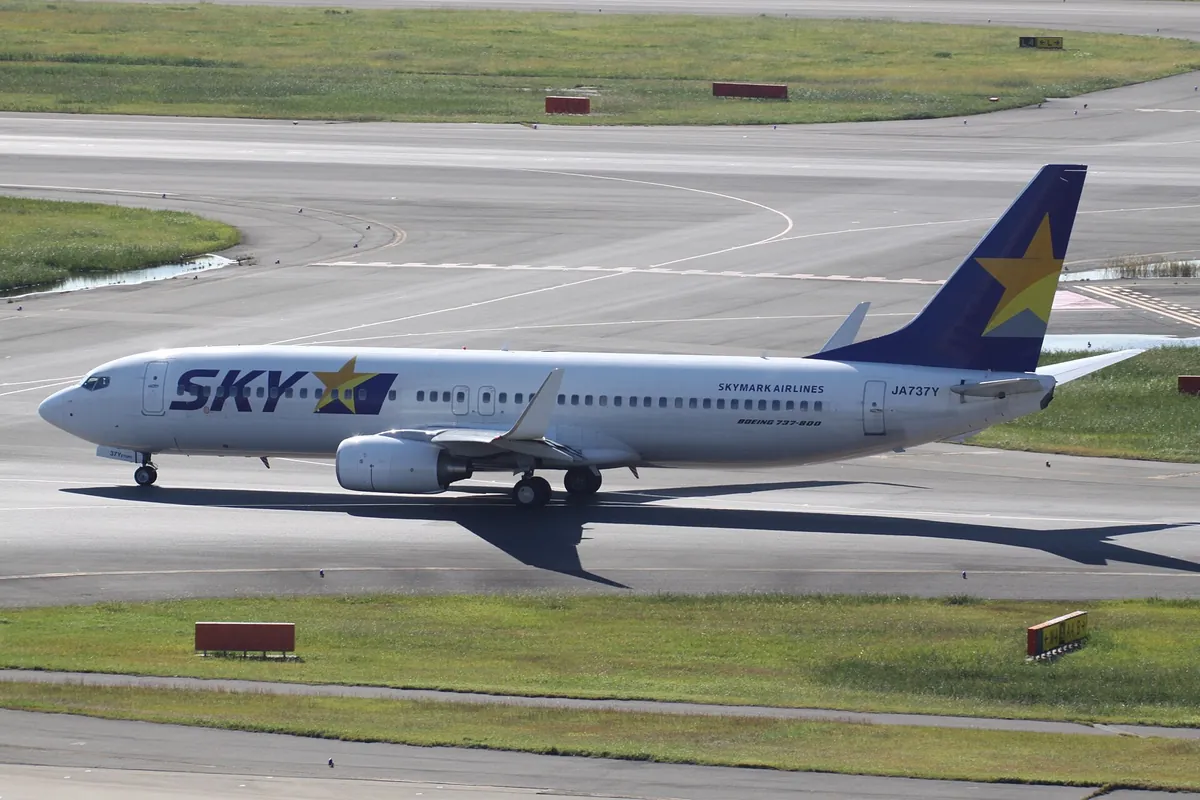
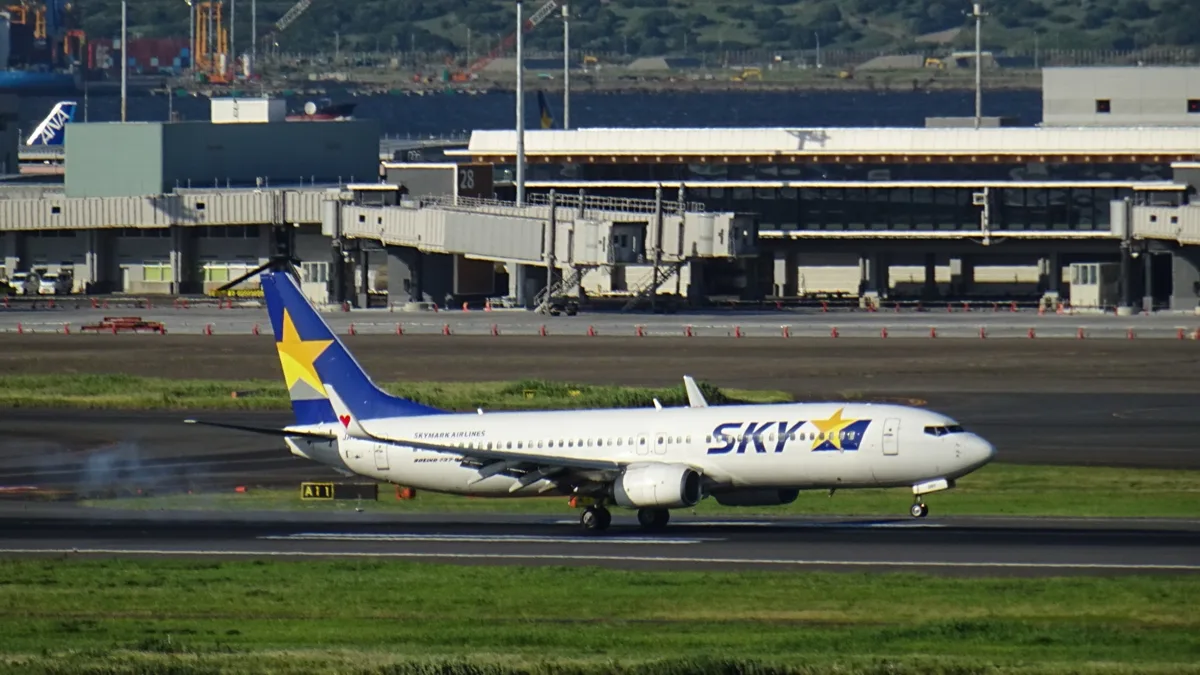
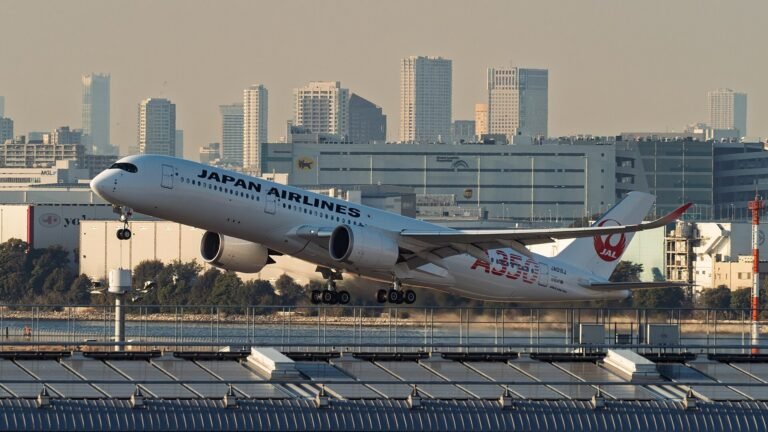
Skymark charges 2,000 yen when you go 1 to 10 kg over its 20 kg allowance, plus 1,000 yen for every further 10 kg. It does not accept a bag over 32 kg or a total over 100 kg. The photo below shows a Skymark aircraft, the other airline on the total-weight rule.
Low-cost airlines: the bag is an add-on
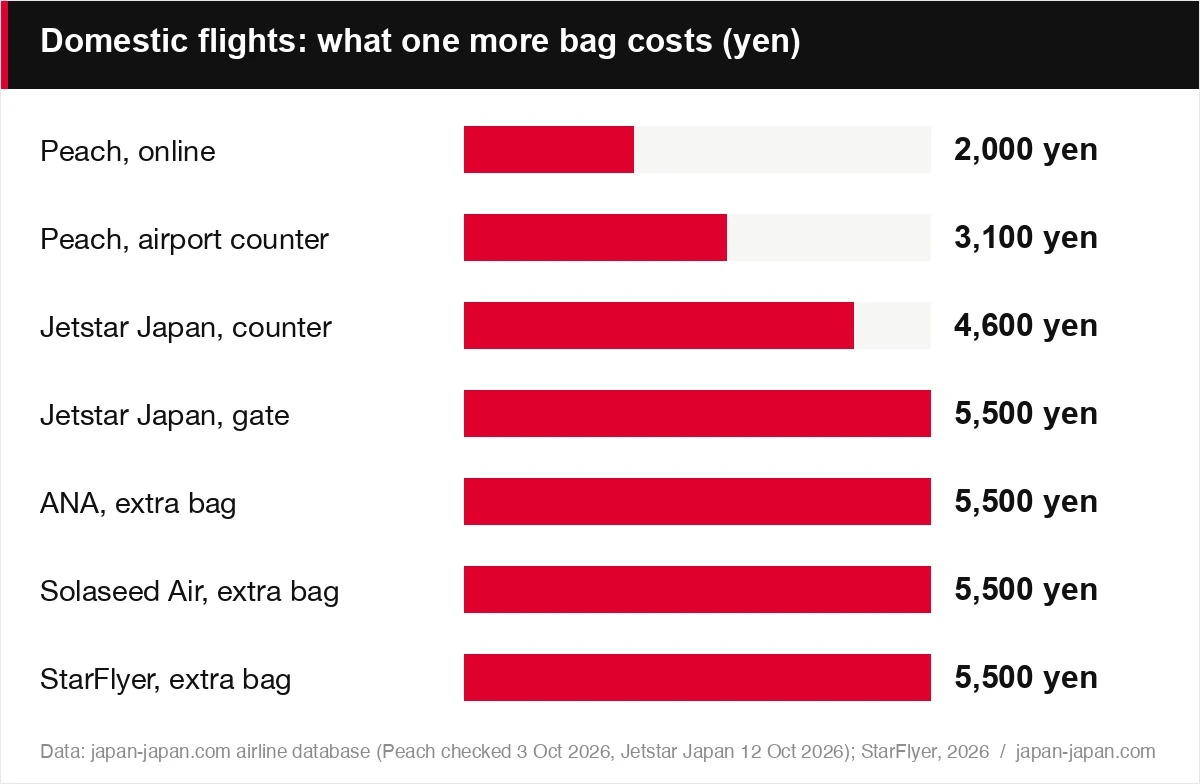
Peach’s Minimum fare includes no checked bag. On domestic flights, a bag up to 20 kg costs 2,000 yen online and 3,100 yen at the airport counter (prices checked 3 October 2026). Peach’s Standard and Standard Plus fares include one bag of up to 20 kg.
Jetstar Japan includes no checked bag by default. On domestic flights, a bag up to 15 kg costs 4,600 yen at the airport counter. At the boarding gate it costs 5,500 yen (checked 12 October 2026). Spring Japan includes no bag on Lucky Spring, 20 kg on Spring and 30 kg on Spring Plus.
The chart below compares what one more bag costs on domestic flights, from Peach online to an extra piece on ANA.
| Item | Value | Note |
|---|---|---|
| Peach, online | 2000 yen | Up to 20 kg |
| Peach, airport counter | 3100 yen | Up to 20 kg |
| Jetstar Japan, counter | 4600 yen | Up to 15 kg |
| Jetstar Japan, gate | 5500 yen | Up to 15 kg |
| ANA, extra bag | 5500 yen | Beyond the free allowance |
| Solaseed Air, extra bag | 5500 yen | Beyond the free allowance |
| StarFlyer, extra bag | 5500 yen | Beyond the free allowance |
Buying early is cheaper on both Peach and Jetstar Japan. Jetstar Japan says advance purchase costs less, and you can add up to 40 kg from Manage Booking. Its pool covers any number of bags, with no single bag over 32 kg. Peach prices each bag instead. Our Peach baggage fees page and Jetstar Japan baggage fees page also list the international prices.
Mid-size airlines: ANA codeshares, seats and drinks
AIRDO, Solaseed Air and StarFlyer sit between JAL or ANA and the low-cost airlines. They keep the 10 kg carry-on and the free checked bags. ANA also sells their flights under ANA flight numbers.
On these codeshare flights, the operating airline runs the airport procedures and the in-flight service. The ANA StarFlyer codeshare information page says only StarFlyer cabin attendants are on board. ANA’s Conditions of Carriage still apply when you fly on an ANA flight number, as the ANA AIRDO codeshare information page also states.
The split shows up at the airport. On a StarFlyer codeshare from Haneda or Kitakyushu, you check in online or at the StarFlyer counter. From Fukuoka, Kansai, Yamaguchi Ube and Chubu Centrair, you use the ANA counter. Online check-in runs through the operating airline’s website, not ANA SKY WEB or the ANA App.
Your boarding pass may show only the StarFlyer flight number, while airport screens show both numbers. Since 25 October 2020, all StarFlyer codeshare flights at Haneda use Terminal 1, through security inspection A. ANA itself uses Terminal 2, and its page allows 50 minutes to change between the two terminals.
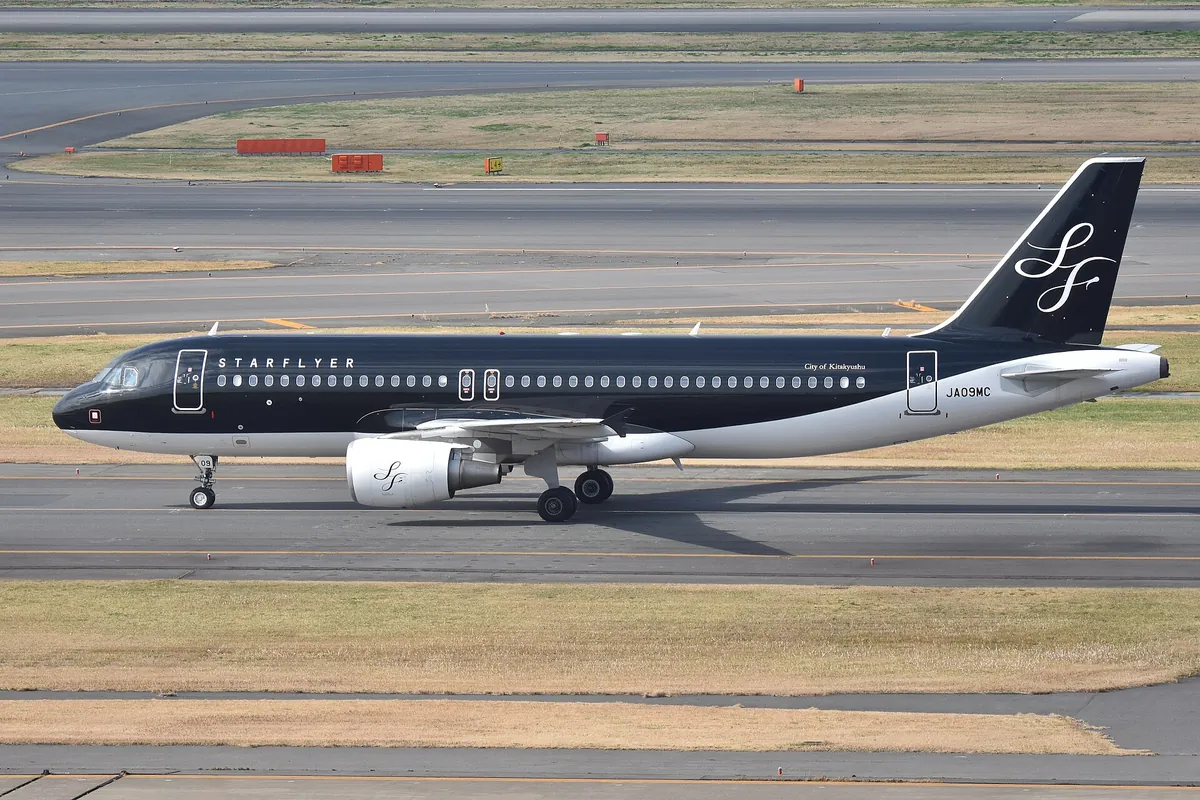
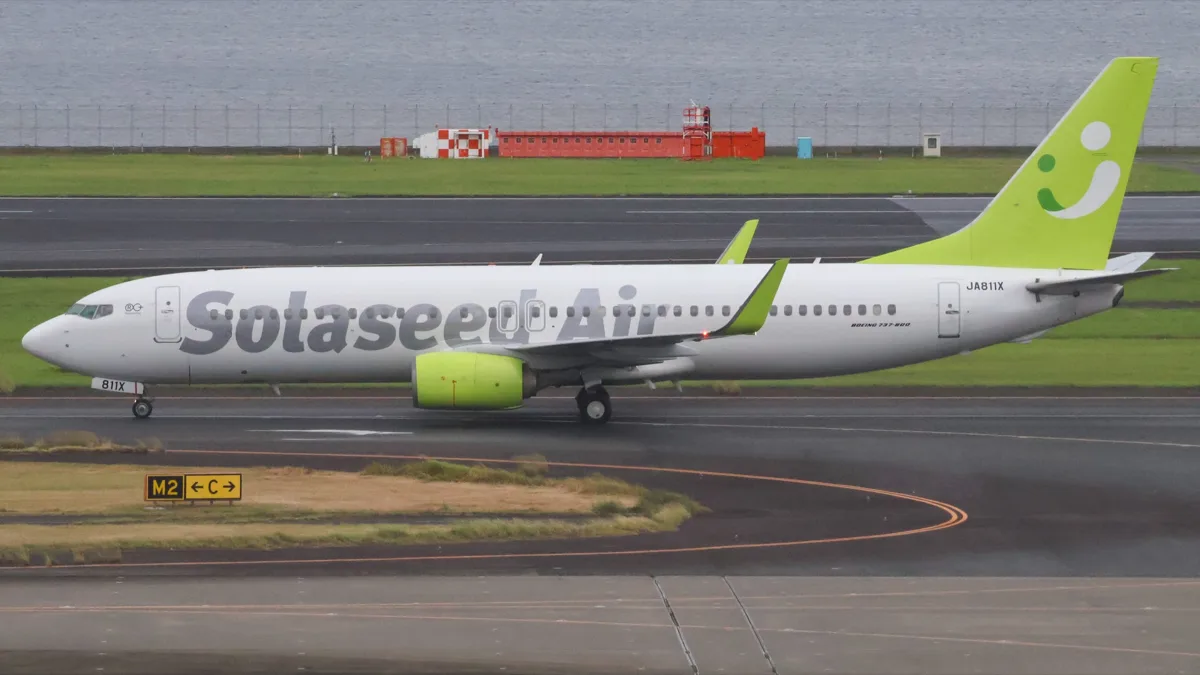
The photo shows a StarFlyer Airbus A320. The ANA domestic aircraft code list includes the partner aircraft. AIRDO flies a Boeing 767-300 with 288 seats, Solaseed Air a Boeing 737-800 with 174 seats, and StarFlyer an A320 with 150 seats.
The StarFlyer seat pitch page says other airlines fit up to 180 seats in the same aircraft, while StarFlyer fits 150. Its A320neo has 162 seats. AIRDO calls its seat pitch characteristically wide, and Solaseed Air promises ample legroom.
Skymark gives a number. The Skymark Airlines in-flight service page puts its seat rows around 31 inches apart, with power outlets under each seat except on certain aircraft. The Skymark Airlines Forward Seat page adds 19 to 38 cm more legroom in the front row, for 1,000 to 2,000 yen per route.
Drinks follow the same pattern. JAL serves its selected drinks free in domestic Economy, which its Japanese pages call 普通席 (futsū-seki, “ordinary seat”). ANA offers a selection of drinks free of charge. Skymark has free drinks plus in-flight sales of snacks from each destination.
Solaseed Air serves soft drinks free and charges for alcohol. StarFlyer pours an original blend coffee made with Tully’s Coffee and lists free Wi-Fi on its A320neo. Our pages for AIRDO, Solaseed Air and StarFlyer cover each airline’s baggage and power bank rules.
Terminals at Haneda, Narita and Kansai
Where you fly from decides which airlines you can pick. The Haneda Airport list of airlines names six domestic airlines: Japan Airlines, ANA, Skymark, AIR DO, Solaseed Air and Star Flyer. Peach appears there only under international flights.
At Haneda, Terminal 1 serves JAL, Skymark and StarFlyer. Terminal 2 serves ANA, AIRDO and Solaseed Air. Terminal 3 is the international terminal, where JAL, ANA and Peach fly abroad. The lookup below matches each terminal with its domestic airlines.

The low-cost airlines fly from Narita and Kansai. Peach uses Narita Terminal 1 and Kansai Terminal 2. Jetstar Japan uses Narita Terminal 3 and Kansai Terminal 1.
The Narita Airport Spring Japan airline page lists Spring Japan at Terminal 3, 2F, for both domestic and international flights. In its winter 2026 schedule, Spring Japan flies from Narita to Saga, Hiroshima and Sapporo (New Chitose).
JAL, ANA and StarFlyer use Kansai Terminal 1. At Narita, JAL uses Terminal 2 and ANA uses Terminal 1.
For trips from Tokyo, this is the real fork. Fly from Haneda and your choice is JAL, ANA or the four mid-size airlines. Pick Peach, Jetstar Japan or Spring Japan and you head to Narita instead. Terminals can change, so check the terminal on your ticket before you set off.
Haneda also has earlier bag deadlines. Skymark and StarFlyer close bag check-in 30 minutes before departure at Haneda and 20 minutes before at other airports. AIRDO moved its Haneda deadline to 30 minutes before departure from 1 September 2026.

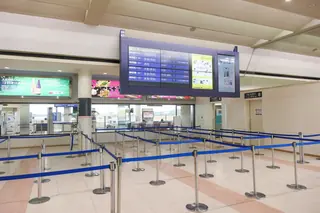
The photo shows the departure hall at Haneda Terminal 1, the domestic terminal for JAL, Skymark and StarFlyer.
Which airline type should you choose?
Your bags and your departure airport decide this more than the brand does. Use the checks below, in this order.
- You are checking a bag: book JAL, ANA or a mid-size airline on a standard fare.
- Several small bags: JAL and Skymark let you check any number of bags within 20 kg in total.
- One or two heavy bags: ANA, AIRDO, Solaseed Air and StarFlyer give two bags of 23 kg each.
- Carry-on only, 7 kg or less: the cheapest low-cost fare works, and you pay nothing for bags.
- Carry-on over 7 kg: fly one of the six 10 kg airlines, or add Jetstar Japan’s +7kg option.
- Flying from Haneda: only the six full-service and mid-size airlines fly domestic routes there.
- Booking a package tour: AIRDO, Solaseed Air and StarFlyer include only one free bag.
The flow chart below runs the first two checks for you.
Weigh your bags at home before you choose. A low-cost fare with a 2,000 yen bag added online can still suit you. A bag added at the gate costs more, as the chart in the checked bag section shows.
Rules change, as AIRDO’s switch on 19 May 2026 shows. Open the airline’s own baggage page before you pay. Our airline database lists the rules for each airline, with links to the pages we checked.
Skymark, LCCs, JAL and ANA: what 98 people in Japan said
On 13–14 October 2026, japan-japan.com ran an online survey of people living in Japan about 32 travel choices. 130 people answered. We removed answers that looked machine-written, one from outside Japan and most of those that contradicted themselves, which left 98. Shares below are of the 98 respondents unless a smaller group is named; they describe these people, not all travellers in Japan. See all 32 comparisons and how we asked.
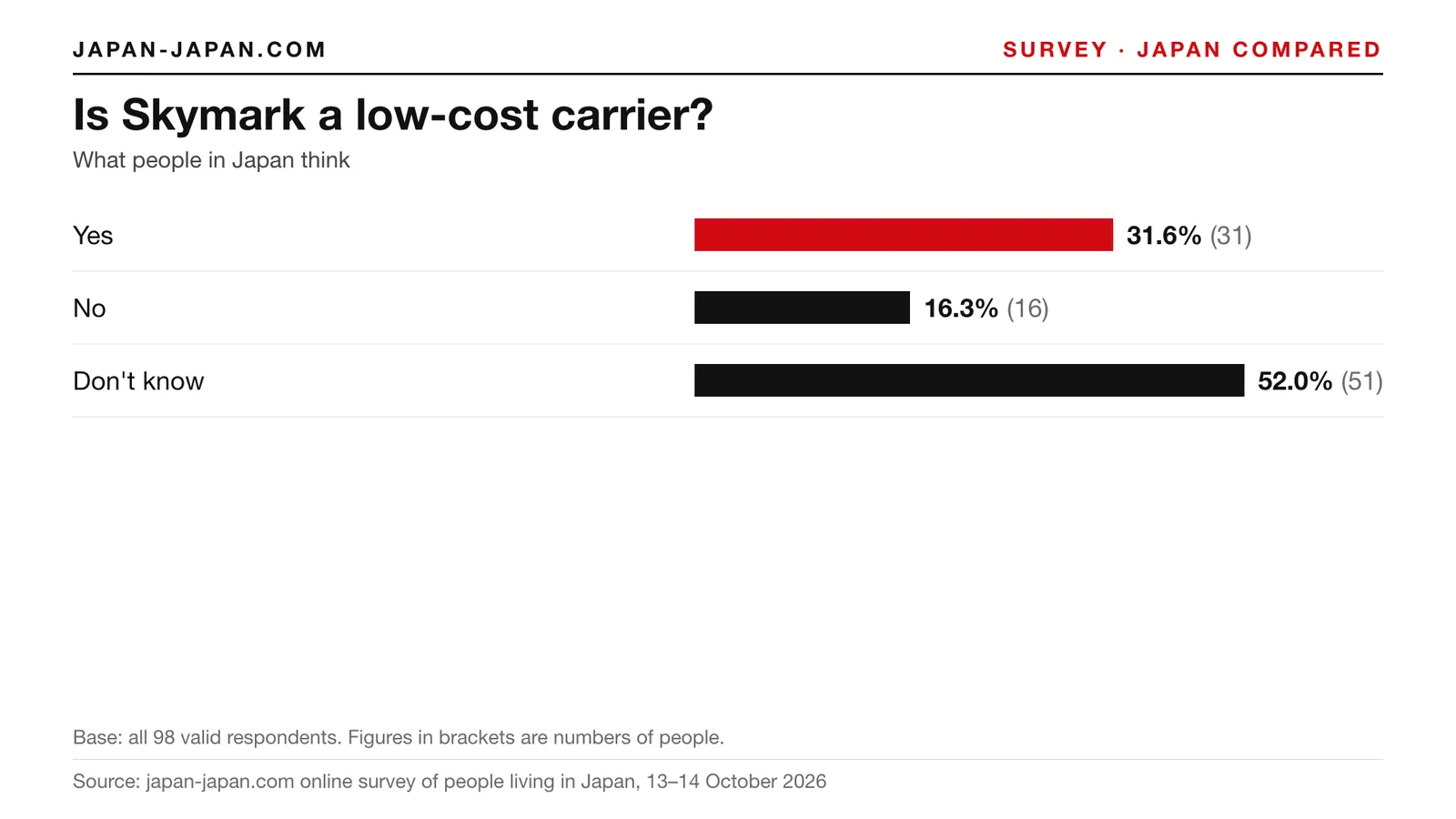
Asked whether Skymark is a low-cost carrier, 31.6% (31 people) said yes, 16.3% (16 people) said no and 52.0% (51 people) did not know. Even people in Japan are split on where it sits, so check the baggage rules above rather than the label.
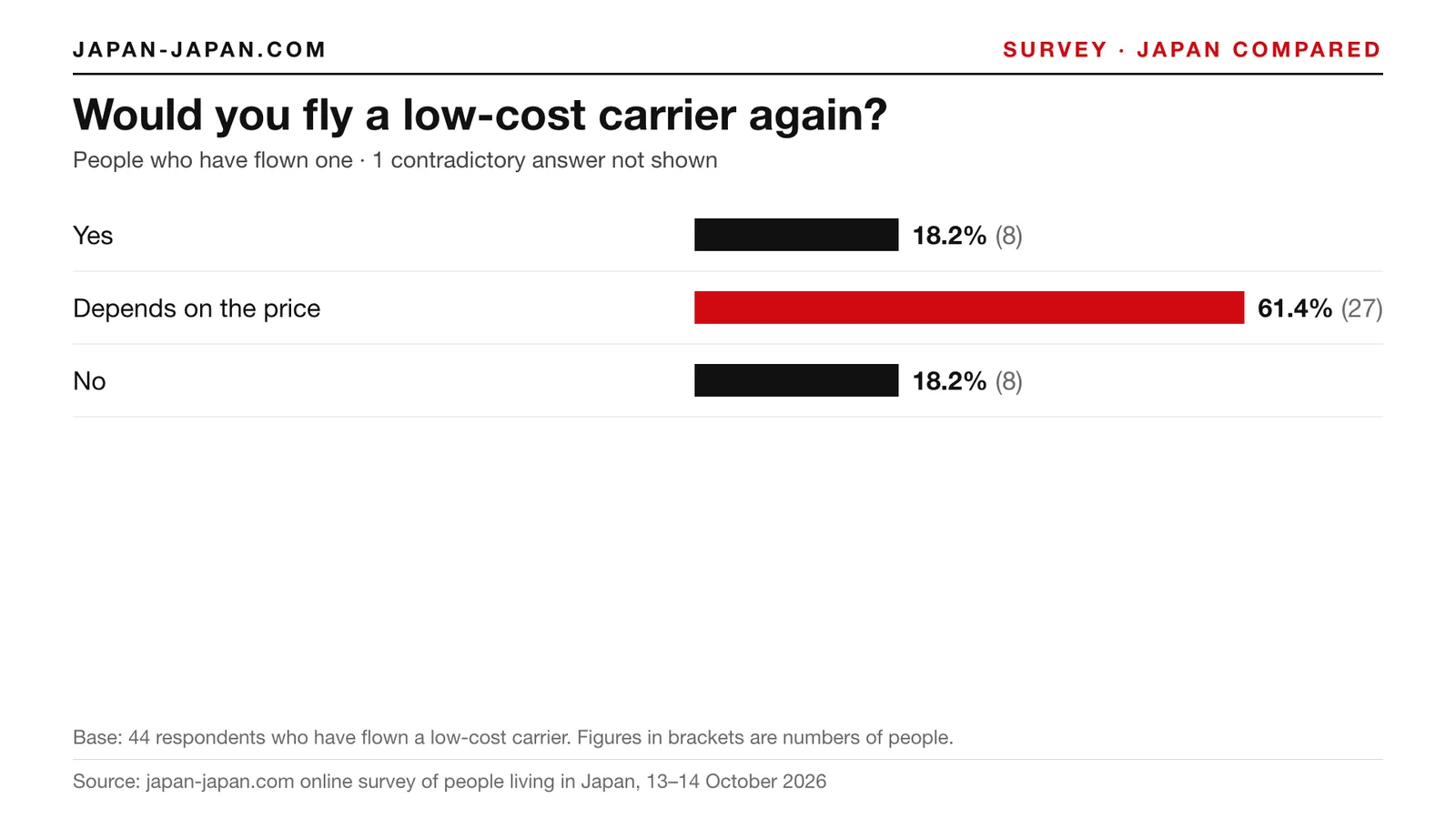
44.9% (44 people) have flown a low-cost carrier, most often Peach (30.6%) and Jetstar Japan (24.5%). Of those 44, 61.4% (27 of 44) said flying one again depends on the price.
Full-service vs low-cost airlines in Japan FAQ
Do low-cost airlines in Japan include a free checked bag?
Not on their cheapest fares. Peach’s Minimum, Jetstar Japan’s basic fare and Spring Japan’s Lucky Spring include no free bag. Peach’s Standard fares include one bag of up to 20 kg, and Spring Japan’s Spring fare includes 20 kg.
Is the carry-on limit 7 kg or 10 kg on Japanese domestic flights?
It depends on the airline. JAL, ANA, Skymark, AIRDO, Solaseed Air and StarFlyer allow 10 kg for a bag plus a personal item. Peach, Jetstar Japan and Spring Japan allow 7 kg. Jetstar Japan’s +7kg option raises its limit to 14 kg.
Can I book AIRDO, Solaseed Air or StarFlyer flights through ANA?
Yes. ANA sells flights operated by all three as codeshares under ANA flight numbers. Check-in, cabin crew and in-flight service follow the operating airline. You check in online on that airline’s website, not on ANA’s.
Which low-cost airlines fly from Haneda on domestic routes?
None of them. Haneda’s domestic list has six airlines: JAL, ANA, Skymark, AIRDO, Solaseed Air and StarFlyer. Peach uses Haneda only for international flights, so low-cost domestic flights leave from Narita or Kansai.
About the author

.jpg)

_Peach_Airbus_A320-251N_JA214P_@_RJAA_2026-06-12.jpg)
.jpg)
.jpg)

_Solaseed_Air_Boeing_737-86N_JA811X_@_RJTT_2026-06-09.jpg)

