Japan Monkey Park 2026-27: Where the Snow Monkeys Bathe
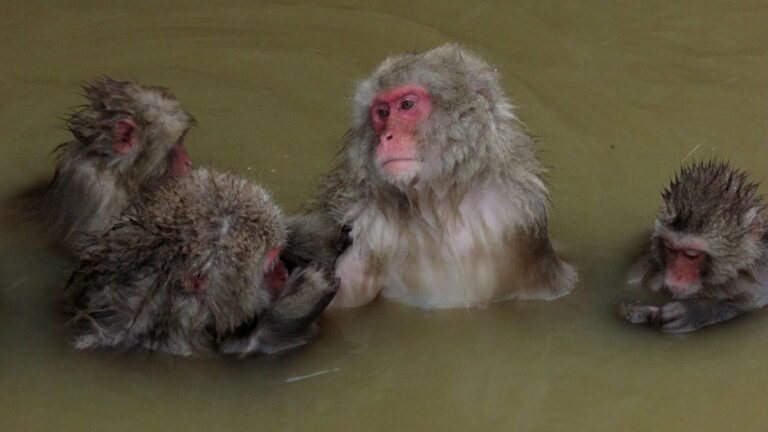
Jigokudani opened in 1964, and the local troop has over 200 monkeys. They live in the mountains around the valley and come down to the park during the day. Staff feed them enough to keep them visiting, but not so much that they depend on people. The park has no fences, so you stand among the monkeys instead of behind glass.
Which monkey park? Jigokudani, Takasakiyama or Inuyama
Three different parks share the name. Searches for monkey park Japan mix them up, so pick the right one before you book a train.
- Jigokudani Monkey Park, Nagano: wild snow monkeys that soak in a hot spring in winter.
- Takasakiyama, Oita: more than 1,000 wild monkeys on a mountain near Beppu in Kyushu.
- Japan Monkey Park, Inuyama: an amusement park with 35 rides, north of Nagoya in Aichi.
The table below compares the three parks on what you see, what you pay and how you get there.
| Park | What you see | Entry | Getting there |
|---|---|---|---|
| Jigokudani, Nagano | Over 200 snow monkeys; bathing Dec to Mar | Adults 800 yen, children 400 yen | 45 min bus from Nagano Station, then a 25-40 min walk |
| Takasakiyama, Oita | More than 1,000 wild monkeys in two troops | Monorail 110 yen round trip | 10 min by bus or taxi from Beppu Station |
| Japan Monkey Park, Inuyama | Amusement park with 35 rides; ice rink in winter | Adults 1,300 yen, children 900 yen | 20 min walk from Meitetsu Inuyama Station |
Only Jigokudani has monkeys in a hot spring. The Go! NAGANO Jigokudani Wild Snow Monkey Park guide calls it the only place in the world where wild monkeys soak in hot spring baths. US magazine Life first showed the monkeys to the world. They later became unofficial mascots of the 1998 Nagano Winter Olympics.
Most of this guide covers Jigokudani. The later sections cover Takasakiyama and Inuyama for readers who meant those parks.
The Japanese name helps at ticket windows and bus stops. Jigokudani Yaen-Koen (地獄谷野猿公苑) means Jigokudani Wild Monkey Park. Show it on your phone if you need to ask staff for the right bus.
Jigokudani Monkey Park tickets and hours
Entry costs 800 yen for adults and 400 yen for children. The park lists group prices on its own website.
Opening hours change with the season. In the green season, April to October, the park opens from 8:30 to 17:00. In the winter season, November to March, it opens from 9:00 to 16:00. Go! NAGANO notes that these seasons are approximate.
The park opens all year and has no regular closing days. It can still close for bad weather, or on days when the monkeys do not come down.
| Place | Jigokudani Wild Snow Monkey Park |
|---|---|
| Price | Adults 800 yen, children 400 yen |
| Hours | Nov to Mar 9:00-16:00; Apr to Oct 8:30-17:00 (seasons approximate). May close in bad weather |
| Access | Express bus from Nagano Station East Exit to Snow Monkey Park stop (45 min), then a 25-40 min forest walk |
| Official site | Go! NAGANO Jigokudani Wild Snow Monkey Park guide |
Snow Monkey Pass prices
Nagano Dentetsu (Nagaden) sells two passes that include park entry. Buy them at the Nagaden ticket window on B1F of Nagano Station.
- Train, local bus and park entry: adults 5,100 yen, children aged 6-12 2,550 yen. It covers Nagaden trains and buses between Nagano and Jigokudani for 1 day.
- Express bus and park entry: adults 6,800 yen, children 3,400 yen. It covers a round trip on the express bus from Nagano Station East Exit.
The express bus pass is new since winter 2025/26. If the park closes for the day, the Nagaden window may stop selling passes until it reopens. Check the park’s website or Facebook page on the morning you go.
When interest peaks
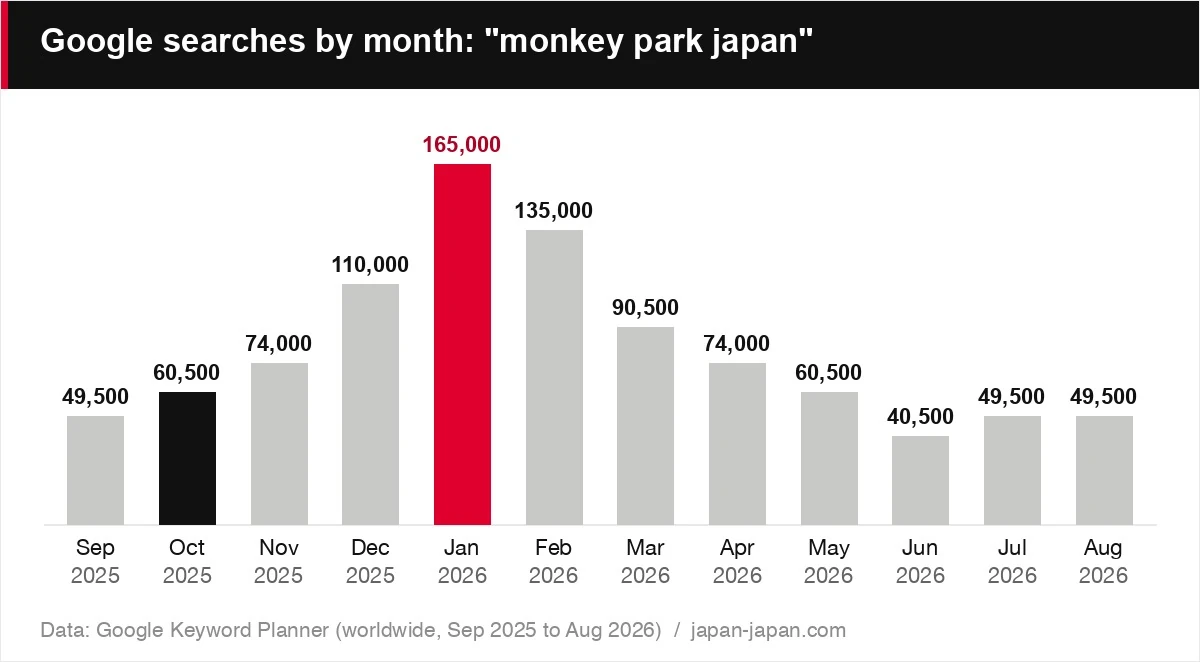
Interest in the park climbs fast before winter. Google Keyword Planner counted 60,500 worldwide searches for monkey park Japan in October 2025 and a peak of 165,000 in January 2026. The chart below shows all 12 months.
| Month | Searches |
|---|---|
| Sep 2025 | 49,500 |
| Oct 2025 | 60,500 |
| Nov 2025 | 74,000 |
| Dec 2025 | 110,000 |
| Jan 2026 | 165,000 |
| Feb 2026 | 135,000 |
| Mar 2026 | 90,500 |
| Apr 2026 | 74,000 |
| May 2026 | 60,500 |
| Jun 2026 | 40,500 |
| Jul 2026 | 49,500 |
| Aug 2026 | 49,500 |
January in the chart had 2.7 times the October searches. The related search jigokudani monkey park tickets averages about 2,400 searches a month. Sort out your route and pass before the January rush of planning.
Getting there from Nagano Station
Every route starts at Nagano Station. The JNTO Snow Monkeys and Hot Springs in Nagano itinerary puts the Hokuriku Shinkansen ride from Tokyo at 1 hour 45 minutes. The fastest Kagayaki is quicker: our Tokyo to Nagano route lists 1 h 17 min for 8,450 yen with a reserved seat.
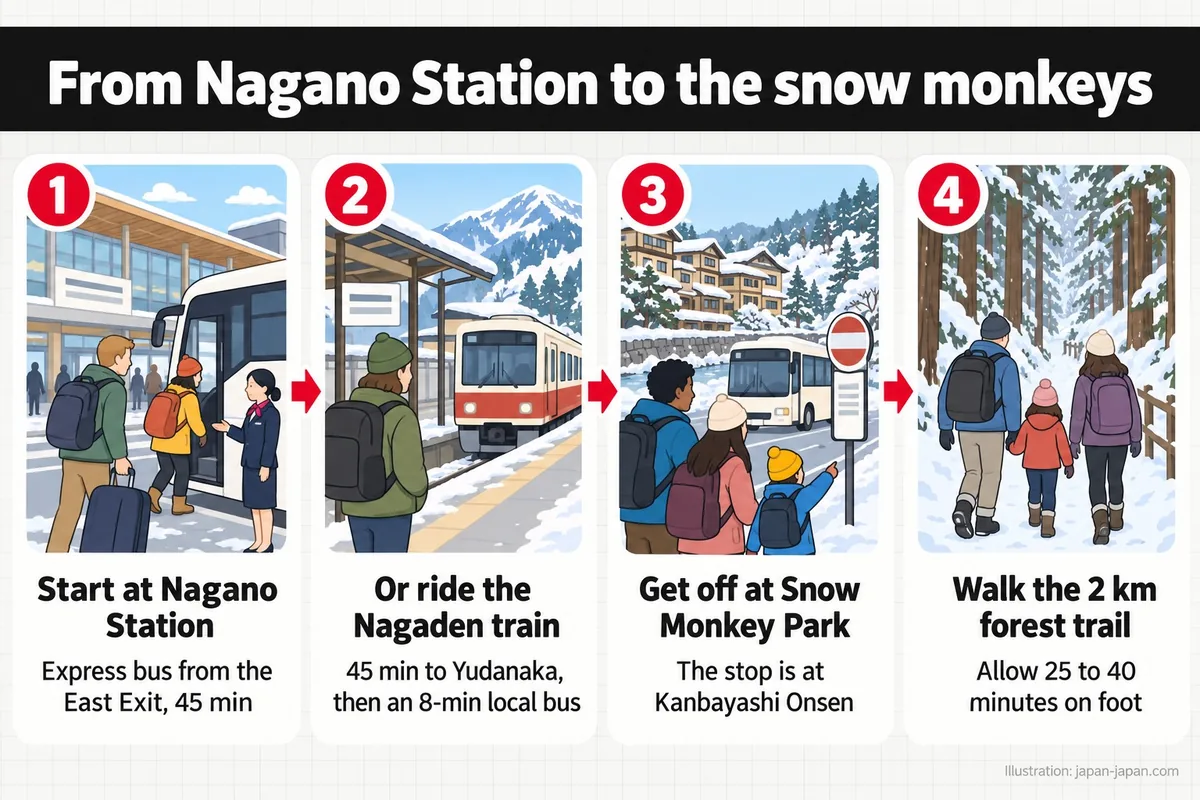
From Nagano Station you have three options: the express bus, the Nagaden train plus a local bus, or a car. The illustration below shows the two public transport routes step by step.
Express bus: the simplest way
Take the Shigakogen line bus from the East Exit of Nagano Station. It reaches the Snow Monkey Park stop in 45 minutes, and the Go! NAGANO guide lists the fare at 3,000 yen. From the stop, the walk to the park takes about 35 minutes.
The JNTO Joshinetsu Kogen National Park access page counts 10 buses a day from Nagano Station toward the park. It gives 40 minutes for the ride to Kanbayashi Onsen, the village at the start of the trail.
Nagaden train and local bus
The Nagano Dentetsu line leaves from B1F of Nagano Station and ends at Yudanaka Station. The Go! NAGANO guide lists the ride at 45 minutes for 1,660 yen. Slower local trains take 70 minutes. At Yudanaka, change to the local bus for the Snow Monkey Park stop, which takes 8 minutes and costs 390 yen.
The photo below shows the Nagaden line that carries visitors to Yudanaka.
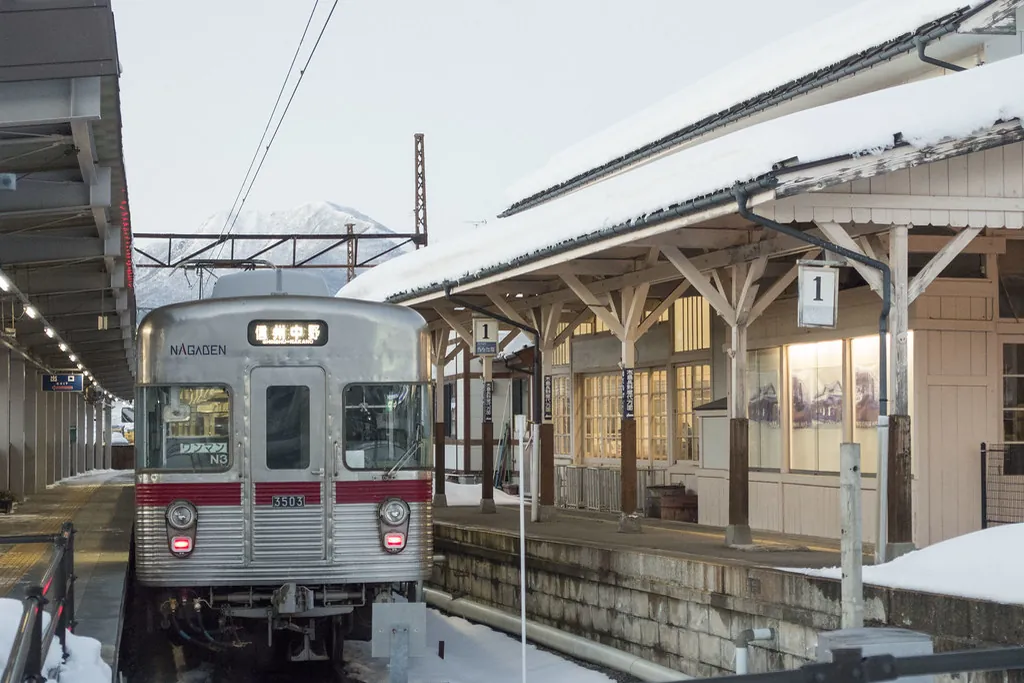
The train passes Obuse, a small town with the Hokusai Museum and many cafes. The 1-day Snow Monkey Pass gives unlimited rides, so you can stop there on the way back.
By car
The parking lot for Jigokudani is about 22 minutes (15km) from the Shinshu Nakano IC exit of the Joshin-etsu Expressway. The Go! NAGANO How to Get to the Snow Monkeys page lists two lots.
- Kanbayashi Onsen Parking Lot: free and open all year, next to Café Enza and the main trailhead.
- Jigokudani Parking Lot: 500 yen and about 15 minutes from the park on foot. It closes from 1 December to 31 March.
In winter you park at Kanbayashi and walk the full trail. Fit snow tyres or chains if you drive in winter.
When the monkeys bathe: winter weather and snow
December to March is the bathing season. The JNTO Jigokudani Snow Monkey Park spot page calls it the usual best time to see the monkeys in the water.
The photo below shows the scene most visitors come for: monkeys sitting in the steaming pool with snow all around.
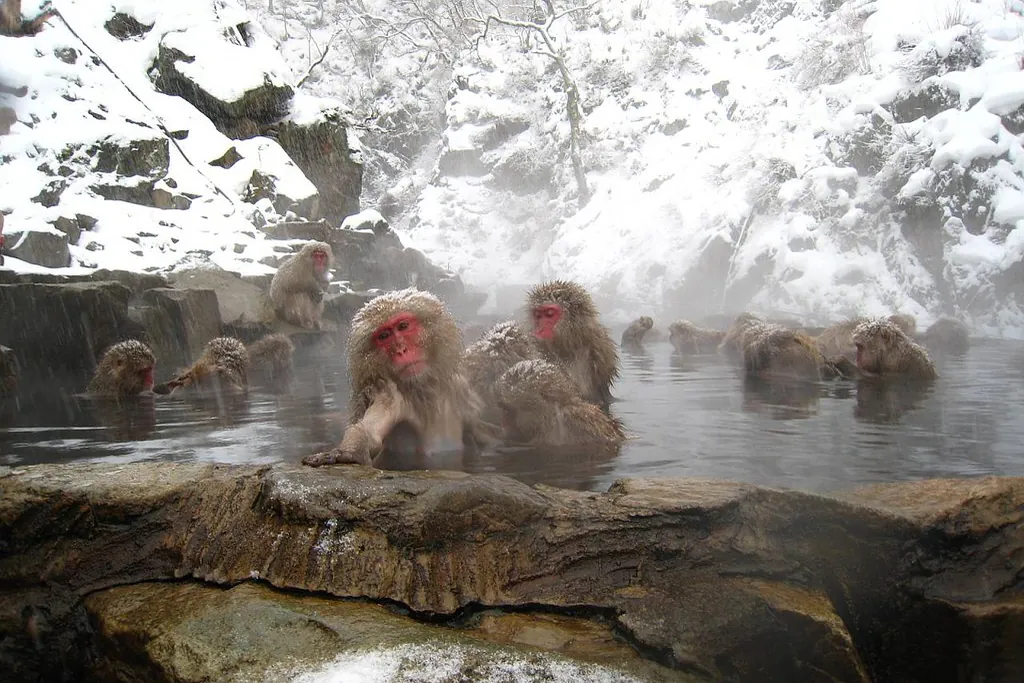
The park opens every month, and each season shows you something different. The illustration below matches the months to what you will see.
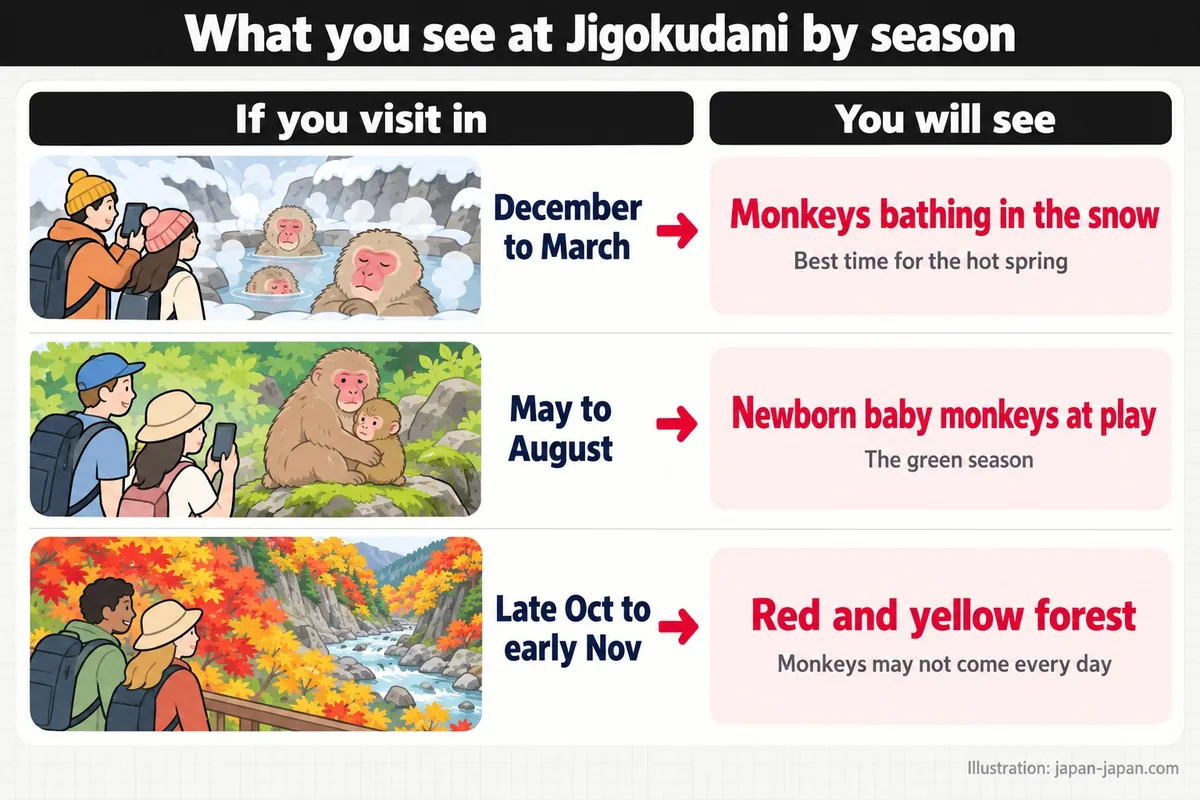
- December to March: snow covers the valley, and the monkeys often soak in the hot spring in the middle of the park.
- May to August: the green season brings newborn baby monkeys at play.
- Late October to early November: the forest turns red and yellow, but the monkeys may visit less regularly.
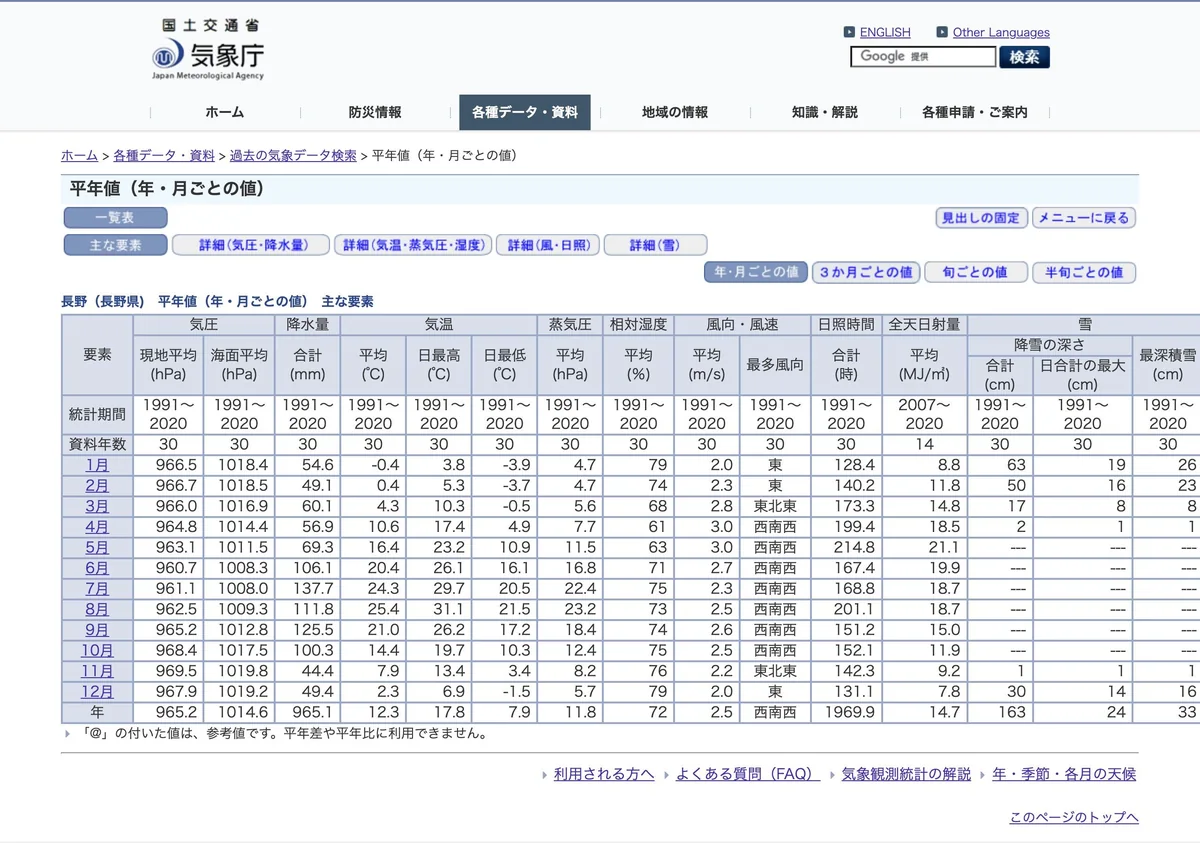
Cold is part of the trip. The Japan Meteorological Agency Nagano climate normals for 1991-2020 show January as the coldest month in Nagano city. The average daily high is 3.8°C and the average daily low is -3.9°C.
February is close behind, with a high of 5.3°C and a low of -3.7°C. December averages 6.9°C and -1.5°C. March warms to 10.3°C and -0.5°C.
Jigokudani sits further into the mountains than Nagano city. JNTO says the valley lies under deep snow for a third of the year, so expect more snow on the trail than in town.
The monkeys also do not visit the park every day. Check the park’s social media accounts before you head out.
The snowy trail: boots, closures and park manners
The last part of every route is on foot. The trail from Kanbayashi Onsen is 2 km long and runs through a quiet cedar forest. JNTO gives 25 to 40 minutes for the walk, and the trail stays open all year.
The photo below shows the forest path on a winter day.
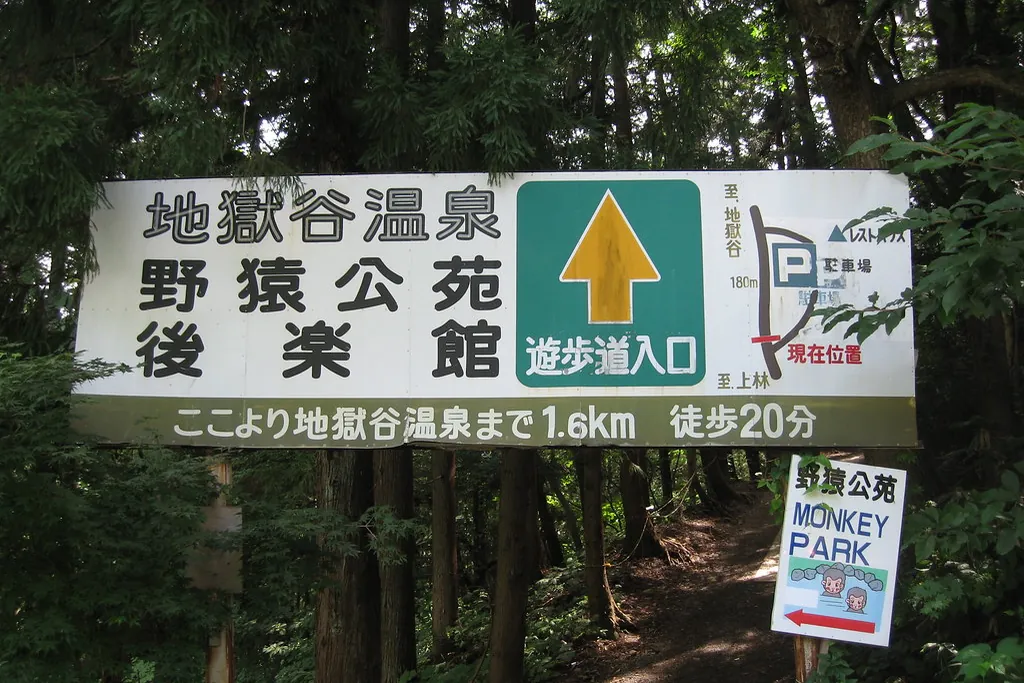
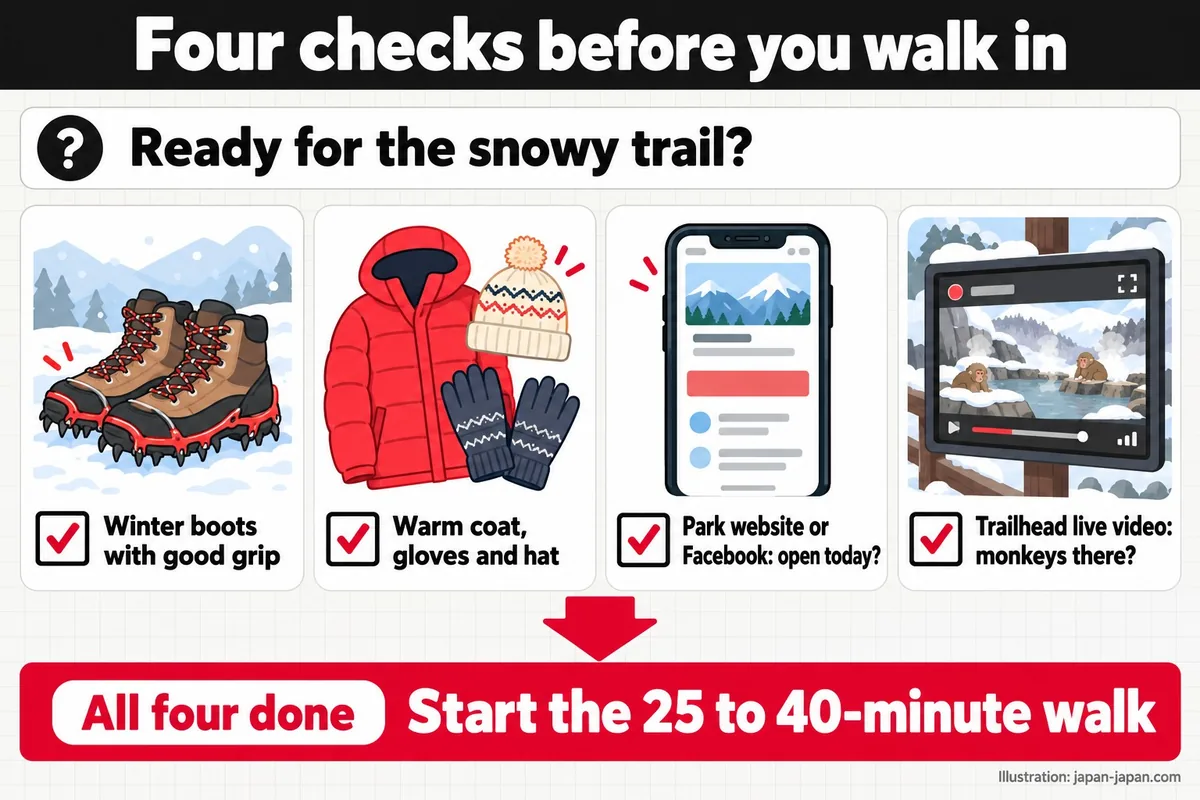
In winter the path is covered in snow and ice. Wear winter boots with good grip. You can rent crampons or a walking stick at the trailhead, or buy crampons at the shop outside it.
Pack warm clothes too. You stand still in the cold while you watch the monkeys and take photos. Our Japan winter packing list covers coats, gloves and footwear.
At the Kanbayashi Onsen trailhead, a live video feed shows whether the monkeys are at the park. Look at it before you start the walk. The illustration below lists four checks to make before you set off.
Closures and a plan B
If the monkeys stay away, the park closes for the day. It posts a notice on its website and Facebook page. This happens most in autumn, when the monkeys are busy in the mountains.
Keep a plan B nearby, such as Togakushi or Obuse. Togakushi is 70 minutes by bus from Nagano Station. Zenkoji Temple is a 20-minute walk or 10-minute bus from the station.
Park manners
These are wild animals, and nothing separates you from them. JNTO lists a few simple rules.
- Do not feed, touch or threaten the monkeys.
- Do not stare into their eyes, since they can take it as aggression.
- Do not get too close, and never step into their bath.
The monkeys are used to people and will mostly ignore you. That is why you can take photos at close range.
Takasakiyama and Japan Monkey Park in Inuyama
Two other parks come up in the same searches. Neither has bathing snow monkeys, but both make good stops on other routes.
Takasakiyama Monkey Park, Oita
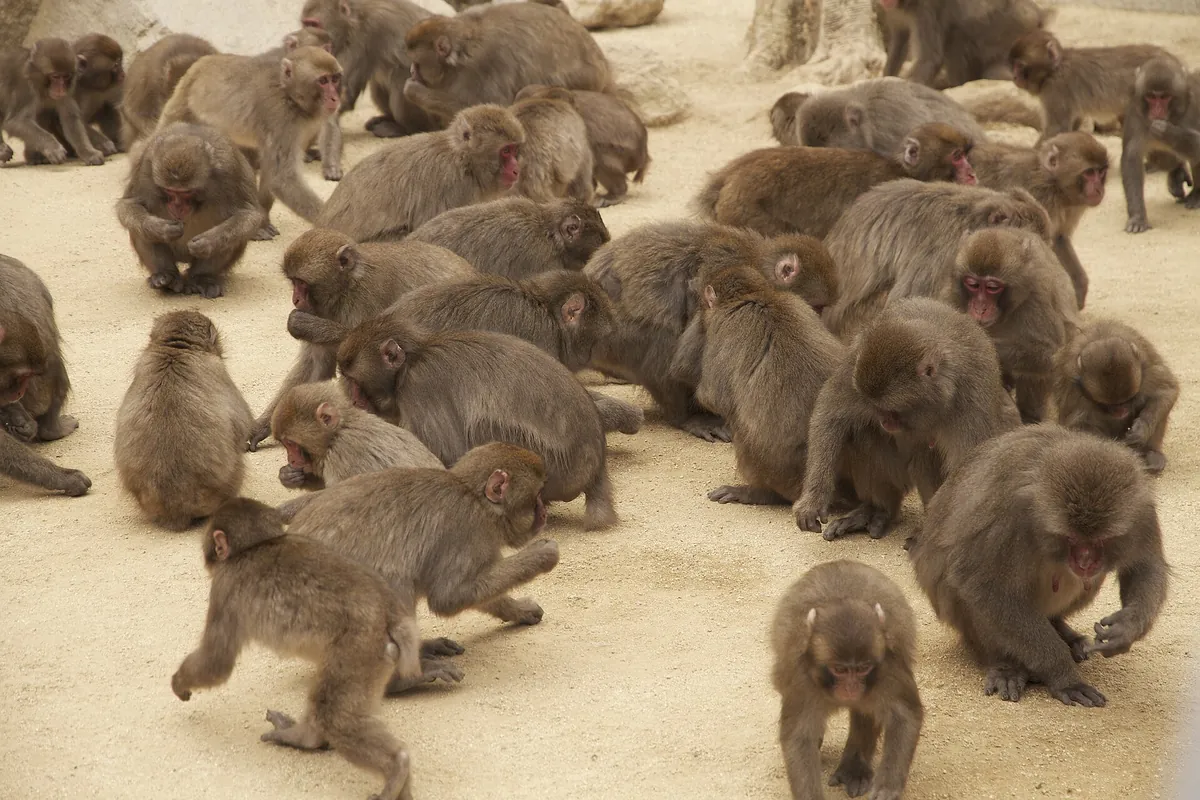
Takasakiyama sits on the steep slopes of a mountain at the western end of Oita city. More than 1,000 wild Japanese macaques live there, in two troops of about 400 to 700. The troops take turns, one in the morning and one in the afternoon.
The park is a 10-minute bus or taxi ride from Beppu Station. Bus AS60 or AS61 toward Oita Station stops at Takasakiyama-Umitamago. Buses run about once an hour, so a taxi is often the better choice.
The JNTO Takasakiyama Monkey Park spot page describes the Sarukko Rail monorail inside the park. It takes 5 minutes and costs 110 yen for a round trip. Staff feed the monkeys wheat every 30 minutes and sweet potatoes twice a day.
The photo below shows the troop gathered on the hillside.
| Place | Takasakiyama Monkey Park |
|---|---|
| Price | Sarukko Rail monorail inside the park: 110 yen round trip |
| Access | 10 min by bus or taxi from Beppu Station; bus AS60 or AS61 to Takasakiyama-Umitamago, about one an hour |
| Official site | JNTO Takasakiyama Monkey Park spot page |
Flying in? Our Oita Airport to Beppu page shows the airport bus at 35 minutes for 1,600 yen. From Kansai, see our Osaka to Beppu route.
Japan Monkey Park, Inuyama
Japan Monkey Park in Inuyama, Aichi, is an amusement park. A one-day passport includes entry and tickets for 35 rides, from roller coasters to a giant Ferris wheel and a merry-go-round. In winter an ice skating rink opens, and in warm months the pool and water park are popular.
The Aichi Now Japan Monkey Park in Inuyama page lists entry at 1,300 yen for adults (junior high school students and older). Children aged 2 and older pay 900 yen. The Japan Monkey Centre needs a separate ticket, and hours are 10:00 to 16:00.
From Nagoya Station, take the Meitetsu Inuyama Line to Inuyama Station. Walk 20 minutes east, or take the community bus to the Nihon Monkipaku stop. You can see most of the park in 2 hours, but give it at least half a day.
| Place | Japan Monkey Park (Inuyama) |
|---|---|
| Price | Adults (junior high and older) 1,300 yen, children (2 and older) 900 yen |
| Hours | 10:00-16:00 |
| Access | Meitetsu Inuyama Line from Nagoya Station to Inuyama Station, then a 20-min walk east |
| Official site | Aichi Now Japan Monkey Park in Inuyama |
Fitting the snow monkeys into a winter trip
Most visitors base themselves in Nagano city or in the hot spring towns below the park. Each choice suits a different kind of trip.
Day trip from Tokyo
Go! NAGANO says you can visit the monkeys as a day trip from Tokyo. The first Kagayaki leaves Tokyo Station at 06:16. In winter the park closes at 16:00, so aim to reach the trailhead by early afternoon.
A rail pass can cover the Shinkansen leg. The JR EAST PASS covers all JR East lines, including the Shinkansen, from 35,000 yen for 5 days. The Hokuriku Arch Pass covers the Hokuriku Shinkansen from Tokyo to Tsuruga, from 35,000 yen for 7 days. For the last leg from Nagano, use the Snow Monkey Pass.
From Kyoto or Osaka, JNTO routes you on the Thunderbird limited express to Tsuruga, then the Hokuriku Shinkansen, about 4 hours in total. Our Kyoto to Nagano route shows the trains.
Stay in Shibu Onsen or Yudanaka
The JNTO itinerary runs over 2 days, with a night in Shibu Onsen. A bus from the Snow Monkey Park stop to Shibu Onsen takes 5 minutes. Guests in Yudanaka-Shibu Onsen can use all nine public bathhouses around town. Kanaguya, one of the best known ryokan there, has over 200 years of history.
Add skiing
Shiga Kogen and Nozawa Onsen are both about 30 minutes by bus from Kanbayashi Onsen. Shiga Kogen rises above 2,000 meters and offers skiing from late December to early May. Local tour operators also run snow monkey trips from Hakuba, Nozawa Onsen and Myoko Kogen. For more snow trips, see our Japan in winter guide.
Pick your month
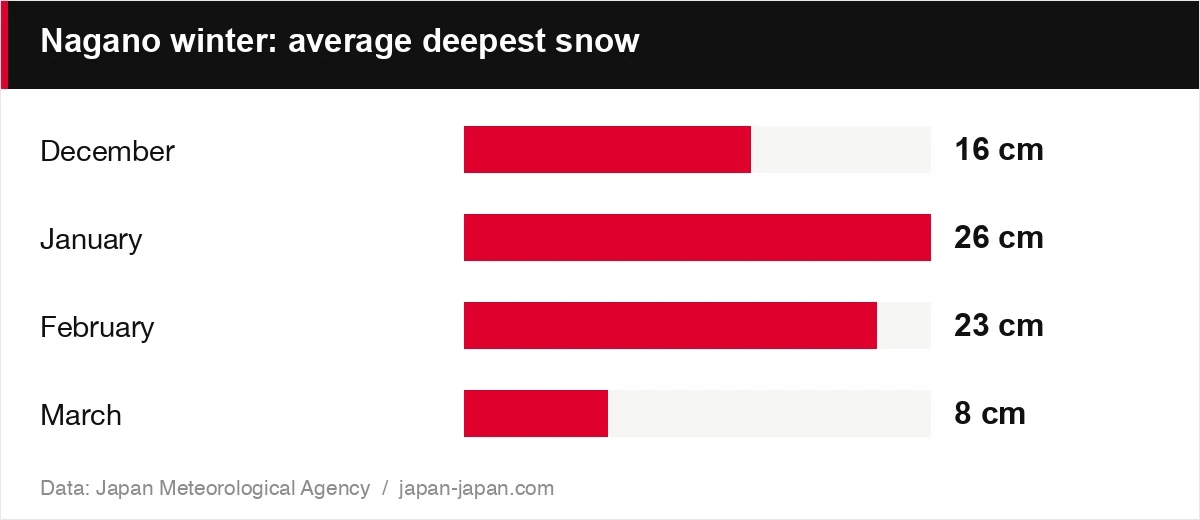
January is the snowiest month in Nagano city as well as the coldest, with an average deepest snow of 26 cm. The chart below shows the average deepest snow on the ground in each winter month.
| Item | Value |
|---|---|
| December | 16 cm |
| January | 26 cm |
| February | 23 cm |
| March | 8 cm |
The bars in the chart drop fast after February. February averages 23 cm, December 16 cm and March 8 cm.
The screenshot below shows the Japan Meteorological Agency table of 1991-2020 normals for Nagano. The temperature and snow figures in this guide come from the Japan Meteorological Agency normals.
Holidays fill trains and inns. New Year’s Day 2027 falls on Friday 1 January, and banks close from 31 December to 3 January. Our New Year 2026-27 guide lists closures, and our February holiday calendar covers later in the winter.
FAQ
Can you see the snow monkeys bathing in November?
December to March is the main bathing season, so November is early. In late October and early November, the monkeys may not visit the park as regularly. Check the park’s social media before you go.
How long is the walk to Jigokudani Monkey Park?
The trail from Kanbayashi Onsen is 2 km long. JNTO gives 25 to 40 minutes, and Go! NAGANO gives 35 to 40 minutes from the Snow Monkey Park bus stop. In winter the trail is snowy and icy, so allow extra time and wear boots with grip.
Can you visit Jigokudani Monkey Park as a day trip from Tokyo?
Yes. The fastest Kagayaki reaches Nagano in 1 h 17 min, and the express bus to the Snow Monkey Park stop takes 45 minutes. Add the forest walk, and leave early because the park closes at 16:00 in winter.
Is the Snow Monkey Pass worth it?
It saves you buying a ticket at each step. The train and local bus pass costs 5,100 yen for adults and gives unlimited Nagaden rides for 1 day, so you can stop at Obuse. The express bus pass costs 6,800 yen and covers the round trip plus entry. Buy either at the Nagaden window on B1F of Nagano Station.
About the author