7-Eleven Japan Survey: What 86 People Living in Japan Buy
We matched the picks against our 7-Eleven Japan food database. Of the 10 most-recommended items that map to one product, 7 cost under ¥200 before tax. The shares show what respondents would recommend, not what sells best.
How we asked 86 people living in Japan
japan-japan.com ran an online survey of people living in Japan. We received 122 answers between 13:53 on 18 October and 08:02 on 21 October 2026, Japan time.
We removed 36. In 6, the written answers looked machine-written. One failed the attention check. Another 29 clearly contradicted themselves, such as saying they never buy something and then naming one.
That left 86 valid answers, all of which passed the attention check. We kept a few answers with smaller contradictions.
The questionnaire had 87 questions: 82 multiple-choice, including one uncounted attention check, and 5 required free-text questions. Four questions named Seven-Eleven Japan’s list prices, checked on 17 October 2026.
Follow-up questions count only the people they applied to, such as the 84 who go to 7-Eleven. For groups under 10 we give numbers of people. Under 30, read the percentages as a rough guide.
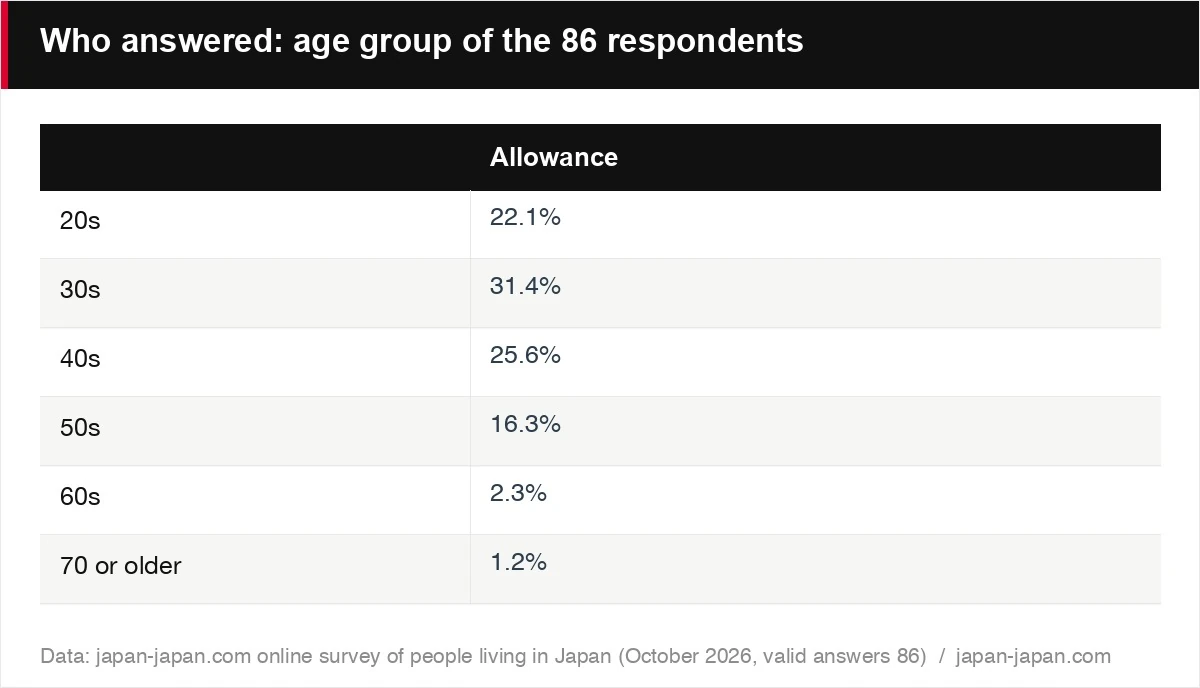
Most respondents were women: 71 of 86, or 82.6%. People in their 30s were the largest age group at 31.4% (27 of 86), as the chart below shows.
| Item | Value | Note |
|---|---|---|
| 20s | 22.1 % | 19 of 86 |
| 30s | 31.4 % | 27 of 86 |
| 40s | 25.6 % | 22 of 86 |
| 50s | 16.3 % | 14 of 86 |
| 60s | 2.3 % | 2 of 86 |
| 70 or older | 1.2 % | 1 of 86 |
| Prefer not to say | 1.2 % | 1 of 86 |
By region, Kyushu led at 22.1% (19 of 86), then Kanto outside Tokyo at 18.6% (16 of 86) and Tokyo at 16.3% (14 of 86). The largest group, 38.4% (33 of 86), lives in the suburbs of a regional city.
The survey has limits. It was an open online call, so it does not represent everyone in Japan. Respondents live in Japan and are not visitors. Their answers about visitors are what they have noticed, not counts.
How to cite: japan-japan.com online survey of people living in Japan (October 2026, valid answers 86).
The full questionnaire (all 87 questions, translated from Japanese)
Respondents saw every question in Japanese, and every question was shown to everyone. Follow-up questions were counted only among people the question applied to. Q45 was an attention check and is not counted. Questions 79 to 83 were required free-text questions.
- Q1. Which convenience store do you use most often? (choose one)
7-Eleven / Lawson / FamilyMart / Ministop / Daily Yamazaki / Seicomart / Other / I rarely use convenience stores - Q2. How often do you go to 7-Eleven? (choose one)
Almost every day / 3–4 times a week / 1–2 times a week / 2–3 times a month / About once a month / A few times a year / I don’t go - Q3. How much do you usually spend per visit at 7-Eleven? (choose one)
Under ¥300 / ¥300–499 / ¥500–799 / ¥800–999 / ¥1,000–1,499 / ¥1,500 or more / I don’t go to 7-Eleven - Q4. Why do you choose 7-Eleven? (choose all that apply)
Close to home or work / Tasty onigiri and bento / Tasty desserts / Seven Premium products / Seven Cafe / ATMs / nanaco and app points / Wide selection / Stores everywhere / Other / No particular reason / I don’t go to 7-Eleven - Q5. How many minutes’ walk is the nearest convenience store from your home? (choose one)
3 minutes or less / 4–5 minutes / 6–10 minutes / 11–20 minutes / 21 minutes or more / Not sure - Q6. How do you choose between 7-Eleven, Lawson and FamilyMart? (choose one)
I go to the nearest one / I choose by what I want to buy / I choose by points or coupons / I go to almost only one chain / I rarely use convenience stores - Q7. Do you buy your everyday breakfast at a convenience store? (choose one)
Almost every day / 3–4 times a week / 1–2 times a week / A few times a month / Rarely / I don’t eat breakfast - Q8. What do you buy for breakfast at convenience stores? (choose all that apply)
Onigiri / Sandwiches / Bread and buns / Salad / Yogurt / Soup / Boiled eggs / Fruit such as bananas / Coffee / Other drinks / Other / I don’t buy breakfast at convenience stores - Q9. What do you often buy at 7-Eleven? (choose all that apply)
Onigiri / Sandwiches / Bread and buns / Bento / Noodles (soba, ramen, etc.) / Salads and side dishes / Fried foods (hot snacks) / Oden / Steamed buns (chukaman) / Desserts / Ice cream / Cup noodles / Snacks / Seven Cafe (coffee, etc.) / Bottled drinks / Alcohol / Frozen food / Daily necessities / I don’t go to 7-Eleven - Q10. How much do you usually spend on lunch at a convenience store, including drinks? (choose one)
Under ¥300 / ¥300–499 / ¥500–699 / ¥700–899 / ¥900–1,099 / ¥1,100 or more / I don’t buy lunch at convenience stores - Q11. Which 7-Eleven items would you recommend to a foreign friend visiting Japan? (choose all that apply)
THE Egg Sandwich / Mixed sandwich / Tuna mayonnaise onigiri / Charcoal-grilled salmon onigiri (red or silver salmon) / Spicy cod roe (mentaiko) onigiri / Seven Premium Gold hamburg steak (Kin no Hamburg) / Agedori (fried chicken thigh) / Nana Chiki (boneless fried chicken) / Oden / Nikuman and other steamed buns / Seven Cafe coffee or cafe latte / Seven Cafe smoothie / Vanilla custard cream puff / Custard eclair / Creamy cheesecake / Seven Premium custard pudding / Matcha desserts / Seven Premium Marude Kanjuku Mango ice bar (frozen mango) / Seven Premium waffle cone ice cream / Mouko Tanmen Nakamoto spicy miso cup noodle / Sugar Butter Tree (sandwich cookies) / Gumi Maru Shine Muscat gummies / Pitted crunchy pickled plums (karikari ume) / Seven Premium Gold bread (Kin no Shokupan) / Melon pan (soft sweet bun) / Seven Premium frozen fried rice / Other / Nothing I’d recommend / Not sure - Q12. Of those, which one would you recommend most? (choose one)
THE Egg Sandwich / Mixed sandwich / Tuna mayonnaise onigiri / Charcoal-grilled salmon onigiri (red or silver salmon) / Spicy cod roe (mentaiko) onigiri / Seven Premium Gold hamburg steak (Kin no Hamburg) / Agedori (fried chicken thigh) / Nana Chiki (boneless fried chicken) / Oden / Nikuman and other steamed buns / Seven Cafe coffee or cafe latte / Seven Cafe smoothie / Vanilla custard cream puff / Custard eclair / Creamy cheesecake / Seven Premium custard pudding / Matcha desserts / Seven Premium Marude Kanjuku Mango ice bar (frozen mango) / Seven Premium waffle cone ice cream / Mouko Tanmen Nakamoto spicy miso cup noodle / Sugar Butter Tree (sandwich cookies) / Gumi Maru Shine Muscat gummies / Pitted crunchy pickled plums (karikari ume) / Seven Premium Gold bread (Kin no Shokupan) / Melon pan (soft sweet bun) / Seven Premium frozen fried rice / Other / Nothing I’d recommend / Not sure - Q13. Do you like 7-Eleven’s THE Egg Sandwich? (choose one)
I love it / I like it / It’s OK / I don’t really like it / I’ve never tried it - Q14. What is your favourite convenience-store onigiri filling? (choose one)
Tuna mayonnaise / Salmon / Spicy cod roe (mentaiko) or plain cod roe (tarako) / Pickled plum (ume) / Kelp (kombu) / Bonito flakes (okaka) / Salmon roe (ikura) / Meat such as minced chicken / Other / I don’t buy convenience-store onigiri - Q15. What is the most you would pay for one convenience-store onigiri? (choose one)
Up to ¥150 / Up to ¥180 / Up to ¥200 / Up to ¥250 / Up to ¥300 / I’d pay more than ¥300 / Price doesn’t matter to me / I don’t buy convenience-store onigiri - Q16. Can you open a hand-rolled onigiri wrapper without tearing the nori? (choose one)
Yes, always neatly / The nori sometimes tears / The nori often tears / I don’t buy hand-rolled onigiri - Q17. Which fried hot snack from the convenience-store counter do you like best? (choose one)
Nana Chiki (7-Eleven) / Agedori (7-Eleven) / Spicy chicken (7-Eleven) / Famichiki (FamilyMart) / Karaage-kun (Lawson) / L-Chiki (Lawson) / Other / I don’t buy fried foods - Q18. In the cold season, what do you buy from the convenience-store counter? (choose all that apply)
Oden / Steamed buns (nikuman, etc.) / Fried foods / Yakitori / Roasted sweet potatoes / Hot drinks / Other / I don’t buy from the counter - Q19. Which convenience-store oden item would you recommend first to a foreign friend? (choose one)
Daikon radish / Egg / Shirataki noodles / Konjac (konnyaku) / Thick fried tofu (atsuage) / Chikuwa fish cake / Sausage wrapped in fish cake / Beef tendon / Fish balls (tsumire) / Chicken meatballs (tsukune) / Fried tofu fritter (ganmo) / Fried fish cake (satsuma-age) / Hanpen fish cake / Chikuwabu (wheat dumpling) / Other / I wouldn’t recommend oden / Not sure - Q20. What have you bought at Seven Cafe? (choose all that apply)
Hot coffee / Iced coffee / Cafe latte / Smoothie / Tea (black tea) / I don’t use Seven Cafe - Q21. Have you tried a Seven Cafe smoothie (you take a frozen cup from the freezer, pay at the register and blend it in the machine)? (choose one)
Yes, often / Yes, I have / I know about it but haven’t tried it / I didn’t know about it - Q22. Which convenience-store desserts would you recommend to a foreign friend? (choose all that apply)
Pudding / Cream puffs / Eclairs / Cheesecake / Roll cake / Crepes / Dorayaki / Daifuku or ohagi / Warabimochi / Dango / Matcha desserts / Ice cream / Other / I wouldn’t recommend desserts - Q23. What alcoholic drinks do you buy at convenience stores? (choose all that apply)
Beer / Happoshu or other beer-like drinks / Canned chuhai or sours / Highballs / Sake / Wine / Plum wine (umeshu) / Non-alcoholic beer, etc. / Other / I don’t buy alcohol at convenience stores - Q24. Which matcha products have you bought at 7-Eleven? (choose all that apply)
Matcha desserts (crepes, Japanese sweets, etc.) / Matcha ice cream or frozen desserts / Matcha snacks (chocolate, langue de chat, etc.) / Drinks such as matcha latte / Green tea with matcha / Other matcha products / I’ve never bought matcha products - Q25. What kind of matcha flavour do you like in matcha products? (choose one)
Strong, bitter matcha / About half sweet, half bitter / Sweet and milky / I don’t like matcha flavour / Not sure - Q26. If you recommended one convenience-store matcha product to a foreign friend, which would it be? (choose one)
Matcha desserts / Matcha ice cream or frozen desserts / Matcha snacks / Drinks such as matcha latte / Green tea with matcha / I wouldn’t recommend any / Not sure - Q27. Do you buy cup noodles at convenience stores? (choose one)
At least once a week / A few times a month / Occasionally / I don’t buy them - Q28. If you recommended one 7-Eleven cup noodle to a foreign friend, which would it be? (choose one)
Mouko Tanmen Nakamoto spicy miso cup noodle / Ippudo Akamaru Hakata tonkotsu cup noodle / Sumire Sapporo rich miso cup noodle / Chuka Soba Tomita rich tonkotsu cup noodle / Iida Shoten wonton soy sauce cup noodle / Seven Premium standards such as soy sauce cup noodle / Standard cup noodles from major makers / Other / I wouldn’t recommend any / Not sure - Q29. Have you tried Mouko Tanmen Nakamoto spicy miso cup noodle? (choose one)
Yes, and it was too spicy / Yes, spicy but tasty / Yes, less spicy than I expected / I’ve never tried it - Q30. Have you ever made cup noodles with the hot water in a convenience store? (choose one)
Yes, often / Yes / No / I didn’t know stores had hot water - Q31. Which convenience-store snacks would you recommend to a foreign friend as souvenirs? (choose all that apply)
Gummies / Chocolate / Cookies or langue de chat / Potato chips and other savoury snacks / Rice crackers (senbei or okaki) / Dried or crunchy pickled plums / Nuts / Matcha-flavoured snacks / Other / Nothing I’d recommend - Q32. Which 7-Eleven snacks (Seven Premium) have you tried? (choose all that apply)
Sugar Butter Tree (sandwich cookies) / Gumi Maru Shine Muscat gummies / Chocolat Gelee Shine Muscat (chocolate) / Seven Premium matcha langue de chat cookies / Pitted crunchy pickled plums (karikari ume) / Unsalted roasted mixed nuts / Bite-size soy sauce rice crackers (senbei) / Crunchy corn snack (Karikari Corn) / I haven’t tried any of these - Q33. Of those, which one would you recommend to a foreign friend? (choose one)
Sugar Butter Tree (sandwich cookies) / Gumi Maru Shine Muscat gummies / Chocolat Gelee Shine Muscat (chocolate) / Seven Premium matcha langue de chat cookies / Pitted crunchy pickled plums (karikari ume) / Unsalted roasted mixed nuts / Bite-size soy sauce rice crackers (senbei) / Crunchy corn snack (Karikari Corn) / I haven’t tried any of these / Nothing I’d recommend - Q34. Do you feel convenience-store prices have gone up over the past year? (choose one)
Gone up a lot / Gone up a little / No change / Gone down / Not sure - Q35. For which items do you feel the price rises most? (choose all that apply)
Onigiri / Bento / Sandwiches / Bread and buns / Fried foods / Desserts / Snacks / Cup noodles / Coffee / Bottled drinks / Alcohol / Other / Nothing in particular - Q36. Since prices went up, has the amount you buy at convenience stores changed? (choose one)
I buy less / I buy a little less / No change / I buy more / I haven’t noticed price rises - Q37. 7-Eleven’s Tuna Mayonnaise hand-rolled onigiri costs ¥182 before tax (about ¥197 with tax). How does this price feel to you? (choose one)
Cheap / About right / A little expensive / Expensive / Not sure - Q38. 7-Eleven’s THE Egg Sandwich costs ¥278 before tax (about ¥300 with tax). How does this price feel to you? (choose one)
Cheap / About right / A little expensive / Expensive / Not sure - Q39. 7-Eleven’s Nana Chiki costs ¥232 before tax (about ¥251 with tax). How does this price feel to you? (choose one)
Cheap / About right / A little expensive / Expensive / Not sure - Q40. 7-Eleven’s Seven Cafe hot coffee (R) costs ¥130 before tax (about ¥140 with tax). How does this price feel to you? (choose one)
Cheap / About right / A little expensive / Expensive / Not sure - Q41. How do 7-Eleven’s prices feel compared with Lawson and FamilyMart? (choose one)
More expensive / A little more expensive / About the same / A little cheaper / Cheaper / Not sure - Q42. Which convenience store do you think has the tastiest onigiri and bento? (choose one)
7-Eleven / Lawson / FamilyMart / Ministop / Another chain / They’re all about the same / Not sure - Q43. Which convenience store do you think has the tastiest fried hot snacks? (choose one)
7-Eleven / Lawson / FamilyMart / Ministop / Another chain / They’re all about the same / Not sure - Q44. Which convenience store do you think has the tastiest desserts? (choose one)
7-Eleven / Lawson / FamilyMart / Ministop / Another chain / They’re all about the same / Not sure - Q45. This is an attention-check question. Please choose “Thursday”. (choose one)
Monday / Tuesday / Wednesday / Thursday / Friday / Saturday / Sunday - Q46. Which convenience store do you think has the best coffee? (choose one)
7-Eleven / Lawson / FamilyMart / Ministop / Another chain / They’re all about the same / Not sure - Q47. Which convenience store do you think has the best own-brand (private-label) snacks and frozen foods? (choose one)
7-Eleven / Lawson / FamilyMart / Ministop / Another chain / They’re all about the same / Not sure - Q48. Which convenience store would you most recommend to a foreign friend visiting Japan? (choose one)
7-Eleven / Lawson / FamilyMart / Ministop / Another chain / They’re all about the same / Not sure - Q49. How do you pay most often at convenience stores? (choose one)
Cash / Credit card (inserted) / Contactless phone or card payment (Apple Pay, iD, etc.) / Transit IC card (Suica, etc.) / nanaco / PayPay / Barcode payment apps other than PayPay / Other - Q50. How often do you pay in cash at convenience stores? (choose one)
Almost always cash / Cash more than half the time / Cash less than half the time / I hardly ever use cash - Q51. Do you use self-checkout at convenience stores? (choose one)
Every time / Sometimes / No / Not available at stores near me - Q52. Which ATMs do you use most often to withdraw cash? (choose one)
Bank branches or ATM corners / 7-Eleven ATMs (Seven Bank) / Lawson ATMs / FamilyMart ATMs / Post office ATMs / ATMs at stations, supermarkets, etc. / I rarely withdraw cash - Q53. What have you done at a Seven Bank ATM? (choose all that apply)
Withdrawing cash / Depositing cash / Smartphone ATM (withdrawing with an app, no card) / Topping up PayPay or other payment apps with cash / Topping up a transit IC card / Topping up nanaco / Credit card cash advance / I’ve never used a Seven Bank ATM - Q54. Do you care about ATM fees? (choose one)
I choose times or ATMs with no fee / I care a little / I don’t care / I don’t use ATMs - Q55. Have you ever seen a foreign traveller having trouble with a convenience-store ATM? (choose one)
Yes / No / I don’t use convenience-store ATMs much - Q56. What have you used a convenience-store multi-copy machine for? (choose all that apply)
Copying / Photo printing / Net print (upload from a phone or PC, then print) / Scanning / Fax / Buying or printing tickets / Certificates such as a resident record (government services) / Other / I’ve never used one - Q57. Which services have you used at 7-Eleven? (choose all that apply)
Sending a parcel (Takkyubin) / Picking up a parcel at the store / Sending flea-market app parcels / Sending luggage to the airport (airport delivery) / Paying utility bills or online orders / Leaving luggage (ecbo cloak) / Renting a mobile battery / Other / None of these - Q58. Do you use the eat-in area (in-store seating) at convenience stores? (choose one)
Often / Sometimes / No / Not available at stores near me - Q59. If you eat convenience-store food in the eat-in area, the consumption tax is 10% instead of the 8% for takeaway. Did you know this? (choose one)
Yes / Vaguely / No - Q60. When you use the eat-in area, do you tell the cashier you will eat in the store? (choose one)
Every time / Sometimes / No / I don’t use the eat-in area - Q61. What do you think about putting rubbish from things bought elsewhere in a convenience-store bin? (choose one)
It’s fine / Fine only for things bought at that store / Better not to / Not sure - Q62. When you use the toilet at a convenience store, do you buy something? (choose one)
Always / Sometimes / No / I don’t use convenience-store toilets - Q63. When choosing food at a convenience store, do you check the ingredients and allergen labels? (choose one)
Always / Sometimes / No - Q64. In which situations do you think foreign travellers have trouble at convenience stores? (choose all that apply)
Withdrawing cash at ATMs / How to pay / Language barrier / Not knowing what’s in products / Being asked whether to heat food / How to throw away rubbish / Toilets / Age checks for alcohol and tobacco / Eat-in rules / Other / I haven’t seen any - Q65. Over the past year, do you think you see more foreign travellers at convenience stores? (choose one)
Many more / A few more / About the same / Fewer / Not sure - Q66. What would you like foreign travellers to know about Japanese convenience stores? (choose all that apply)
Queue at the register and wait your turn / Tell the cashier if you’ll eat in the store / Take rubbish with you or follow the store’s sorting rules / Ask staff before using the toilet / Alcohol only from age 20 / Don’t hang around making noise outside the store / Answer when asked whether to heat your food / Other / Nothing in particular - Q67. How many overnight trips in Japan have you taken in the past year (not counting visits home)? (choose one)
0 / 1 / 2–3 / 4–5 / 6 or more - Q68. On trips in Japan, when do you use convenience stores at your destination? (choose all that apply)
Buying breakfast / Buying lunch / Buying late-night snacks or alcohol / Buying drinks or snacks / Looking for local-only products / Withdrawing cash at ATMs / Printing tickets / Sending luggage by parcel delivery / Using the toilet / Resting in the eat-in area / Buying daily necessities or medicine / Other / I don’t use convenience stores when travelling / I don’t travel in Japan - Q69. On trips in Japan, how much do you spend at convenience stores per day? (choose one)
Under ¥500 / ¥500–999 / ¥1,000–1,999 / ¥2,000–2,999 / ¥3,000 or more / I don’t use convenience stores when travelling / I don’t travel in Japan - Q70. On trips in Japan, what do you usually do for breakfast? (choose one)
Breakfast at my accommodation / From a convenience store / A bakery or cafe / A local breakfast place / I skip it / It depends / I don’t travel in Japan - Q71. When choosing where to stay on a trip, do you care whether there is a convenience store nearby? (choose one)
Yes, a lot / A little / No / I don’t travel in Japan - Q72. Have you ever bought regional (local-only) products at a convenience store while travelling? (choose one)
Yes, often / Yes, I have / I know about them but haven’t bought any / I didn’t know they existed - Q73. When you go on a long drive, where do you usually stop for a break? (choose one)
A convenience store / An expressway service or parking area / A roadside station (michi-no-eki) / It depends / I don’t go on long drives - Q74. How do you travel most often on trips in Japan? (choose one)
Shinkansen or limited express / Local JR lines or private railways / Highway buses / Plane / My own or a family car / Rental car / Ferry / Other / I don’t travel in Japan - Q75. What do you use to look up destinations and places for a trip? (choose all that apply)
Google Search / Google Maps / Instagram / TikTok / YouTube / X (formerly Twitter) / Travel booking sites / Guidebooks or magazines / Generative AI such as ChatGPT / Family or friends / Other / I don’t really look things up - Q76. What is your budget per person for one trip in Japan (including transport and accommodation)? (choose one)
Under ¥10,000 / ¥10,000–19,999 / ¥20,000–29,999 / ¥30,000–49,999 / ¥50,000–99,999 / ¥100,000 or more / Not sure - Q77. On trips in Japan, how much do you spend on food per person per day? (choose one)
Under ¥2,000 / ¥2,000–3,999 / ¥4,000–5,999 / ¥6,000–9,999 / ¥10,000 or more / Not sure - Q78. Do you have plans for an overnight trip in Japan this winter (December 2026–February 2027)? (choose one)
Yes, already planned / I’d like to, but haven’t decided / No plans - Q79. What would you like a foreign friend visiting Japan to buy first at 7-Eleven? Please give the product name and why. (free text (required))
- Q80. What do you think is uniquely Japanese about Japanese convenience stores (products or services you won’t find abroad), and why? (free text (required))
- Q81. Share tips and things to watch out for when foreign travellers use Japanese convenience stores. (free text (required))
- Q82. Tell us when convenience stores helped you on trips in Japan, or your tips for using them. (free text (required))
- Q83. Since convenience-store prices went up, what have you changed about how you shop? (free text (required))
- Q84. Age group (choose one)
Teens / 20s / 30s / 40s / 50s / 60s / 70 or older / Prefer not to say - Q85. Gender (choose one)
Female / Male / Other / Prefer not to say - Q86. Where you live (choose one)
Hokkaido / Tohoku / Tokyo / Kanto (outside Tokyo) / Chubu (Hokuriku, Koshinetsu, Tokai) / Kinki (Kansai) / Chugoku / Shikoku / Kyushu / Okinawa / Outside Japan / Prefer not to say - Q87. Which best describes where you live? (choose one)
Central area of a big city / Suburbs of a big city / Central area of a regional city / Suburbs of a regional city / A town or village
Who answered and how they use 7-Eleven
7-Eleven is the store most respondents use. 58.1% (50 of 86) use it most, against 22.1% (19 of 86) for Lawson and 16.3% (14 of 86) for FamilyMart.
Visits are frequent and small. 40.7% (35 of 86) go once a week or more. Among the 84 who go, 67.9% (57 of 84) usually spend under ¥800 a visit.
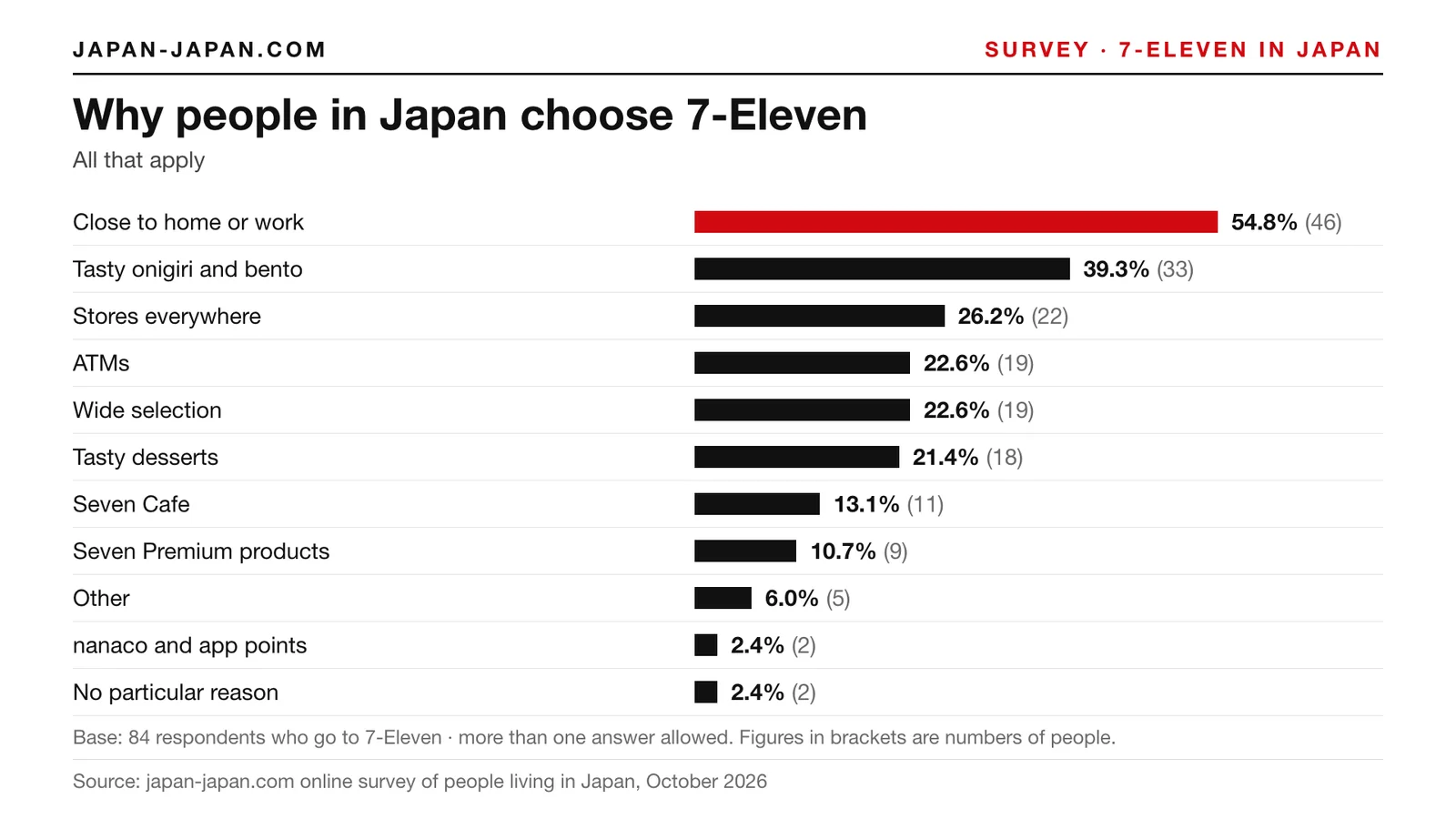
Location drives the choice. 52.3% (45 of 86) live within a 5-minute walk of a convenience store.
| Why they choose 7-Eleven | Share | People |
|---|---|---|
| Close to home or work | 54.8% | 46 of 84 |
| Tasty onigiri and bento | 39.3% | 33 of 84 |
| Stores everywhere | 26.2% | 22 of 84 |
| ATMs | 22.6% | 19 of 84 |
| Wide selection | 22.6% | 19 of 84 |
| Other | 6.0% | 5 of 84 |
| No particular reason | 2.4% | 2 of 84 |
Between the three chains, 47.7% (41 of 86) choose by what they want to buy and 40.7% (35 of 86) go to the nearest one. Our convenience store counts by prefecture show which chain leads where, a separate question from where respondents live.
What they buy and would recommend
Onigiri is the everyday buy, chosen by 57.1% (48 of 84) of people who go to 7-Eleven. Bread and buns follow at 47.6% (40 of 84) and bottled drinks at 46.4% (39 of 84).
For a friend from abroad, counter food rises. 89.5% (77 of 86) named at least one 7-Eleven item, and 59.3% (51 of 86) named a counter item.
| Item to recommend | Share | People |
|---|---|---|
| Nikuman and other steamed buns | 31.4% | 27 of 86 |
| Nana Chiki (boneless fried chicken) | 30.2% | 26 of 86 |
| Kin no Hamburg (Seven Premium Gold hamburg steak) | 25.6% | 22 of 86 |
| Seven Cafe coffee or cafe latte | 25.6% | 22 of 86 |
| Charcoal-grilled salmon onigiri | 24.4% | 21 of 86 |
| Agedori (fried chicken thigh) | 24.4% | 21 of 86 |
| Not sure | 5.8% | 5 of 86 |
| Nothing I’d recommend | 4.7% | 4 of 86 |
Our 7-Eleven nikuman page lists 156 yen before tax, and the Nana Chiki page lists 232 yen. 38.4% (33 of 86) would recommend Agedori, Nana Chiki or both.
Asked for one item only, 9 of 86 chose THE Egg Sandwich. Our guide to what to buy at 7-Eleven lists every recommended item with its list price. Tuna mayonnaise onigiri, Agedori, Nana Chiki and nikuman tied next with 7 each.
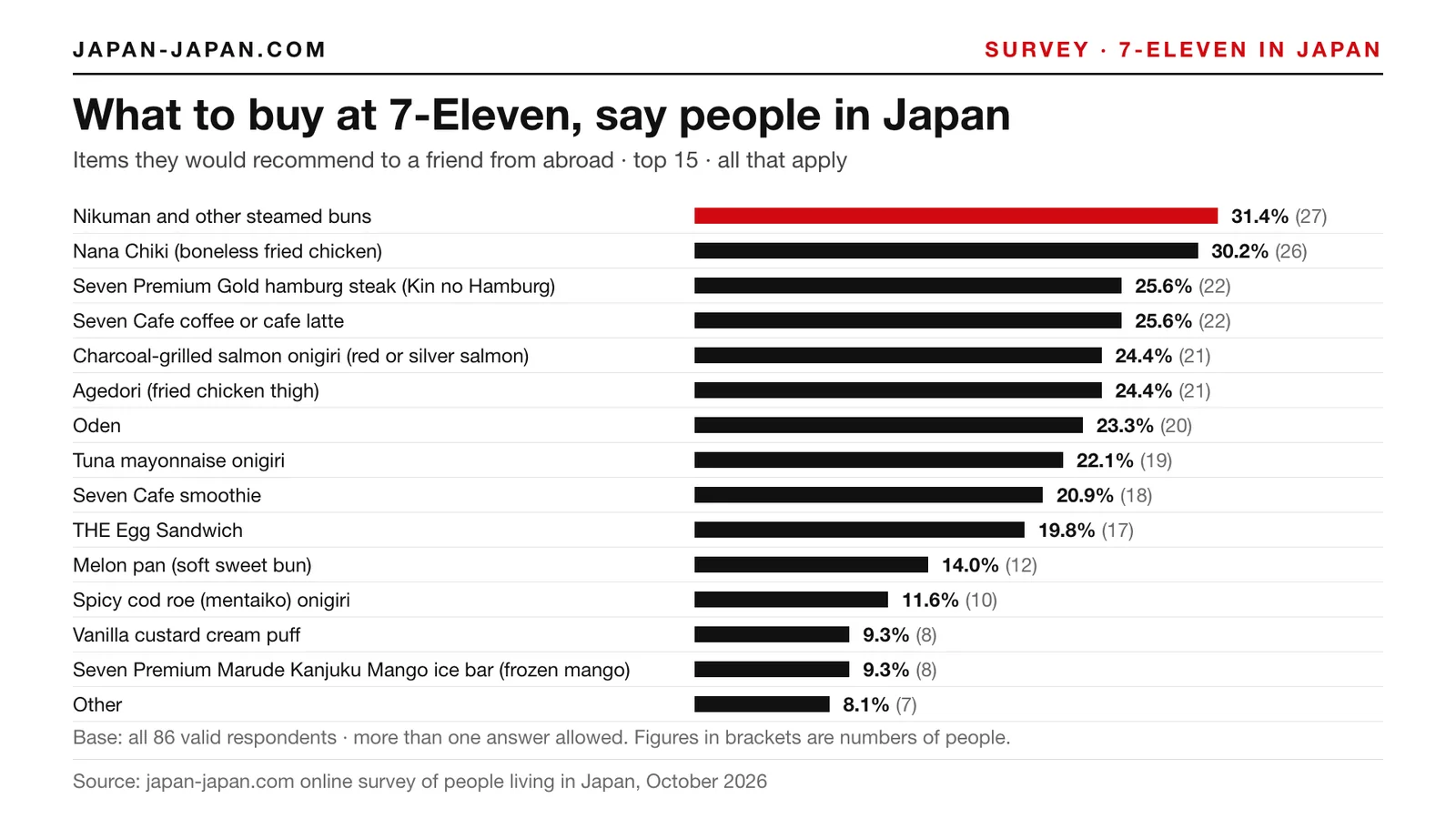
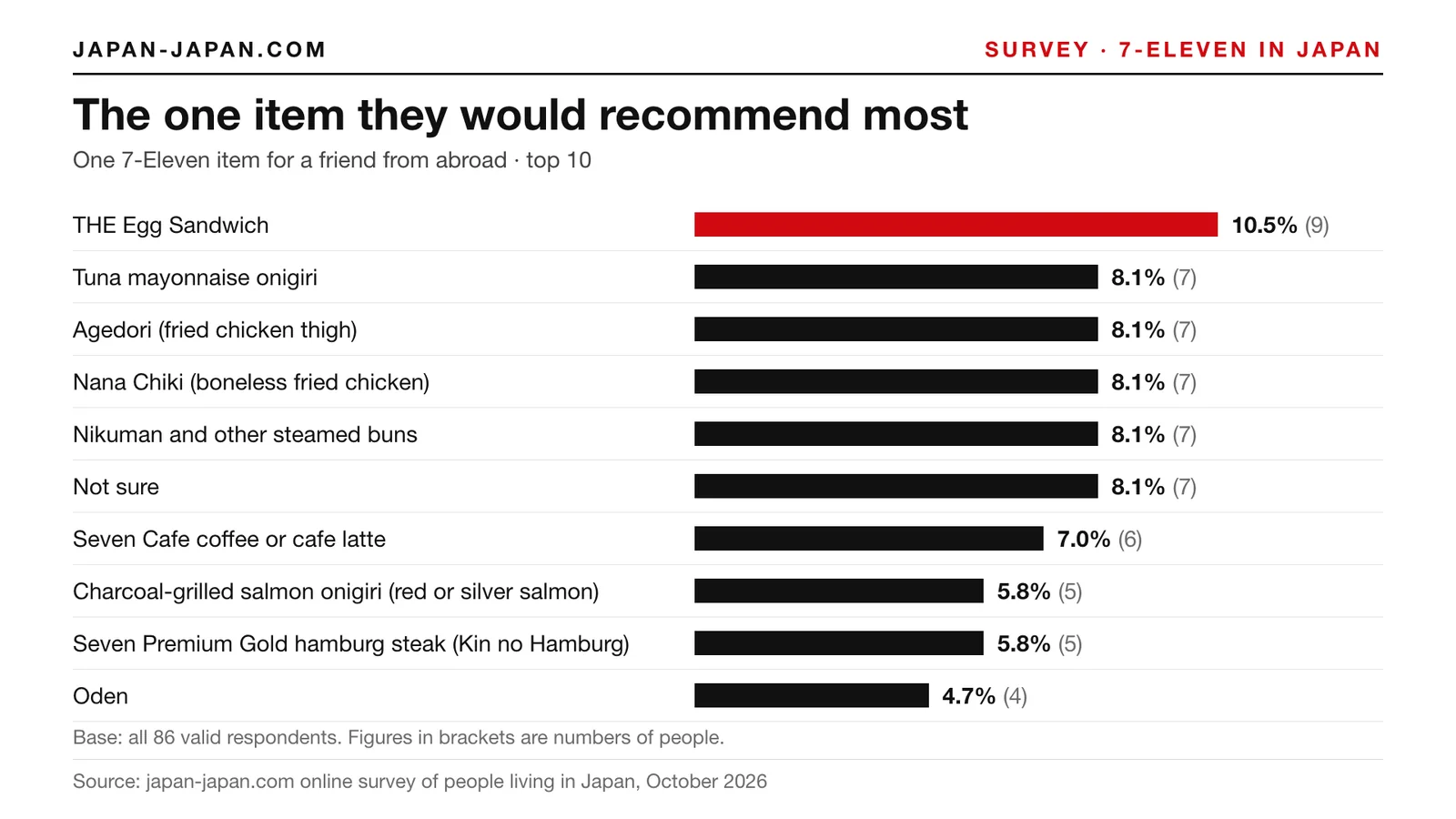
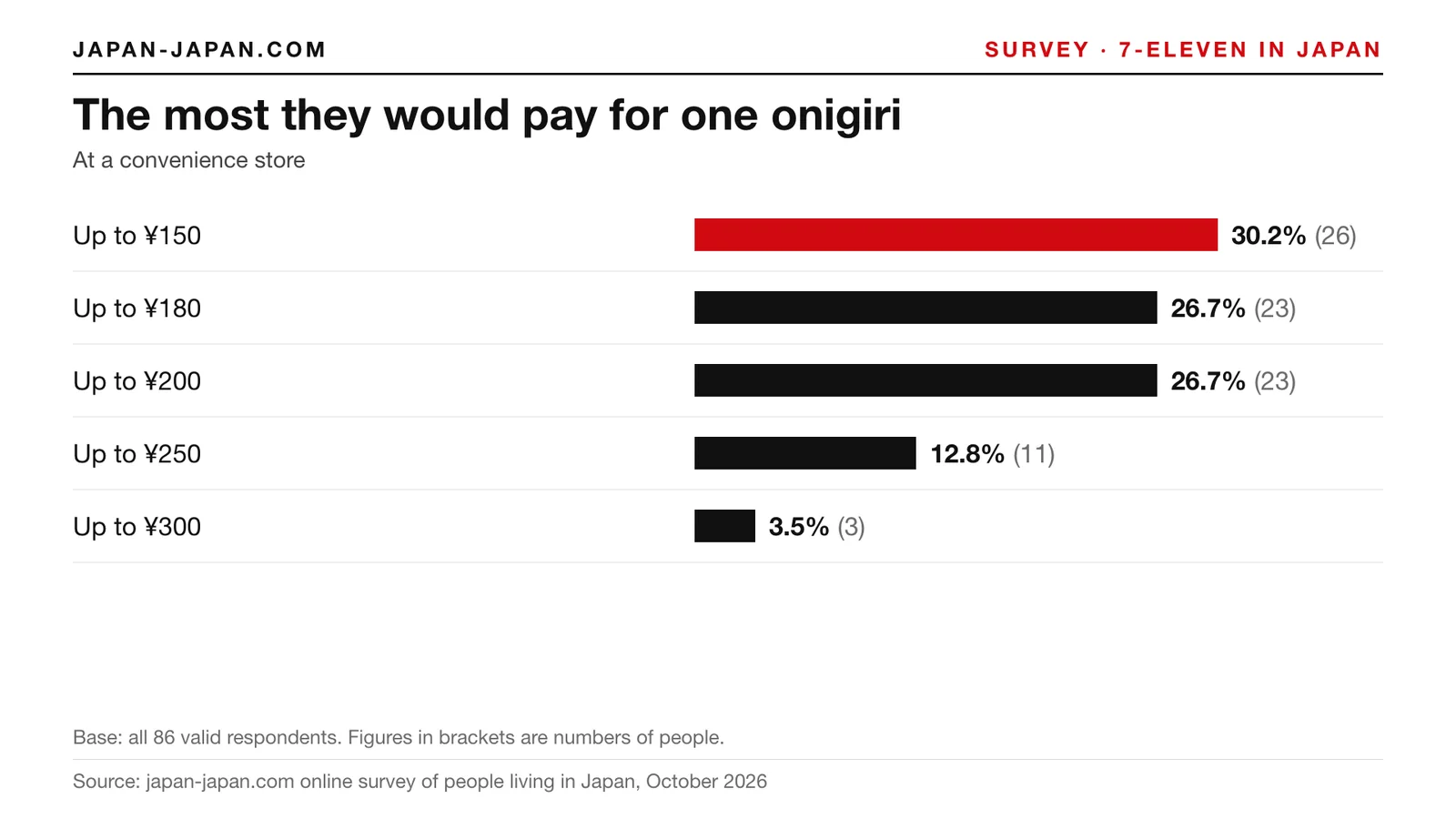
Onigiri, the egg sandwich, hot snacks and oden
Cod roe is the favourite filling: 29.1% (25 of 86) picked mentaiko or tarako, and 23.3% (20 of 86) salmon. Our 7-Eleven onigiri guide lists fillings in English and Japanese.
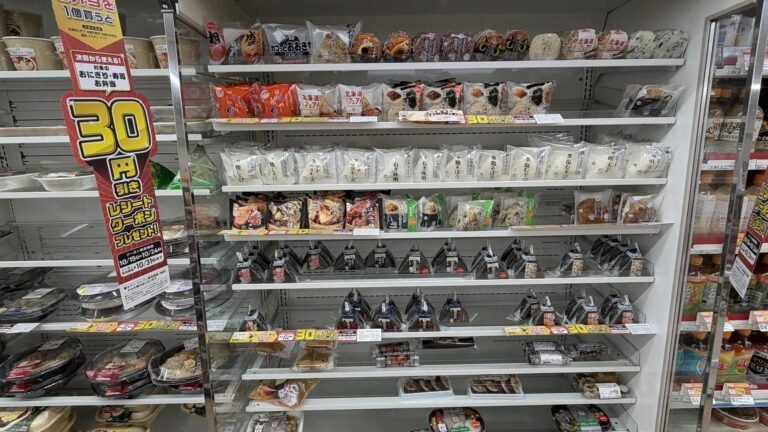
57.0% (49 of 86) would pay at most ¥180 for one onigiri, and 83.7% (72 of 86) at most ¥200. The Seven-Eleven Japan onigiri list (Kanto) shows tuna mayonnaise at 182 yen before tax.
Opening them takes practice. Among the 82 who buy hand-rolled onigiri, 79.3% (65 of 82) say the nori sometimes or often tears.
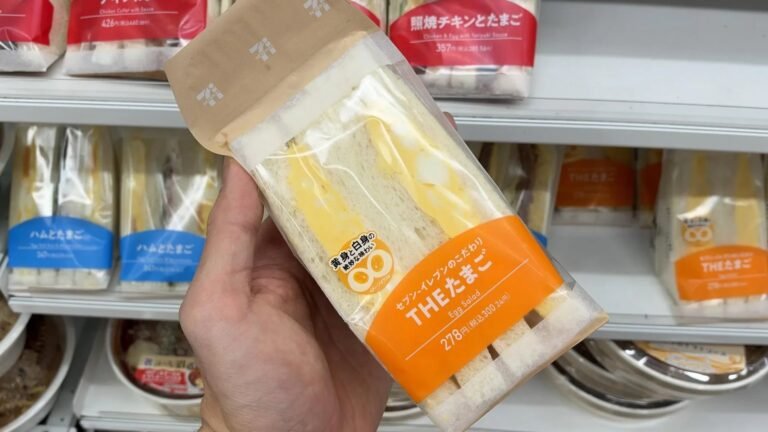
46.5% (40 of 86) have never tried THE Egg Sandwich. Among the 46 who have, 73.9% (34 of 46) like or love it. Our THE Egg Sandwich page lists 278 yen before tax.
For fried snacks, rival chains win. 31.4% (27 of 86) chose Lawson’s Karaage-kun as their favourite and 19.8% (17 of 86) FamilyMart’s Famichiki. Agedori got 15.1% (13 of 86). Among the 73 who buy fried counter food, 30.1% (22 of 73) prefer a 7-Eleven item. Our 7-Eleven hot snacks guide explains how to order.
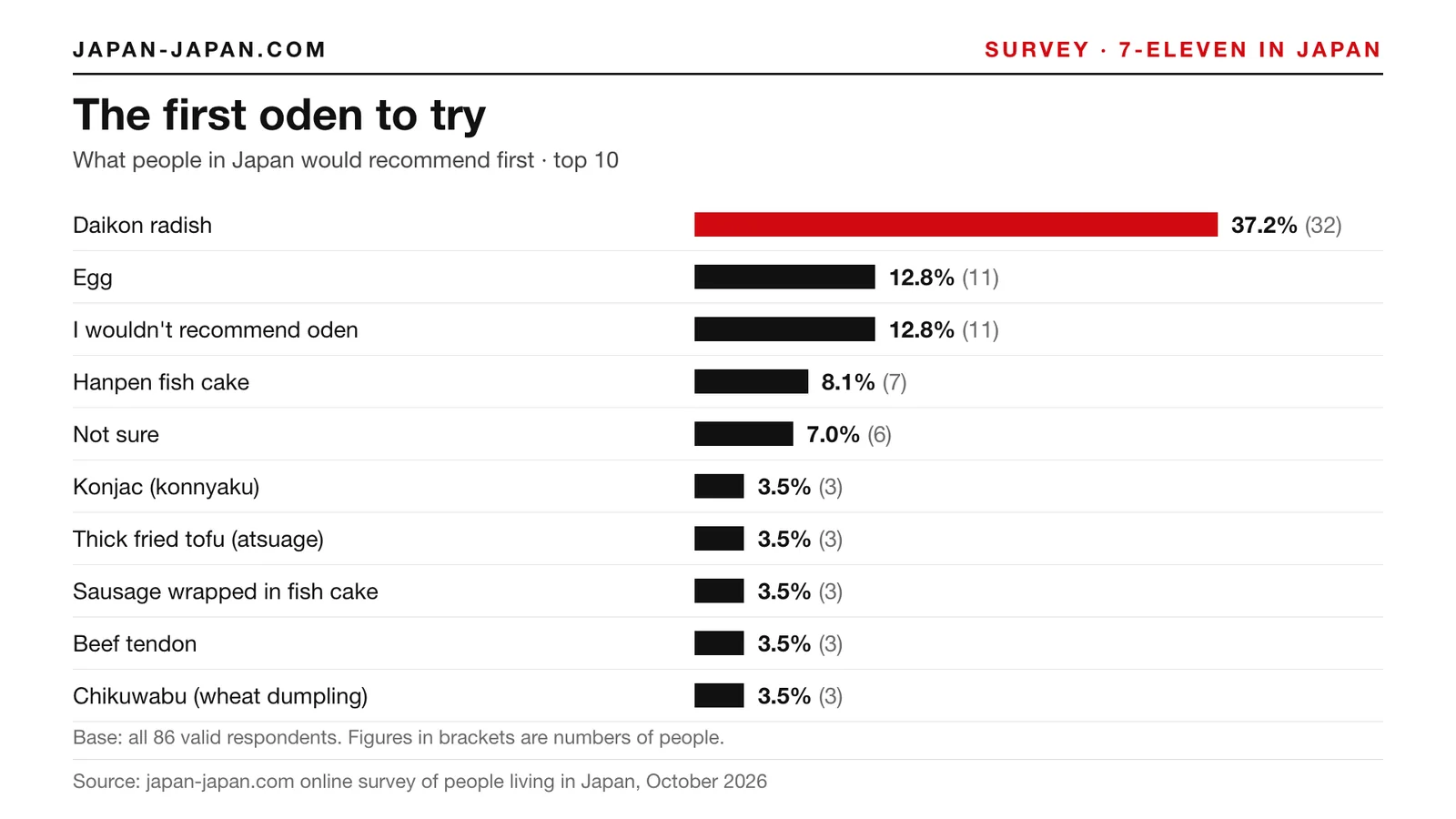
In the cold season, 62.8% (54 of 86) buy steamed buns from the counter and 33.7% (29 of 86) buy oden. For a first oden item, daikon wins clearly.
| Oden item to try first | Share | People |
|---|---|---|
| Daikon radish | 37.2% | 32 of 86 |
| Egg | 12.8% | 11 of 86 |
| Hanpen fish cake | 8.1% | 7 of 86 |
| I wouldn’t recommend oden | 12.8% | 11 of 86 |
Coffee, sweets, matcha, cup noodles and snacks
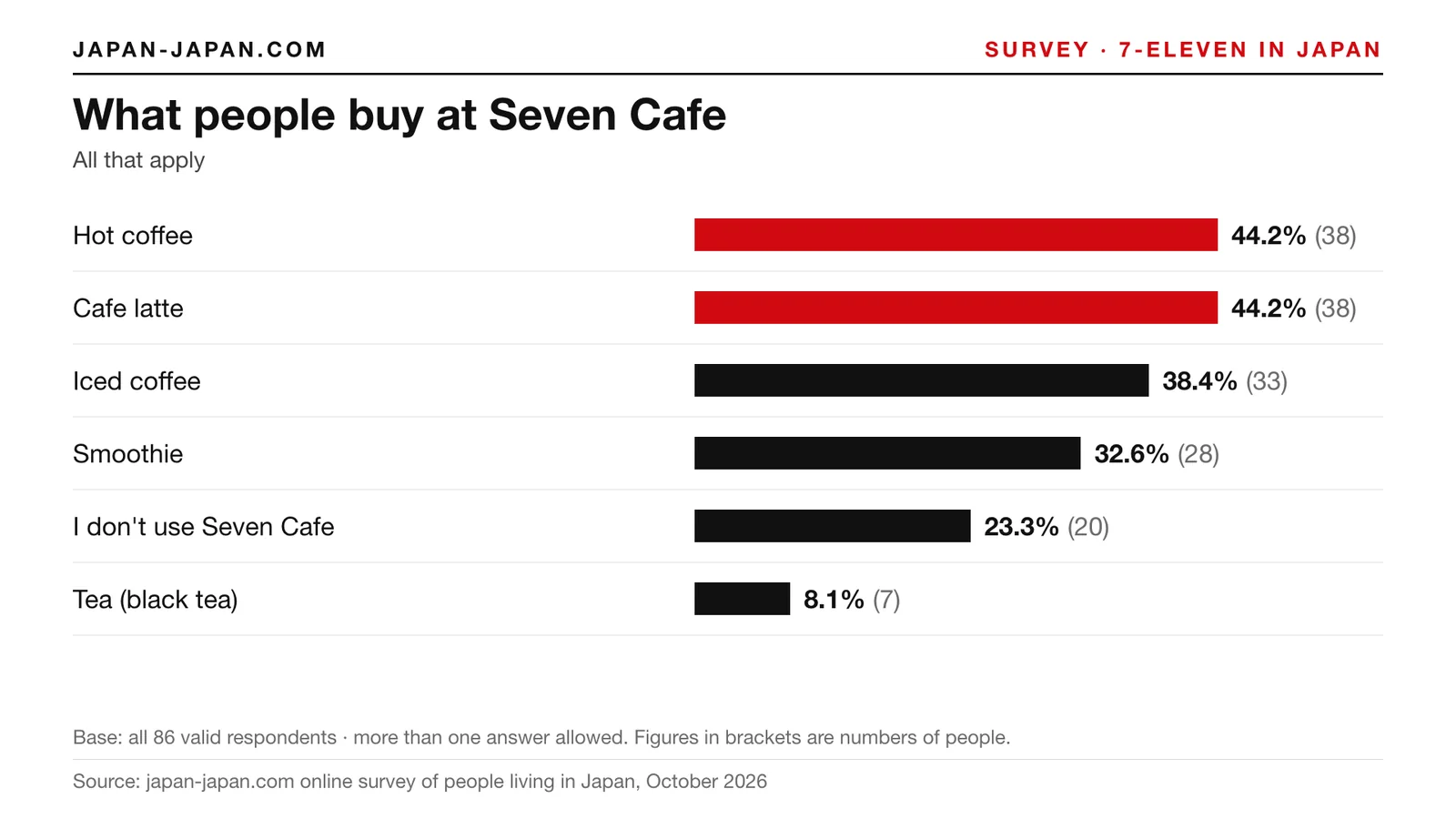
76.7% (66 of 86) have bought something at Seven Cafe. Hot coffee and cafe latte tie at 44.2% (38 of 86). Our Seven Cafe coffee guide lists cup sizes and prices.
43.0% (37 of 86) have had a Seven Cafe smoothie, and 11.6% (10 of 86) did not know it existed. You take a frozen cup from the freezer, pay, then blend it in the machine.
For desserts, cream puffs lead at 43.0% (37 of 86), ahead of pudding at 30.2% (26 of 86). Our 7-Eleven Japan desserts list has prices.
55.8% (48 of 86) have bought a matcha product at 7-Eleven. The favourite taste is about half sweet, half bitter, at 45.3% (39 of 86). For one matcha pick, 47.7% (41 of 86) chose matcha desserts.
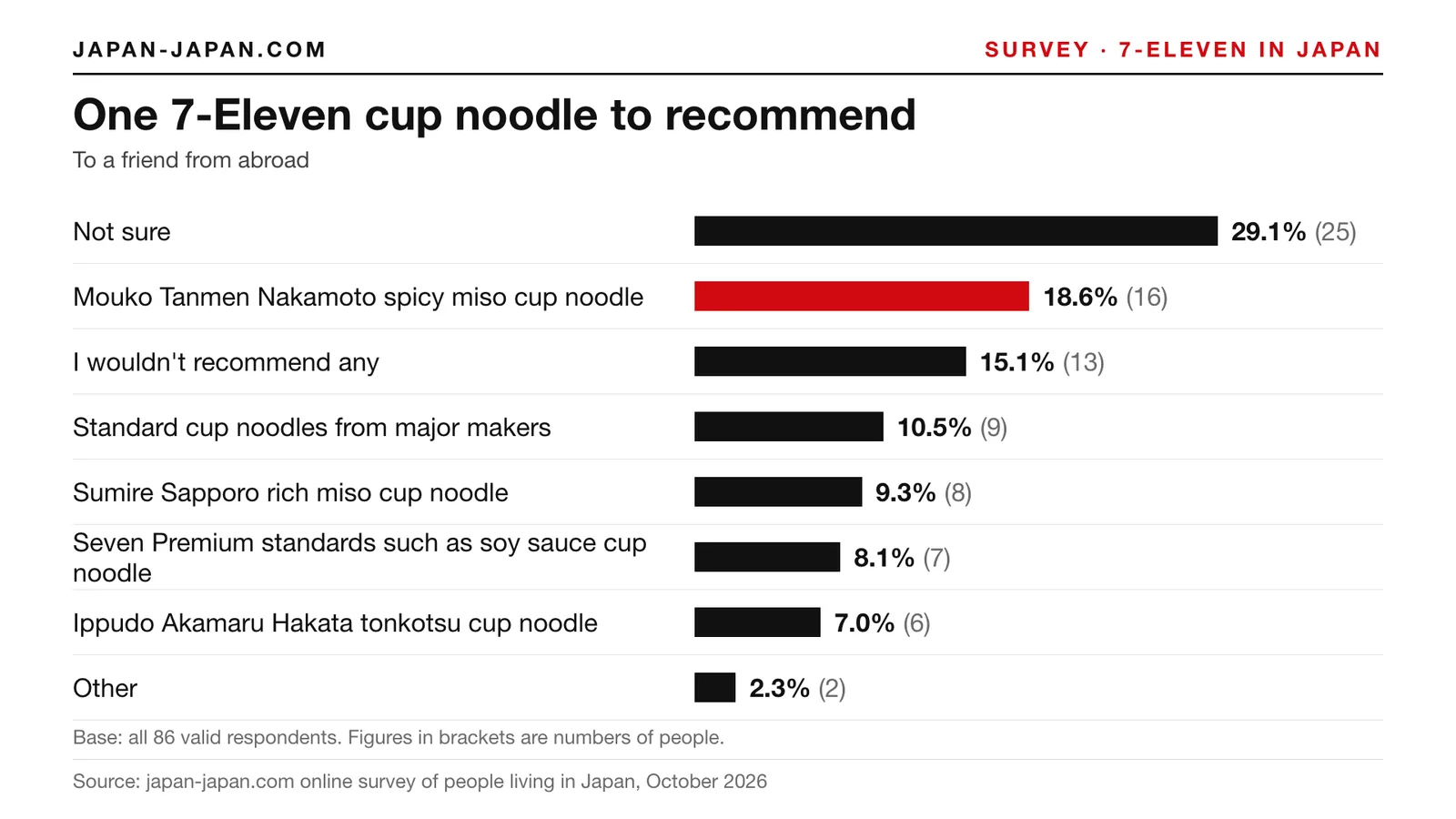
Cup noodles split the group: 50.0% (43 of 86) buy them at least sometimes. The top cup to recommend is Mouko Tanmen Nakamoto at 18.6% (16 of 86). Of the 25 who have eaten it, 19 chose spicy but tasty and 3 said too spicy, a rough guide. Our 7-Eleven cup noodles guide lists prices.
For souvenir snacks, chocolate leads.
| Snack to recommend as a souvenir | Share | People |
|---|---|---|
| Chocolate | 41.9% | 36 of 86 |
| Potato chips and other savoury snacks | 34.9% | 30 of 86 |
| Gummies | 33.7% | 29 of 86 |
| Matcha-flavoured snacks | 25.6% | 22 of 86 |
| Nothing I’d recommend | 10.5% | 9 of 86 |
59.3% (51 of 86) have eaten at least one of the Seven Premium snacks listed. Sugar Butter Tree was the top single pick at 22.1% (19 of 86). Our 7-Eleven Japan snacks guide lists allergens.
How prices feel to people living in Japan
98.8% (85 of 86) feel convenience store prices went up over the past year. Onigiri is where they feel it most, named by 91.9% (79 of 86). As a result, 83.7% (72 of 86) now buy less or a little less.
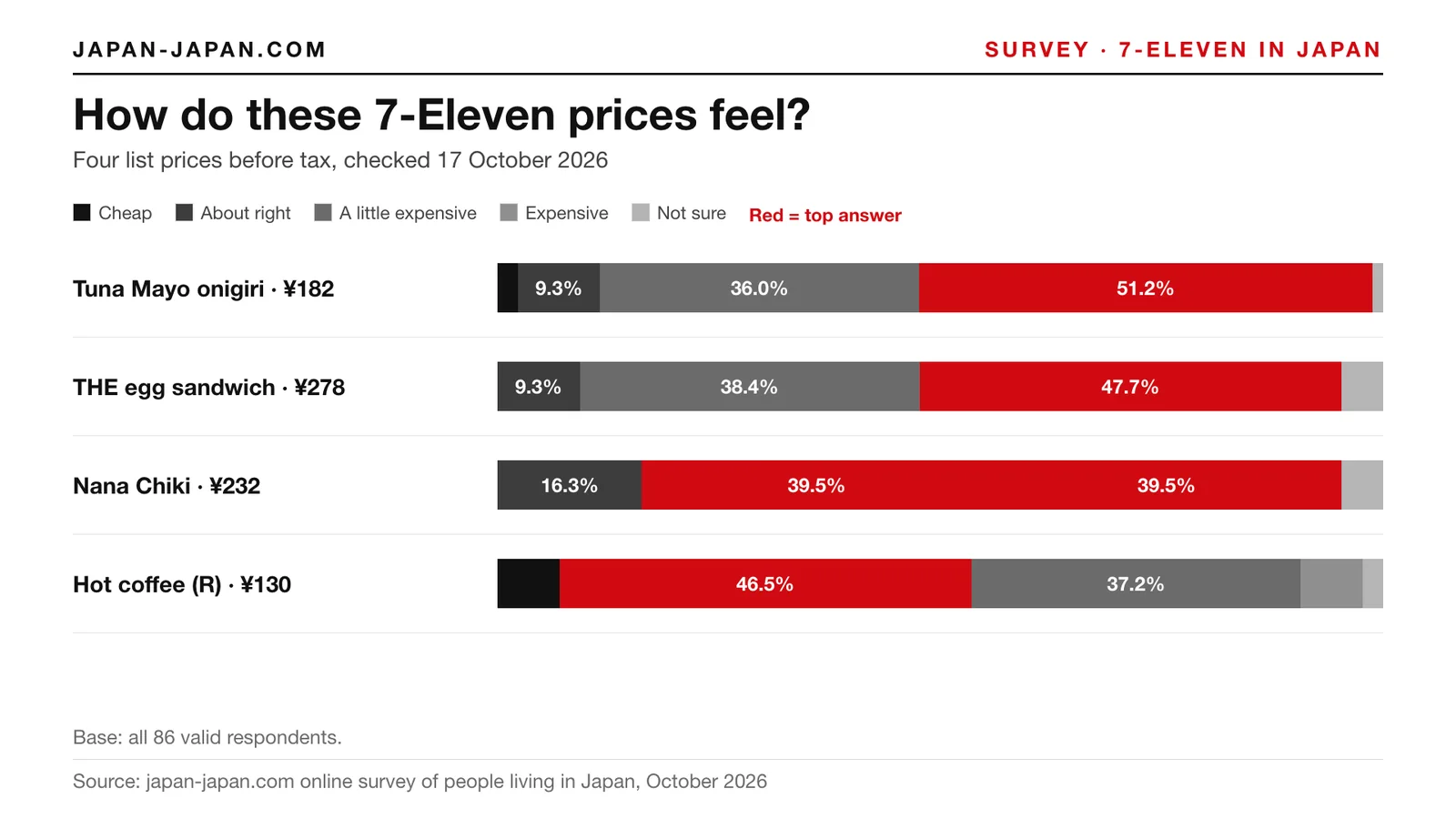
Four questions named a 7-Eleven price before tax. Most respondents called three of them high.
- Tuna mayonnaise onigiri at ¥182: 87.2% (75 of 86) find it expensive or a little expensive.
- THE Egg Sandwich at ¥278: 86.0% (74 of 86) say the same.
- Nana Chiki at ¥232: 79.1% (68 of 86) say the same.
- Seven Cafe hot coffee (R) at ¥130: 53.5% (46 of 86) find it cheap or about right.
55.8% (48 of 86) say 7-Eleven prices feel about the same as Lawson and FamilyMart, and 26.7% (23 of 86) feel 7-Eleven is pricier. These are opinions, not a price comparison.
The table below shows recommended items with one match in our database. Prices are before tax from Seven-Eleven Japan’s official list, checked 17 October 2026, using the Kanto list where regions differ.
| Item | Recommended by | Price before tax |
|---|---|---|
| Nikuman | 27 of 86 | 156 yen |
| Nana Chiki | 26 of 86 | 232 yen |
| Agedori | 21 of 86 | 232 yen |
| Charcoal-grilled salmon onigiri | 21 of 86 | 198 yen |
| Tuna mayonnaise onigiri | 19 of 86 | 182 yen |
| THE Egg Sandwich | 17 of 86 | 278 yen |
| Melon pan | 12 of 86 | 118 yen |
| Spicy cod roe (mentaiko) onigiri | 10 of 86 | 198 yen |
| Vanilla custard cream puff | 8 of 86 | 160 yen |
| Seven Premium Marude Kanjuku Mango ice bar | 8 of 86 | 158 yen |
The Seven-Eleven Japan hot snack list shows Nana Chiki and Agedori at 232 yen each. Melon pan is the cheapest item in the table at 118 yen.
7-Eleven vs Lawson vs FamilyMart
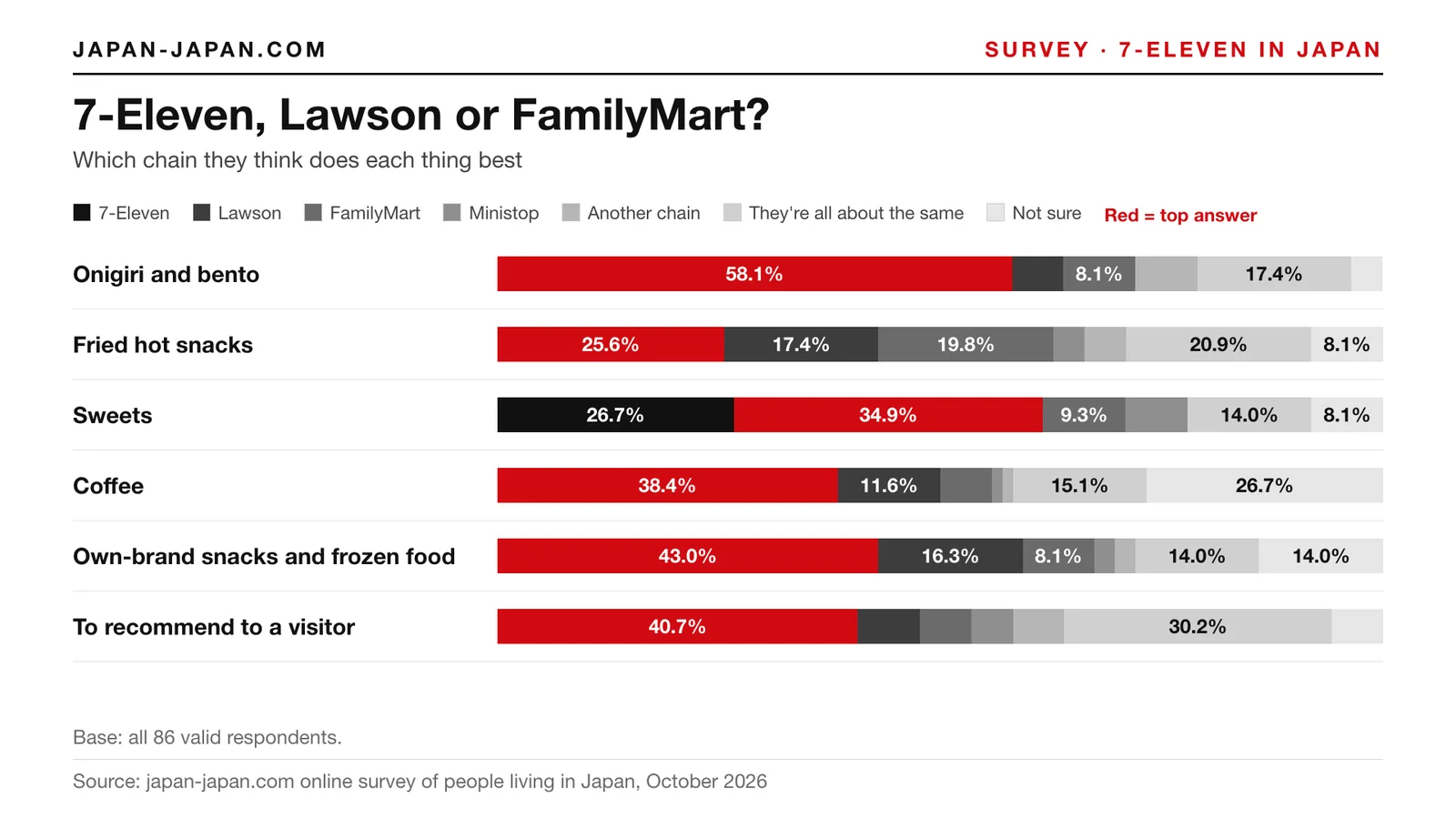
7-Eleven leads most categories, but not desserts. Shares are out of 86, with people in brackets.
| Category | 7-Eleven | Lawson | FamilyMart |
|---|---|---|---|
| Tastiest onigiri and bento | 58.1% (50) | 5.8% (5) | 8.1% (7) |
| Tastiest fried hot snacks | 25.6% (22) | 17.4% (15) | 19.8% (17) |
| Tastiest desserts | 26.7% (23) | 34.9% (30) | 9.3% (8) |
| Best coffee | 38.4% (33) | 11.6% (10) | 5.8% (5) |
| Best own-brand snacks and frozen food | 43.0% (37) | 16.3% (14) | 8.1% (7) |
| Store to recommend to a foreign friend | 40.7% (35) | 7.0% (6) | 5.8% (5) |
Lawson wins desserts at 34.9% (30 of 86). Hot snacks are close, and 20.9% (18 of 86) say the three are about the same. For onigiri and bento, 17.4% (15 of 86) see no difference.
For a foreign friend, 30.2% (26 of 86) say they’re all about the same. Store numbers are a separate question, covered in our 7-Eleven vs Lawson vs FamilyMart store count comparison.
Paying, cash and ATMs
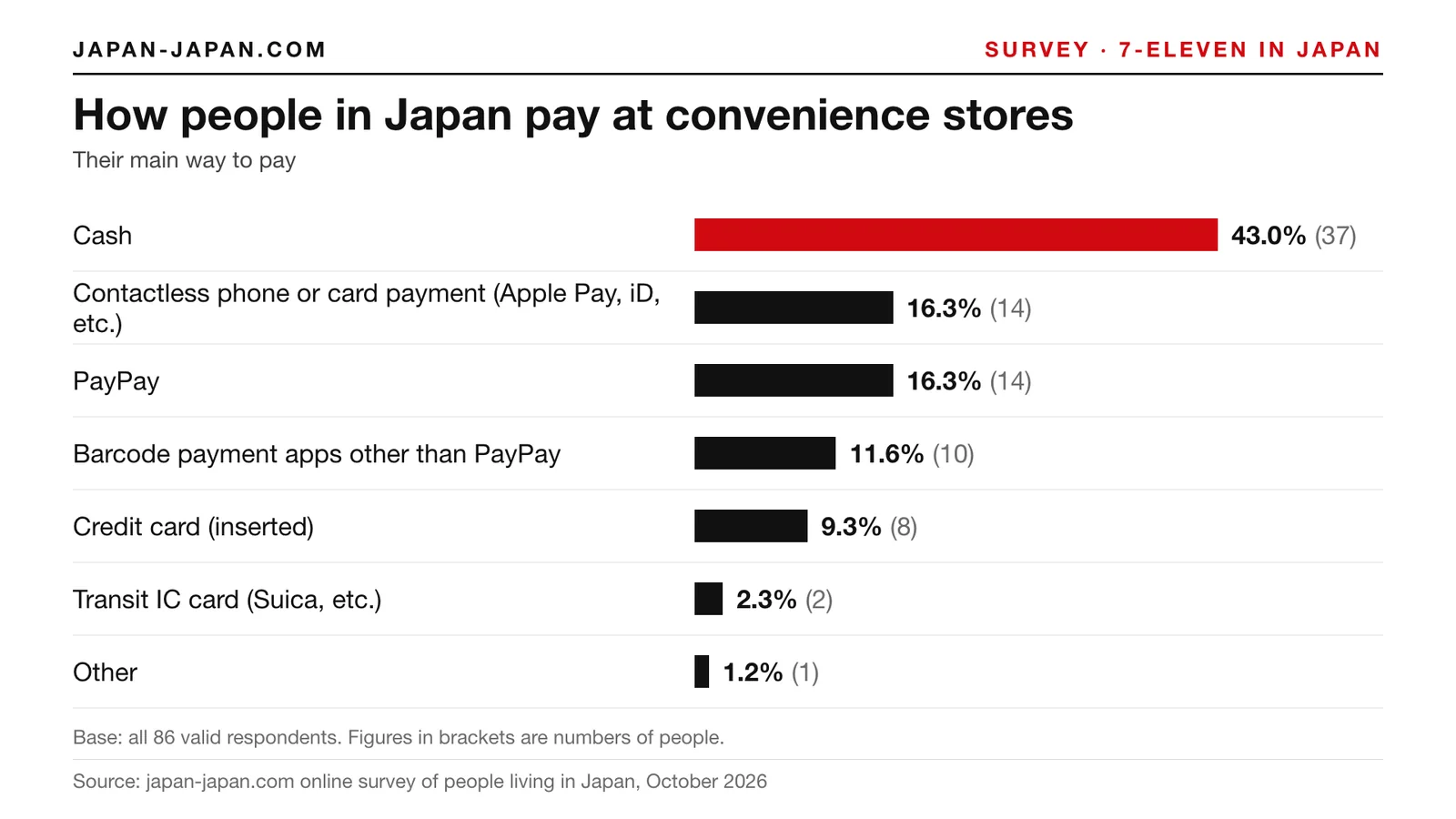
Cash is still the most common single way to pay, but 55.8% (48 of 86) mainly use something else.
| Main way to pay | Share | People |
|---|---|---|
| Cash | 43.0% | 37 of 86 |
| Contactless phone or card | 16.3% | 14 of 86 |
| PayPay | 16.3% | 14 of 86 |
| Barcode apps other than PayPay | 11.6% | 10 of 86 |
| Credit card (inserted) | 9.3% | 8 of 86 |
| Transit IC card (Suica, etc.) | 2.3% | 2 of 86 |
40.7% (35 of 86) hardly ever use cash, while 36.0% (31 of 86) almost always do. Among the 72 with self-checkout nearby, 69.4% (50 of 72) use it at least sometimes.
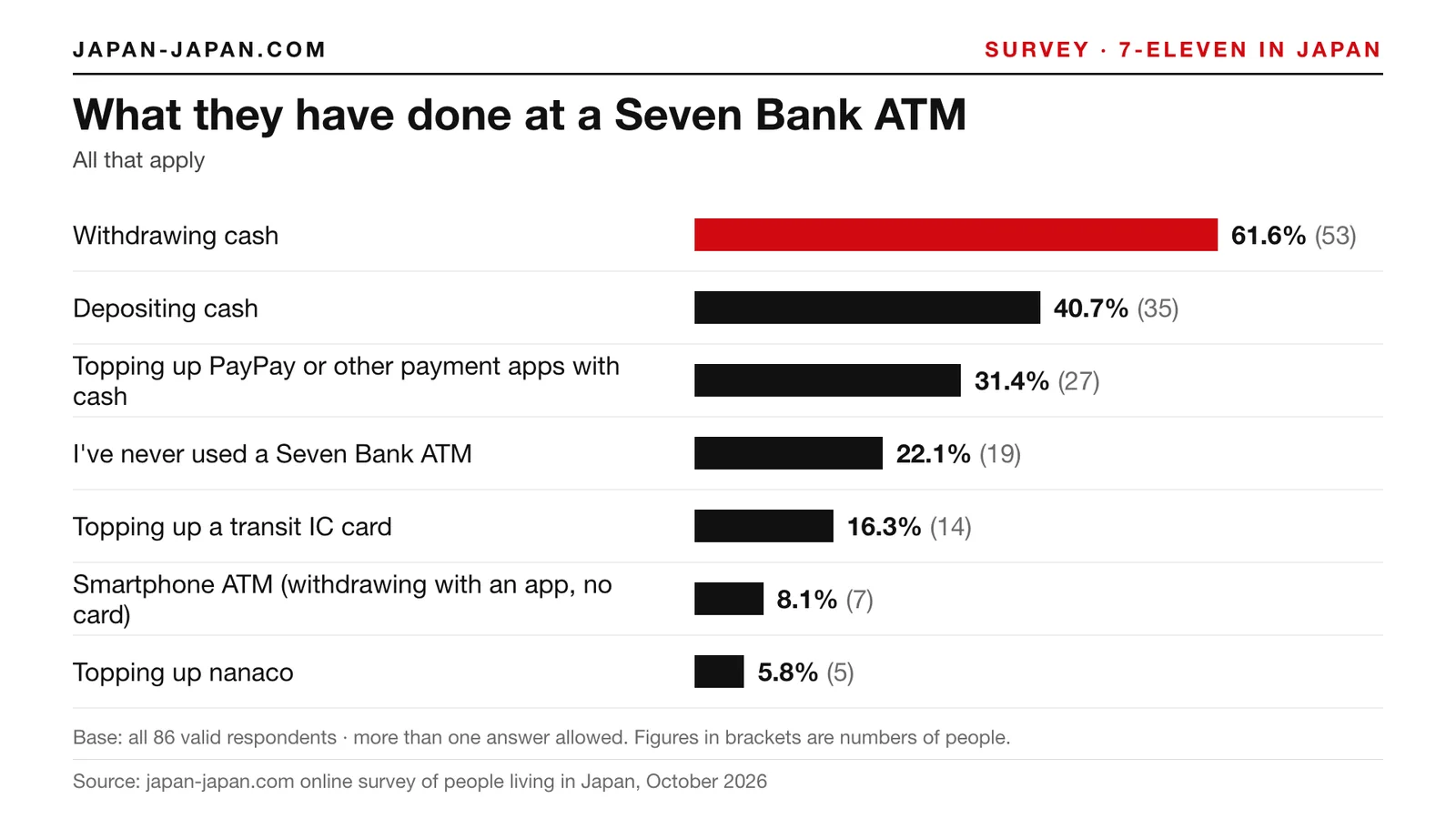
For withdrawals, 48.8% (42 of 86) use bank branches and 20.9% (18 of 86) a convenience store ATM. Still, 77.9% (67 of 86) have used a Seven Bank ATM, mostly to withdraw cash at 61.6% (53 of 86).
Among the 83 who use ATMs, 97.6% (81 of 83) care about the fee. For hours by card, see our 7-Eleven ATM guide and our 7-Eleven Japan payments database.
90.7% (78 of 86) have used a multi-copy machine, and 72.1% (62 of 86) have used at least one listed 7-Eleven service.
Eat-in tax, trash bins and toilets
27.9% (24 of 86) have no eat-in area nearby. Among the 62 who do, 27.4% (17 of 62) use it often or sometimes.
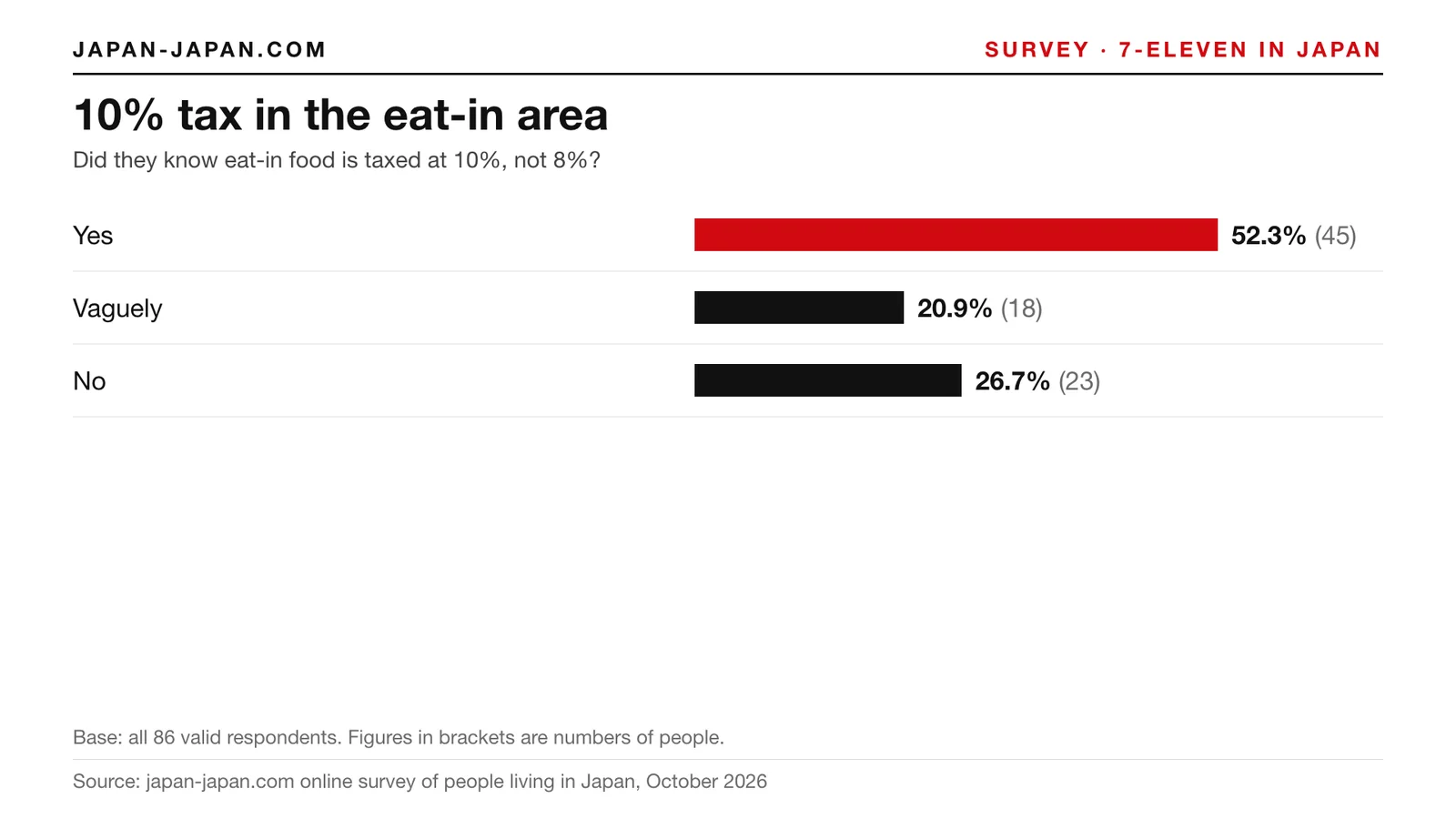
The Seven-Eleven Japan FAQ says a 10% tax rate applies when you eat reduced-tax items in the eat-in area, against 8% for takeaway. 73.3% (63 of 86) knew this or roughly knew it. The FAQ also asks you to avoid long stays and follow store rules for trash.
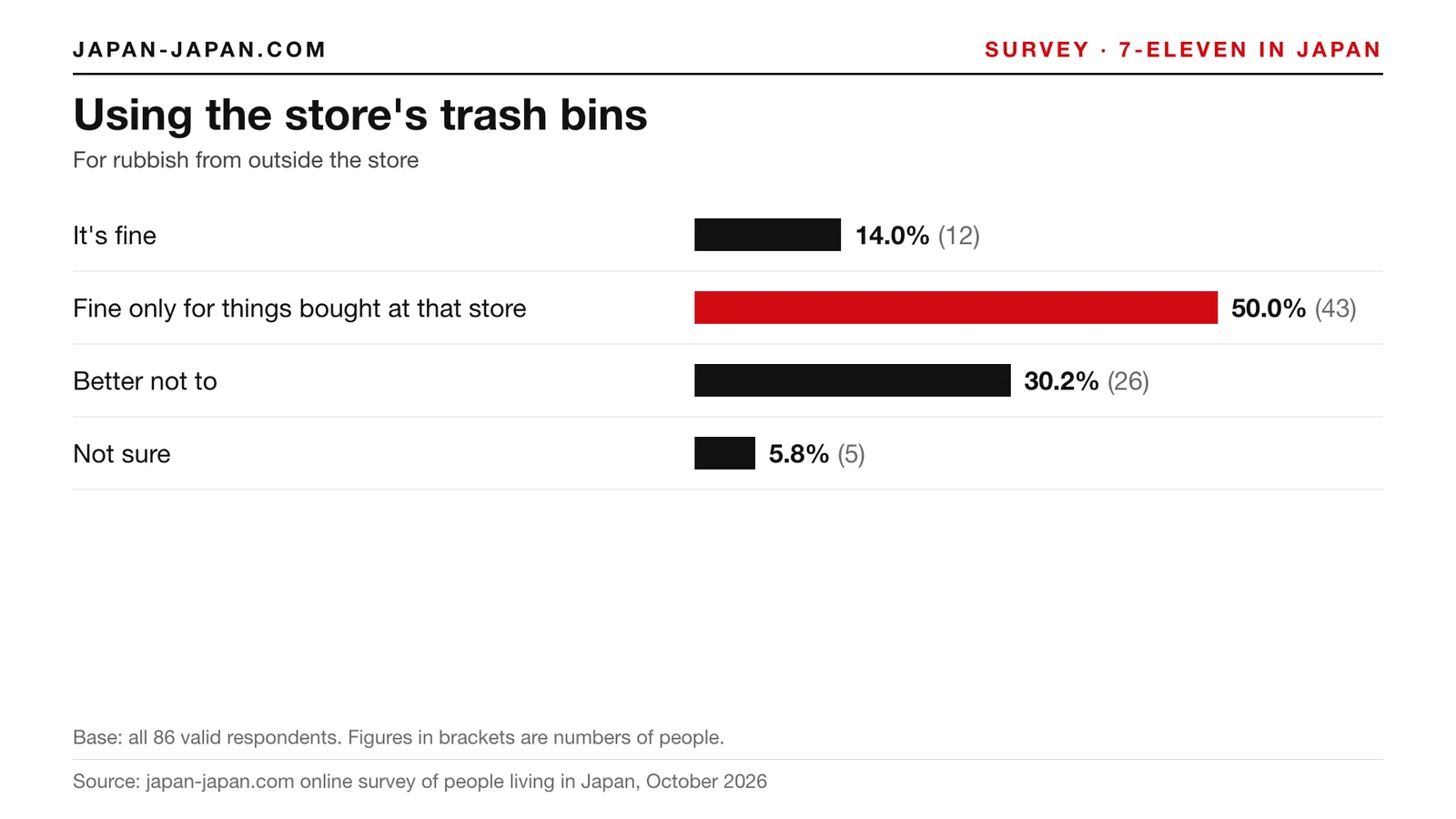
| Using a store bin for rubbish from elsewhere | Share | People |
|---|---|---|
| It’s fine | 14.0% | 12 of 86 |
| Fine only for things bought at that store | 50.0% | 43 of 86 |
| Better not to | 30.2% | 26 of 86 |
| Not sure | 5.8% | 5 of 86 |
In total, 64.0% (55 of 86) accept the store bin, at least for things bought there.
Among the 80 who borrow store toilets, 87.5% (70 of 80) buy something always or sometimes. Our konbini rules guide covers bags, heating and eat-in manners.
52.3% (45 of 86) check allergen labels at least sometimes, and 45.3% (39 of 86) buy alcohol at convenience stores.
Where visitors get stuck, as respondents see it
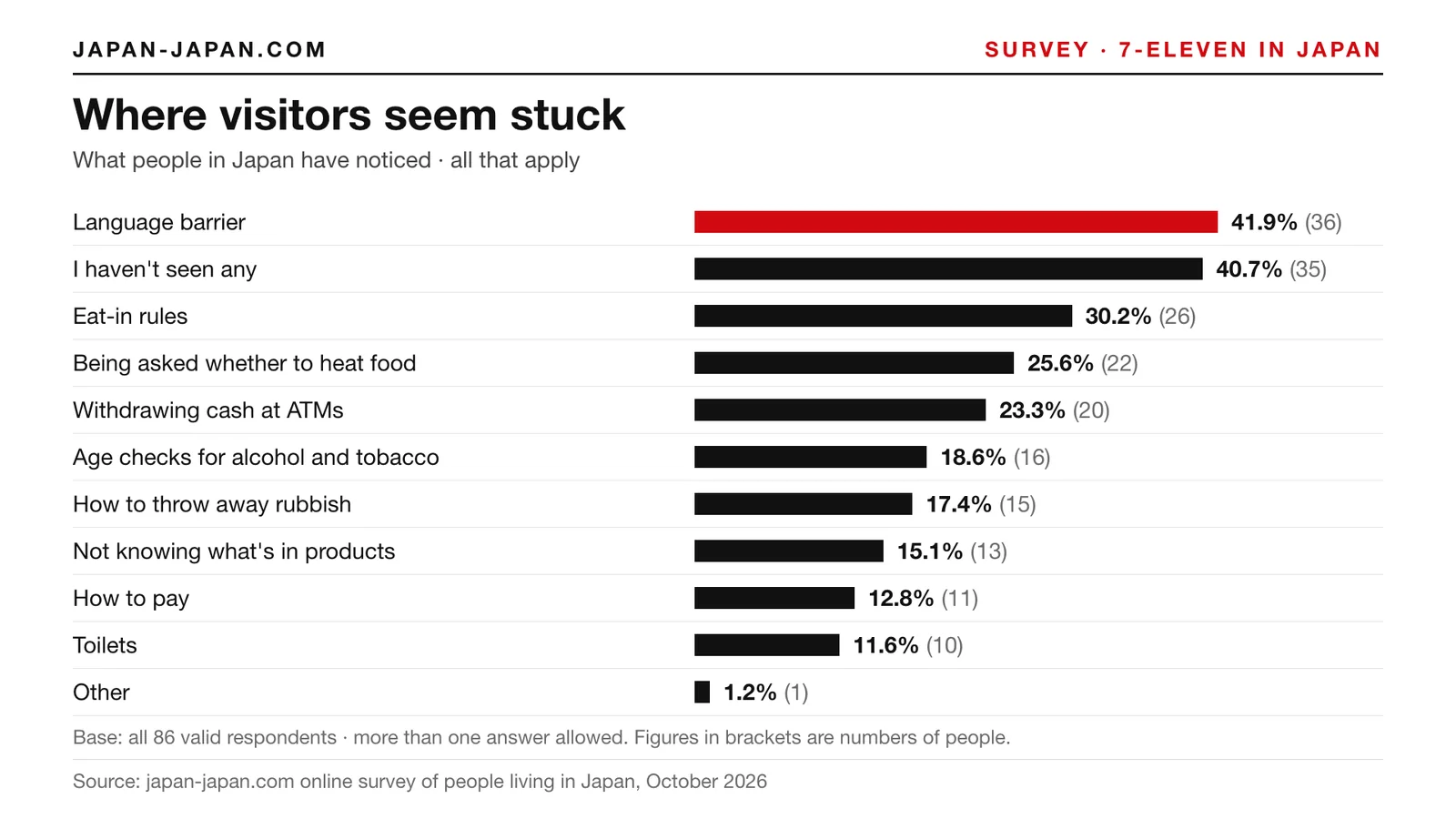
These are things respondents have noticed, not counts. 60.5% (52 of 86) have seen visitors seem stuck at least once.
| Where visitors seem stuck | Share | People |
|---|---|---|
| Language barrier | 41.9% | 36 of 86 |
| Eat-in rules | 30.2% | 26 of 86 |
| Being asked whether to heat food | 25.6% | 22 of 86 |
| Withdrawing cash at ATMs | 23.3% | 20 of 86 |
| Age checks for alcohol and tobacco | 18.6% | 16 of 86 |
| I haven’t seen any | 40.7% | 35 of 86 |
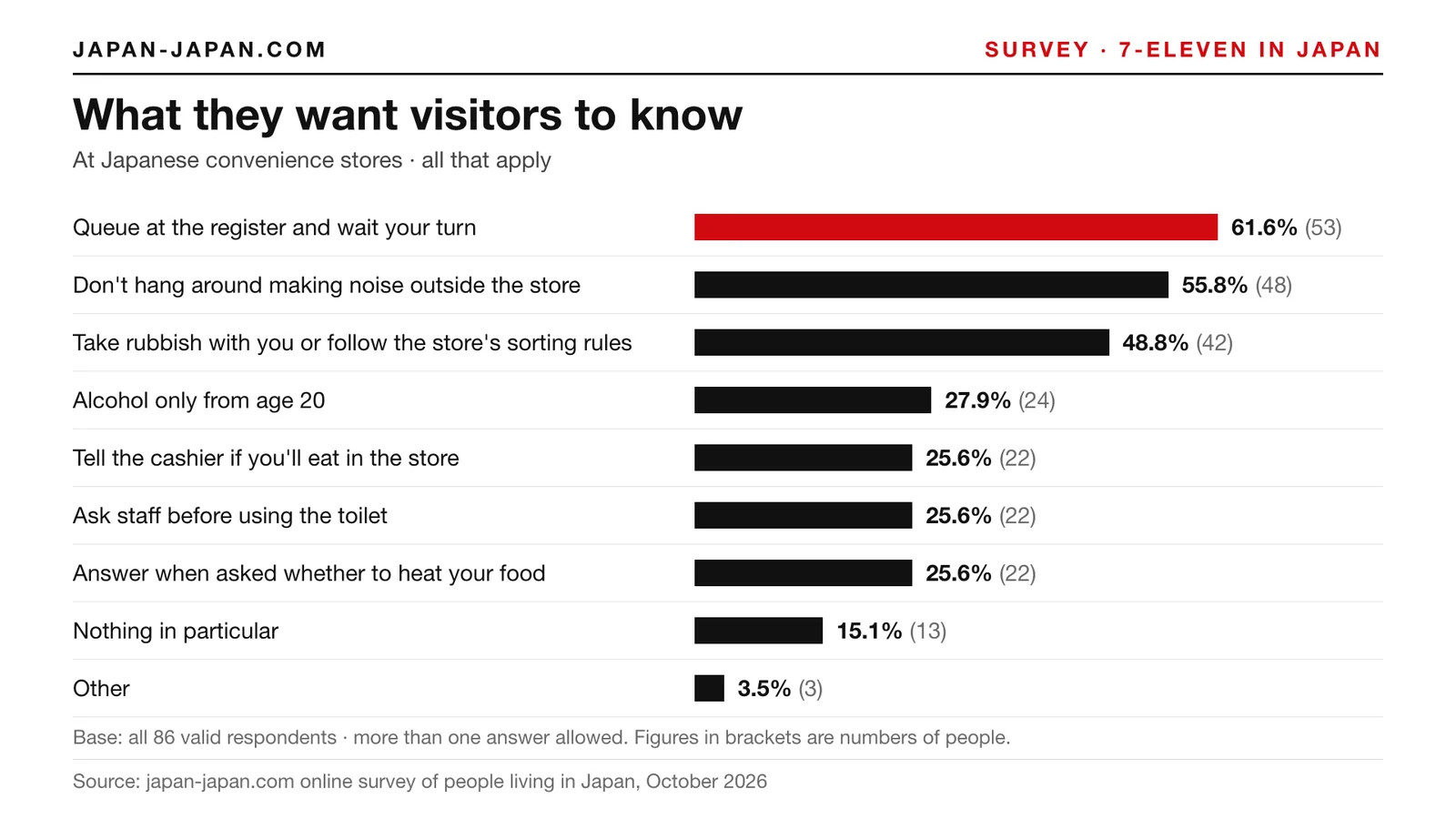
The FAQ says staff may ask whether you want items like bento heated. When you buy alcohol, you confirm your age with a tap on the screen at the till. The chart at the end of this section shows what respondents want visitors to know.
Queuing comes first at 61.6% (53 of 86), then not making noise outside at 55.8% (48 of 86). Telling the cashier if you’ll eat in got 25.6% (22 of 86).
How people in Japan use konbini on their own trips
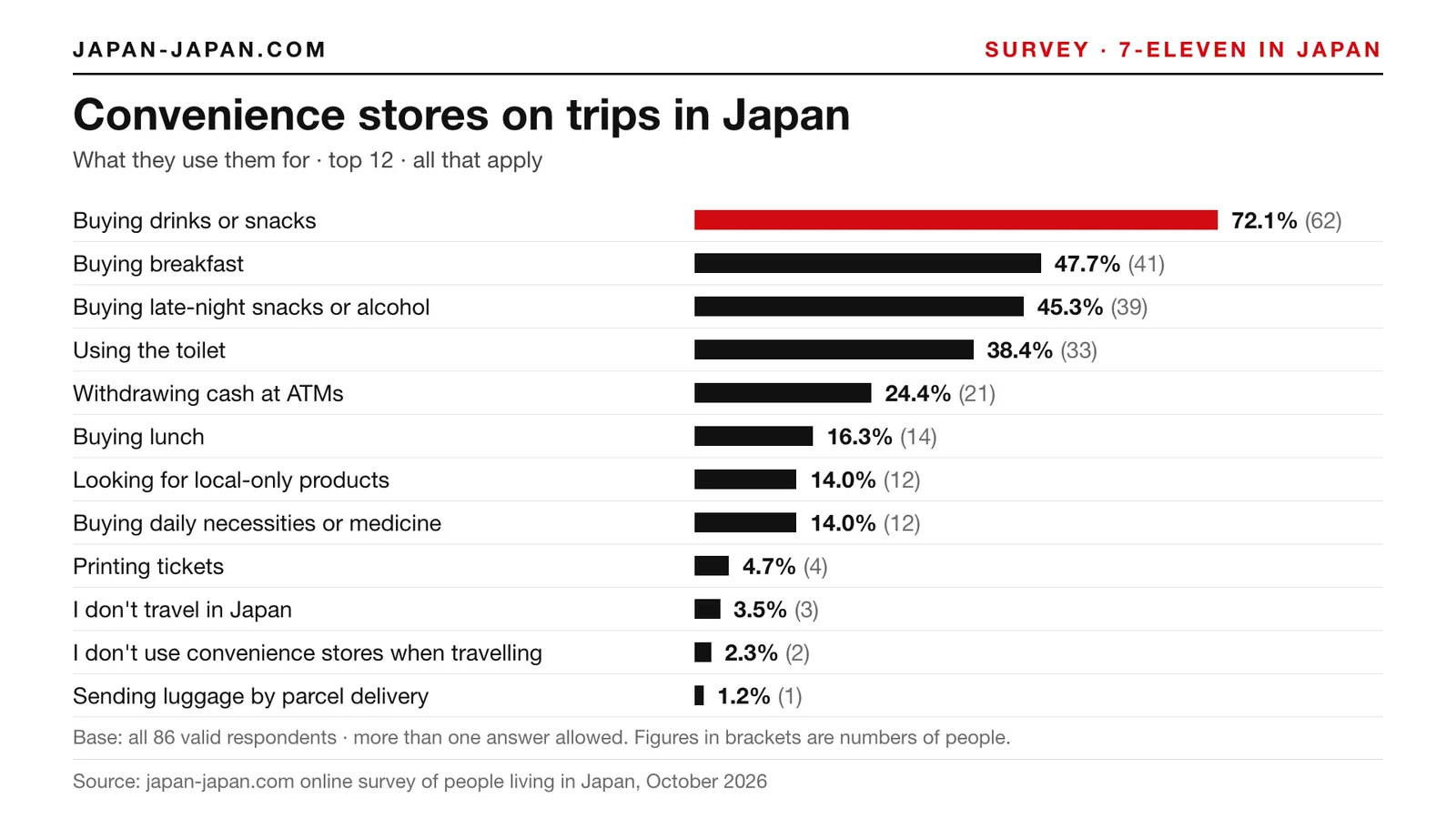
68.6% (59 of 86) took at least one overnight trip in Japan in the past year. On trips, drinks and snacks are the main buy.
| Use on trips in Japan | Share | People |
|---|---|---|
| Buying drinks or snacks | 72.1% | 62 of 86 |
| Buying breakfast | 47.7% | 41 of 86 |
| Late-night snacks or alcohol | 45.3% | 39 of 86 |
| Using the toilet | 38.4% | 33 of 86 |
| Withdrawing cash at ATMs | 24.4% | 21 of 86 |
| Looking for local-only products | 14.0% | 12 of 86 |
Among the 81 who use konbini on trips, 84.0% (68 of 81) spend under ¥2,000 a day there. For breakfast, 18.6% (16 of 86) buy it at a convenience store.
Among the 83 who travel, 62.7% (52 of 83) care whether a convenience store is near their lodging. 17.4% (15 of 86) did not know regional-only products existed.
What respondents wrote
All five free-text questions were required, so every one of the 86 respondents wrote something. Here are some of their answers, translated from Japanese by japan-japan.com. Age, gender and region are as respondents reported them.
“Egg sandwich. The egg tucked into the soft bread is delicious.”
— Man in his 40s, Tokyo. Original Japanese (excerpt): 「たまごサンド 柔らかいパンに挟んだたまごが美味しいから。」
“…Fluffy bread packed with moist egg salad, and really filling!”
— Woman in her 40s, Kanto (outside Tokyo). Original Japanese (excerpt): 「…ふわふわのパンにしっとりとした卵サラダがたっぷり入っていてボリューム満点!」
“Salmon onigiri. Compared with other convenience stores, it’s packed with filling and the salmon is thick.”
— Woman in her 30s, Kyushu. Original Japanese (excerpt): 「鮭おにぎり。他のコンビニと比べて具材がぎっしりなうえに鮭も肉厚だから。」
“Onigiri, of course. It’s the symbol of Japanese convenience stores. Crisp nori and just the right amount of salt. I’d like you to eat it as is, without heating it in the microwave.”
— Woman in her 30s, Kyushu. Original Japanese (excerpt): 「やっぱり、おにぎり。日本のコンビニの象徴。パリパリの海苔と程よい塩気。レンジで温めずにそのままの状態で食べてほしい。」
“Salmon onigiri and mentaiko (cod roe) onigiri. The classic Japanese snack is onigiri, and salmon and mentaiko are the most typical ones.”
— Man in his 40s, Tokyo. Original Japanese (excerpt): 「鮭おにぎりと明太子おにぎり 日本定番の軽食といえばおにぎり。中でも鮭と明太子はとても代表的なものだと思うから。」
“I really like the karaage stick, so if you can’t decide what to eat, I’d recommend it. It’s crispy and lightly seasoned, and even though it’s fried chicken it isn’t heavy, so I finish it in no time.”
— Woman in her 30s, Kyushu. Original Japanese (excerpt): 「唐揚げ棒が気に入っていますので、食べるものに悩んでいたらおすすめしたいですね。さくさくで味もあっさりで唐揚げですが、重たくなくぺろっと食べてしまいます。」
“Seven-Eleven’s oden. I want you to find out how good the dashi broth is.”
— Woman in her 20s, Tokyo. Original Japanese (excerpt): 「セブンイレブンのおでん。出汁の美味しさを知ってほしいから」
“Oden, because I want you to taste Japanese dashi broth.”
— Woman in her 40s, Kanto (outside Tokyo). Original Japanese (excerpt): 「おでん 理由は、日本のお出汁を味わってほしいから」
“Seven Cafe tea (black tea). It’s made with Assam leaves, and I’d like you to try the iced tea first. It’s a fragrant tea with a real tea-leaf taste, like what a café would serve…”
— Woman in her 50s, Kinki (Osaka and Kyoto area). Original Japanese (excerpt): 「セブンカフェのティー(紅茶)です。茶葉はアッサムでアイスティーをまず飲んでほしいです。喫茶店で提供されるような薫り高い茶葉感の紅茶なので…」
“The Seven Cafe café latte. I think it’s the best among the major convenience store chains.”
— Woman in her 40s, Hokkaido. Original Japanese (excerpt): 「セブンカフェのカフェラテです。大手コンビニの中で一番おいしいと思います。」
“Seven Cafe coffee. It’s just as good as the iced coffee at a certain coffee chain.”
— Woman in her 20s, Kyushu. Original Japanese (excerpt): 「セブンカフェのコーヒー 某コーヒーチェーン店でのアイスコーヒーなどに劣らず美味しい」
“I recommend the matcha line. Matcha is popular overseas too, and I think you’ll like the parfait and the dorayaki.”
— Woman in her 50s, Kinki (Osaka and Kyoto area). Original Japanese (excerpt): 「抹茶シリーズがおすすめです。抹茶は海外でも人気があり、パフェやどら焼きが口に合うと思います。」
“Moko Tanmen Nakamoto spicy miso (cup noodles): it’s spicy and delicious, and I’d really like you to try Japanese ramen.”
— Woman in her 40s, Tokyo. Original Japanese (excerpt): 「蒙古タンメン中本 辛旨味噌(カップ麺):辛くて美味しいし、日本のラーメンをぜひ試してみてほしい」
“Moko Tanmen. The spiciness is just great.”
— Woman in her 20s, Chugoku. Original Japanese (excerpt): 「蒙古タンメン 辛さがとてもいいから」
“…Paying utility bills like electricity, water and gas, taxes, online shopping orders and insurance premiums in cash or e-money just by having the barcode scanned at the register. I don’t think there’s much of that overseas.”
— Woman in her 60s, Kanto (outside Tokyo). Original Japanese (excerpt): 「…電気・水道・ガスなどの公共料金、税金、通販の代金、保険料などをレジのバーコードを読み取るだけで現金・電子マネー決済できるのは、海外にあまりないと思います。」
“The way they politely ask whether you want your food heated and whether you need chopsticks or a spoon.”
— Woman in her 30s, Tohoku. Original Japanese (excerpt): 「商品を温めるかや箸やスプーンを入れるかを丁寧に聞いてくれるところ。」
“Onigiri with nori. I want people to experience the crisp nori and the way you open the package.”
— Woman in her 30s, Tokyo. Original Japanese (excerpt): 「海苔つきのおにぎり。海苔のパリパリ感と、パッケージの開け方を体験してほしい。」
“…Store designs that match the character of the area? (…exteriors designed to fit the atmosphere of places like Kyoto or Kamakura…)”
— Woman in her 20s, Kanto (outside Tokyo). Original Japanese (excerpt): 「…その地域の特徴に合わせた店舗デザイン?(…京都や鎌倉などの雰囲気に合わせた外観デザインなど…)」
“Taiwan has them too, but I think steamed meat buns and oden are uniquely Japanese. I often use convenience stores in Taiwan and buy meat buns and oden there, but they’re different from the Japanese ones and feel unusual to me, so…”
— Woman in her 50s, Kyushu. Original Japanese (excerpt): 「台湾にはあるが、肉まんやおでんは日本ならではだと思う。台湾でもよくコンビニを利用し、肉まんやおでんを買うが、日本のものと違って珍しいと思うので…」
“Even when there are several registers, most stores have everyone wait in a single line, so look at the floor and follow the markers…”
— Woman in her 50s, Tokyo. Original Japanese (excerpt): 「レジがいくつもあっても、並ぶのは一列のところがほとんどだから、足元をよく見てマークに従って…」
“Whether you’re buying something to be heated in the microwave. If you want it heated, it’s faster to say so up front.”
— Man in his 40s, Tokyo. Original Japanese (excerpt): 「電子レンジで温める物を買うかどうか。温めるなら事前に伝える方が早い。」
“Ask for cigarettes by their number.”
— Woman in her 20s, Kyushu. Original Japanese (excerpt): 「たばこは番号で伝えること」
“If you’re paying by credit card, the self-checkout is usually much faster. You don’t have to bother waiting in a long line.”
— Woman in her 20s, Chubu (Hokuriku, Koshinetsu, Tokai). Original Japanese (excerpt): 「クレジットカードで支払うならセルフレジの方が断然早いことの方が多い。わざわざ長い列に並ばなくて良い、」
“…If you’re going to eat in, you have to tell them, and the tax rate changes.”
— Woman in her 20s, Kinki (Osaka and Kyoto area). Original Japanese (excerpt): 「…もしイートインにする場合は伝えないといけないことと、税率が変わることだと思う。」
“If you stop at a convenience store while you’re on the move, it’s better to get a plastic bag. You can use it as a trash bag.”
— Woman in her 30s, Kanto (outside Tokyo). Original Japanese (excerpt): 「移動途中などでコンビニに寄るなら、レジ袋は貰うほうがいいです。ゴミ袋として活用できます。」
“In Japan, eating while walking or sitting down by the roadside to eat is bad manners.”
— Woman in her 30s, Tokyo. Original Japanese (excerpt): 「日本では食べ物を食べながら歩いたり、道端に座り込んで食事をするのはマナー違反です。」
“My phone battery died and I got lost with no idea what to do, but they sold chargers, so I somehow made it back.”
— Woman in her 40s, Kyushu. Original Japanese (excerpt): 「スマホの充電がなくなり道に迷って路頭に迷っていたが、充電器が売っていたのでなんとか帰ることができたこと。」
“Hotel vending machines are expensive… With a convenience store nearby, you can buy a 2-liter bottle of water cheaply, and beer and such for less than at the hotel vending machine, which really helps.”
— Woman in her 50s, Kyushu. Original Japanese (excerpt): 「ホテルの自販機は高いし…コンビニが近くにあると、2リットルの水も安く買えるし、ビール等もホテルの自販機より安く買えるので助かる。」
“On a road trip, they’re spaced just right for rest and bathroom breaks, well stocked and clean inside, so they’re convenient and great to use.”
— Man in his 70s or older, Hokkaido. Original Japanese (excerpt): 「車による旅行の場合、休憩やトイレタイムに程よい間隔で存在し、品ぞろえも豊富で店内もきれいなので、便利で使い勝手が素晴らしい。」
“I used to decide on lunch by the items, like bread and a salad, but now I set a budget first and pick things that fit within it.”
— Woman in her 20s, Chubu (Hokuriku, Koshinetsu, Tokai). Original Japanese (excerpt): 「前は昼食とかも、パンとサラダ、みたいにモノで決めていたが、今は予算を先に決めてからその中におさめに行く選び方をするようになった。」
“Onigiri are expensive now, so I’ve started buying bread instead.”
— Woman in her 30s, Kyushu. Original Japanese (excerpt): 「おにぎりの値段が高いのでパンを購入するようになった。」
“When I can buy Seven products at a supermarket, I buy them there, since I can get points and so on.”
— Woman in her 50s, Kyushu. Original Japanese (excerpt): 「スーパーでセブンの商品が買えるときは、スーパーで買うようにしている。ポイントが付いたりするので。」
FAQ
What do people in Japan recommend buying at 7-Eleven?
Nikuman and Nana Chiki top the list at 31.4% (27 of 86) and 30.2% (26 of 86). For one item only, 9 of 86 chose THE Egg Sandwich.
Which convenience store do people in Japan think is best?
For a foreign friend, 40.7% (35 of 86) would recommend 7-Eleven first. 30.2% (26 of 86) say all three are about the same.
Do people in Japan still pay cash at convenience stores?
Many do. Cash is the top single method at 43.0% (37 of 86), but 55.8% (48 of 86) mainly pay another way.
Is it OK to use a convenience store’s trash bin in Japan?
Mostly for things bought there. 50.0% (43 of 86) say that, and 30.2% (26 of 86) say better not to. In total, 64.0% (55 of 86) accept it in some form.
About the author