Can you take eye drops on a plane?
In Japan eye drops are allowed in carry-on with conditions, and in checked bags. Carry-on: Yes. On international flights eye drops count as medication: they are excepted from the 100ml limit in the amount you need in the cabin if you show them to the screener, and a bottle of 100ml or less inside the liquids bag needs no declaration. Checked baggage: Yes.
Carry-on: conditionsChecked bag: yes
Eye drops on flights in and from Japan
On a domestic flight the 100ml liquid limit does not apply. On an international flight it does.
| Where | Allowed? | What applies |
|---|---|---|
| In the cabin | Yes, within limits | Yes. On international flights eye drops count as medication: they are excepted from the 100ml limit in the amount you need in the cabin if you show them to the screener, and a bottle of 100ml or less inside the liquids bag needs no declaration. |
| In checked baggage | Yes | Yes. |
- Domestic flights in Japan
- The 100ml liquid limit does not apply.
- International flights from Japan
- Each container 100ml or less, all of them inside one transparent re-sealable bag of 1 litre or less, one bag per person.
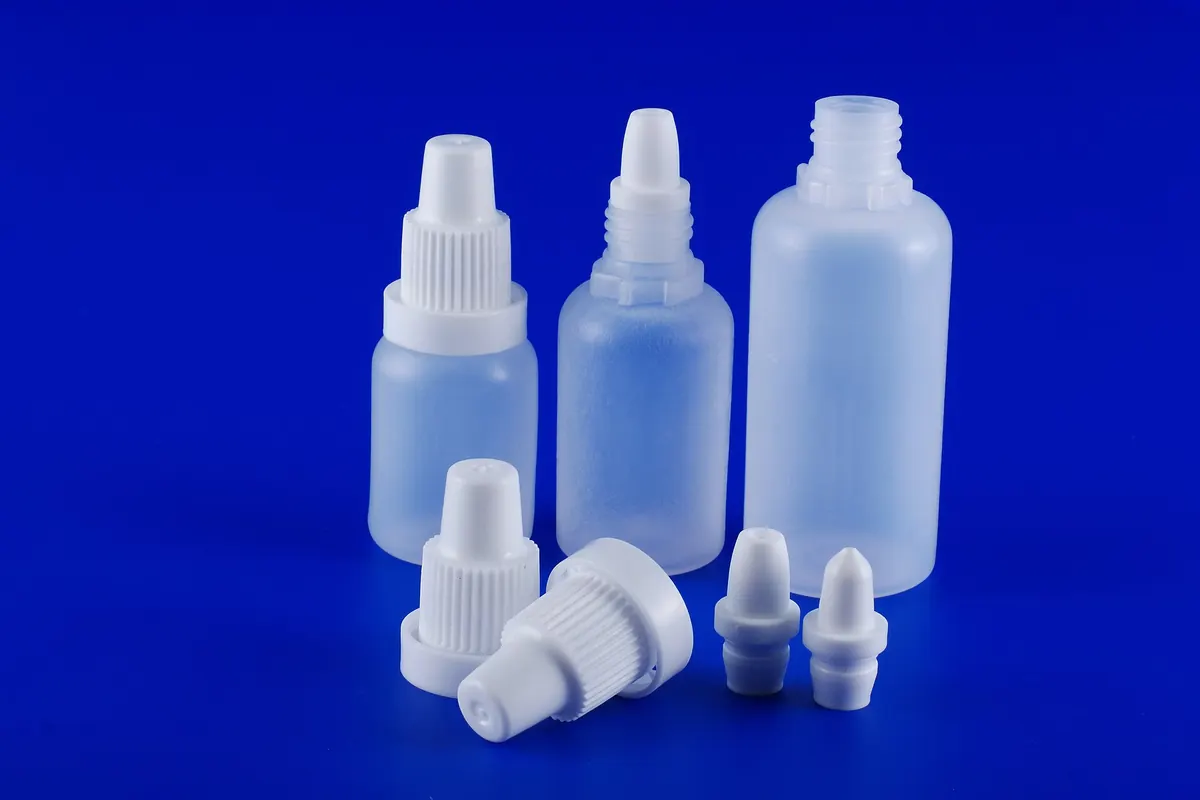

Eye drops, saline and contact lens solution at the checkpoint
Japan's list writes eye drops into its medical exception by name, so a bottle can pass inside the liquids bag or outside it.
- Named in the exception, together with saline
- The medications row on Japan's liquids list reads: liquids and gels including eye drops and saline solution for medical purposes. The list says you are not limited in the amount or volume of items in that row, but they must be declared to the screener for a further security check, and the permitted column narrows it to the amount necessary in the cabin.
One Japanese eye drop, translated line by line from its package insert: Sante FX Neo.
- Contact lens solution is not treated the same everywhere
- Narita Airport says contact lens solution is also treated as a medicine, limited to the amount you use on the plane. GOV.UK takes another line: it lists contact lens solution among liquids and allows it in hand luggage up to 100ml. The TSA allows it in carry-on but warns that some solutions contain chemicals that set off alarms, and recommends putting bottles over 3.4 ounces in checked baggage.
- The TSA's Eye Drops entry has no medical wording
- The TSA lists Eye Drops as its own item with the ordinary carry-on limit of 3.4oz/100 ml and nothing more. Its exception sits in a separate entry, Medications (Liquid): larger amounts of medically necessary liquids are allowed in reasonable quantities for the trip if you declare them to the officers at the checkpoint for inspection.
- Declared medicine gets a closer check
- Declaring drops as medicine brings a closer look. The Japanese version of the list says screeners may carry out a hands-on check and an opening inspection where something seems doubtful. GOV.UK says the same of medicines at UK airports: staff might need to open the containers to screen the liquids at the security point.
Eye drops: the rule country by country
The carry-on answer for eye drops is the same in all 8 other places we checked. The limits themselves are not identical, so read the row for the country you fly from.
| Flying from | Carry-on | Checked bag | What the authority says |
|---|---|---|---|
| JapanCivil Aviation Bureau | With limits | Yes | On international flights eye drops count as medication: they are excepted from the 100ml limit in the amount you need in the cabin if you show them to the screener, and a bottle of 100ml or less inside the liquids bag needs no declaration. Source |
| United StatesTSA | With limits | Yes | Eye drops are allowed in carry-on bags in containers of 3.4oz/100 ml or less.TSA entry: Eye Drops Source |
| European UnionEuropean Commission, EASA | With limits | — | Counts as a liquid: containers of 100 ml or less in one transparent re-sealable bag of one litre or less. Essential medicines are permitted in quantities larger than 100 ml, but only for use during the trip. Source |
| United KingdomUK Government | With limits | Yes | Liquid medicine in a container of 100ml or smaller needs no proof. Essential medicines of more than 100ml are allowed with proof that they are prescribed to you (a doctor's letter or a copy of your prescription). Source |
| South KoreaMOLIT Aviation Security 365 | With limits | Yes | Eye drops fall under liquids, aerosols and gels. Carry-on is restricted on international flights only. Source |
| TaiwanCivil Aviation Administration | With limits | Yes | Counts as a liquid: on international flights each carry-on container must be 100 ml or less, in one resealable clear bag of up to 1 litre. Medically needed liquids over that limit can be carried if declared at security and approved. Source |
| Hong KongCivil Aviation Department | With limits | With limits | Covered as a liquid and a medicinal article. Carry-on: containers of 100 ml or less in the 1-litre bag (medications can be exempted, subject to verification). Carry-on or checked: no more than 0.5 L per article. Source |
| Mainland ChinaCAAC | With limits | Yes | Treated as a liquid: no carry-on on domestic flights; containers up to 100mL in one 1L clear bag on international/regional flights. Liquid medicine a patient needs during the journey is allowed after confirmation at security. Source |
| AustraliaHome Affairs, CASA | With limits | With limits | Eye drops are a medical item allowed in carry-on and checked baggage: 0.5 kg or 0.5 L per item and 2 kg or 2 L in total per person. On international flights you can bring a reasonable amount of medicine required during the flight.CASA Pack Right entry: Eye Drops, Toiletries including perfumes, aerosols, hairsprays and colognes Source |
Each row comes from that authority's own page. Airlines can be stricter, and the screening officer has the final say.
If security in Japan will not let eye drops through
- What to do
- Move eye drops to the bag you check in before you reach security. Narita Airport states that anything given up at the checkpoint is discarded and cannot be returned.
Buying eye drops in Japan
- Where to buy
- Drugstores. Japanese eye drops are a common souvenir.
Frequently asked questions
Can you take eye drops on a plane?
On flights in and from Japan: Yes. On international flights eye drops count as medication: they are excepted from the 100ml limit in the amount you need in the cabin if you show them to the screener, and a bottle of 100ml or less inside the liquids bag needs no declaration. In checked baggage: Yes.
Can you bring eye drops on a plane without a prescription?
Yes. The medications row on Japan's liquids list covers prescription and over-the-counter products and names eye drops, so shop-bought drops are treated like prescribed ones. The TSA's Eye Drops entry asks for nothing beyond the 3.4oz/100 ml container size. GOV.UK says no proof is needed for liquid medication in a container that is 100ml or smaller.
Can you carry several bottles of eye drops bought in Japan in carry-on?
Only inside the liquids bag. The medical exception on Japan's list is limited to the amount necessary in the cabin, so bottles bought to take home fall outside it. They can still travel in carry-on as ordinary liquids: bottles of 100ml or less in the 1 litre bag, 1 bag per passenger. The list asks passengers to put liquids they will not use in the cabin into checked baggage.
Does the TSA allow eye drops in carry-on bags?
Eye drops are allowed in carry-on bags in containers of 3.4oz/100 ml or less.
Can you put eye drops in checked luggage?
Yes on flights in and from Japan. Hong Kong and Australia: accepted in checked baggage with conditions.
What is the rule for eye drops on flights from Australia?
Australia: Eye drops are a medical item allowed in carry-on and checked baggage: 0.5 kg or 0.5 L per item and 2 kg or 2 L in total per person. On international flights you can bring a reasonable amount of medicine required during the flight.
Related items
Sources for this page
- Japan Civil Aviation Bureau (MLIT) — List and Description of LAGs Restriction (1 October 2015)checked October 2, 2026
- Japan Civil Aviation Bureau — Items restricted in carry-on and checked baggage (updated 24 April 2026)checked October 2, 2026
- Japan Civil Aviation Bureau — List of liquids covered by the quantity limits (Japanese, 1 October 2015)checked October 2, 2026
- Narita International Airport — FAQ: prohibited itemschecked October 2, 2026
- TSA — What Can I Bring?: Eye Dropschecked October 1, 2026
- European Commission — Information for air travellerschecked October 1, 2026
- GOV.UK — Hand luggage restrictions: Medicines, medical equipment and dietary requirementschecked October 1, 2026
- Aviation Security 365 (MOLIT / KOTSA) — Items prohibited on boardchecked October 1, 2026
- Taiwan CAA — Dangerous goods passengers and crew may carrychecked October 1, 2026
- Civil Aviation Department (Hong Kong) — Packing Tips for Air Passenger: Provisions for Dangerous Goods Carried by Passenger and Crewchecked October 1, 2026
- CAAC — Air travel basics (航空旅行常识)checked October 1, 2026
- CASA — Pack Right: Eye Dropschecked October 1, 2026
- Australian Department of Home Affairs — TravelSECURE: What you can and can't bringchecked October 1, 2026
- GOV.UK — Hand luggage restrictions at UK airportschecked October 1, 2026
Read more
- Japan Tax-Free Shopping from 1 Nov 2026: How Refunds WorkFrom 1 November 2026 you pay the tax in the shop, pass a customs check at the airport w…
- Nishiki Market vs Kuromon and Tsukiji: 2026 Hours and RulesNishiki Market asks you to eat at the shop, Kuromon welcomes eating as you stroll, and …
- Kobe Beef in Japan 2026: A5 Grades, Rules and Where to EatKobe beef is Tajima cattle raised in Hyogo with marbling of BMS 6 or higher and quality…
- Types of Ramen in Japan 2026: Tonkotsu, Miso, Shoyu, ShioThe four main types of ramen are shoyu, miso and shio, named for the seasoning, and ton…
Compiled by Japan Japan !! · Updated October 2, 2026