Arashiyama Bamboo Forest Entrance Fee and What You Pay For
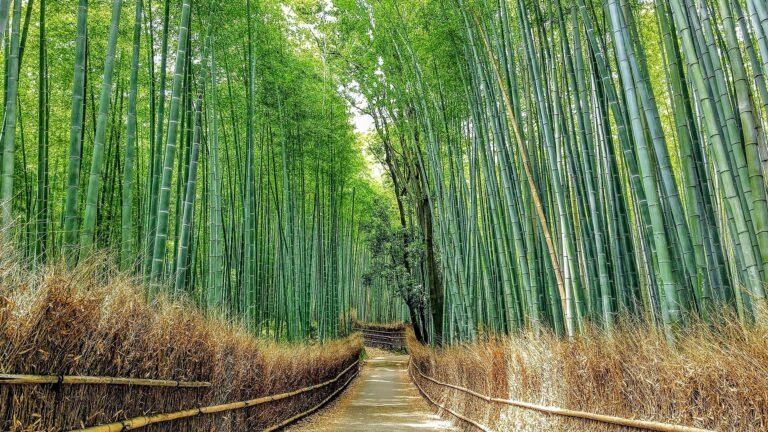
The money you spend in Arashiyama goes to the places at each end of the bamboo path. Okochi-Sanso Villa sits at the top of the grove and charges admission. Tenryu-ji Temple charges for its garden, and its north gate opens onto the bamboo path. If you sleep in Kyoto, the city adds a lodging tax to every night. This guide lists what is free, what costs money, how to get there and when to go.
What is free and what costs money
The ANA Japan Travel Planner Arashiyama page describes the bamboo forest as a walking path of approximately 400 meters. It runs from Nonomiya Shrine to the Okochi-sanso Garden via the north gate of Tenryu-ji Temple. You walk it like a street. Nobody checks a ticket at either end.
These parts of Arashiyama cost nothing to see:
- The bamboo path: the main stretch of about 400 meters through the grove.
- Nonomiya Shrine and its lanes: a second section of the grove reaches the shrine.
- Togetsukyo Bridge: the bridge over the Katsura River, lit in the evening.
- The bamboo craft shops: the street toward Randen Saga Station.
The JNTO Arashiyama Bamboo Grove spot page explains the shrine’s history. Daughters of the Imperial family once purified themselves at Nonomiya before they served as shrine maidens at Ise Jingu. Today young women in yukata come to pray for a love match. Rickshaw drivers stop here to tell their riders about the history.
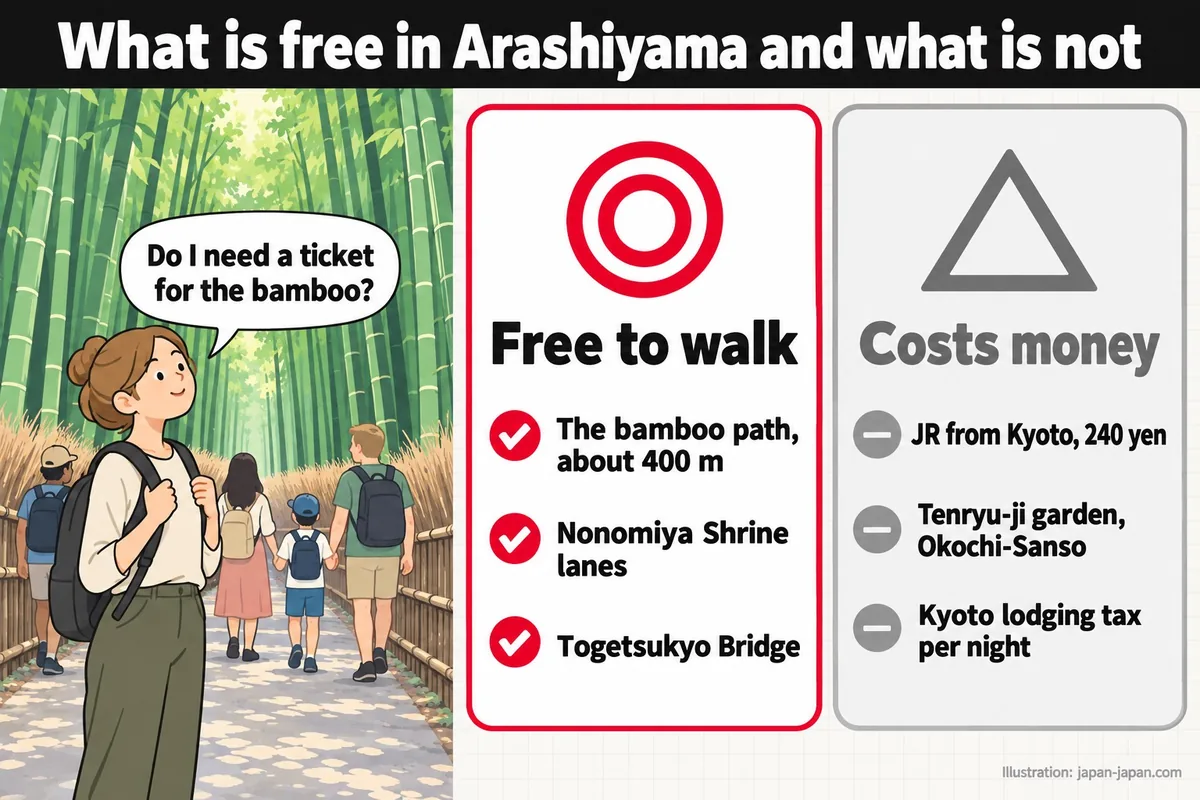
The picture above splits Arashiyama into two lists. The free list is the path, the shrine lanes and the bridge. The paid list is the train, the villa, the temple garden and the lodging tax.
Okochi-Sanso Villa is the first paid stop. It stands at the top of the grove, so you reach it at the end of the path. JNTO calls it a fine alternative to the Imperial villas, with large gardens and some of the best views of Kyoto. It is also generally free of crowds. The admission fee includes a Japanese sweet and hot matcha tea in the villa’s teahouse. Plan to sit down for the tea, because it is part of what you paid for.
Tenryu-ji Temple is the second paid stop. The JNTO Tenryuji Temple spot page says the main reason to visit is the garden. It calls the garden one of the finest examples of traditional Japanese garden design. JNTO suggests you enter the grove from the side gate of Tenryu-ji for the best first view of the bamboo.
The ANA page says the garden has kept its original form around the pond. It borrows the scenery of Kameyama and Arashiyama, the two hills behind it. Japanese gardeners call this technique shakkei.
So a visit can cost almost nothing, or it can add up. Walk the path and the bridge, and you pay only for the train. Add the villa and the temple garden, and you pay two admission fees on top. Add a night in Kyoto, and the lodging tax joins the bill.
Getting there from Kyoto Station
The JR Sagano Line is the quickest way in. The Kyoto to Arashiyama route page gives the JR Rapid at 11 minutes from Kyoto Station to Saga-Arashiyama Station, for 240 yen. The first train leaves Kyoto Station at 05:31 and the last one at 23:46. Both rapid and local trains stop at Saga-Arashiyama.
The Kyoto City Tourism Association access to Saga and Arashiyama page adds two tips for Kyoto Station. The Sagano Line platform is further away than the other lines, so leave extra time to walk to it. The front cars fill up first, so board from the back of the platform.
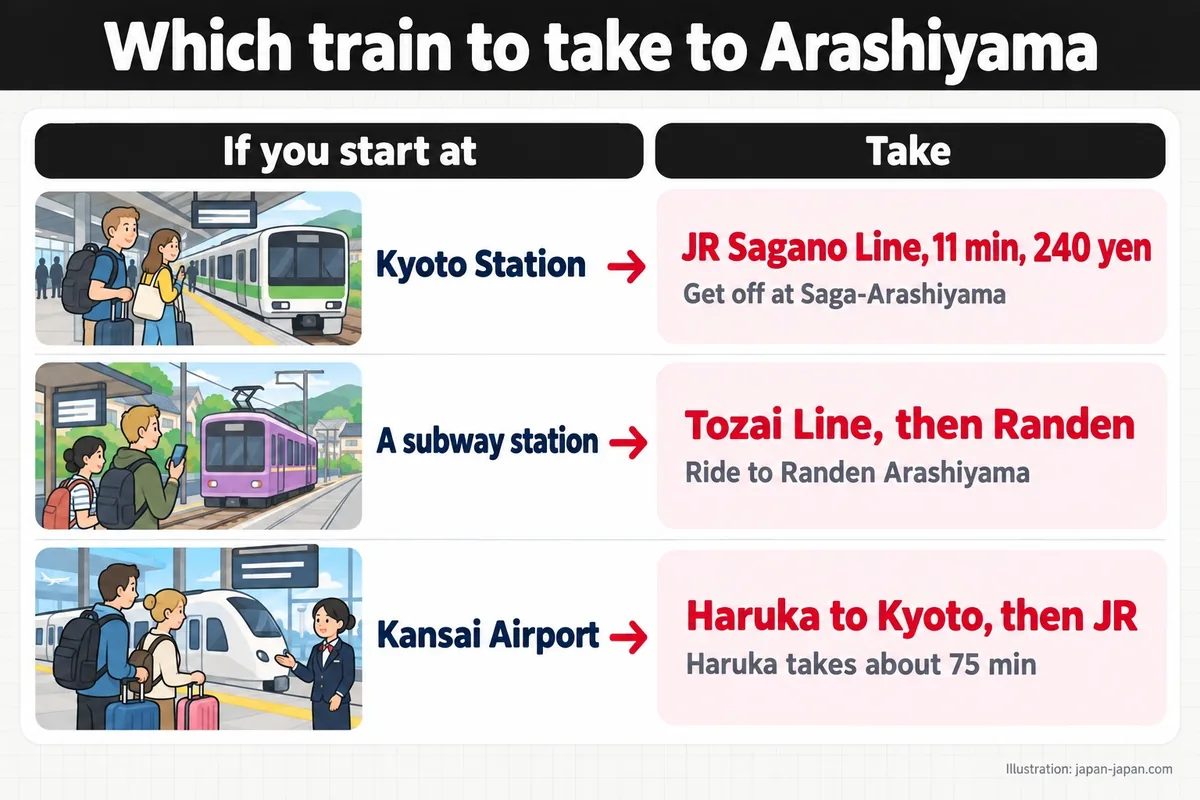
The lookup above matches your starting point to a train. Most visitors start at Kyoto Station and take JR. If you stay near the subway, the Tozai Line and Randen route avoids the crowded JR trains. If you land at Kansai Airport, you ride to Kyoto Station first.
From Saga-Arashiyama Station, the grove is a 10-minute walk, according to JNTO. The Kyoto City Tourism Association says the walk to the Togetsu-kyo Bridge area takes about 8 minutes. Follow the signs, walk straight past the viaduct and join Nagatsuji-dori, the main street. Stay on the sidewalk, because that road is very busy.
| Place | Arashiyama Bamboo Grove |
|---|---|
| Price | Free: no ticket and no gate on the bamboo path |
| Access | 10-minute walk from Saga-Arashiyama Station on the JR Sagano Line (11 min, 240 yen from Kyoto) |
| Official site | JNTO Arashiyama Bamboo Grove spot page |
The Kyoto City Tourism Association also names a calmer route. Take the Subway Karasuma Line to Karasuma Oike Station and change to the Tozai Line. Ride to the last stop in the west, Uzumasa Tenjingawa Station. There you can change to the Keifuku Railway, known as Randen, and ride to its last stop, Arashiyama Station.
| Route | Get off at | Time and fare | Notes |
|---|---|---|---|
| JR Sagano Line (Rapid) | Saga-Arashiyama | 11 min, 240 yen | 10-minute walk to the grove; board at the back |
| Subway Karasuma and Tozai lines, then Randen | Randen Arashiyama | Change at Karasuma Oike and Uzumasa Tenjingawa | Calmer than JR |
| Hankyu Kyoto Line, then Arashiyama Line | Hankyu Arashiyama | Change at Katsura | From Kyoto Kawaramachi |
| City bus from Kyoto Station | Arashiyama area | Crowded and slow | The association advises the train |
The table sets the routes side by side. JR is fast but crowded. The subway and Randen take two changes but feel calmer. The association says the bus from Kyoto Station is crowded and slow. From Shijo Kawaramachi, it advises you to avoid City Bus No. 11, because Shijo-dori is often jammed.
Randen is a small tram line that runs partly on the street. Planning several Randen rides in one day? The Randen 1-day pass page lists the pass at 700 yen for adults and 350 yen for children. It covers the Arashiyama Main Line and the Kitano Line. At the ticket window, you can say: 嵐電1日フリーきっぷ、ください (Randen ichinichi furii kippu, kudasai), which means “A Randen 1-day pass, please.”
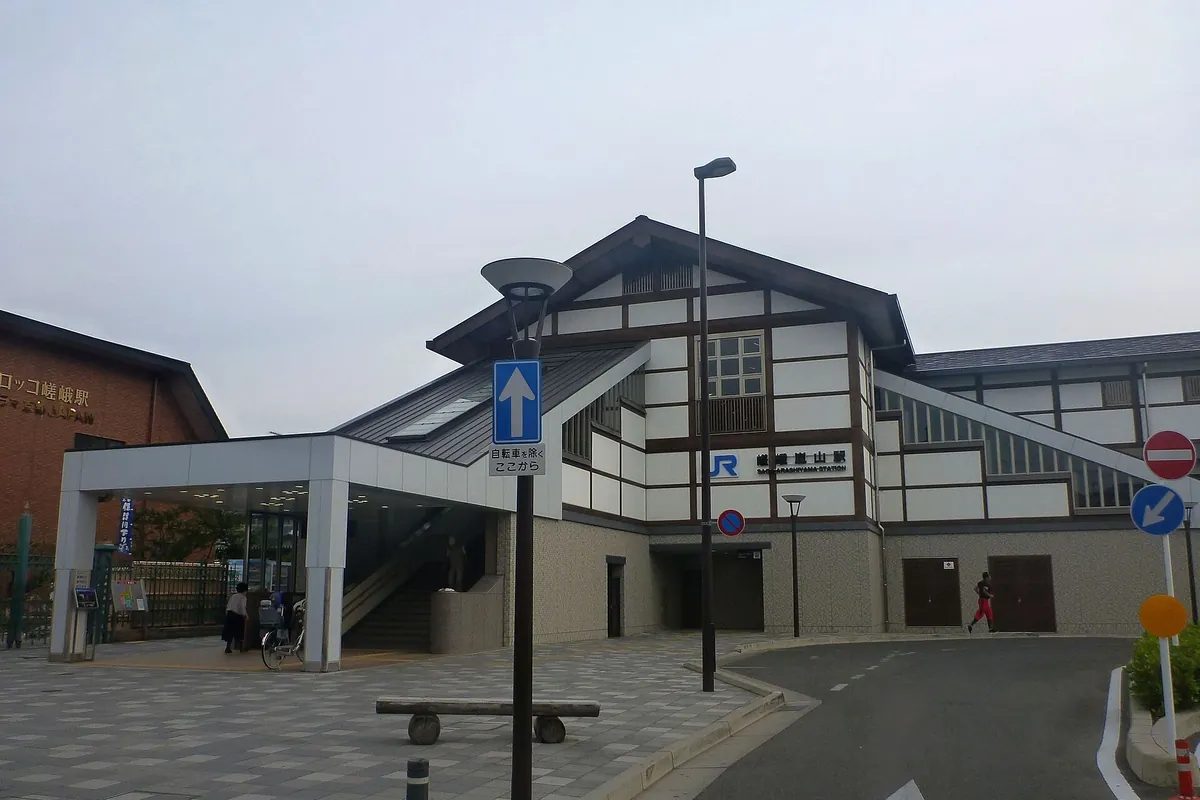
The photo shows Saga-Arashiyama Station on the JR Sagano Line, where the walk to the grove begins. You can pay the fare with an IC card. Our guide to IC cards in Kyoto lists which cards work on the city’s trains and buses. An ICOCA card costs 2,000 yen, which includes a 500 yen deposit that comes back with the card.
Coming straight from the airport, use the Kansai Airport to Kyoto transfer page. The JR Haruka limited express takes about 75 minutes to Kyoto Station for 2,200 yen. The limousine bus takes 85 to 88 minutes for 2,800 yen. Our Kansai Airport page covers the terminals and the other trains.
Best time to go: early morning and weekdays
Go early. The bamboo path has no gate and no opening time, so nothing stops you from walking it at dawn. The first JR train from Kyoto Station leaves at 05:31 and reaches Saga-Arashiyama 11 minutes later. A path of about 400 meters is short, so a small crowd fills it fast.
The Kyoto City Tourism Association tips for Kiyomizu, Arashiyama and Gion names Arashiyama as one of the busiest areas in Kyoto. It asks visitors to take extra care during the cherry blossom and autumn foliage seasons. Before you leave, check the Kyoto Sightseeing Comfort Level Map on Sightseeing Navi, the city’s tourism site. It shows how crowded popular areas are by time of day. Some spots also have live cameras.
Weekdays are calmer than weekends. Japan has two public holidays in November 2026, listed on our November holidays page:
- Culture Day: Tuesday 3 November 2026.
- Labor Thanksgiving Day: Monday 23 November 2026.
The second holiday makes a three-day weekend, from Saturday 21 to Monday 23 November. Expect Arashiyama to be at its fullest on those three days. Our holiday page also counts 3,517,659 visitors who arrived in Japan in November 2025.
Autumn also changes the buses. City Bus 109 runs on the Rakuraku Kinkaku-ji Temple and Arashiyama Line on some days. It runs at weekends and holidays from late April to early May and in the autumn high season. On those days, the train is still the easier choice.
Autumn 2026: leaves and the bamboo light-up
Arashiyama is one of Kyoto’s best-known autumn spots. The ANA page describes the area’s colourful leaves in autumn and its cherry blossoms in spring. Togetsukyo Bridge is even more striking when it is lit in the evening.
The Japan Weather Association autumn leaves forecast 2026 came out on 1 October 2026. For western Japan, it expects temperatures above average through November. So the leaves will colour a little late, and many places will reach their peak at the usual time or later. The association plans 3 to 4 updates to the forecast on tenki.jp through November.
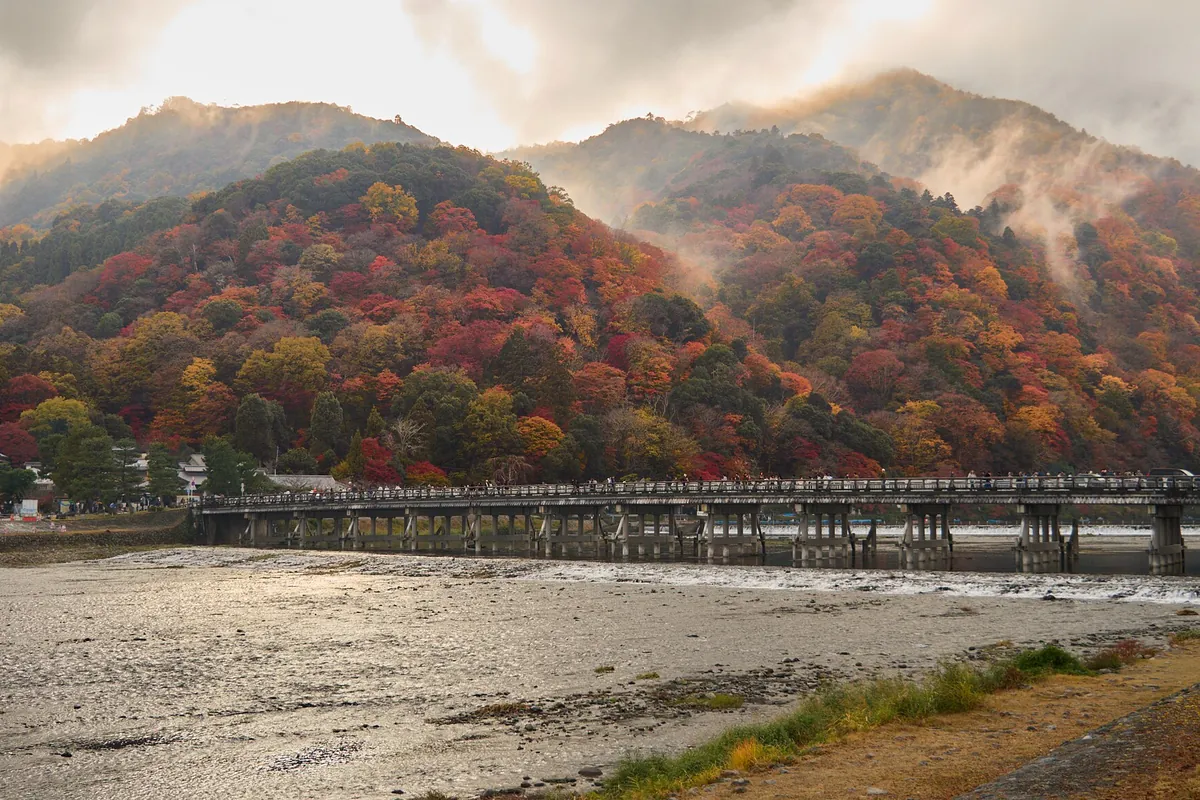
The photo shows Togetsukyo Bridge over the Katsura River with the autumn hills behind it. For dates, our Kyoto autumn leaves page uses the Japan Meteorological Agency’s sample maple near the Kyoto weather observatory. In an average year (1991–2020), that tree turns red around 5 December and loses most of its leaves by 18 December. In 2025 it turned red on 10 December, 5 days later than average. The sample ginkgo turns yellow around 24 November on average.
Across the region, the Kansai autumn leaves page shows maples turning red from about 21 November in Nara to 6 December in Wakayama. These are single sample trees in city centres, so treat them as a guide. Use them with the Japan Weather Association forecast.
The bamboo itself gets a night event. Arashiyama Tsukitouro, also called the Arashiyama Bamboo Light-up, is one of the November events on our Kyoto in November guide. A second lantern event, Arashiyama Hanatoro, started in 2005. ANA calls it a regular winter event that lights temples, streets and bamboo forests in orange. It is held in early winter.
For the full autumn picture, read our Kyoto autumn leaves and crowds guide. It covers peak dates and how to plan around the busiest days.
Bamboo path manners: what not to do
The bamboo path is narrow, and rickshaws share it with walkers. The Kyoto City Tourism Association lists a few rules for busy areas like Arashiyama. Its main point: do not stop in the flow of people to talk or take photos. Blocking the path annoys others and can cause falls.
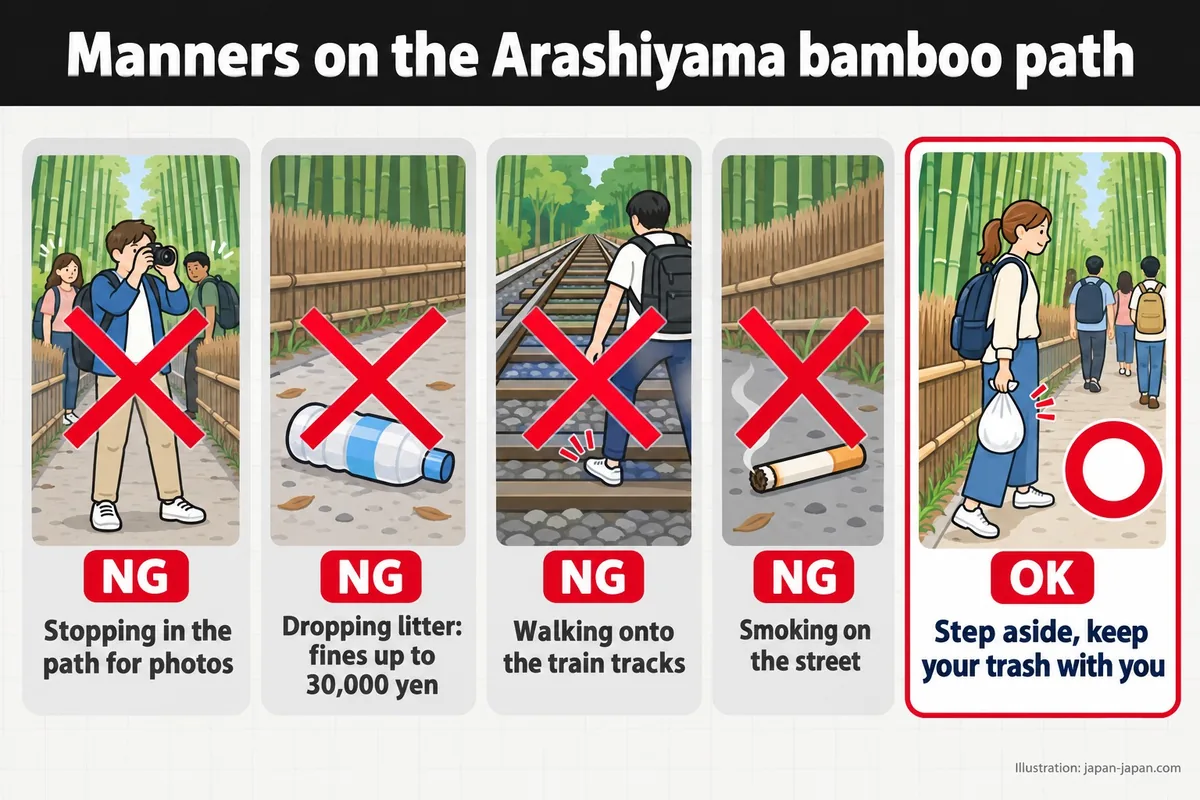
The picture shows the four things to avoid and the one thing to do. Each item comes from the association’s list for Arashiyama:
- Do not block the path: step aside before you stop for a photo.
- Do not drop litter: use a trash can or take your trash with you.
- Do not walk onto the train tracks: this is strictly prohibited.
- Do not smoke on the street: this is also strictly prohibited.
Litter rules carry real fines. Kyoto City has named 43 areas, mainly tourist spots such as Arashiyama and Fushimi Inari Taisha Shrine, as Beautification Promotion Areas. People who break the ordinance can face fines of up to 30,000 yen. The association offers a trash can map so you can find a bin.
Leave the drone at home. Under Japan’s Civil Aeronautics Act, most of Kyoto City counts as a densely populated area where drone flying is prohibited. Some temples and shrines also ban photography or flash in parts of their grounds. Read the signs at each gate.
Beyond the bamboo: Togetsukyo, Tenryu-ji and Randen
Tenryu-ji Temple was built in 1339 by the then Shogun Ashikaga Takauji, the ANA page says. JNTO adds that it was once a huge complex of more than one hundred sub-temples. Eight major fires destroyed most of it over the centuries. All the current buildings date from a rebuilding in the Meiji Era (1868-1912).
Look up when you enter the Hatto Hall. The Cloud Dragon painting on its ceiling is the temple’s best-known feature. The first head priest, Muso Soseki, gets the credit for the garden. JNTO says it is believed to be the least changed of his gardens. Inside the grounds, Shigetsu serves Zen vegetarian food and holds a Michelin star. Two sub-temples, Hogon-in and Kogenji, open to visitors only for limited periods in spring and autumn.
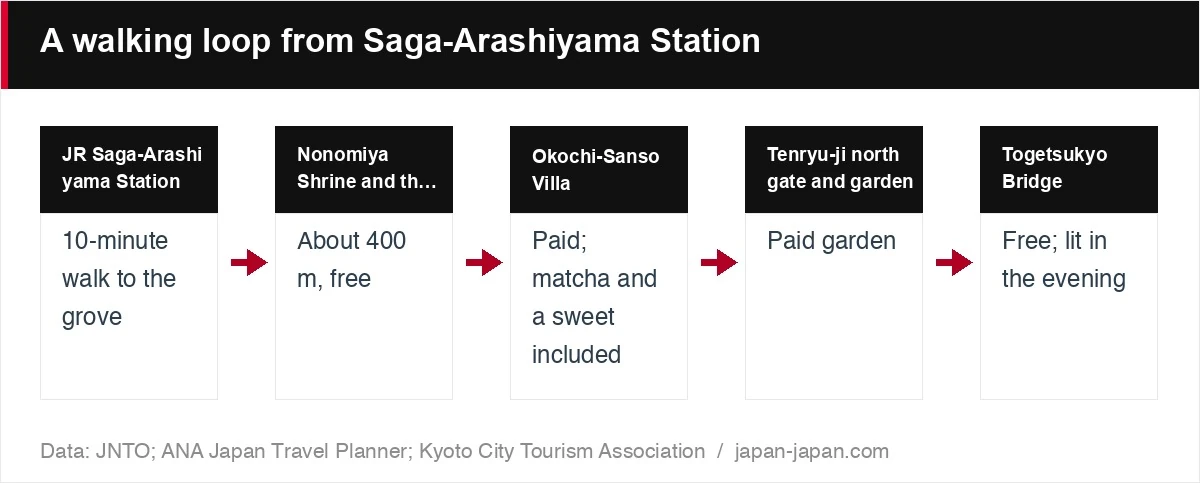
The flow above links the sights into one walk from Saga-Arashiyama Station. Walk 10 minutes to the grove and pass Nonomiya Shrine. Follow the path to Okochi-Sanso at the top. Come back to the north gate of Tenryu-ji and cross the garden. Leave by the main gate and walk to Togetsukyo Bridge.
Togetsukyo means “the moon crossing a bridge.” ANA says it is one of the most popular landmarks in Kyoto. Aristocrats from the capital came here for leisure a thousand years ago. In the Heian Period (794-1185), they built holiday villas in the area.
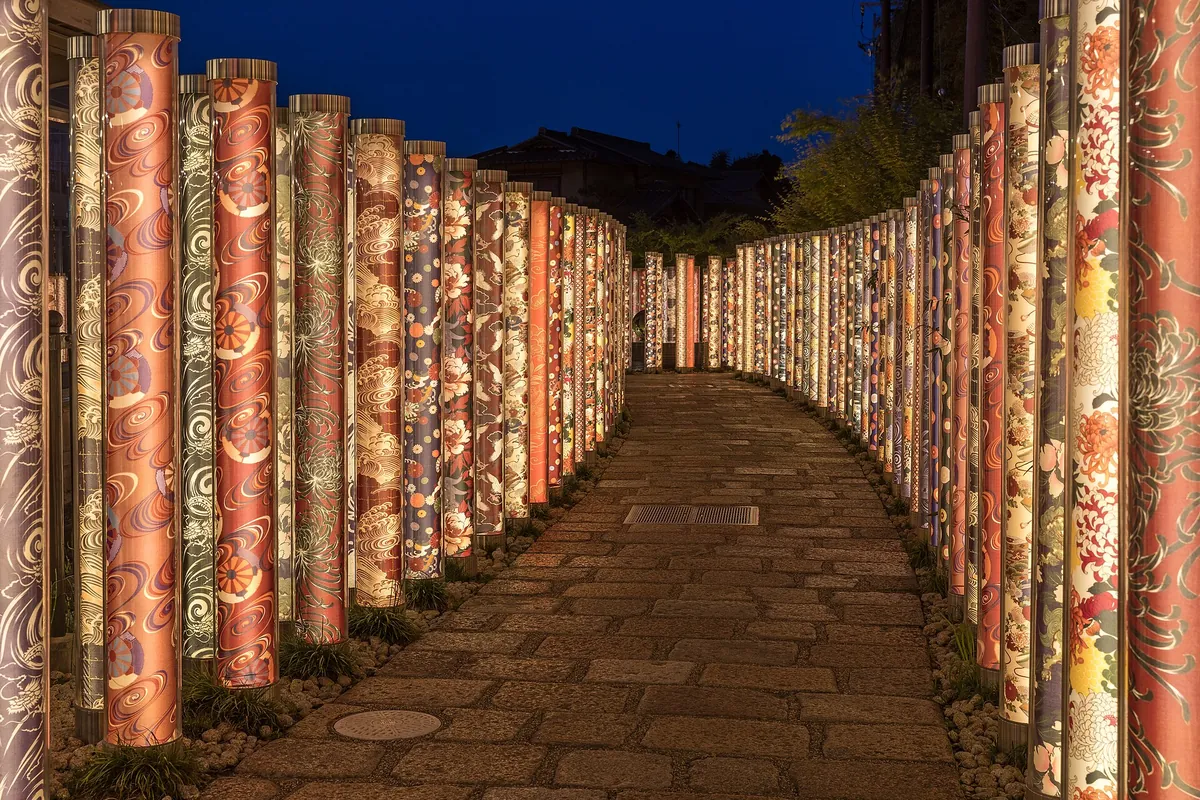
The photo shows the Kimono Forest at Randen Arashiyama Station, the end of the walk. Tenryu-ji is just two minutes from this station. From the terminal, turn left and walk about 4 minutes to reach Togetsu-kyo Bridge. The tram takes you back toward Shijo-Omiya and central Kyoto.
Making a longer day of it? Our Fushimi Inari Shrine entrance fee guide covers the other famous free walk in Kyoto.
Staying in Arashiyama: Kyoto’s lodging tax
Arashiyama is inside Kyoto City, so a night here comes with Kyoto’s lodging tax. The City of Kyoto lodging tax page sets the tax per person per night, by the room charge. New rates took effect on 1 March 2026.
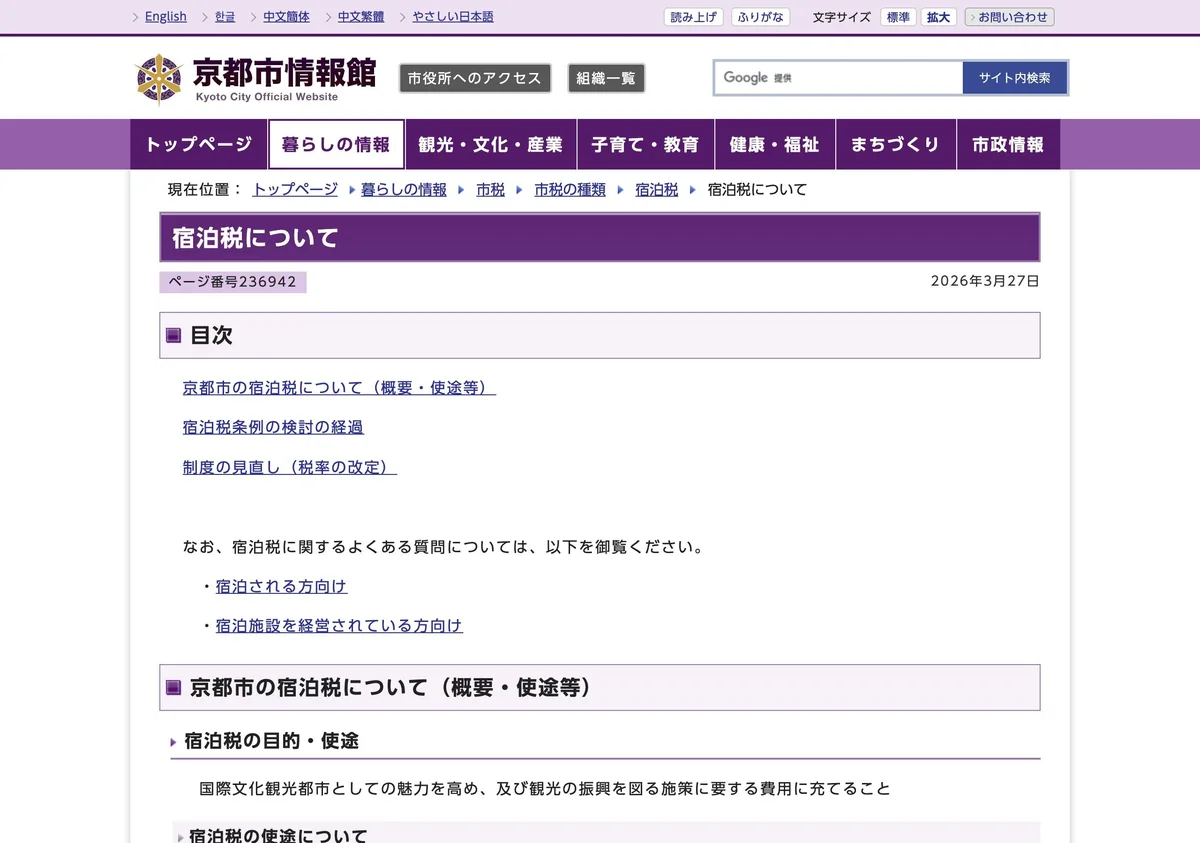
The screenshot is the City of Kyoto page on the lodging tax, in Japanese. It lists the current and revised rates side by side, with the start date of 1 March 2026.
| Room charge per person per night | Tax from 1 March 2026 |
|---|---|
| Under 6,000 yen | 200 yen |
| 6,000 yen to under 20,000 yen | 400 yen |
| 20,000 yen to under 50,000 yen | 1,000 yen |
| 50,000 yen to under 100,000 yen | 4,000 yen |
| 100,000 yen and over | 10,000 yen |
The room charge here means the room-only rate, with the service charge. Meals and consumption tax do not count. The tax applies to every guest at hotels, ryokan and simple lodgings, including illegal private rentals. School groups on official school trips are exempt.
You pay the tax to your hotel or inn, and the property pays the city. It may already be inside the price you paid to a booking site or travel agency. The city asks you to check with your property.
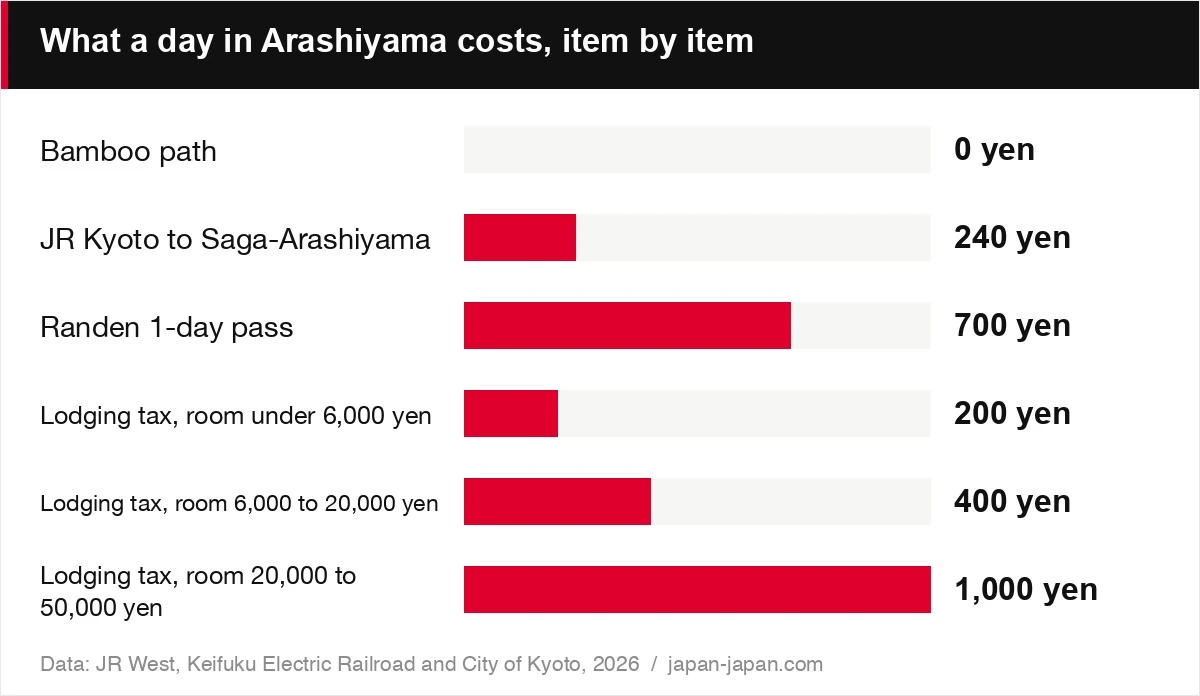
| Item | Value | Note |
|---|---|---|
| Bamboo path | 0 yen | No ticket |
| JR Kyoto to Saga-Arashiyama | 240 yen | One way, Rapid |
| Randen 1-day pass | 700 yen | Adult |
| Lodging tax, room under 6,000 yen | 200 yen | Per person per night |
| Lodging tax, room 6,000 to 20,000 yen | 400 yen | Per person per night |
| Lodging tax, room 20,000 to 50,000 yen | 1000 yen | Per person per night |
The chart puts the day’s costs in one place, in yen. The bamboo path is free. The JR ride and a Randen pass are small. The lodging tax depends on your room. To compare Kyoto with other cities, see our Japan accommodation tax guide.
FAQ
Is the Arashiyama Bamboo Forest free to enter?
Yes. The bamboo path of about 400 meters has no gate and no ticket. You pay only at the places beside it, such as Okochi-Sanso Villa and the Tenryu-ji garden.
What time is best to visit the Arashiyama Bamboo Forest?
Early morning on a weekday. The first JR train from Kyoto Station leaves at 05:31. Avoid the three-day weekend from 21 to 23 November 2026, and check the Kyoto Sightseeing Comfort Level Map before you go.
How long does it take to walk through the Arashiyama Bamboo Forest?
The main path is about 400 meters, from Nonomiya Shrine to the Okochi-sanso Garden via the north gate of Tenryu-ji. Add a 10-minute walk from Saga-Arashiyama Station. Leave time for the villa and the temple garden if you plan to go in.
Is there a light-up at the Arashiyama Bamboo Forest in autumn 2026?
Yes. Arashiyama Tsukitouro, the Arashiyama Bamboo Light-up, is one of the November events on our Kyoto in November guide. Arashiyama Hanatoro, a lantern event that started in 2005, lights the bamboo forest in early winter.
About the author


.jpg)

