Japan Visa Bank Statement: 3 or 6 Months, by Embassy
The statement is one part of a short file. The MOFA Japan single-entry short-term stay visa checklist asks tourists for six things. They are a valid passport, the application form, one photo, a flight itinerary, proof you can pay for the trip, and an itinerary in Japan. For most tourists, the bank statement covers the fifth item.
The months differ because each Japanese embassy writes its own list. The pages for Egypt and Sri Lanka spell the rule out in plain words, and this guide quotes them. If you apply somewhere else, read the list from the office that takes your file before you visit your bank.
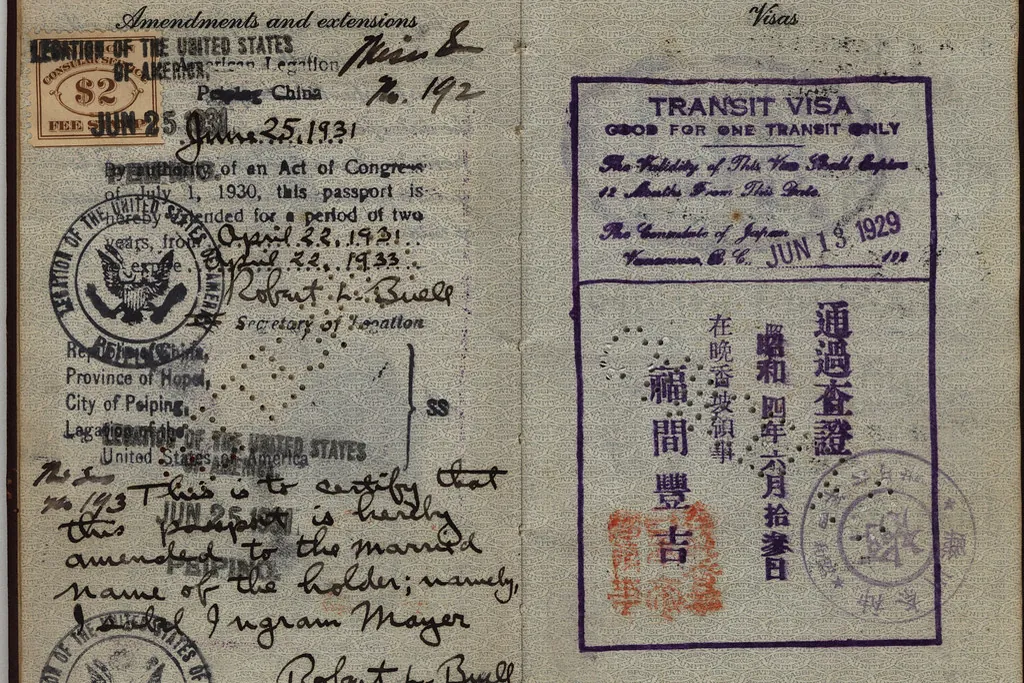
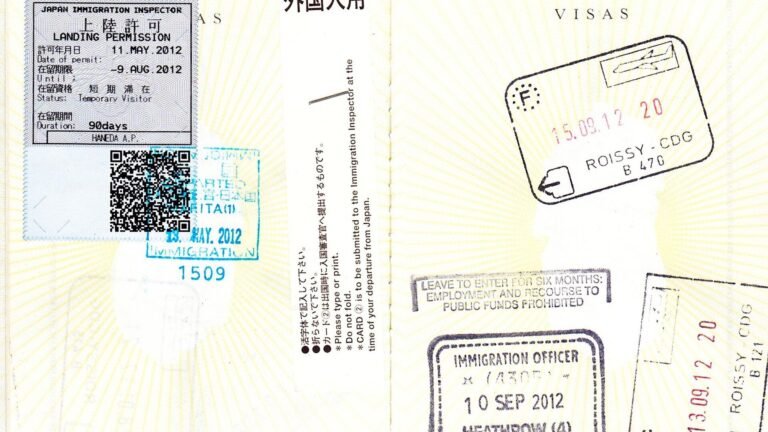
The photo shows what the whole file is for: a Japanese visa sticker on a passport page. Our page on Japan tourist visa requirements lists every document in the file, including the 45 × 35 mm photo.
What counts as proof of funds
Proof of funds is any paper that shows who pays.
For a tourist paying their own way, that paper is a bank statement. Egypt’s tourist list names it outright: item 5 is an original stamped bank statement for the last 3 months, in English. The same list asks for a certificate of employment with your salary, tenure and position. Students hand in an enrollment certificate in its place.
Business trips work differently. Here the Egypt page accepts travel orders from your employer, a letter of temporary assignment or a bank statement as proof of funds. So the bank statement is one option among several when a company pays.
When someone in Japan pays, the papers change again. The host signs a letter of guarantee and sends their own documents, and that route has its own section below. Some nationalities also follow a separate outline. The foreign ministry checklist sets apart nationals of China, Russia, the CIS countries, Ukraine, Georgia and the Philippines. Each of those has its own document list.
The illustration below sorts you into one of three routes with two questions.
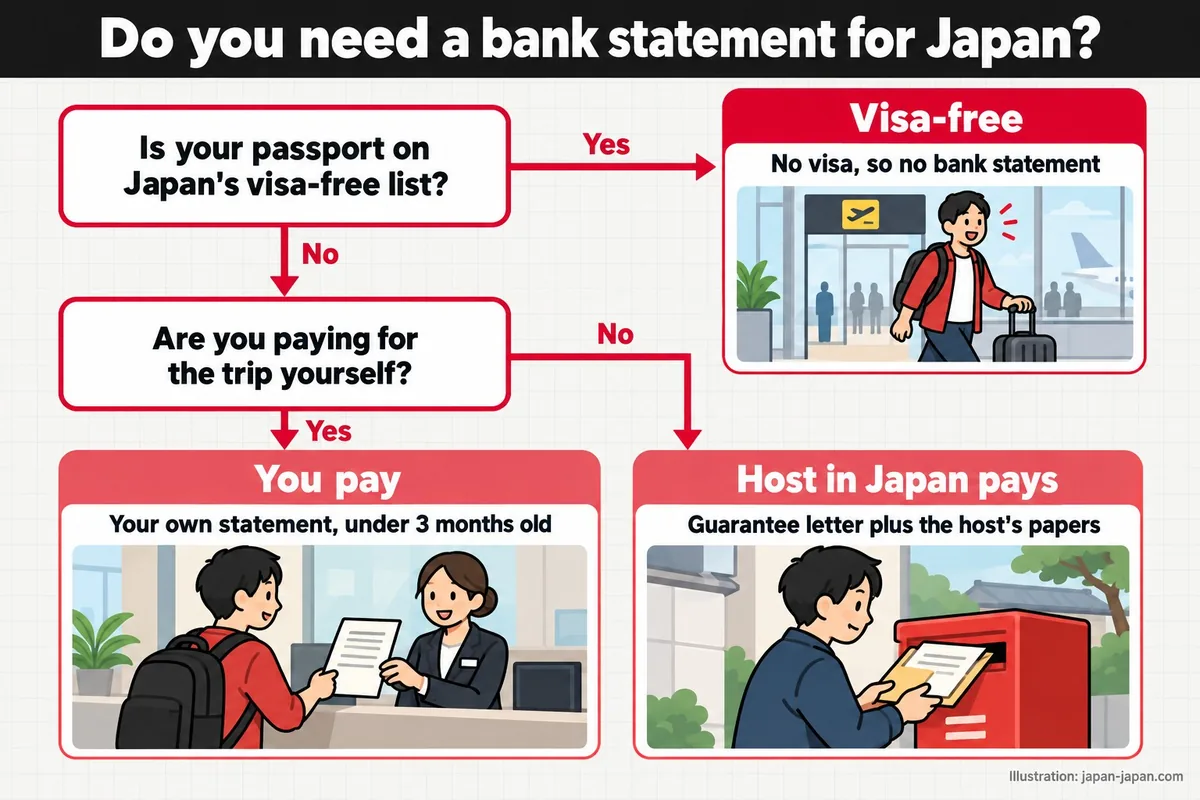
Start with the visa-free question, because 74 countries and regions skip the whole file for a short stay. Then ask who pays. Your answer decides whose bank papers go into the envelope.
3 or 6 months: what each embassy asks
Two embassies set a clear number.
The Embassy of Japan in Egypt short-term visa documents page asks tourists and family visitors for the last 3 months. The Embassy of Japan in Sri Lanka visa requirements page asks for the last six months. The table below puts the exact wording side by side.
| Who asks | Document | Period | Form |
|---|---|---|---|
| All applicants (MOFA) | Proof you can pay for the trip | Issued within the last 3 months | One of 6 core documents |
| Egypt, tourism | Bank statement | Last 3 months | Original, stamped, in English |
| Egypt, visiting relatives | Your statement, plus the guarantor’s if they pay | Last 3 months | Yours: original, stamped, in English |
| Egypt, business | Travel orders, assignment letter or bank statement | No month count | Any one of these |
| Sri Lanka | Bank statement of deposit balance | Last 6 months, issued within 3 months | Original plus A4 photocopy |
Egypt’s rule has three parts beyond the months. The statement must be the original, it must carry the bank’s stamp, and it must be in English. The embassy adds that all Arabic documents need an English or Japanese translation attached. Do not staple anything: the Egypt page repeats that line under its document lists.
Sri Lanka’s rule has two parts. The statement covers the last six months, and the bank must issue it within three months of the day you apply. Hand in the original with an A4 photocopy. The embassy keeps what you submit, and the A4 copy is how originals such as the bank statement come back to you.
The checklist illustration below turns both pages into four checks you can run at the bank counter.
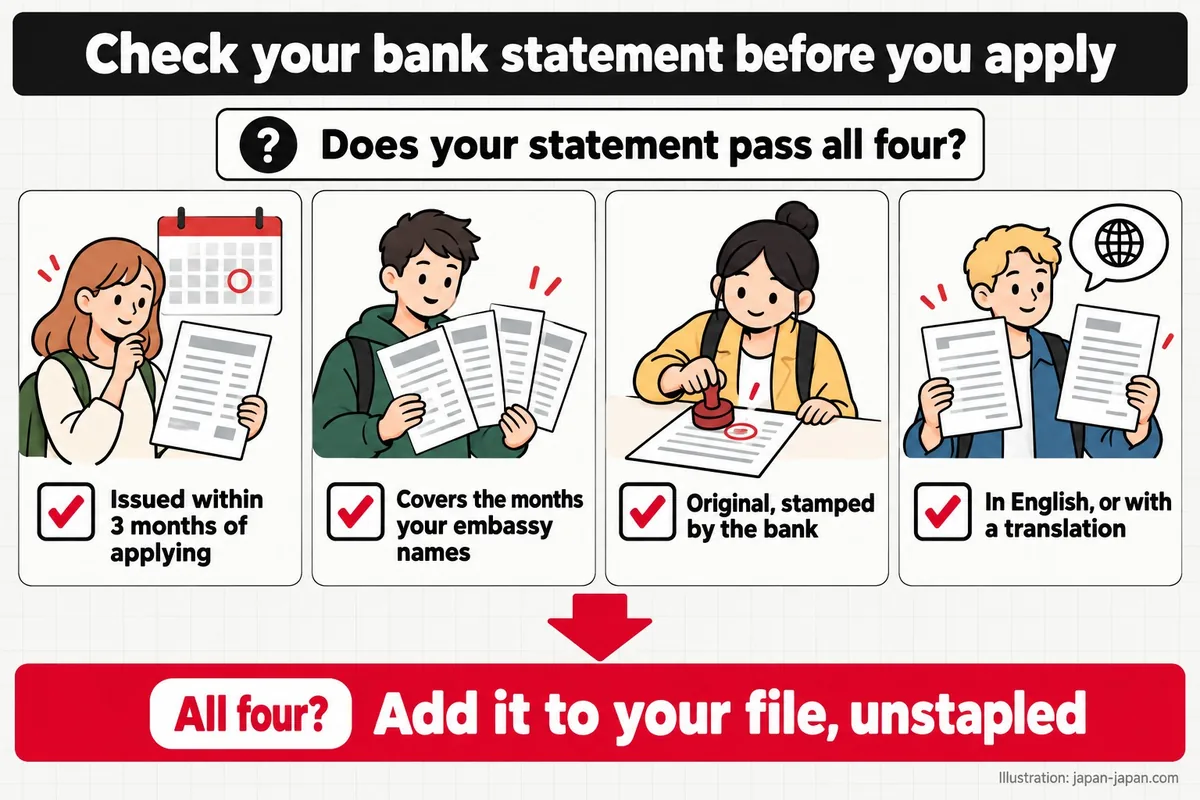
Run the four checks on the day the bank prints your statement. A statement printed too early can pass the months test and still be too old by the time you apply.
For India, the Philippines, Indonesia and Vietnam, take the month count from the list of the office that receives your file. The Embassy of Japan in India visa information page sends applicants to VFS. The Embassy of Japan in the Philippines visa page sends them to its Visa Center, which opened in April 2025. Our country pages for Indian applicants, Filipino applicants and Vietnamese applicants show where each file goes.
The chart below lines up every month count that touches the statement.
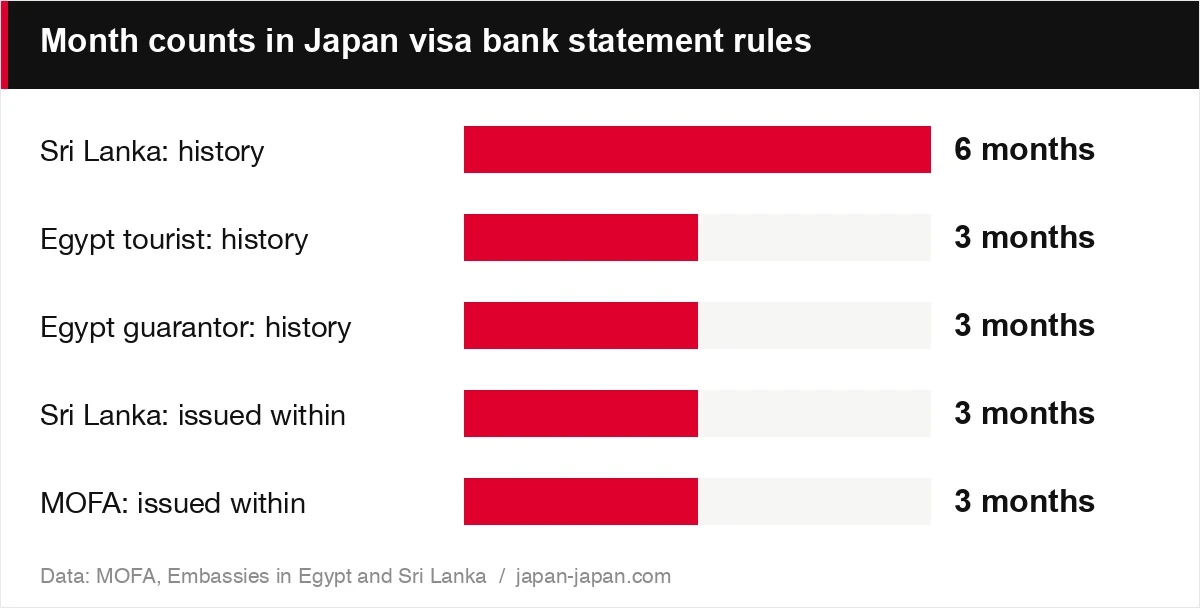
| Item | Value |
|---|---|
| Sri Lanka: history | 6 months |
| Egypt tourist: history | 3 months |
| Egypt guarantor: history | 3 months |
| Sri Lanka: issued within | 3 months |
| MOFA: issued within | 3 months |
Sri Lanka’s six months of history is the longest bar in the chart. Every other month count in these rules is three months. Two of those counts are about the age of the paper, and the rest are about the period it covers.
Japan visa bank certificate vs bank statement
A bank certificate and a bank statement are different papers.
A bank certificate, also called a balance certificate, is usually one page. It states the balance in your account on a single date. A bank statement lists every deposit and withdrawal across a period, such as three or six months. The certificate shows how much you hold on one day. The statement shows the money coming in and going out, so a large deposit made last week stands out.
The month rules decide which one you need. Sri Lanka’s page names a bank statement of deposit balance and asks for six months of it. A one-day certificate cannot meet that rule alone. Egypt’s page asks for a statement for the last 3 months, with the bank’s stamp. If your bank offers both, bring the statement for the months your embassy names.
Many applicants ask whether the paper must be addressed to the embassy. The Egypt and Sri Lanka pages set their rules on months, originals, the stamp, A4 copies and language. Neither page asks for an addressee. What both lists check is the period, the original and the bank’s stamp.
Filipino tourists file through the embassy’s Visa Center, which forwards applications to the embassy. VFS Services Philippines runs it at five sites: Paranaque, Makati, Quezon City, Cebu and Davao. The temporary visitor visa, for stays of up to 90 days, is free for Philippine nationals. The same embassy lists a multiple-entry visa for Philippine nationals with considerable financial capacity. Our guide to the Japan multiple entry visa covers who qualifies.
When someone in Japan pays
A host in Japan can carry part or all of the cost.
In that case the host signs a letter of guarantee, and some of the paperwork moves to their side. Egypt’s list for visiting relatives spells out the trigger. If the guarantor covers part or all of the travel expenses, submit a letter of guarantee and a bank statement for the last 3 months. You still hand in your own stamped statement for the last 3 months on the same list.
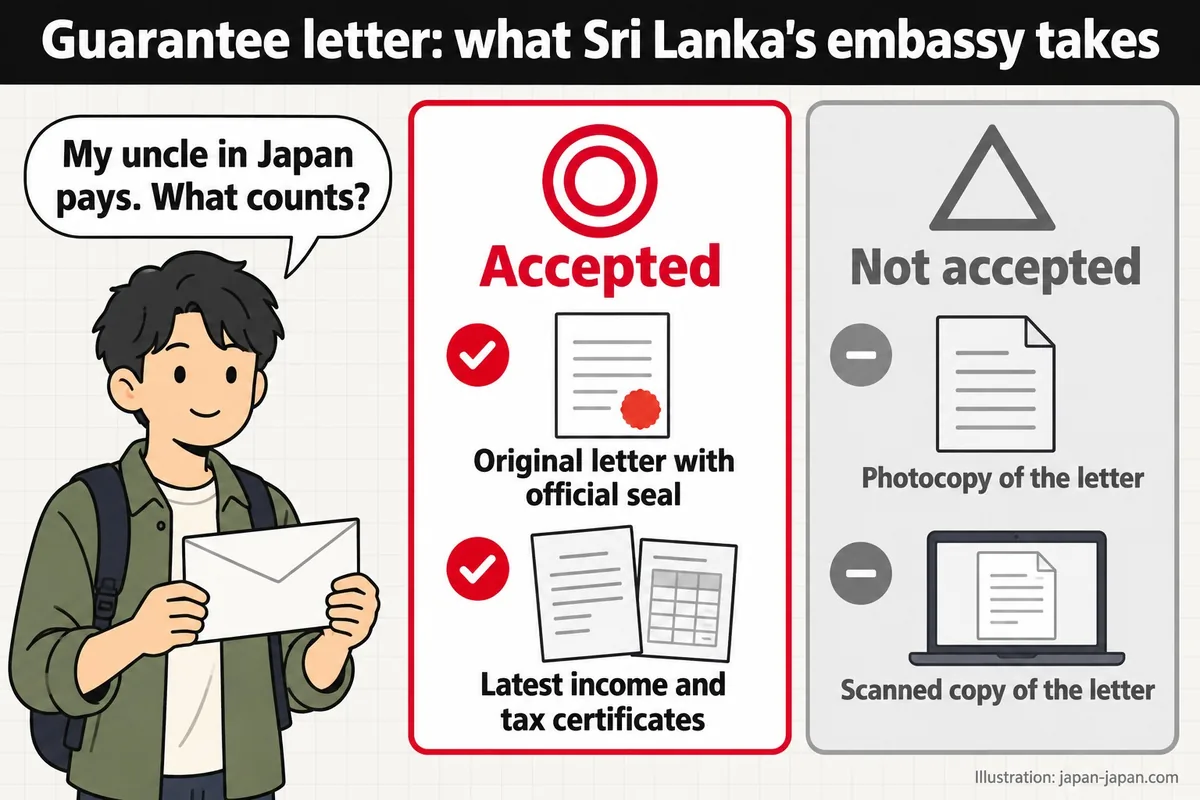
Sri Lanka’s page lists what the guarantor prepares. The letter of guarantee must be the original with an official seal, and the embassy does not accept copies or scanned letters. The guarantor also supplies an income certificate and a tax payment certificate or receipt. Both must be originals and the latest ones at the time of application.
The illustration below shows where Sri Lanka’s embassy draws the line on the letter.
A foreign guarantor adds a copy of both sides of a valid residence card, a certificate of residence and a passport copy. The certificate of residence must list every item except the My Number and the resident record code. Egypt also asks a foreign inviter for both sides of the residence card.
Japanese hosts send a family register to prove the relationship. Egypt’s list writes it as Kosekitohon: 戸籍謄本 (koseki tohon, family register). Sri Lanka’s page asks for one issued by the Japanese local government within three months of the application.
The Philippine embassy takes a different line on paper. It accepts photocopies of documents issued or prepared in Japan instead of the originals. It also offers the Letter of Guarantee form in Japanese and English. Our Japan visa guarantee letter guide walks through who signs it and what to attach.
How long it takes and why it slows down
The foreign ministry’s standard is 5 working days.
The clock starts the day after the embassy receives your application, and it assumes nothing is missing. If the embassy refers the case to Tokyo, the ministry says it can take more than a month. Our Japan visa processing time page tracks what each embassy says. The guide on how to apply for a Japan visa covers the office for each country.
| Where you apply | Time the embassy gives | Also on the page |
|---|---|---|
| Egypt | 5 working days, sometimes longer | No appointment needed |
| Sri Lanka | Usually 6 working days, counting the day you submit | 3 months to send extra documents |
| Indonesia | At least 5 working days after receipt | Incomplete files are not accepted |
| Philippines | Several weeks for tourist visas | Apply no earlier than 3 months before travel |
| India | Varies widely, cannot be expedited | Files accepted from 3 months before travel |
Files slow down when something is missing. The Egypt, Sri Lanka and Indonesia pages all say the embassy may ask for extra documents after you apply. Sri Lanka gives you three months to send them, and after that the application ends. The Embassy of Japan in Indonesia visa page says it will not accept a file with missing items. The Indian embassy does not answer questions about status, documents or reasons for refusal.
A refusal costs time too. Sri Lanka’s embassy does not give reasons, and you can apply again for the same purpose after six months. Forged papers carry a heavier price: Sri Lanka treats anyone who submits them as permanently ineligible for a Japanese visa.
The diagram below puts the steps in order.
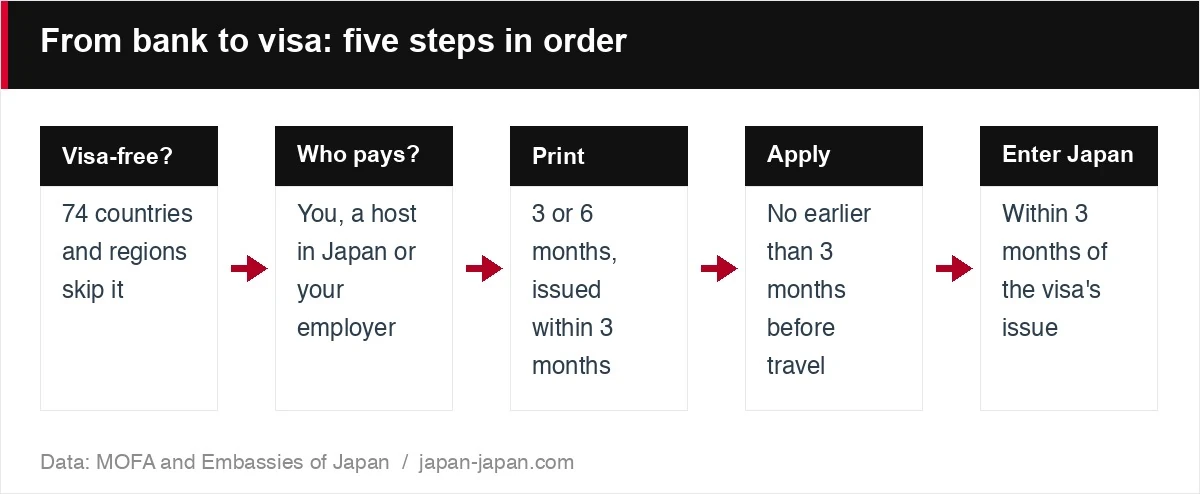
Most of the timing hinges on three months. Your statement must be under 3 months old, and India and the Philippines take files from 3 months before travel. A single-entry visa from Egypt, Sri Lanka or the Philippines is valid for 3 months from the day it is issued.
A visa gets you to the immigration counter, and the officers there make the last call. The Indonesian embassy describes a visa as a recommendation for entry, with the final decision made by Japanese immigration when you land.
Who needs a Japan visa in 2026
Many visitors skip the bank statement entirely.
Nationals of 74 countries and regions can enter Japan without a visa for a short stay, mostly for up to 90 days. Our list of visa-free countries for Japan follows the foreign ministry list revised on 1 September 2025. Indonesia is on it with a condition. Indonesians need an ICAO-compliant ePassport registered in advance at a Japanese mission, and the stay is capped at 15 days. Everyone else from Indonesia applies for a visa, and our Japan visa page for Indonesians covers both routes.
Everyone else applies, and that is a lot of people. The MOFA Japan number of visas issued in 2025 release counts 7,862,060 visas for 2025, about 9% more than in 2024. Only 2019, with 8,277,340, was higher. Nationals of China, the Philippines and Vietnam took nearly 80% of the total.
The photo below shows the Ministry of Foreign Affairs building in Kasumigaseki, Tokyo.

The ministry also names its busiest offices. The Consulate-General in Shanghai, the Embassy in China and the Consulate-General in Guangzhou issued the most visas. The top 9 missions were all in Asia.
Fees depend on your nationality. Indian nationals pay 500 INR from 1 July 2026, and the temporary visitor visa is free for Filipinos. Chinese nationals pay 715 CNY, and our Japan visa fees page covers the rest. In China and Vietnam, applications go through travel agencies accredited by the Japanese mission, so your bank statement goes to the agency. Citizens of Egypt and Sri Lanka need a visa too, tourism included.
Some applicants can skip the paper file. India started the JAPAN eVISA on 1 April 2024. In the Philippines, eVISA issuance began on 15 December 2025 for packaged tours, and those applications still go through the Visa Center.
FAQ
Is there a minimum bank balance for a Japan tourist visa?
The official pages in this guide set rules on months and format, not on a sum. Egypt wants 3 months of stamped history and Sri Lanka wants six. Egypt’s business list describes the goal as proof of enough funds to cover all your expenses in Japan. Make the balance fit the trip in your itinerary.
How old can my bank statement be for a Japan visa?
Under three months old on the day you apply. The foreign ministry checklist asks for documents issued within the last three months, and Sri Lanka’s page repeats the rule for the statement. Print it close to your application date, after you book your flights and hotel.
Can my parents’ bank statement be used for my Japan visa?
Egypt’s lists show two routes. A host in Japan who pays adds a letter of guarantee and their own 3-month statement. When family members apply together, Egypt asks for a birth or marriage certificate to show the relationship. Ask the office taking your file before you swap your own statement for a parent’s.
Does a Japan visa bank certificate need to be addressed to the embassy?
Neither the Egypt nor the Sri Lanka page asks for an addressee. Their rules cover the period, the original, the bank’s stamp and, in Egypt, English. If the office taking your file hands out its own checklist, follow that one.
About the author