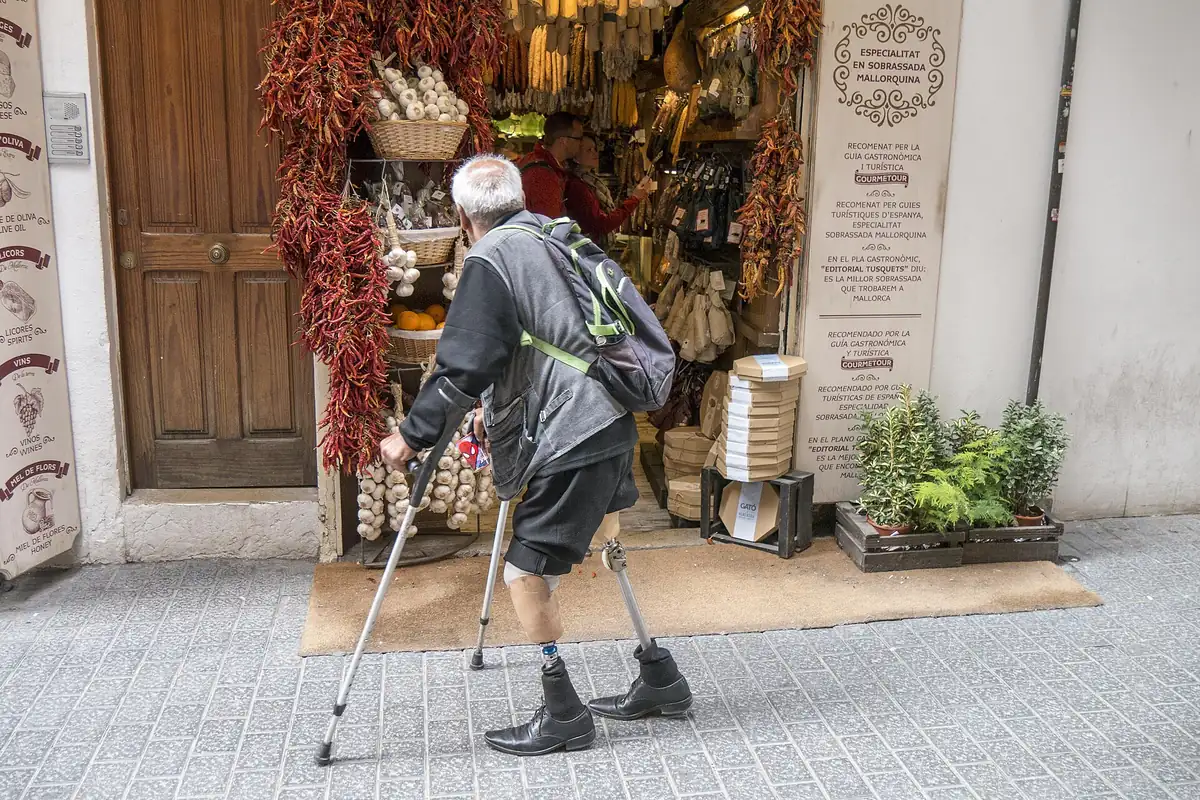

In Japan crutches are allowed in carry-on with conditions, and in checked bags.
Carry-on: Yes, when you are physically impaired and use them yourself. Japan's list does not name crutches. The closest entries are the walking stick and the splint: one of 60cm or less can be carried on, and a longer one can too when a physically impaired passenger uses it personally. Checked baggage: Yes.
Crutches on flights in and from Japan
The rule for crutches comes from the Civil Aviation Bureau's list of restricted items and is the same on domestic and international flights.
| Where | Allowed? | What applies |
|---|---|---|
| In the cabin | Yes, within limits | Yes, when you are physically impaired and use them yourself. Japan's list does not name crutches. The closest entries are the walking stick and the splint: one of 60cm or less can be carried on, and a longer one can too when a physically impaired passenger uses it personally. |
| In checked baggage | Yes | Yes. |
Narita Airport says commercially sold walking canes can be brought onto the airplane, and asks you to consult the airline about other items that are excessively long.
Crutches in the cabin: who may carry them and where they are stowed
Security decides whether crutches pass the checkpoint. The airline decides where they stay once you are seated.
- JAL does not count crutches as a carry-on piece
- JAL's FAQ says walking sticks and crutches can be brought into the cabin free of charge and are not included in the carry-on piece limit. JAL asks passengers to stow them under the seat or in the shared overhead bin. It adds that one with a sharp tip may be refused.
- On ANA the cabin crew keep crutches for you
- ANA's FAQ allows sticks and crutches whose tips are not pointed. It treats the 2 differently once on board: a stick is laid flat under the seat in front, while crutches are kept by the cabin crew during the flight.
- South Korea ties cabin carriage to the user
- South Korea's aviation security list names crutches (목발) and marks them allowed in cabin and checked baggage, with a condition: cabin carriage is possible only when an elderly or infirm person, a person with a disability or a patient uses them. Mainland China's CAAC says an ordinary crutch or walking stick (拐杖) can be carried on or checked.
- A trekking pole used as a crutch is judged as a pole
- Japan's list lets a physically impaired passenger carry a trekking pole or ski pole in place of a walking stick only when no pointed metal spike is attached. CAAC is firmer: a trekking pole used as a crutch has to be checked.
- Listed by name in the US and Australia
- The TSA has a Crutches entry of its own, allowed in carry-on and checked bags, next to separate entries for canes and walkers. CASA files crutches under mobility aids, with a cane and a non-powered wheelchair, as items that can be carried on and checked in. GOV.UK says walking aids are usually allowed in the cabin but are security screened first.
Crutches: the rule country by country
In the United States, the United Kingdom, Mainland China and Australia the authority's page lists crutches as allowed in carry-on.
| Flying from | Carry-on | Checked bag | What the authority says |
|---|---|---|---|
| JapanCivil Aviation Bureau | With limits | Yes | Yes, when you are physically impaired and use them yourself. Japan's list does not name crutches. Source |
| United StatesTSA | Yes | Yes | Crutches are allowed in carry-on and checked bags. Canes and walkers are listed the same way.TSA entry: Crutches, Canes, Walkers Source |
| United KingdomUK Government | Yes | Yes | A walking aid is allowed in hand luggage and hold luggage. Walking aids are usually allowed in the cabin, but need to be security screened first. Source |
| South KoreaMOLIT Aviation Security 365 | With limits | Yes | Crutches can be carried into the cabin only when used by an elderly or infirm person, a person with a disability or a patient. They can go in checked baggage. Source |
| Mainland ChinaCAAC | Yes | Yes | An ordinary walking stick or crutch (拐杖) can be carried on or checked. A trekking pole used as one must be checked. Source |
| AustraliaHome Affairs, CASA | Yes | Yes | Mobility aids such as a cane, crutches or a non-powered wheelchair can be carried on and checked in.CASA Pack Right entry: Mobility aids, such as a cane, crutches or non-powered wheelchair Source |
Each row comes from that authority's own page. Airlines can be stricter, and the screening officer has the final say.
If security in Japan will not let crutches through
- What to do
- Move crutches to the bag you check in before you reach security. Narita Airport states that anything given up at the checkpoint is discarded and cannot be returned.
Frequently asked questions
Can you take crutches on a plane?
On flights in and from Japan: Yes, when you are physically impaired and use them yourself. Japan's list does not name crutches. The closest entries are the walking stick and the splint: one of 60cm or less can be carried on, and a longer one can too when a physically impaired passenger uses it personally. In checked baggage: Yes.
Do crutches count as a carry-on bag?
Not on JAL. JAL's FAQ says walking sticks and crutches are not included in the carry-on baggage piece limit and can be brought to the cabin free of charge. The answer comes from the airline, not from Japan's security list, so other carriers set their own allowance.
Where do crutches go during a flight?
It depends on the airline. JAL asks passengers to stow crutches under the seat or in the shared overhead bin. ANA's FAQ says the cabin crew will keep crutches for the passenger, while a walking stick is laid flat under the seat in front.
Can you bring crutches on a plane if you are not the one using them?
Not into the cabin in South Korea, where the list allows crutches on board only when an elderly or infirm person, a person with a disability or a patient uses them. Japan's nearest rows, the walking stick and the splint, allow one over 60 cm when a physically impaired passenger uses it personally. Checked baggage is allowed in both.
Are walkers and walking frames allowed on planes?
Yes in the United States and the UK. The TSA lists Walkers as allowed in carry-on and checked bags. GOV.UK's table marks a walking aid as allowed in hand luggage and hold luggage, and says walking aids need to be security screened before they go into the cabin.
Does the TSA allow crutches in carry-on bags?
Crutches are allowed in carry-on and checked bags. Canes and walkers are listed the same way.
Can you take crutches in hand luggage in the UK or Europe?
The United Kingdom: A walking aid is allowed in hand luggage and hold luggage. Walking aids are usually allowed in the cabin, but need to be security screened first.
Read more
- Can You Take an Electric Toothbrush in Hand Luggage? YesYes. You can take an electric toothbrush in hand luggage or checked bags to Japan. Spar…
- teamLab Botanical Garden Osaka: Tickets and If It RainsteamLab Botanical Garden Osaka is a night-only outdoor museum in Nagai Park, opening 18…
- Can You Bring Alcohol Wipes on a Plane to Japan? 2026 RulesYes. Alcohol wipes sit outside the 100ml liquid rule. Gel and spray go in 100ml contain…
- What Can You Not Bring Into Japan? 2026 Customs Banned ListMeat, most fresh fruit, amphetamine medicines and fake brand goods are stopped at Japan…
Sources for this page
- Japan Civil Aviation Bureau (MLIT) — Items restricted in carry-on and checked baggage (updated 24 April 2026)
- TSA — What Can I Bring?: Crutches
- GOV.UK — Hand luggage restrictions: Personal items
- Aviation Security 365 (MOLIT / KOTSA) — Items restricted on the plane: search result for 목발 (crutches)
- CAAC — Air travel basics (航空旅行常识)
- CASA — Pack Right: Mobility aids, such as a cane, crutches or non-powered wheelchair
- All Nippon Airways — FAQ for passengers with disabilities: canes and crutches (Japanese)
- Japan Airlines — FAQ: Can canes and crutches be carried on board? (Japanese)
- GOV.UK — Hand luggage restrictions at UK airports