Buying medicine in Japan: the class on the box, pharmacists and 要確認
Japanese OTC medicine boxes carry one of five classes. The class decides whether a pharmacist must sell it, what the shop has to explain and where it sits on the shelf. From 1 May 2026, medicines with eight ingredients are also checked before sale.
The class on the box
Every Japanese OTC medicine box carries its class. The class decides who may sell it and how.
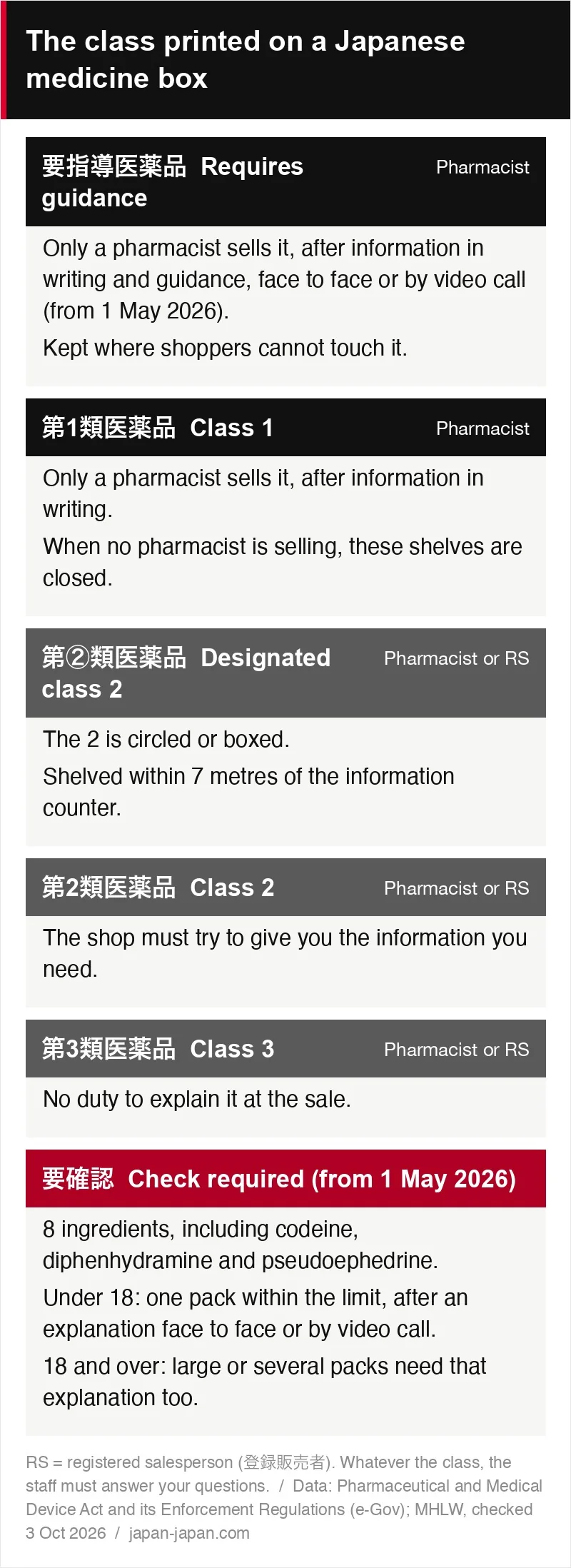
Chart: japan-japan.com, from the Pharmaceutical and Medical Device Act and its Enforcement Regulations (e-Gov) and MHLW.
| On the box | Who can sell it | Information when you buy | On the shelf |
|---|---|---|---|
| 要指導医薬品 · Requires guidance | Only a pharmacist may sell it. | The pharmacist must give the information in writing and guidance, face to face or, from 1 May 2026, by video call. | Shelved in an area shoppers cannot enter, or in a locked case or other place shoppers cannot touch. |
| 第1類医薬品 · Class 1 | Only a pharmacist may sell it. | The pharmacist must give the information in writing (on paper or on a screen). This can be skipped if you say you do not need it and the pharmacist judges you will use it properly. | Shelved in an area shoppers cannot enter, or in a locked case or other place shoppers cannot touch. When no pharmacist is selling, these shelves are closed. |
| 第②類医薬品 · Designated class 2 | A pharmacist or a registered salesperson may sell it. | The shop must try to give you the necessary information. | Shelved within 7 metres of the shop's information counter, unless it is in a locked case or shoppers are kept 1.2 metres from the shelf. |
| 第2類医薬品 · Class 2 | A pharmacist or a registered salesperson may sell it. | The shop must try to give you the necessary information. | Class 1, class 2 and class 3 medicines are not shelved together. |
| 第3類医薬品 · Class 3 | A pharmacist or a registered salesperson may sell it. | The ministry's chart gives no duty to explain class 3 medicines when they are sold. | Class 1, class 2 and class 3 medicines are not shelved together. |
- The box reads 第2類医薬品 with the 2 in a square, or 第②類医薬品.
- The box reads 要指導医薬品 in a black frame.
Source: e-Gov law search (Digital Agency, Japan) — Pharmaceutical and Medical Device Act (医薬品医療機器等法), current text · e-Gov law search (Digital Agency, Japan) — Enforcement Regulations of the Pharmaceutical and Medical Device Act (施行規則), current text · Ministry of Health, Labour and Welfare — Classes of medicine and how they are sold (参考資料, 6 March 2026) · Ministry of Health, Labour and Welfare — Designated class 2 medicines (指定第2類医薬品について)
Pharmacists and registered salespeople
Two kinds of staff can sell OTC medicine in Japan.
- Registered salesperson
- A registered salesperson (登録販売者) has passed an exam set by the prefecture and is registered with the prefectural governor.
- Name badges
- Staff wear name badges, so you can tell a pharmacist, a registered salesperson and other staff apart.
- Questions
- Whatever the class, if you ask about a medicine, the pharmacist or registered salesperson must give you the information you need.
Japan Visitor Hotline, run by JNTO: 050-3816-2787, 24 hours a day, 365 days a year, in English, Chinese and Korean.
Source: e-Gov law search (Digital Agency, Japan) — Pharmaceutical and Medical Device Act (医薬品医療機器等法), current text · e-Gov law search (Digital Agency, Japan) — Enforcement Regulations of the Pharmaceutical and Medical Device Act (施行規則), current text · Japan National Tourism Organization (JNTO) — For safe travels in Japan: guide for when you are feeling ill
When no pharmacist is working
Class 1 medicines and medicines that require guidance can only be sold by a pharmacist.
Class 1 medicines (第1類医薬品) are shelved in an area shoppers cannot enter, or in a locked case or other place shoppers cannot touch. When no pharmacist is selling, these shelves are closed.
Medicines that require guidance (要指導医薬品) are shelved in an area shoppers cannot enter, or in a locked case or other place shoppers cannot touch.
要確認: medicines the shop checks before selling
From 1 May 2026, eight ingredients put a medicine under extra checks.
要確認: the shop checks before selling.From 1 May 2026, medicines containing any of 8 ingredients are designated abuse-prevention medicines (指定濫用防止医薬品): ephedrine, codeine, dihydrocodeine, diphenhydramine, dextromethorphan, pseudoephedrine, bromovalerylurea and methylephedrine, with their hydrates and salts. Medicines for external use are not included.
- Under 18: you can buy one pack within that quantity, after a pharmacist or registered salesperson explains it face to face or by video call. Larger packs and more than one pack cannot be sold to you.
- 18 and over: a larger pack or more than one pack needs the explanation face to face or by video call, and the shop asks why you need that much.
- The shop gives the information in writing and checks what you have bought there and at other shops.
- Two different products with the same designated ingredient count as more than one pack.
- If the staff cannot tell from your appearance that you are 18 or over, they may ask to see ID.
- The ministry's Q&A gives carrying medicine for a long posting or a trip abroad as one example of a reason.
- The box carries 要確認 (check required). On packs larger than the quantity the ministry sets, 要 is circled or boxed.
- Packs released within a year of 1 May 2026 may keep the old labelling for three years, so a pack without 要確認 can still be one of these medicines.
The quantity the ministry sets is one pack, holding no more than 5 days' supply by the directions. It is 7 days' supply for cold medicines with dihydrocodeine, diphenhydramine, dextromethorphan, pseudoephedrine or methylephedrine, for nasal allergy medicines taken by mouth with pseudoephedrine or methylephedrine, and for fever and pain medicines with bromovalerylurea.
Class 2 and class 3 medicines of this kind are kept out of shoppers' reach, or within 7 metres of the counter with a pharmacist or registered salesperson always there.
- Codeine and dihydrocodeine in Japan
- Dextromethorphan in Japan
- Pseudoephedrine in Japan
- Diphenhydramine in Japan
Source: e-Gov law search (Digital Agency, Japan) — Pharmaceutical and Medical Device Act (医薬品医療機器等法), current text · e-Gov law search (Digital Agency, Japan) — Enforcement Regulations of the Pharmaceutical and Medical Device Act (施行規則), current text · Ministry of Health, Labour and Welfare — Designated abuse-prevention medicines, Notice No. 32 of 2026 (告示第32号) · Ministry of Health, Labour and Welfare — Quantity for designated abuse-prevention medicines, Notice No. 33 of 2026 (告示第33号) · Ministry of Health, Labour and Welfare — Selling designated abuse-prevention medicines (医薬発1226第16号, 26 December 2025) · Ministry of Health, Labour and Welfare — Q&A on selling designated abuse-prevention medicines (30 January 2026)
Buying medicine in a drugstore, step by step
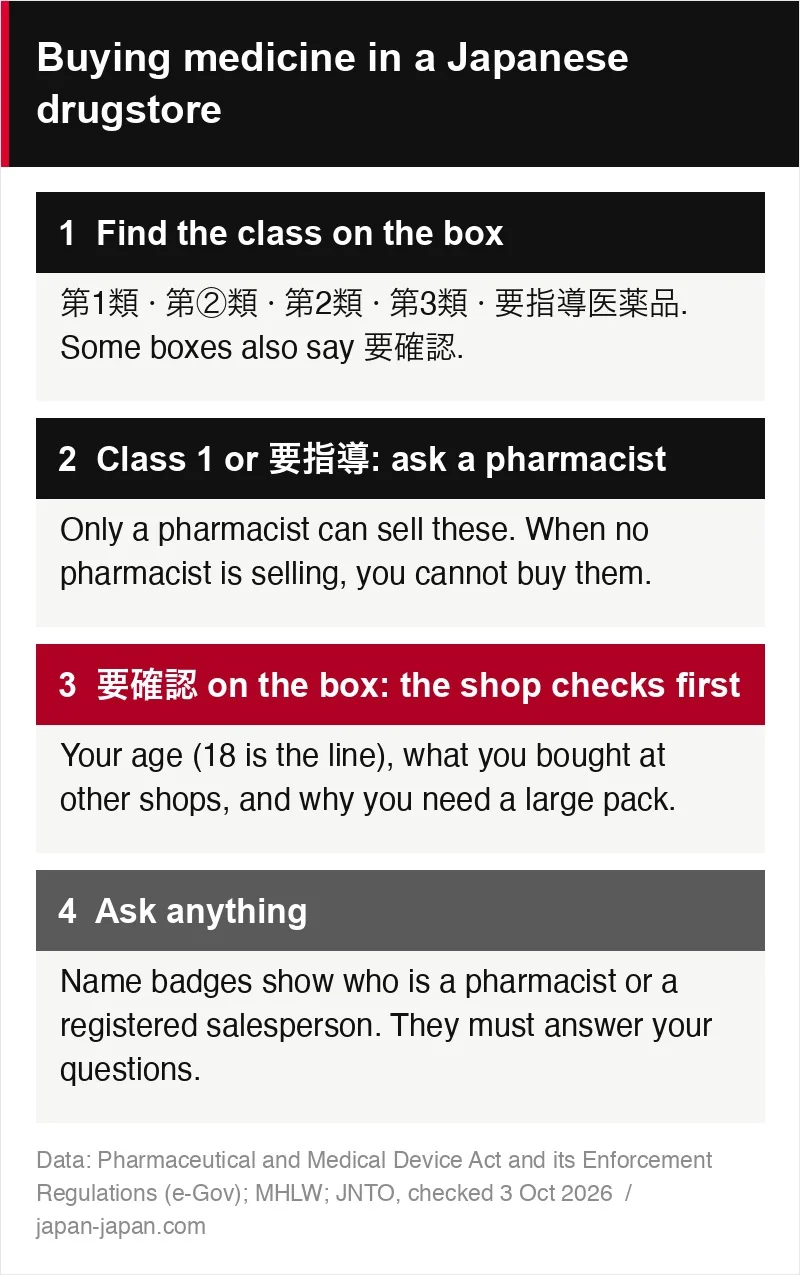
Chart: japan-japan.com, from the Pharmaceutical and Medical Device Act and its Enforcement Regulations (e-Gov), MHLW and JNTO.
Buying online
Licensed pharmacies and drugstores can sell class 1, 2 and 3 medicines online, but only medicines stocked or displayed in the shop. From 1 May 2026, medicines that require guidance can also be sold online after the pharmacist's explanation by video call, except the few 'specified' ones that must be sold face to face.
For now the only 'specified' medicine that must be sold face to face is the emergency contraceptive levonorgestrel.
Source: e-Gov law search (Digital Agency, Japan) — Enforcement Regulations of the Pharmaceutical and Medical Device Act (施行規則), current text · Ministry of Health, Labour and Welfare — Enforcement of the 2025 amendment from 1 May 2026 (医薬発1226第2号) · Ministry of Health, Labour and Welfare — List of medicines that require guidance (要指導医薬品一覧), updated 31 July 2026
Tax-free shopping
Medicine counts as a consumable in Japan's tax-free rules.
Frequently asked questions
What do 第1類, 第2類 and 第3類 on a Japanese medicine box mean?
They are the classes of OTC medicine. 第1類 (class 1): Only a pharmacist may sell it. 第2類 and 第3類 (class 2 and 3): A pharmacist or a registered salesperson may sell it.
What is a registered salesperson (登録販売者)?
A registered salesperson (登録販売者) has passed an exam set by the prefecture and is registered with the prefectural governor.
Why can't I buy some medicine when no pharmacist is working?
Class 1 medicines (第1類医薬品) and medicines that require guidance (要指導医薬品) can only be sold by a pharmacist. Class 1 medicines are shelved in an area shoppers cannot enter, or in a locked case or other place shoppers cannot touch. When no pharmacist is selling, these shelves are closed.
What does 要確認 on a box mean?
The box carries 要確認 (check required). On packs larger than the quantity the ministry sets, 要 is circled or boxed. From 1 May 2026, medicines containing any of 8 ingredients are designated abuse-prevention medicines (指定濫用防止医薬品): ephedrine, codeine, dihydrocodeine, diphenhydramine, dextromethorphan, pseudoephedrine, bromovalerylurea and methylephedrine, with their hydrates and salts. Medicines for external use are not included.
Can I buy medicine online in Japan?
Licensed pharmacies and drugstores can sell class 1, 2 and 3 medicines online, but only medicines stocked or displayed in the shop. From 1 May 2026, medicines that require guidance can also be sold online after the pharmacist's explanation by video call, except the few 'specified' ones that must be sold face to face.
Related items
Sources for this page
- e-Gov law search (Digital Agency, Japan) Pharmaceutical and Medical Device Act (医薬品医療機器等法), current textchecked October 3, 2026
- e-Gov law search (Digital Agency, Japan) Enforcement Regulations of the Pharmaceutical and Medical Device Act (施行規則), current textchecked October 3, 2026
- Ministry of Health, Labour and Welfare Classes of medicine and how they are sold (参考資料, 6 March 2026)checked October 3, 2026
- Ministry of Health, Labour and Welfare Designated class 2 medicines (指定第2類医薬品について)checked October 3, 2026
- Japan National Tourism Organization (JNTO) For safe travels in Japan: guide for when you are feeling illchecked October 3, 2026
- Ministry of Health, Labour and Welfare Enforcement of the 2025 amendment from 1 May 2026 (医薬発1226第2号)checked October 3, 2026
- Ministry of Health, Labour and Welfare List of medicines that require guidance (要指導医薬品一覧), updated 31 July 2026checked October 3, 2026
- Ministry of Health, Labour and Welfare Designated abuse-prevention medicines, Notice No. 32 of 2026 (告示第32号)checked October 3, 2026
- Ministry of Health, Labour and Welfare Quantity for designated abuse-prevention medicines, Notice No. 33 of 2026 (告示第33号)checked October 3, 2026
- Ministry of Health, Labour and Welfare Selling designated abuse-prevention medicines (医薬発1226第16号, 26 December 2025)checked October 3, 2026
- Ministry of Health, Labour and Welfare Q&A on selling designated abuse-prevention medicines (30 January 2026)checked October 3, 2026
Compiled by Japan Japan !! · Updated October 3, 2026