Japan Visa for US Green Card Holders: Who Still Needs One
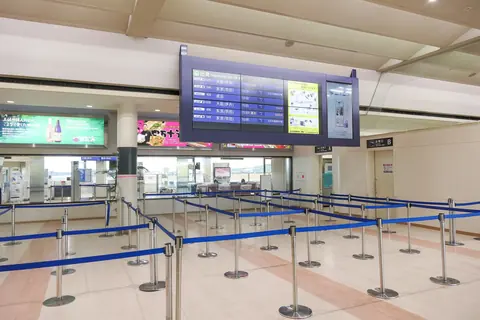
The Consulate-General of Japan in Chicago visa information page answers the green card question in one line. It says it depends on your nationality, and that non-exempt nationals need a visa to enter Japan.
Your Passport Decides, Not the Green Card
Japan grants visa-free short stays by nationality. The MOFA visa exemption (short-term stay) list names 74 countries and regions with reciprocal arrangements. If your passport is on that list, you can visit without a visa. If it is not, a US green card does not change the answer.
First, is your passport on the list? Second, is your trip tourism with a single entry?
Most passports on the list get 90 days on arrival. A few get less: 15 days for Indonesia and Thailand, and 30 days for Brunei and Qatar. Indonesian citizens also need to register an ICAO-compliant ePassport with a Japanese mission in Indonesia before they can travel visa-free.
Many green card holders come from countries that are not on the list. If you hold an Indian passport, a Philippine passport, a Chinese passport or a Vietnamese passport, you need a visa for Japan. The same goes for holders of a Nigerian passport. By contrast, citizens of South Korea and Mexico are on the list, so they can visit without one. Our list of visa-free countries for Japan shows every passport on one page.
Your green card still counts in one place. The visa criteria say you need a valid passport and the right to re-enter your country of nationality or your country of residence. For a green card holder, the US is that country of residence. The Consulate-General of Japan in Seattle visa general information page adds one more point. The documents you submit vary with your nationality, US immigration status, and the purpose and length of your trip.
Japan eVISA for US Residents
JAPAN eVISA lets you apply online if you live in the US and need a visa. The MOFA JAPAN eVISA system page lists the places whose residents can use it. As of 15 May 2026, there are nine: Australia, Brazil, Cambodia, Canada, Saudi Arabia, South Africa, Taiwan, the United Kingdom and the US.
The rule covers all foreign nationals living in those places, except people who are already visa-exempt. A green card holder from India or Nigeria therefore qualifies through US residence, not through nationality.
The scope is narrow. eVISA gives you a single-entry short-term stay visa for tourism, for up to 90 days. The Chicago consulate spells out what it leaves out: visiting people who live in Japan, business trips and academic trips. For those, you apply at a consulate.
Three more conditions apply. You must arrive by air or by sea, and the sea route is limited to scheduled passenger ferries between Japan and Busan or Shanghai. Only ordinary passport holders can apply. During the process, the consulate for your area may ask you to come in for an interview.
You pay online. The MOFA visa frequently asked questions page says eVISA applicants in certain countries and regions can pay by credit card. Consulate fees, in contrast, are paid in cash in the local currency.
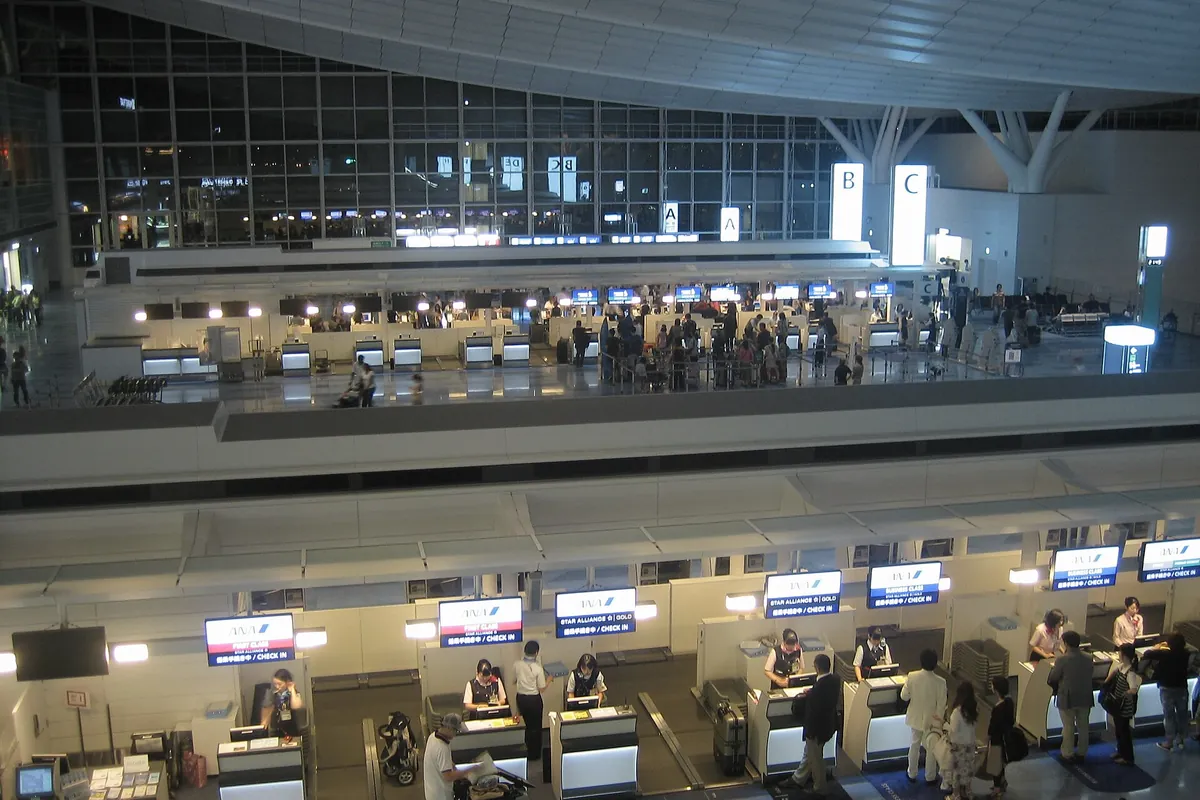
You receive an electronic Visa issuance notice instead of a sticker in your passport. MOFA says you must display it at the airport while you are online. A PDF, a screenshot or a printed copy is not accepted. Set up roaming data or Wi-Fi before you reach the airport. The photo below shows check-in counters at Haneda Airport.
For questions, call the Japan Visa Information Hotline at 1-202-499-1468. Chicago lists it in English, Vietnamese, Russian and Ukrainian, around the clock. Both the Chicago consulate and MOFA warn about fake eVISA websites that ask for payment, so start from the MOFA page. Our JAPAN eVISA page has more on the online route.
Applying at a Consulate: Jurisdiction and Rules
If eVISA does not fit your trip, you apply on paper. The MOFA visa top page says Japan issues visas only at its embassies and consulates abroad. You cannot get one on arrival in Japan or while you are staying there. The table below compares the two routes.
| Item | JAPAN eVISA | Consulate |
|---|---|---|
| Purpose | Tourism only | Tourism, business, family visits and more |
| Entries | Single entry | Single or multiple |
| Stay | Up to 90 days | Up to 15, 30 or 90 days |
| Payment | Credit card online | Exact cash |
| Proof | Visa issuance notice shown online | Sticker in your passport |
Long stays follow a different path. If you plan to work, study or live in Japan, someone in Japan first gets you a Certificate of Eligibility from the Immigration Bureau. It is valid for 3 months from its date of issue, so you must get the visa and enter Japan within that time.
Jurisdiction is strict. You apply at the consulate that covers the place where you live now. The Chicago consulate takes residents of 10 states: Illinois, Indiana, Wisconsin, Missouri, Kansas, Minnesota, Nebraska, North Dakota, South Dakota and Iowa.
The Consulate-General of Japan in Boston visa overview lists its own area. It covers Connecticut, except Fairfield County, plus Maine, Massachusetts, New Hampshire, Rhode Island and Vermont. Fairfield County goes to the Consulate General in New York.
A hometown inside a consulate’s area does not help if you live elsewhere. Chicago also refuses mail applications sent from outside its area. If you are away on business, wait until you are back home to apply.
Chicago gives you three ways to apply. You can walk in during visa hours with no appointment. You can mail your application if you live outside Cook, Lake, McHenry, Kane, Du Page, Will and Kendall counties in Illinois and Lake County in Indiana. Or you can send a proxy with a signed Authorization form.
Other consulates set their own rules. Seattle takes applications only by mail or by drop-off during business hours, and it returns every visa by mail. Boston takes walk-ins only, from 9:00 AM to 12:15 PM and 1:15 PM to 4:00 PM on weekdays. Its visa section phone is 617-973-9772.
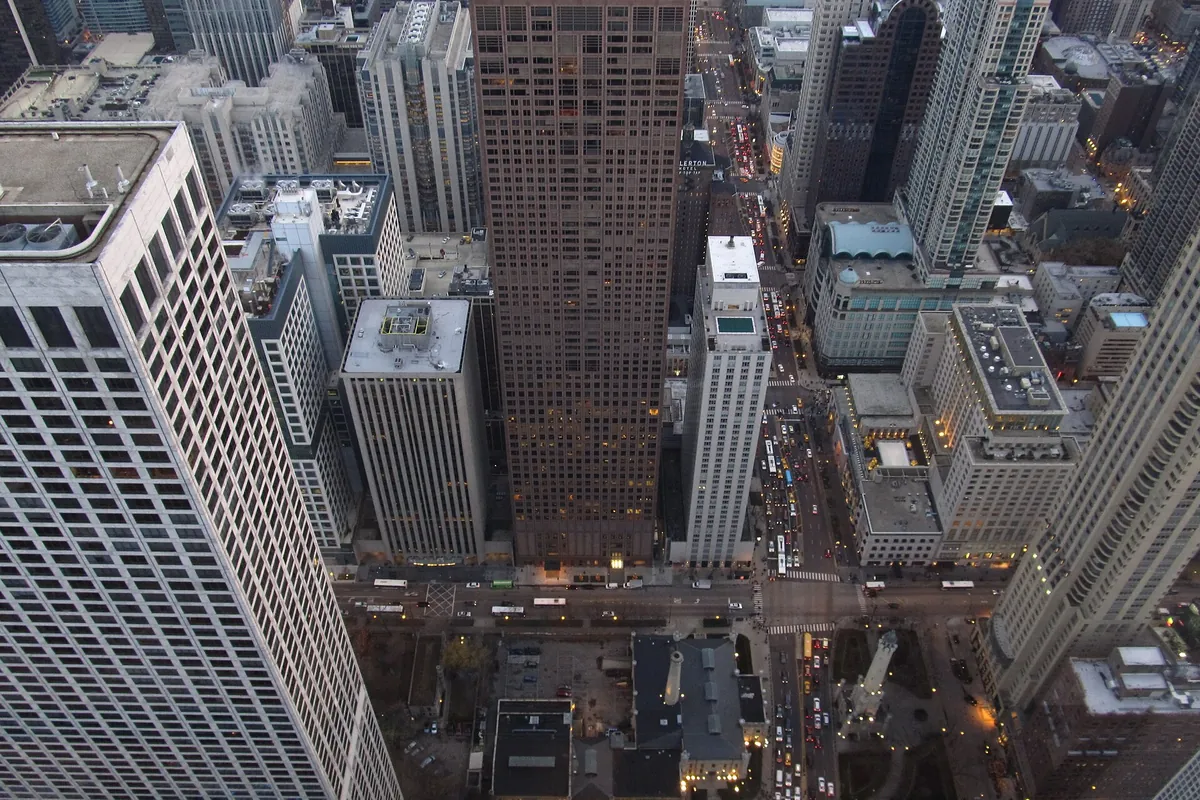
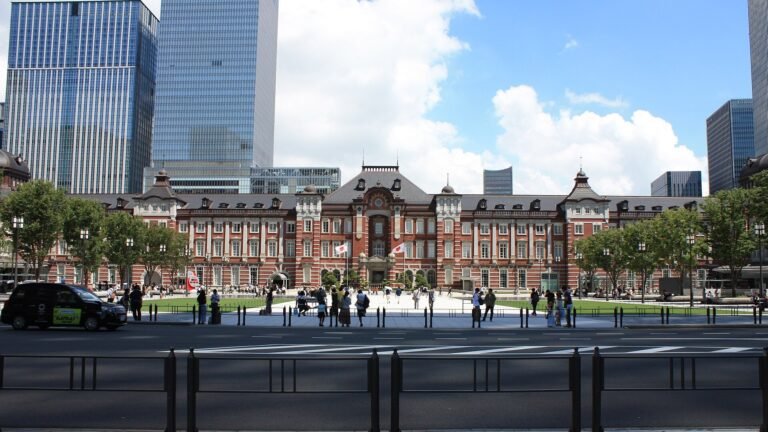
The Chicago consulate is in the Olympia Centre at 737 North Michigan Avenue, with its entrance on Chicago Avenue. The photo below shows the tower.
| Place | Consulate-General of Japan in Chicago (Visa Section) |
|---|---|
| Price | Ordinary fee from 1 July 2026: single entry US$101, multiple US$201. Exact cash only |
| Hours | Monday to Friday 9:30-12:15 and 13:15-16:00, except consulate holidays. No appointment |
| Access | 737 North Michigan Avenue, Olympia Centre Suite 1100 (11th floor). Entrance on Chicago Avenue |
| Official site | Consulate-General of Japan in Chicago visa information |
The main form is the visa application form. Its Japanese title is 査証申請用紙 (sashō shinsei yōshi), which means visa application form. Our Japan visa photo size guide covers the photo you attach to it.
Some applications are not accepted at all.
Chicago and Boston do not accept applications from people in the US on a B-1 or B-2 visa. Chicago also turns away visa waiver visitors and residents of other areas. The MOFA FAQ adds more cases. These include holding a valid Japan visa, holding Japanese nationality, or reapplying for the same purpose within six months of a refusal. As a permanent resident, you are not caught by the B-1 or B-2 rule. A relative who is visiting you on a tourist visa is.
Japan Visa Fees From July 2026
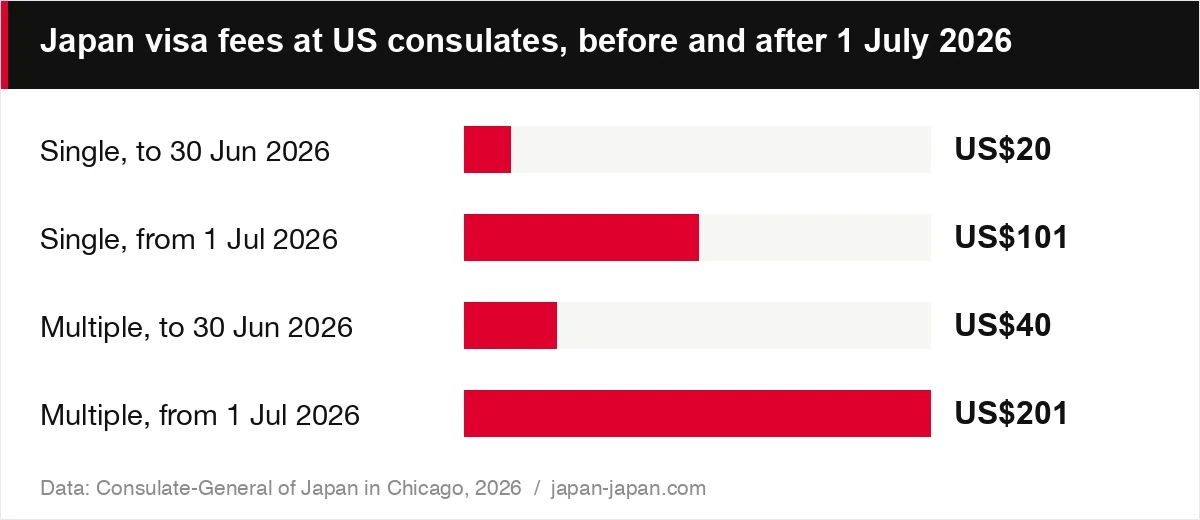
Japan’s visa fees at the Chicago consulate rose on 1 July 2026. The ordinary fee for a single-entry visa went from US$20 to US$101. A multiple-entry visa went from US$40 to US$201. Indian nationals still pay US$6 for either type. The bar chart below compares the old and new ordinary fees.
| Item | Value |
|---|---|
| Single, to 30 Jun 2026 | 20 US$ |
| Single, from 1 Jul 2026 | 101 US$ |
| Multiple, to 30 Jun 2026 | 40 US$ |
| Multiple, from 1 Jul 2026 | 201 US$ |
The new fees apply until 31 March 2027. The consulate revises its fees on April 1 each year, so check them again if you apply next spring.
Many nationalities pay nothing. Chicago’s fee-exemption list includes the United States, Canada, Mexico, Bangladesh, Korea, Malaysia and Pakistan. Pakistani and Bangladeshi green card holders still need a visa, but they pay no fee. Philippine nationals are exempt only as temporary visitors staying 90 days or less, or in transit.
Bring the exact amount in cash. Boston collects the fee when you pick up your passport and does not take personal checks or credit cards. Seattle accepts cash only as well. If the consulate does not issue a visa, you pay nothing. If you cancel a visa before you use it, MOFA does not refund the fee. Our Japan visa fees page tracks the fee in yen.
Processing Time: Apply Early
Chicago processes most visas in 5-7 business days, not counting mailing time. There is no expedite service. Boston says an in-person visa takes 5 business days, and Seattle quotes 5 working days.
Some cases take longer. The consulate may need to consult headquarters in Japan, ask for more documents or call you in for an interview. MOFA says those cases can take from a couple of weeks to several months.
The flow chart below lays out the steps from checking your passport to entering Japan, with the waiting time.
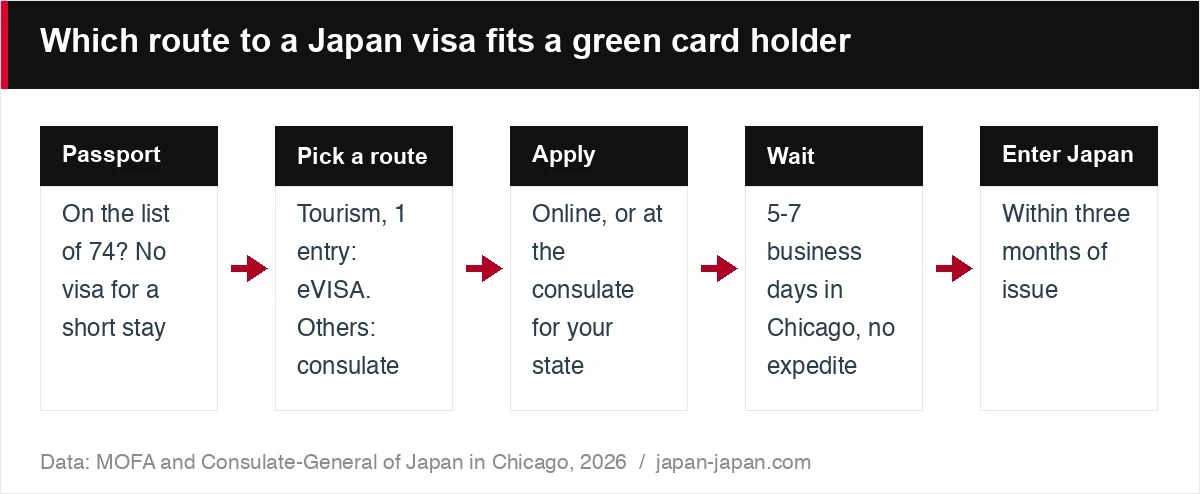
Errors also cost time. If Chicago finds a problem after accepting your file, it contacts you within 3 business days for in-person applications. For mailed applications, it contacts you within 5 business days. There is also a ceiling on how early you can apply. Seattle accepts applications only less than 3 months before your travel date.
The visa itself has a short life. A single-entry visa is generally valid for three months, so plan to enter Japan within three months of issue. A good plan for a winter or spring trip is to apply as soon as your flights are booked and you are inside that window. Our Japan visa processing time page compares other missions.
Transit, Multiple Entry and Dual Citizens
A short connection usually needs no visa. The Chicago FAQ sets three conditions. Your transit must stay within the same airport, on the same calendar date, and you must hold a confirmed ticket to a third country. You then wait at the gate area without going through immigration.
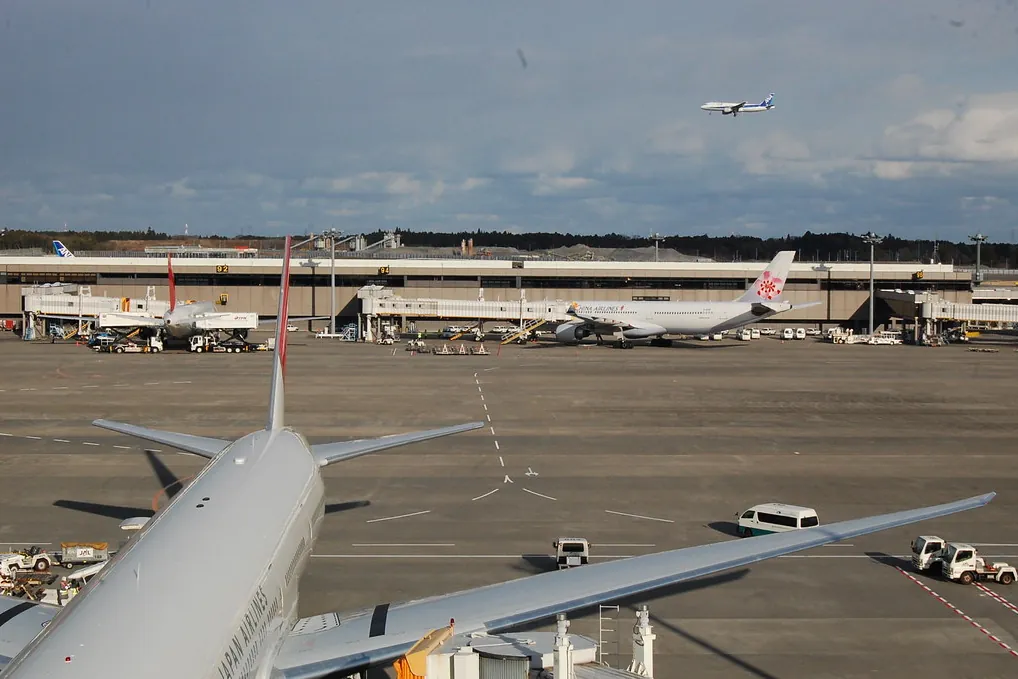
The photo above shows the gate area at Narita Airport. Boston adds the cases that do need a visa. If you must move between Narita Airport and Haneda Airport, or stay overnight, a non-exempt national needs a short-term visa.
Frequent visitors can ask for a multiple-entry visa at the consulate, not through eVISA. Chicago lists separate types by nationality. Chinese, Filipino and Ukrainian nationals can get stays of up to 90 days. Indian nationals have their own type with stays of up to 90 days. Indonesian, Filipino and Vietnamese nationals have a type with stays of up to 30 days. Our Japan multiple entry visa guide explains who qualifies.
Dual citizens of Japan and the US cannot get a Japan visa. Chicago says it does not issue visas to Japanese nationals. Enter with your Japanese passport.
Before You Fly to Japan
Check your passport first. Seattle notes that Japan does not require six months of validity, as long as your ordinary passport is valid at the time of travel. Pack your passport and your green card together. The visa criteria ask whether you can return to your country of residence, and the card is the proof. If you used eVISA, make sure your phone can open the Visa issuance notice online at the airport.
A visa does not guarantee entry. An immigration officer at the airport grants landing permission. Boston notes that this officer, not the consulate, decides how long you may stay. The MOFA FAQ adds that you can be refused if you cannot explain your plans in Japan.
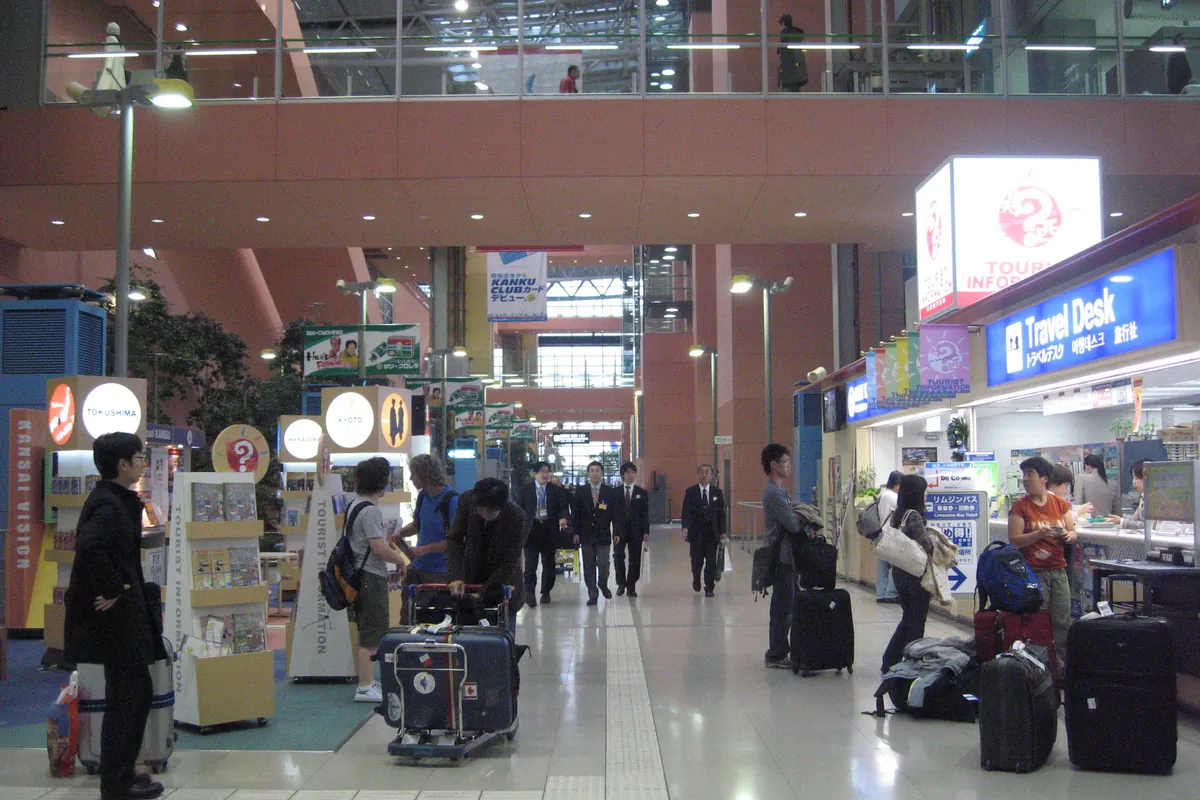
The photo above shows the arrivals hall at Kansai Airport in Osaka. Before you land at Kansai Airport or any other airport, fill in Visit Japan Web. Our Visit Japan Web QR code guide shows the steps for immigration and customs.
For the wider rules, read our Japan visa requirements guide or browse the Japan visa pages by passport. A single-entry visa ends once you enter Japan, so plan a new application for your next trip.
FAQ
Do I need a visa for Japan if I have a US green card?
It depends on your passport, not the green card. If your nationality is on Japan’s list of 74 visa-exempt countries and regions, you can visit for a short stay without a visa. If it is not, you need a visa. As a US resident, you can apply through JAPAN eVISA for tourism.
Can green card holders apply for the Japan eVISA?
Yes, if you live in the US and need a visa. JAPAN eVISA is open to all foreign nationals living in the US, except those already exempt. It covers a single-entry tourist visa for up to 90 days, and you pay online by credit card.
How much is a Japan visa for green card holders in 2026?
At the Chicago consulate, the ordinary fee from 1 July 2026 is US$101 for a single entry and US$201 for multiple entries. Indian nationals pay US$6. Pakistani and Bangladeshi nationals pay nothing. Filipino visitors staying 90 days or less are also exempt.
Do green card holders need a visa to transit through Japan?
Usually not, if you stay in the same airport on the same calendar date and hold a confirmed ticket to a third country. You wait at the gate area without passing immigration. If you need to switch airports or stay overnight, a non-exempt national needs a short-term visa.
About the author


.jpg)

