Is There Uber in Japan? Taxi Apps, GO and Ride-Share Rules

The fare figure comes from the JNTO Taxis in Japan guide, which describes a seven-kilometer Tokyo ride of about 25 minutes. So the answer to the Uber Japan question has two parts. You can open the Uber app and book a ride in many cities. What you get is a regular taxi at the regular price. The model you may know from home, where any driver with a private car picks you up, does not run freely here. Japan only lets private cars carry paying passengers under specific schemes, and the national government sets the rules for each one.
That explains why Uber prices look like taxi prices. It also explains why a second app such as GO is worth installing.
How Uber works in Japan: taxis, not private cars
Book Uber in Japan and a taxi company sends one of its cars. The driver holds a professional licence and drives a vehicle that carries a taxi sign. The fare follows the taxi meter, as JNTO explains: fares are calculated by distance, except on certain fixed-rate routes to airports and major sightseeing spots. A late-night surcharge applies between 10 p.m. and 5 a.m. Any highway tolls on the way are added to your bill.
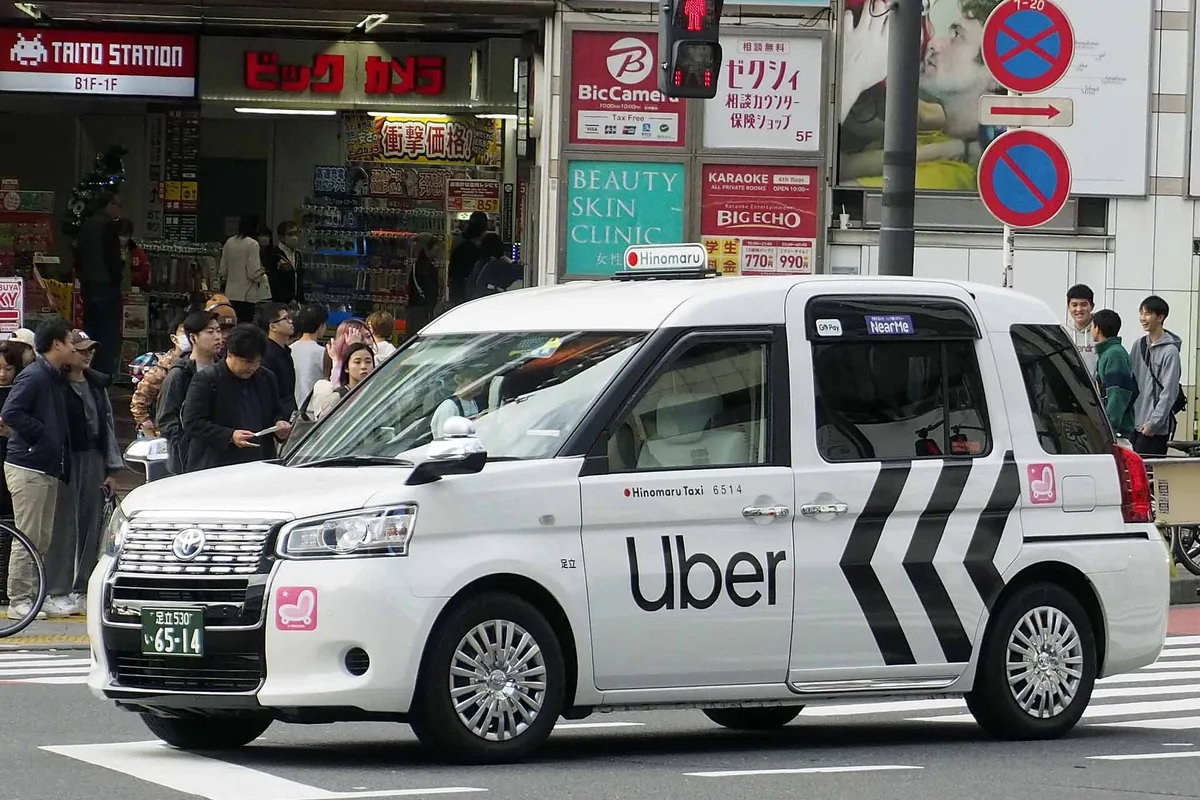
The photo shows the tall, boxy taxi you will see across Tokyo. Inside, an app ride feels the same as hailing on the street. JNTO describes Japanese taxis as spotlessly clean with a high level of service. Drivers use the GPS and meter to reach your destination quickly, and they do not expect or accept tips.
Booking a ride, step by step
You install the app and register before you land. You set your pickup point and destination. You check the car and its plate when it arrives. Then you pay by the card saved in the app.
- Register early. Download the app at home and add a credit card. Hotel Wi-Fi works, but registering before the trip saves time at the airport.
- Type the destination in the app. The driver sees the address on a screen. JNTO suggests carrying your destination written in Japanese, especially for a place that is not a major hotel or sightseeing spot.
- Match the car. The app shows the plate number and car colour. Compare them before you open the door.
- Let the door work for you. Taxi doors open and close automatically. Do not pull them by hand as you get in or out.
On the street, look at the small sign behind the windscreen. JNTO notes that it is usually in Japanese but colour coded. Red means the taxi is free to pick you up, and green means it is taken. The red sign usually reads 空車 (kūsha), which means “vacant car”.
Uber Japan Premier and Premier Van
Searches for “Uber Japan Premier Van” come from travellers with large groups or a lot of luggage. The ride types depend on the city and the hour. Open the app at your hotel and compare them early. Larger cars still come from licensed operators and still follow Japanese rules. For a group of three or four, JNTO says a taxi can sometimes be an economical way to travel, because you split one fare.
Paying
App rides usually charge the card you registered. If you hail a taxi on the street instead, JNTO says credit cards can generally be used in major city taxis. In the countryside, cash might be your only option, so keep some yen when you travel outside the big cities.
Uber vs GO, DiDi and S.RIDE
JNTO lists four taxi apps that offer an English service once downloaded: S.RIDE, Uber, DiDi and GO. All four call licensed taxis. The table sets out what the official tourism guides say about each one.
| App | English service | Listed by | What the official guides say |
|---|---|---|---|
| GO | Yes | JNTO, Go Tokyo | Overseas numbers can register; card payment; 47 prefectures except remote islands (May 2026) |
| Uber | Yes | JNTO | Calls licensed taxis that charge by the meter |
| DiDi | Yes | JNTO | Taxi app with an English service |
| S.RIDE | Yes | JNTO | Taxi app with an English service |
GO has the most detail in the official guides. The Go Tokyo useful apps for visitors page, updated on September 1, 2026, says GO shows nearby taxis with an approximate arrival time. It supports cashless payment once you register a credit card. Overseas mobile phone numbers can also be used to register. As of May 2026, Go Tokyo says GO works in 47 prefectures, excluding remote islands.
Coverage matters outside Tokyo, where one app may have cars nearby and another none. A simple plan:
- Install two apps. Keep Uber if you already use it at home, and add GO for its national reach.
- Register both before the flight. Verification codes by text message can be slow on a roaming connection.
- Compare at the pickup point. Open both apps and book the one with the shorter wait.
- Use the taxi rank when the apps are busy. Stations and airports have ranks where taxis line up.
JNTO also notes that in local areas the number of taxis drops, but you can usually find them in front of the train station. In rural areas, or after trains stop for the night, a taxi may be the only way to move. That is when an app with wide coverage saves you a long wait.
Japan-style ride-share: where private cars are allowed
Private drivers can carry paying passengers only through Japan-style ride-share. The MLIT white paper column on ride-share in Japan explains how it works. The Ministry of Land, Infrastructure, Transport and Tourism created it in March 2024. A taxi company manages the service, and it fills the gap in areas, seasons and times of day when there are not enough taxis.
The scheme has grown. By the end of the fiscal year in March 2025, Japan-style ride-share ran in 130 areas. A separate scheme, public ride-share, ran in 645 areas through 788 organisations. Public ride-share is for places where bus and taxi services are hard to keep, and town offices or non-profit groups run it. Since launch, the ministry has added more cars on rainy days and at events. It has also allowed bookings by phone and payment in cash.
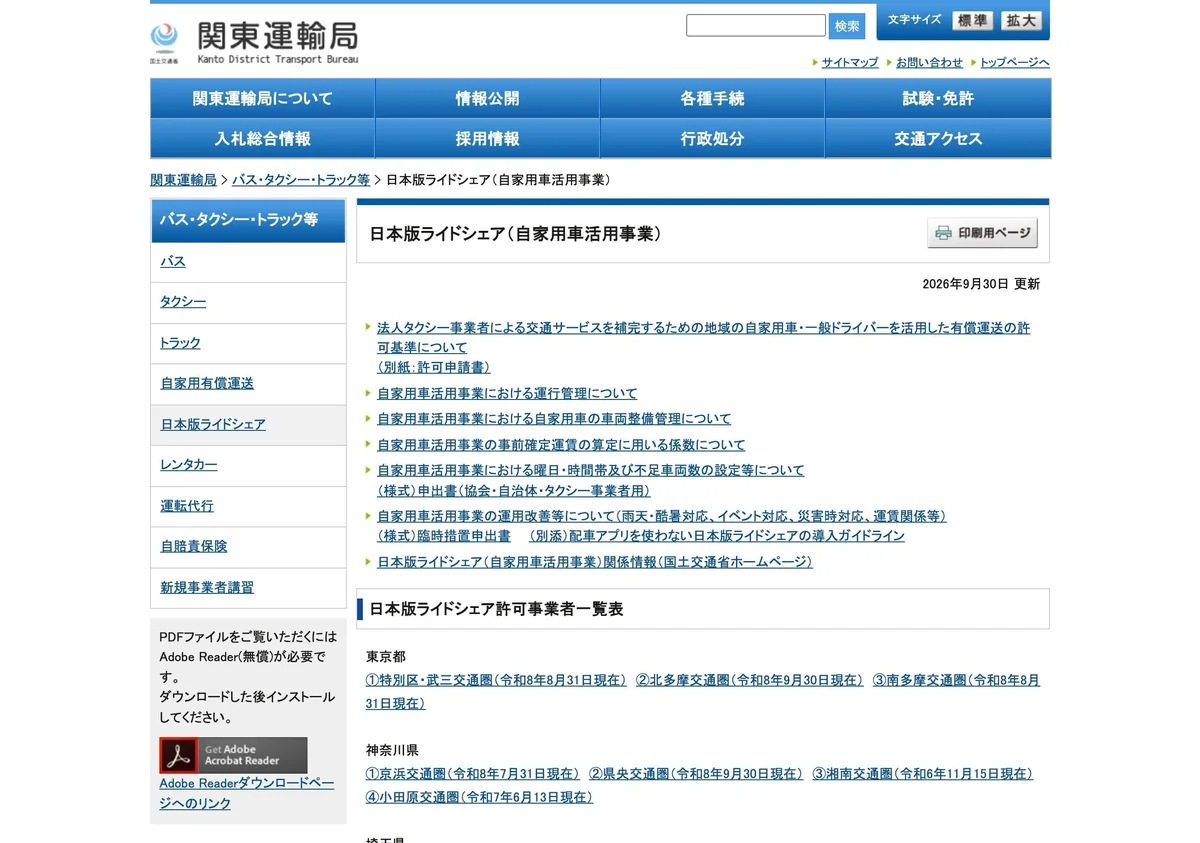
The screenshot above is the Kanto Transport Bureau Japan-style ride-share page, updated on September 30, 2026. The bureau publishes the list of licensed operators by taxi zone. The list covers zones in Tokyo, Kanagawa, Saitama, Chiba, Gunma, Ibaraki, Tochigi and Yamanashi. In Tokyo it covers the special wards with Musashino and Mitaka, the Kitatama zone and the Minamitama zone. The page also links to the rules on each zone’s days and hours. It explains how the fare is set before the ride.
For a visitor, the practical points are short:
- You book it through the same apps. A taxi company manages the driver and the car.
- The fare is fixed in advance. The Kanto bureau publishes the method for that pre-set fare.
- It runs only at set times. Each zone has its own days and hours, so the option may not show up when you open the app.
The bus company trial in Shinagawa and Ota
The ministry is also testing whether bus and rail companies can take part. The MLIT press release on bus company ride-share trial says Tokyu Bus began a trial in Shinagawa and Ota wards on December 3. The trial is one of five planned around Japan. The goal is to cover trips that regular bus routes cannot serve.
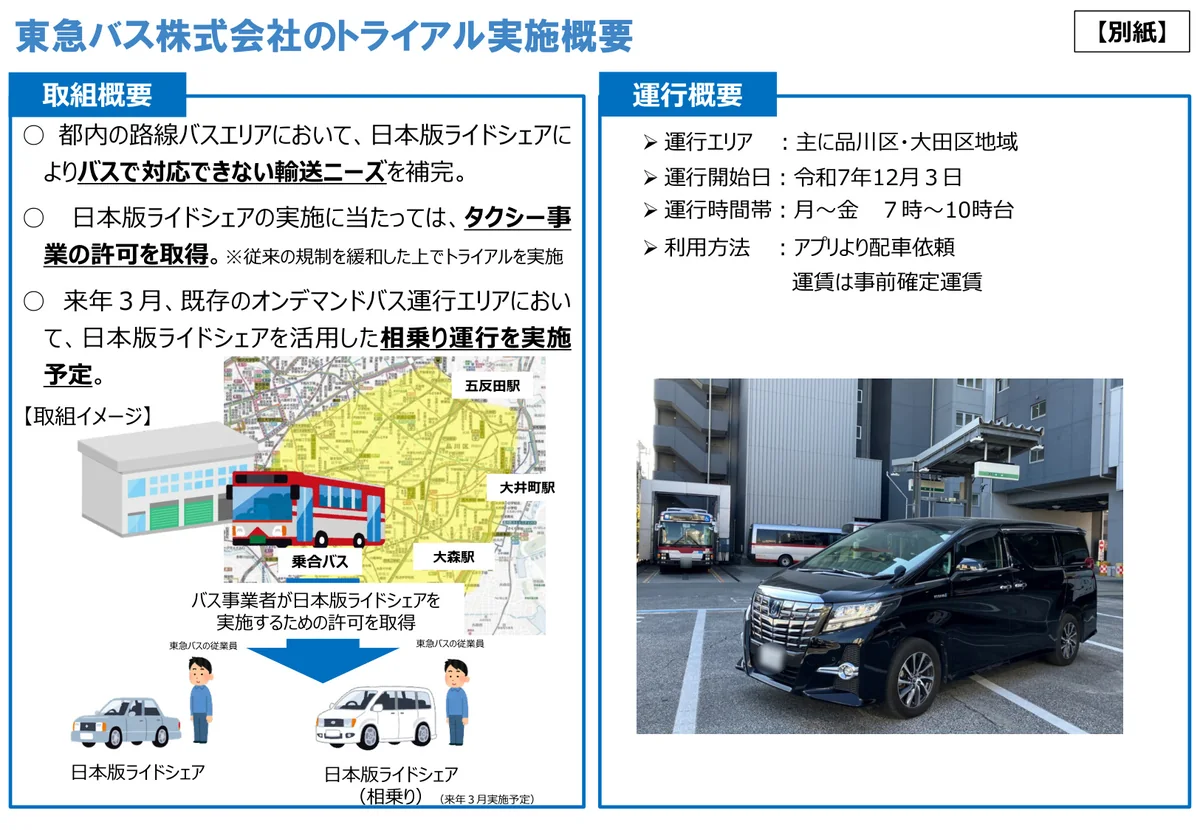
The page above is the attachment to that press release, in Japanese. It shows the trial area on a map between Gotanda, Oimachi and Omori stations. Tokyu Bus took a taxi business licence for it. Riders book through an app at a fare fixed in advance. Shinagawa and Ota sit right next to Haneda Airport, so you may see these cars near the bay side of Tokyo.
White taxis: how to spot an illegal ride
A white taxi (shirotaku) is a paid ride in a private car with no licence. In Japan this is illegal. The name comes from the plate: licensed taxis carry green business plates, and private cars carry white ones. The Kinki Transport Bureau illegal taxi warning is an English leaflet that tells visitors not to use these cars.
The illustration splits the cars you can take from the ones you should refuse. On the safe side are licensed taxis, taxis booked through an app, and Japan-style ride-share cars managed by a taxi company. On the other side is any private car where the driver asks you for money directly.
| Ride type | Who runs it | Where and when | Take it? |
|---|---|---|---|
| Licensed taxi (green plate) | Licensed taxi company | Any time, across Japan | Yes |
| Taxi booked by app | Licensed taxi company via Uber, GO, DiDi or S.RIDE | Where the app has cars | Yes |
| Japan-style ride-share | Private driver managed by a taxi company | Set zones, days and hours | Yes |
| White taxi (white plate) | Private driver with no licence | Often at airports and tourist spots | No |
The risk goes beyond the fare. If an unlicensed driver has an accident, the car’s insurance may not cover paying passengers. These drivers also set a price on the spot, often in cash, with no receipt.
How to check a car in ten seconds
- Look at the plate. A green plate means a licensed taxi. A white plate on a car offering paid rides is a warning sign.
- Look at the roof. Licensed taxis carry a roof sign and a meter on the dashboard.
- Match the app. If you booked with Uber or GO, the plate must match the one on your screen.
- Ignore offers in the arrivals hall. Walk past anyone who offers a ride as you leave customs, and go to the official taxi rank.
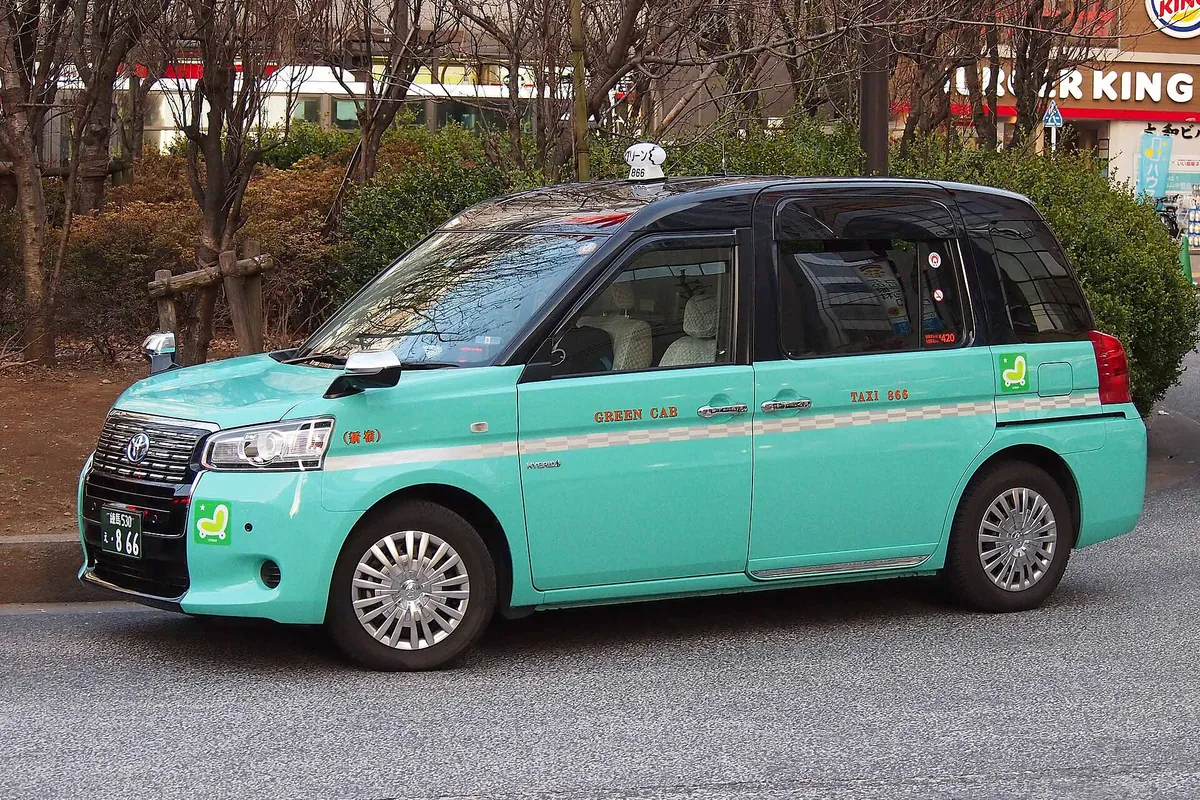
The photo shows the green business plate of a licensed taxi. Once you know it, a white plate on a car touting for riders stands out. White taxi drivers wait at airports and big tourist spots.
Using Uber at Haneda, Narita and other airports
Uber and other taxi apps work at Japan’s big airports. The official taxi rank is often faster. Arriving visitors also have a choice that many miss: fixed fares. JNTO says Narita and Haneda both offer fixed-fare taxis to most areas of Tokyo. You ask the driver for the fixed rate when you get in. Check prices beforehand, though, since the ride from Narita is long.
The Haneda Airport guide on our site shows where the stands and stations are in each terminal. For Narita, start with our Narita Airport guide.
Taxi or train from the airport
The decision chart below asks two questions. Do you have heavy luggage or three or more people? Is it late at night with no train left? If both answers are no, the train or bus usually wins.
The Haneda Airport access by train page lists rail times from the airport. Shinagawa Station is about 15 minutes away, Tokyo Station about 30 minutes, Shibuya about 45 minutes and Shinjuku about 50 minutes. The Keikyu Line and Tokyo Monorail platforms in Terminals 1 and 2 are on floor B1.
Our route pages put prices on those trips. Haneda Airport to Shinjuku costs 590 yen by Keikyu Line and JR in 43 minutes. The Airport Limousine bus takes 40–55 minutes for 1,400 yen. The first bus from Terminal 3 leaves at 06:15 and the last at 23:40. After that, a taxi or an app ride is the main choice.
From Narita the gap is bigger. Narita Airport to Tokyo Station takes 53 minutes by Narita Express for 3,140 yen. The AIRPORT BUS TYO-NRT costs 1,500 yen and takes 65 minutes. A taxi over the same distance costs many times more, plus highway tolls.
Chubu Centrair and Kansai
The Chubu Centrair Airport taxi fares page puts the Terminal 1 taxi pick-up on the 1st floor of Access Plaza. Terminal 2 uses the 1st floor of the same building. From the arrivals lobby on the 2nd floor, take the passage to Access Plaza. Meitetsu Chita taxi takes bookings 24 hours a day, 7 days a week. Our Chubu Centrair Airport guide covers the trains from the terminal.
In the Kansai area, JNTO notes a shared taxi shuttle service to Kansai International and Itami airports. It can be a cheap option for the trip to the airport, because you share the car with other passengers.
Uber fares in Japan: what a ride costs
Because Uber in Japan uses taxis, the fare follows the taxi meter. JNTO’s example is the best guide: about 2,500 to 3,000 yen for 7 km in Tokyo by day. Three things push the price up. The late-night surcharge applies from 10 p.m. to 5 a.m. Highway tolls go on your bill. Traffic jams add time on the meter.
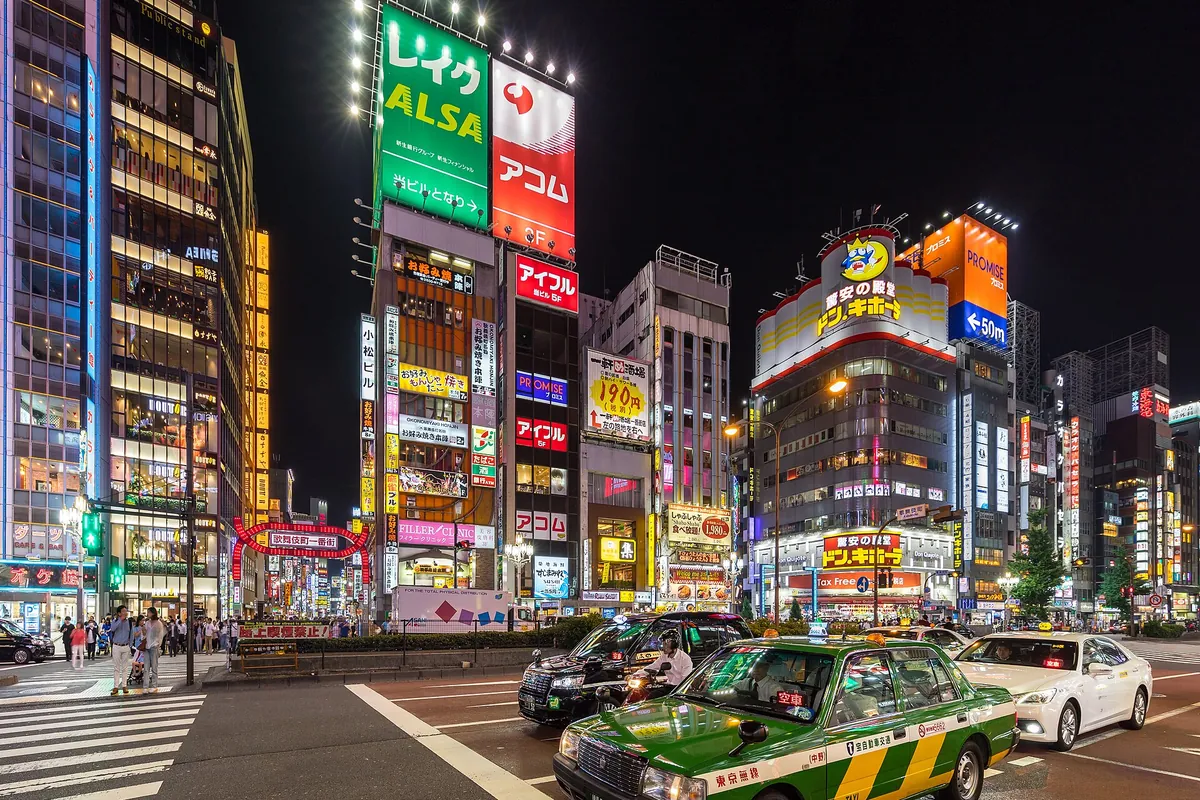
A night in Shinjuku, as in the photo, is when many visitors reach for an app. The surcharge is already running, but three or four people can still split one fare.
Long rides from the airport
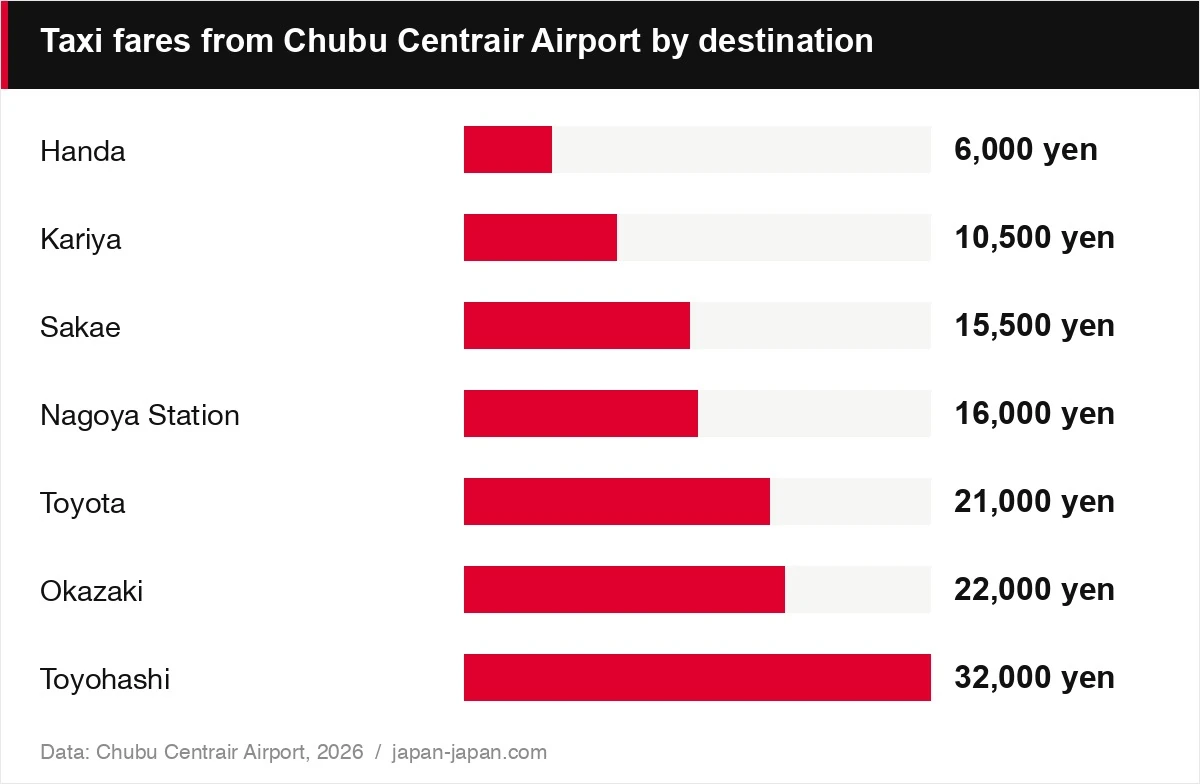
Airport rides show how fast a taxi bill grows. Chubu Centrair publishes estimated fares and times from the airport. The chart lists eight of them.
| Item | Value | Note |
|---|---|---|
| Handa | 6000 yen | 40 min |
| Kariya | 10,500 yen | 45 min |
| Sakae | 15,500 yen | 45 min |
| Nagoya Station | 16,000 yen | 50 min |
| Toyota | 21,000 yen | 60 min |
| Okazaki | 22,000 yen | 65 min |
| Toyohashi | 32,000 yen | 90 min |
| Hamamatsu | 41,000 yen | 115 min |
Handa is the shortest trip on the list, at 6,000 yen and 40 minutes. Nagoya Station costs 16,000 yen and takes 50 minutes. Sakae, in central Nagoya, costs 15,500 yen and takes 45 minutes. Hamamatsu, 115 minutes away, reaches 41,000 yen. Centrair notes that the freeway fare, including the Centrair Bridge, is paid by the customer on top of these amounts. Traffic jams and waiting at lights can change the figures.
The train is far cheaper on the main route. Our Chubu Centrair Airport to Nagoya page shows the Meitetsu mu-SKY at 28 minutes for 1,430 yen. The Meitetsu limited express costs 980 yen and takes 36 minutes. Both beat the taxi on time and on cost.
When a taxi app wins
- Late at night: after the last train, a taxi may be the only way home.
- Groups with luggage: three or four people with suitcases pay one fare between them.
- Rural areas: where trains and buses are rare, JNTO says a taxi may be your only option.
- Short hops in bad weather: a short ride costs little, and the ministry adds ride-share cars on rainy days.
Related guides for getting around Japan
For Narita fixed fares and Haneda rates, read our guide to taxi fares in Japan. If you would rather sit on a direct bus, the Haneda Airport Limousine Bus guide lists fares, stops and the last buses of the day. Our Airport Limousine bus fares page compares Haneda and Narita routes side by side. Every route we track is in the airport transfers database.
Planning a road trip instead? The Japan car rental guide covers the driving permit, daily rates and tolls. If you arrive over New Year, check our New Year holiday guide first, because taxi ranks and trains get busy on peak travel days.
FAQ
Does Uber in Japan use private cars?
In most cases, no. Uber in Japan sends a taxi from a licensed company, and the fare follows the meter. Private cars carry paying passengers only through Japan-style ride-share, which a taxi company manages in set areas and time slots.
Can I use Uber from Haneda or Narita Airport?
Yes, you can book a taxi through the app at both airports. The official taxi rank is often quicker, and JNTO says both airports offer fixed fares to most of Tokyo if you ask the driver. Trains and the Airport Limousine bus cost far less if you are travelling light.
Is Uber more expensive than a regular taxi in Japan?
The ride itself is a taxi ride, so the meter fare is the same base. JNTO puts a 7 km daytime ride in Tokyo at about 2,500 to 3,000 yen. Late-night surcharges and highway tolls apply either way, so compare the fare shown in the app before you book.
Can I register GO or Uber with a foreign phone number?
For GO, yes. Go Tokyo says overseas mobile phone numbers can be used to register, and you can pay by a registered credit card. Set up the app before your flight so the verification step does not hold you up at the airport.
About the author




.jpg)

