Taxi Fares in Japan 2026: Narita Flat Rates, Haneda, Nagoya
Those two airports publish prices you can check before you land. At Haneda, a flat-rate taxi also runs to Tokyo and Kanagawa, but each taxi company quotes its own price. Inside cities, Japan taxis run on the meter, so traffic and route decide the final number.
The figure below shows the fare most visitors ask about first: Narita Airport to the Tokyo Station area.
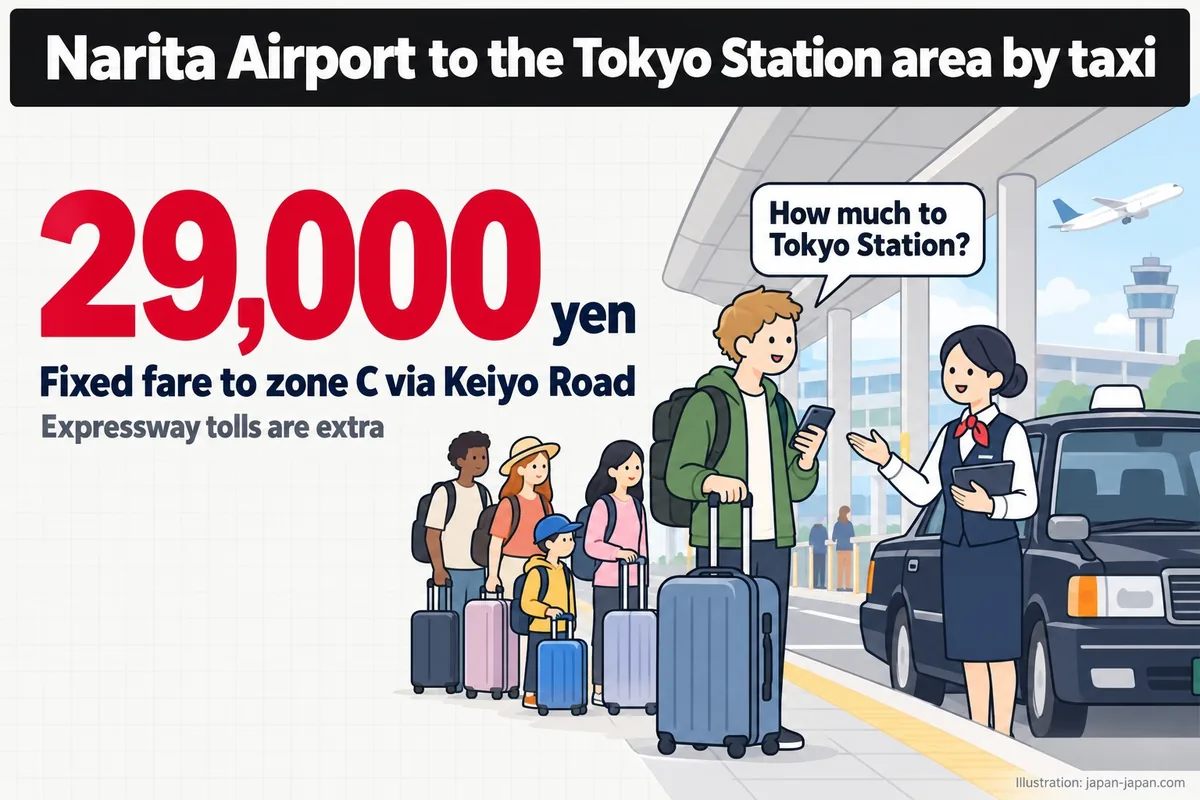
That 29,000 yen covers zone C, which takes in Chuo-ku and Chiyoda-ku, the two wards around Tokyo Station. The rest of this guide lists every Narita zone, the Haneda and Nagoya options, and the cases where a train is the better buy.
How Japan taxi fares work: meter, flat rate and tolls
A taxi in Japan charges you in one of two ways. Most rides run on the meter. A few airport routes use a fixed or flat fare that you can read off a price list before you get in.
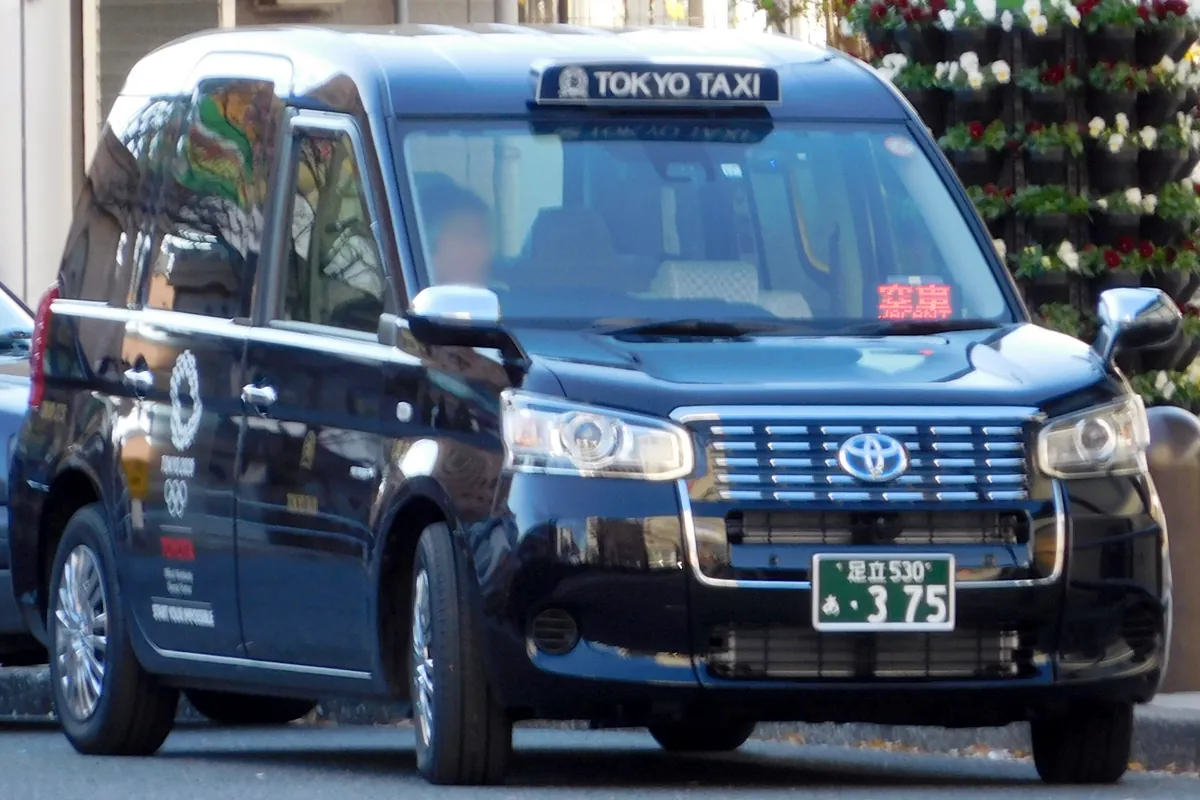
The photo above shows a typical Japan taxi in Tokyo. Every taxi like this one runs on the meter unless you agree on a fixed fare at the start.
Metered rides
On a metered ride, the fare depends on the route and on how long the car sits in traffic. Chubu Centrair Airport says this plainly on its own price list. The Chubu Centrair Airport taxi fares page calls its numbers estimates and warns that traffic jams and waiting at traffic lights can change the fare.
So treat any metered price you see online as a rough guide. Watch the meter during the ride and pay what it shows at the end, plus any tolls.
Fixed fares and flat rates
Narita and Haneda both offer a set price into the city. The Narita Airport taxi and flat fare page explains that fixed-fare taxis charge one uniform price from the airport to each zone of Tokyo. These prices assume the taxi uses the expressway. If you ask the driver to avoid the expressway, the driver switches to the meter instead.
The Haneda Airport taxi page describes a similar flat rate between Haneda, Tokyo and Kanagawa Prefecture. The Ministry of Land, Infrastructure, Transport and Tourism approves it. Some areas still pay the standard meter, and each taxi company gives the details.
What goes on top of the fare
- Expressway tolls: You pay them on top of the fixed fare at Narita and the flat rate at Haneda.
- Night hours at Narita: A late night and early morning surcharge applies from 22:00 to 5:00.
- Aqua-Line route: Narita adds a charge if the taxi crosses the Tokyo Bay Aqua-Line.
- Centrair Bridge: At Chubu Centrair, the customer pays the freeway fare, including the bridge to the airport island.
Narita also offers discounts for disabled passengers on its fixed fares. Ask your driver about the fare before you set off. Narita’s own page gives that advice, and it saves a surprise at the end of the ride.
Japan taxi from Narita Airport: flat fares by zone
Narita is Tokyo’s long-haul gateway, about an hour from the city in Chiba. Our Narita Airport guide covers the terminals, lockers and every way into Tokyo. For a taxi, the price depends on which Tokyo ward you are going to.
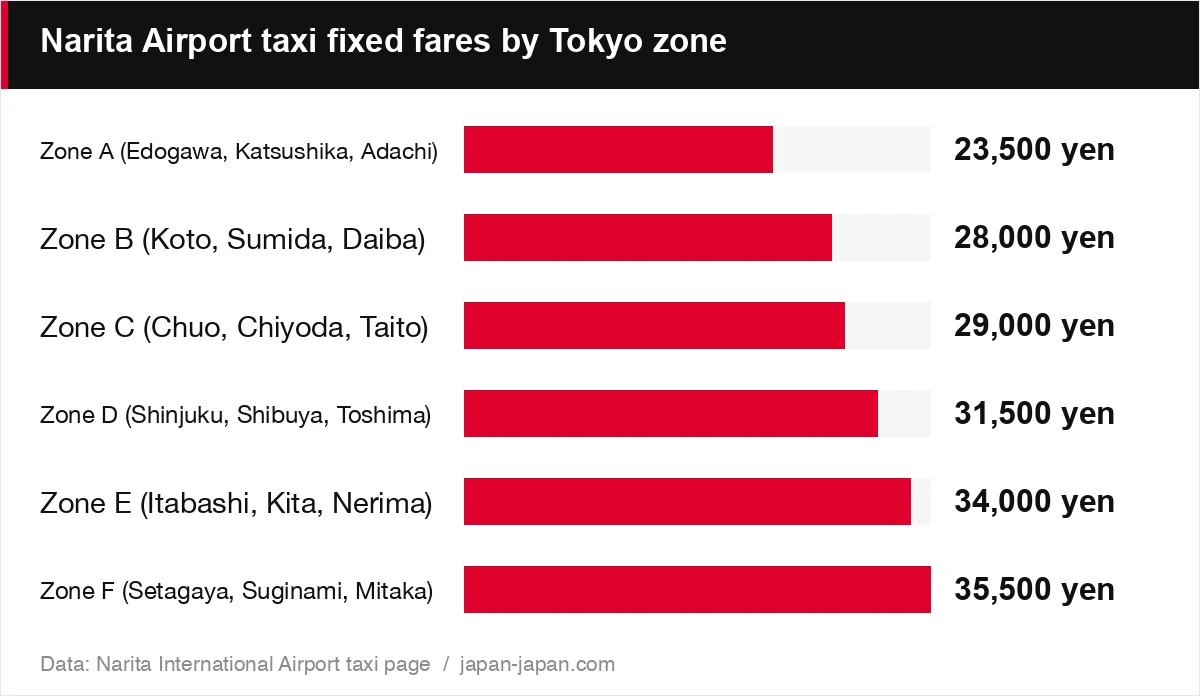
The chart below compares the six zones on the Keiyo Road route, from the cheapest zone A to the farthest zone F.
| Item | Value |
|---|---|
| Zone A (Edogawa, Katsushika, Adachi) | 23,500 yen |
| Zone B (Koto, Sumida, Daiba) | 28,000 yen |
| Zone C (Chuo, Chiyoda, Taito) | 29,000 yen |
| Zone D (Shinjuku, Shibuya, Toshima) | 31,500 yen |
| Zone E (Itabashi, Kita, Nerima) | 34,000 yen |
| Zone F (Setagaya, Suginami, Mitaka) | 35,500 yen |
Zone A starts at 23,500 yen for Edogawa-ku, Katsushika-ku and Adachi-ku. Zone F reaches 35,500 yen for Setagaya-ku, Suginami-ku, Mitaka-shi and Musashino-shi. Each zone also has a second price for the Bayshore Freeway route.
| Zone | Where it goes | Via Keiyo Road | Via Bayshore Freeway |
|---|---|---|---|
| A | Edogawa-ku, Katsushika-ku, Adachi-ku | 23,500 yen | 26,500 yen |
| B | Koto-ku, Sumida-ku, Daiba in Minato-ku, Higashi-yashio in Shinagawa-ku | 28,000 yen | 28,000 yen |
| C | Chuo-ku, Chiyoda-ku, Taito-ku, Bunkyo-ku, Arakawa-ku | 29,000 yen | 31,000 yen |
| D | Shinjuku-ku, Toshima-ku, Nakano-ku, Shibuya-ku, Meguro-ku, the rest of Minato-ku and Shinagawa-ku, Ota-ku | 31,500 yen | 32,500 yen |
| E | Itabashi-ku, Kita-ku, Nerima-ku | 34,000 yen | 36,000 yen |
| F | Setagaya-ku, Suginami-ku, Mitaka-shi, Musashino-shi | 35,500 yen | 38,500 yen |
Only zone B costs the same on both routes, at 28,000 yen. In zone F the gap is widest: 35,500 yen via Keiyo Road against 38,500 yen via the Bayshore Freeway. Agree on the route with the driver before you leave the stand.
Shinjuku, Shibuya and Ikebukuro all sit in zone D. A ride to a hotel there costs 31,500 yen via Keiyo Road or 32,500 yen via the Bayshore Freeway. Asakusa is in Taito-ku, so it falls in zone C at 29,000 yen or 31,000 yen.
How to use a Narita fixed-fare taxi
- Find the stand. Walk to the taxi stand of your terminal, listed below.
- Pick any taxi. You do not need to book ahead, and you may choose the taxi you like.
- Ask first. Tell the driver your ward and ask for the fixed fare before you hire the taxi.
- Pay at the end. Pay the zone fare plus the expressway tolls, and the night surcharge if it applies.
At Terminal 1 you board at the No. 15 Taxi Stand. Terminal 2 uses the No. 28 and No. 31-A Taxi Stands, and Terminal 3 has its own taxi stand.
| Place | Narita Airport taxi stands |
|---|---|
| Price | Fixed fares 23,500-38,500 yen to Tokyo zones A-F, plus expressway tolls; surcharge 22:00-5:00 |
| Access | Terminal 1: No. 15 Taxi Stand. Terminal 2: No. 28 and No. 31-A Taxi Stands. Terminal 3: taxi stand |
| Official site | Narita Airport taxi and flat fare page |
The Narita International Airport Taxi Council answers questions on standard and fixed-fare taxis. Call +81 476-34-8755 on weekdays from 9:00 a.m. to 5:00 p.m. After 5:00 p.m. on weekdays, call +81 476-32-9516. The same number works on weekends and public holidays from 6:00 a.m. to 10:00 p.m.
Taxi fares outside Tokyo: Chubu Centrair and Nagoya
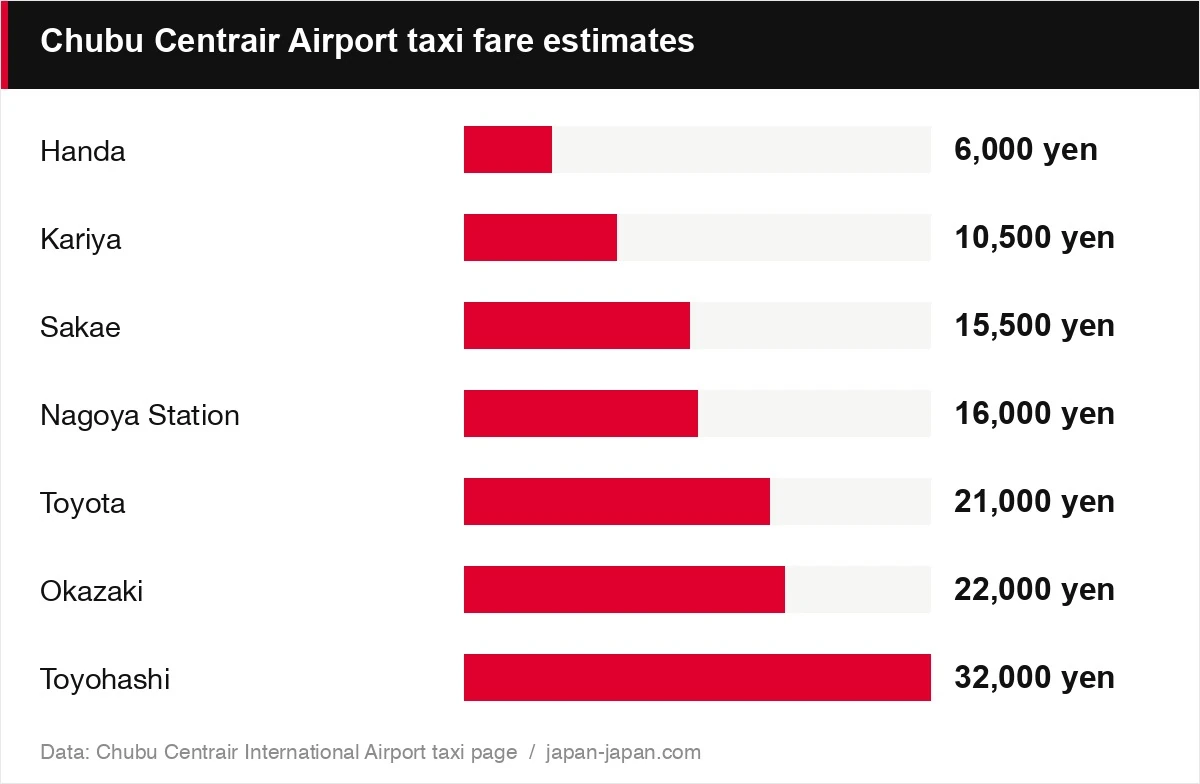
Outside Tokyo, Chubu Centrair Airport publishes the clearest taxi prices. It is Nagoya’s airport, on its own island in Ise Bay. Its price list gives a time and a fare for 11 destinations. The chart below shows eight of them, from the nearest to the farthest.
| Item | Value | Note |
|---|---|---|
| Handa | 6000 yen | 40 min |
| Kariya | 10,500 yen | 45 min |
| Sakae | 15,500 yen | 45 min |
| Nagoya Station | 16,000 yen | 50 min |
| Toyota | 21,000 yen | 60 min |
| Okazaki | 22,000 yen | 65 min |
| Toyohashi | 32,000 yen | 90 min |
| Hamamatsu | 41,000 yen | 115 min |
Nagoya Station costs about 16,000 yen and takes about 50 minutes. Sakae, the shopping district in central Nagoya, is a little cheaper at 15,500 yen and 45 minutes. Handa is the closest on the list at 6,000 yen and 40 minutes. Hamamatsu is the farthest at 41,000 yen and 115 minutes.
Other entries include Kariya at 10,500 yen, Toyota at 21,000 yen and Okazaki at 22,000 yen. Komaki costs 21,000 yen, Ichinomiya 22,000 yen and Yokkaichi 21,000 yen. Toyohashi takes 90 minutes and costs 32,000 yen. All of these are estimates, and you pay the freeway fare on top.
Taxis pick up from the 1st floor of Access Plaza for Terminal 1. Terminal 2 passengers use the 1st floor of the same building. Take the passage from the arrivals lobby to Access Plaza.
Several companies serve the airport. Meitetsu Chita taxi runs 24 hours a day, 7 days a week, on +81-569-37-1112. Anzen Taxi runs from 6:00 to 2:00 a.m. on +81-569-21-0685. Anshin Net Nagoya takes dispatch calls on 052-604-3322.
For a small group with bags, Aichi Airport Limousine runs a jumbo taxi from Centrair to Nagoya City and the area just east of it. You must reserve it in advance.
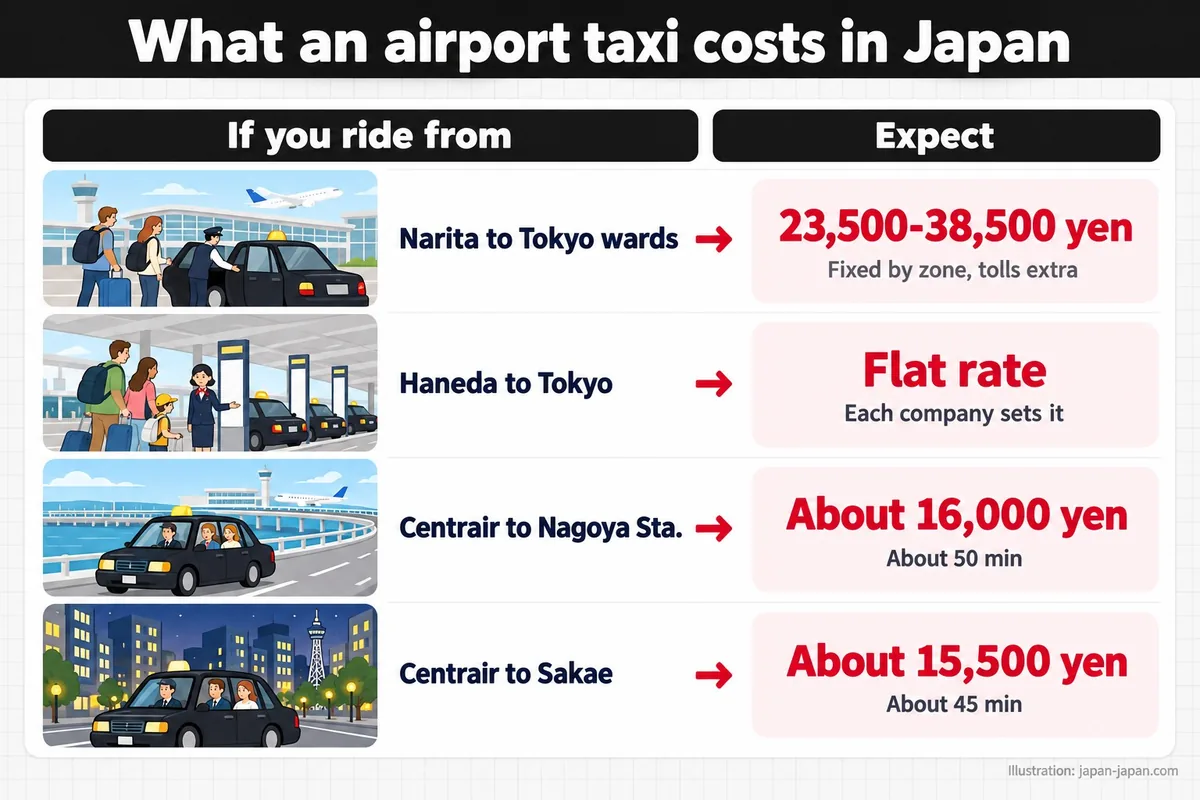
The lookup above puts the three airports side by side: Narita and Centrair publish prices, while Haneda’s flat rate comes from each taxi company. For the train and bus options from Centrair, see our Chubu Centrair Airport guide. The Meitetsu mu-SKY reaches Nagoya Station in 28 min for 1,430 yen, and a Meitetsu limited express takes 36 min for 980 yen. Our Chubu Centrair Airport to Nagoya page compares all five ways.
A late night and early morning Meitetsu Bus also runs to the West Exit of Nagoya Station in 55 min for 1,500 yen. That bus is the cheap fallback when trains have stopped. In the Kansai region, our Kansai Airport guide lists the trains and buses into Osaka and Kyoto. The JR Haruka reaches Kyoto in 75 min for 2,200 yen.
Haneda Airport taxis: ranks, flat rates and app pick-up
Haneda is Japan’s busiest airport and the one closest to central Tokyo. Each terminal has numbered taxi stops on the arrival level, split by where you are going.
Find your terminal below, then join the queue at the stop for your destination.
- Terminal 1: 1st floor, arrival lobby. Stops 1 and 17 serve Kawasaki, Yokohama, Yokosuka and Miura. Stops 2 and 18 serve all other areas. Stops 0 and 19 are for reserved taxis.
- Terminal 2: 1st floor, arrival lobby. Stops 2 and 20 serve Kawasaki, Yokohama, Yokosuka and Miura. Stops 3 and 19 serve all other areas. Stop 1 is for private taxis.
- Terminal 3: Follow the taxi signs from the 2nd floor or 3rd floor access hall down to the 1st floor, 2nd lane. Taxis wait at Stop 21.
| Place | Haneda Airport taxi stands |
|---|---|
| Price | Flat rate to Tokyo and Kanagawa from each taxi company, plus Shuto Expressway tolls; some areas metered |
| Access | T1 and T2: 1st floor arrival lobby. T3: Stop 21, 1st floor 2nd lane. App taxis: 2nd floor |
| Official site | Haneda Airport taxi page |
App taxis and reserved taxis
If you book a taxi through an app, do not wait at the 1st-floor stands. Haneda opened dedicated stands for app-hailing and reserved taxis at 5:00 AM on Wednesday, October 22, 2025. They sit on the 2nd floor, the departure level.
- Terminal 1: Near Exit 7 on the 2nd floor.
- Terminal 2: Near Exit 2 on the 2nd floor.
- Terminal 3: On the 8th floor of the P5 Parking.
The airport says boarding spots may change when it gets busy. Check the pick-up point in your app before you walk over.
The Haneda flat rate
Most routes between Haneda, Tokyo and Kanagawa Prefecture can run at a fixed fare. The flat rate assumes the Shuto Expressway, and you pay the tolls on top. A few areas still use the standard meter. The Tokyo Hire-Taxi Association and the Kanagawa Taxi Association handle the details, so ask the driver for the flat rate before you leave.
At the Terminal 3 stand, Haneda runs an Excellent Service Taxi stand. It matches foreign travelers with taxis meant to make Tokyo rides and sightseeing easier. See our Haneda Airport guide for the terminals, lockers and bus stops.
Is a taxi expensive in Japan? Taxi vs train from the airport
Yes, from the airports a taxi costs far more than the train. The gap is largest at Narita, where even the cheapest zone costs 23,500 yen before tolls.
The table below compares the four ways from Narita to Tokyo Station, using the zone C taxi fare.
| Way | Time | Fare | Note |
|---|---|---|---|
| Fixed-fare taxi (zone C) | Depends on traffic | 29,000 yen plus tolls | Night surcharge 22:00 to 5:00 |
| Narita Express | 53 min | 3,140 yen | No change |
| Airport Limousine bus | 75 to 100 min | 3,100 yen | Last bus 20:45 |
| AIRPORT BUS TYO-NRT | 65 min | 1,500 yen | Lowest listed fare |
The Narita Express runs to Tokyo Station without a change in 53 min for 3,140 yen. The Airport Limousine bus takes 75 to 100 min for 3,100 yen. AIRPORT BUS TYO-NRT costs only 1,500 yen and takes 65 min. Our Narita Airport to Tokyo Station page lists the bus stops and departures for each.
Even a group of four pays less on the train. Four Narita Express tickets come to well under half the 29,000 yen zone C fare. What the taxi gives you is comfort and a door-to-door ride.
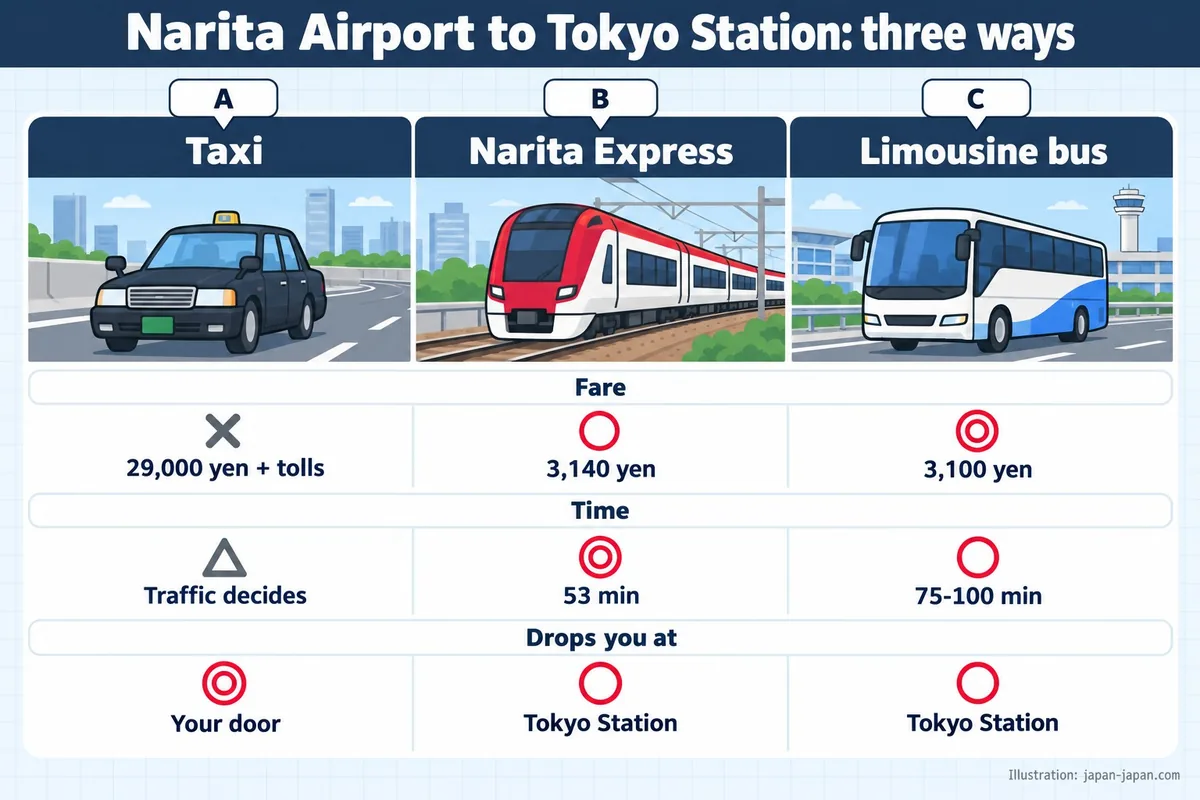
The comparison above shows why most visitors take the train or bus into Tokyo. A taxi makes sense in a few cases:
- Late arrivals: The last Airport Limousine bus from Narita to Tokyo Station leaves at 20:45.
- Heavy bags or small children: The taxi drops you at your hotel door with no change of train.
If you land after 22:00 at Narita, remember the night surcharge on top of the zone fare. Our guide to Narita and Haneda to Tokyo compares the fastest and cheapest ways from both airports.
From Haneda
Haneda is closer, and the train is cheap. The Keikyu Line and JR reach Tokyo Station in 33 min for 540 yen, with one change at Shinagawa. The Tokyo Monorail and JR Yamanote Line cost 720 yen, with a change at Hamamatsucho.
The Airport Limousine bus to Tokyo Station takes 55 min for 1,200 yen. It runs only 6 times a day from Terminal 3, and the last one leaves at 16:00. Our Haneda Airport to Tokyo Station page has the stops. If you land late and head for Shinjuku, the bus runs until 23:40 and costs 1,400 yen.
How to get a taxi in Japan: ranks, hailing and apps
You have three ways to get a taxi in Japan. Queue at a rank, wave one down on the street, or book one by app or phone.
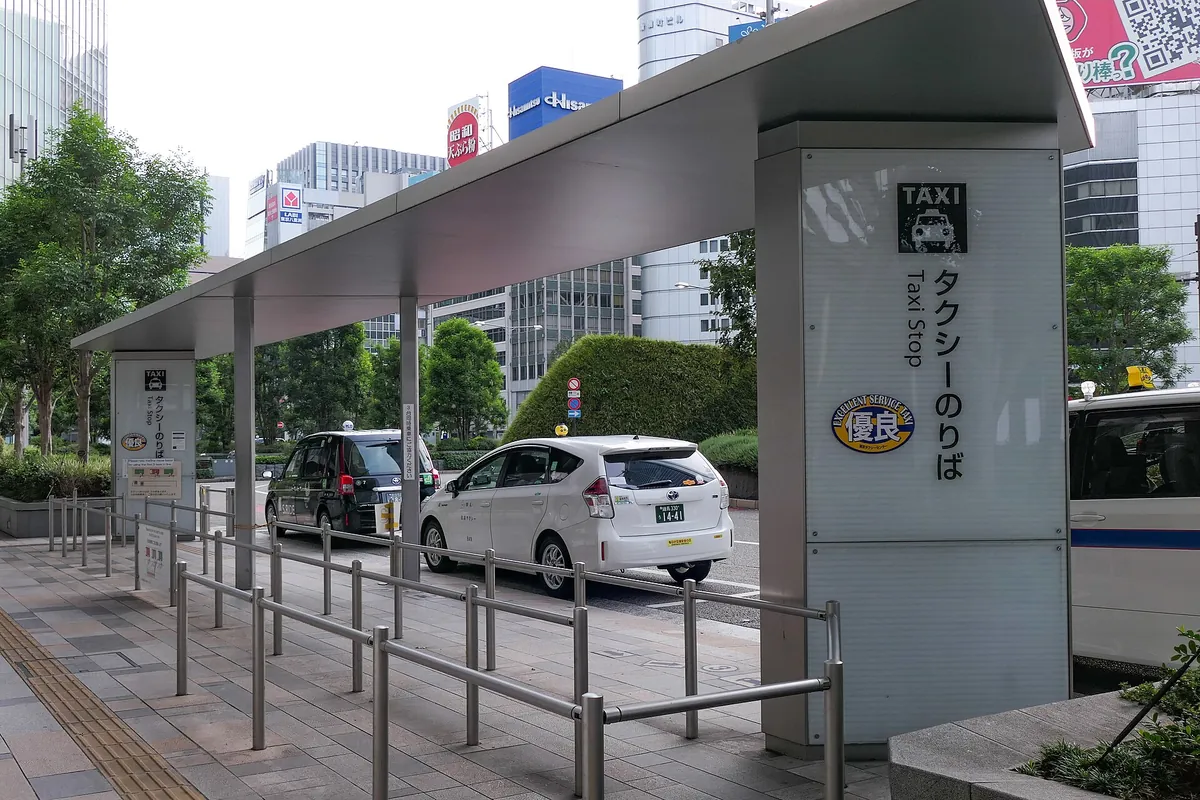
The photo shows the taxi rank at Tokyo Station, where taxis wait in a line and passengers queue in order. Airports and big stations all work this way.
At a taxi rank
Join the end of the queue and take the next taxi. At the airports, check the stop number first. Haneda splits its stops by destination, and Narita gives each terminal its own stand. At Narita you may still choose the taxi you like.
On the street
In city centres you can wave down an empty taxi from the kerb. Have your destination ready in Japanese, such as a hotel name or a map pin on your phone. A printed address helps the driver find the right street.
By app or by phone
Taxi apps work in the big cities. At Haneda, use the 2nd-floor app stands near Exit 7 in Terminal 1 and Exit 2 in Terminal 2. In Nagoya, Anshin Net Nagoya takes dispatch calls on 052-604-3322, and Meitetsu Chita taxi answers 24 hours a day.
Paying the fare
Ask the driver before you set off how you can pay, by cash, card or IC card. Our Suica card guide explains Welcome Suica and PASMO, and the Suica page shows where the card works. Keep the receipt. It shows the taxi company if you leave something in the car.
If you plan long drives in the countryside, a rental car can cost less than a taxi. Read our Japan car rental guide for the permit you need.
FAQ
How much is a taxi from Narita Airport to central Tokyo?
A fixed-fare taxi costs 23,500 to 38,500 yen, depending on the zone and the expressway route. The Tokyo Station area is zone C, at 29,000 yen via Keiyo Road or 31,000 yen via the Bayshore Freeway. You pay expressway tolls on top.
Do I need to book a fixed-fare taxi at Narita Airport?
No. Narita says advance reservations are not required. Walk to your terminal’s taxi stand, choose a taxi and ask the driver for the fixed fare before you hire it.
Are taxis more expensive late at night in Japan?
At Narita, yes. A late night and early morning surcharge applies from 22:00 to 5:00 on top of the fixed fare. Elsewhere, ask the taxi company or the driver before the ride.
Is a taxi cheaper than the train from Haneda Airport?
No. The Keikyu Line and JR reach Tokyo Station in 33 min for 540 yen. A Haneda flat-rate taxi adds Shuto Expressway tolls to its fare, and each taxi company sets the price.
About the author