Onigiri Calories at 7-Eleven Japan: 165 to 368 kcal
Most onigiri sit in a narrow band. Fifteen of the 25 have under 200 kcal, and only 3 go above 250 kcal. Two of those three are the large omusubi, and they also carry the most carbohydrate in the list: 52.1 g and 65.5 g.
Every number in this article is per onigiri, not per gram.
The figures come from Seven-Eleven Japan’s own product pages for the Kanto area, which includes Tokyo. We copied each value as printed. We did not round anything and did not estimate missing items.
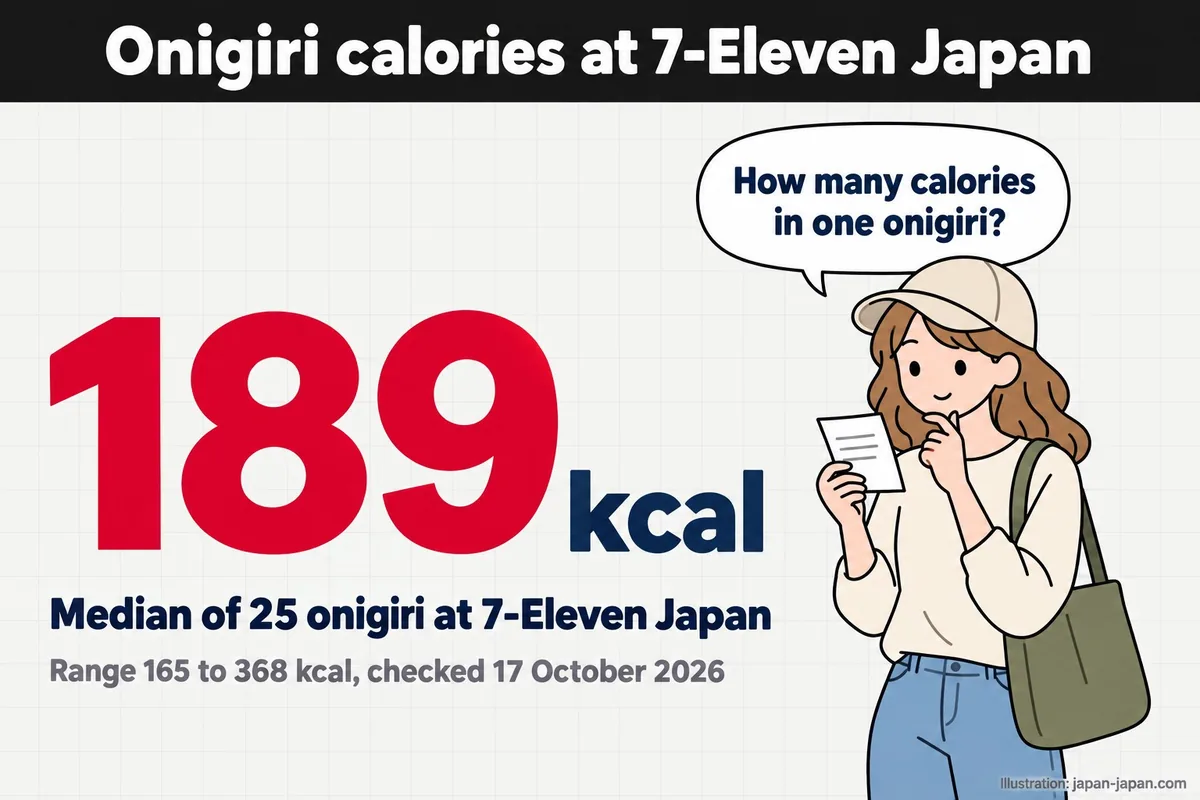
The illustration above sums up the answer. It shows the median of 189 kcal, the range of 165 to 368 kcal and our check date.
Plain fillings such as pickled plum, kelp and cod roe stay low. Mayonnaise and the large size push the number up.
Calories in every 7-Eleven onigiri
The table below lists all 25 onigiri in our database, from the fewest calories to the most. Each value is per onigiri. We took the values from the Seven-Eleven Japan onigiri product list (Kanto) and the product page behind each item.
The Japanese name in the second column of the table is the name printed on the front label. You can hold the pack next to your phone and match the characters.
| Onigiri | Japanese name on the label | kcal | Protein (g) |
|---|---|---|---|
| Salted kelp and edamame barley omusubi | ぷちもち食感!もち麦おむすび 塩こんぶ枝豆 | 165 | 4.7 |
| Pickled plum (ume) onigiri | 手巻おにぎり 熟成仕立て紀州南高梅 | 166 | 2.9 |
| Hokkaido kelp (kombu) onigiri | 手巻おにぎり 北海道産昆布 | 171 | 3.3 |
| Spicy cod roe (mentaiko) onigiri | 手巻おにぎり 具たっぷり辛子明太子 | 173 | 5.1 |
| Plain salt rice ball (Ginshari Musubi) | 銀しゃりむすび 塩むすび | 173 | 2.6 |
| Spicy cod roe rice ball (Ginshari Musubi) | 銀しゃりむすび 辛子明太子 | 173 | 3.9 |
| Charcoal-grilled red salmon onigiri | 手巻おにぎり 炭火焼紅しゃけ | 174 | 4.6 |
| Bonito flakes (okaka) onigiri | 味付海苔おにぎり おかか | 174 | 3.9 |
| Wakame seaweed rice omusubi | わかめご飯おむすび(三陸産わかめ使用) | 176 | 3.4 |
| Green onion miso rice ball (Ginshari Musubi) | 銀しゃりむすび ねぎ味噌 | 179 | 3 |
| Grilled salmon rice ball (Ginshari Musubi) | 銀しゃりむすび 焼しゃけ | 179 | 4.3 |
| Charcoal-grilled salmon onigiri | 手巻おにぎり 炭火焼銀しゃけ | 182 | 4.5 |
| Tuna, cod roe and mayo barley omusubi | 直巻もち麦おむすび ツナ明太マヨネーズ | 189 | 5.1 |
| Chicken mixed-rice omusubi | 直巻おむすび 具たっぷりとり五目 | 190 | 5.2 |
| Minced chicken rice ball (Ginshari Musubi) | 銀しゃりむすび 鶏そぼろ | 192 | 4.2 |
| Grilled soy-sauce rice ball (yaki onigiri) | 醤油の香り引き立つ 香ばし焼おにぎり | 204 | 3.8 |
| Egg and soy sauce dashi rice ball | だしむすび たまご醤油 | 206 | 4.8 |
| Fried rice (chahan) omusubi | 香ばし醤油炒め コク旨チャーハンおむすび | 208 | 4.8 |
| Maitake mushroom rice omusubi | 舞茸ご飯おむすび | 222 | 3.3 |
| Red bean sticky rice (sekihan) omusubi | もち米もっちり 赤飯おこわおむすび | 225 | 5.1 |
| Tuna mayonnaise rice ball (Ginshari Musubi) | 銀しゃりむすび ツナマヨネーズ | 227 | 4 |
| Tonkotsu rice omusubi with soft-boiled egg | 濃厚豚骨醤油ご飯 半熟煮玉子おむすび | 232 | 6.4 |
| Chicken and burdock omusubi (large) | おおきなおむすび 鶏ごぼう | 252 | 5.9 |
| Tuna mayonnaise onigiri | 手巻おにぎり ツナマヨネーズ | 258 | 5.2 |
| Chashu pork and mayo omusubi (large) | おおきなおむすび チャーシューマヨネーズ | 368 | 8.3 |
The English names are ours. Japanese labels often add a selling phrase before the filling. For example, the plum onigiri reads 手巻おにぎり 熟成仕立て紀州南高梅, where 南高梅 (nanko-ume) is the plum variety. The part to match is usually the last word or two.
Four of these onigiri have their own page in our food database, with price, sale area and allergens. They are the tuna mayonnaise onigiri, the charcoal-grilled salmon onigiri, the spicy cod roe onigiri and the pickled plum onigiri.
For prices, fillings in plain English and how to open the wrapper, read our guide to 7-Eleven onigiri prices and fillings. It covers the same 25 onigiri, which cost 135 to 268 yen before tax.
Seven-Eleven Japan also says that specs, prices and release dates can differ by region. A store outside Kanto may sell a slightly different line-up.
Lowest and highest onigiri calories
The lowest-calorie onigiri at 7-Eleven Japan is the salted kelp and edamame barley omusubi, at 165 kcal. Its label reads ぷちもち食感!もち麦おむすび 塩こんぶ枝豆. Here もち麦 (mochimugi) is the barley mixed into the rice.
This omusubi has 3 g of fibre and 34.4 g of carbohydrate. The pickled plum onigiri, with plain white rice, has 2 g of fibre and 37.8 g of carbohydrate.
Right behind it come the classic fillings. The pickled plum (ume) onigiri has 166 kcal and the Hokkaido kelp (kombu) onigiri has 171 kcal. Three onigiri tie at 173 kcal: the hand-rolled spicy cod roe, the Ginshari Musubi spicy cod roe and the plain salt rice ball.
The charcoal-grilled red salmon and the bonito flakes (okaka) onigiri both have 174 kcal. The wakame seaweed rice omusubi has 176 kcal.
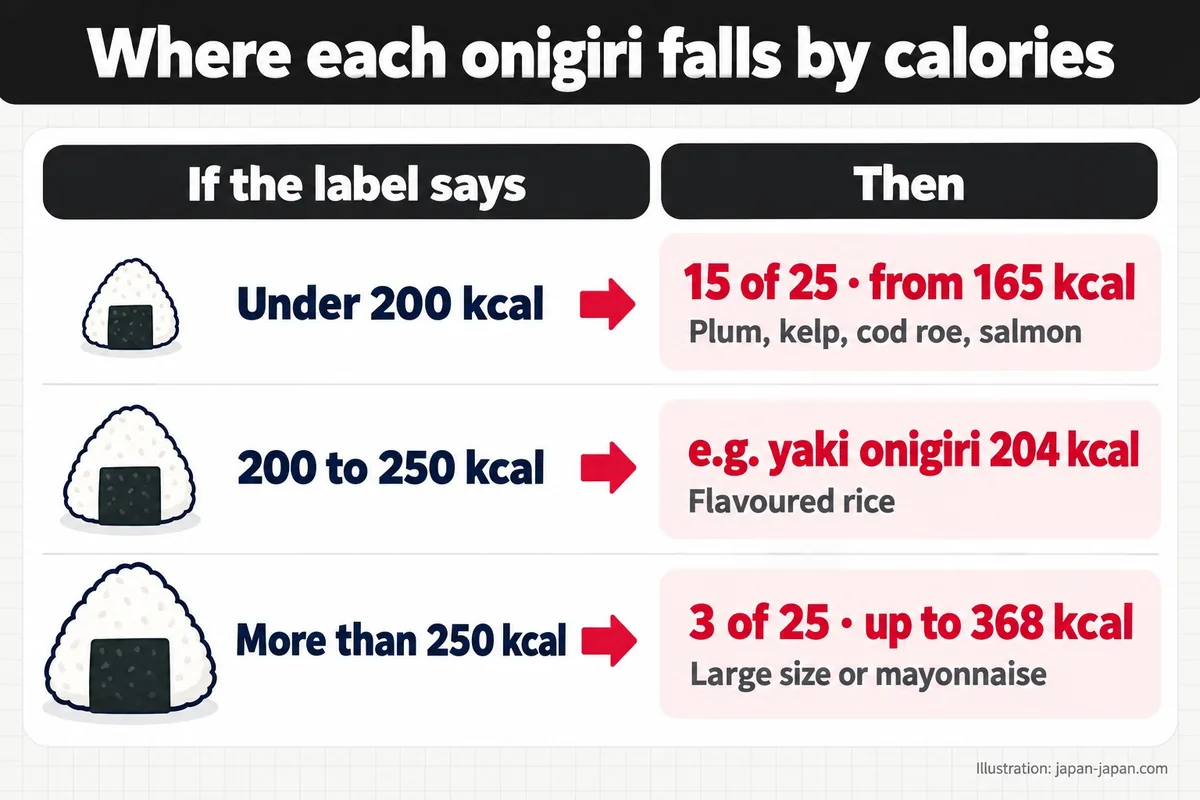
The chart above sorts the 25 onigiri into three calorie bands. Fifteen fall under 200 kcal. The middle band, 200 to 250 kcal, holds onigiri such as the yaki onigiri at 204 kcal and the fried rice omusubi at 208 kcal.
Flavoured rice lands in that middle band. The maitake mushroom rice omusubi has 222 kcal and the red bean sticky rice (sekihan) omusubi has 225 kcal. The tonkotsu rice omusubi with soft-boiled egg has 232 kcal.
At the top, 3 onigiri pass 250 kcal. The large chicken and burdock omusubi (おおきなおむすび 鶏ごぼう) has 252 kcal. The hand-rolled tuna mayonnaise onigiri has 258 kcal. The large chashu pork and mayo omusubi has 368 kcal.
Both large omusubi in the list are above 250 kcal. On the label, おおきな (ookina) means big.
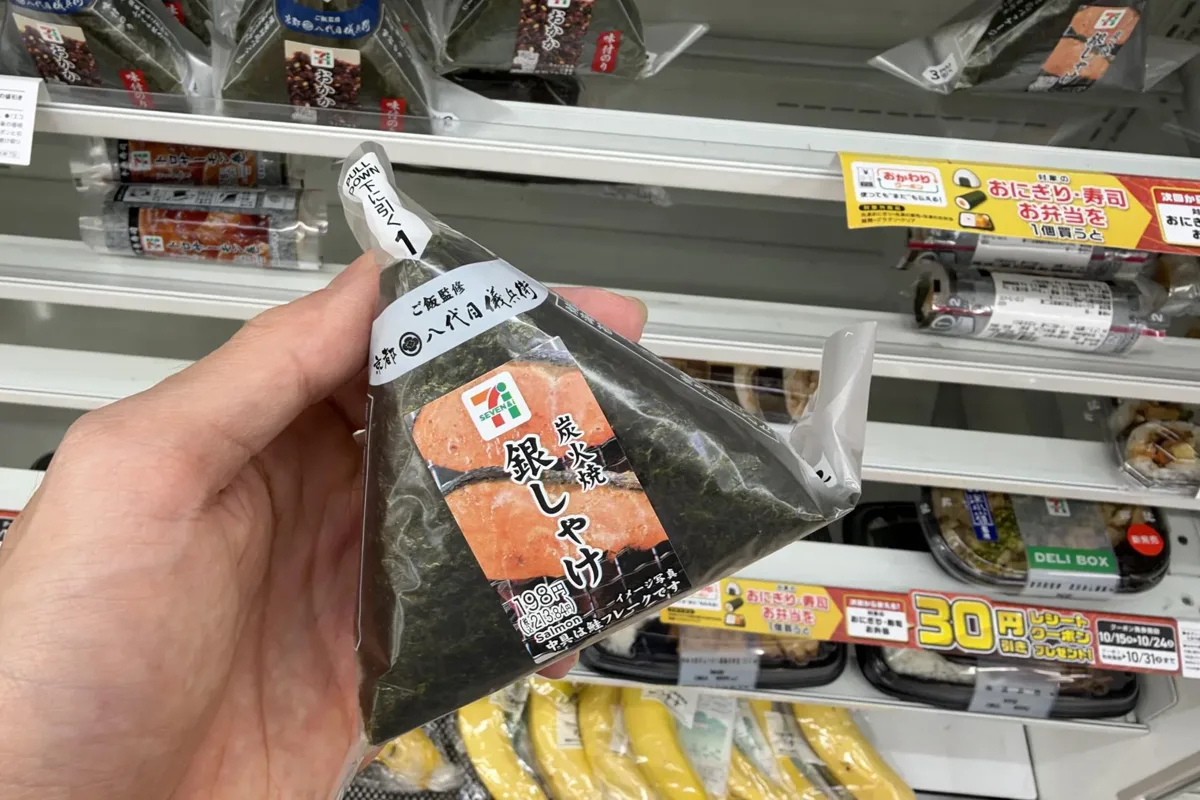
Salmon onigiri sit near the low end. The hand-rolled charcoal-grilled salmon onigiri has 182 kcal, and the Ginshari Musubi grilled salmon has 179 kcal.
The chashu mayo omusubi is also the priciest of the 25, at 268 yen before tax. It has 8.3 g of protein, the most in the list.
Protein, fat and carbohydrate
Calories are only the first value on the label. Seven-Eleven Japan lists five values for each onigiri under the heading 栄養成分 (eiyo seibun), which means nutrition facts.
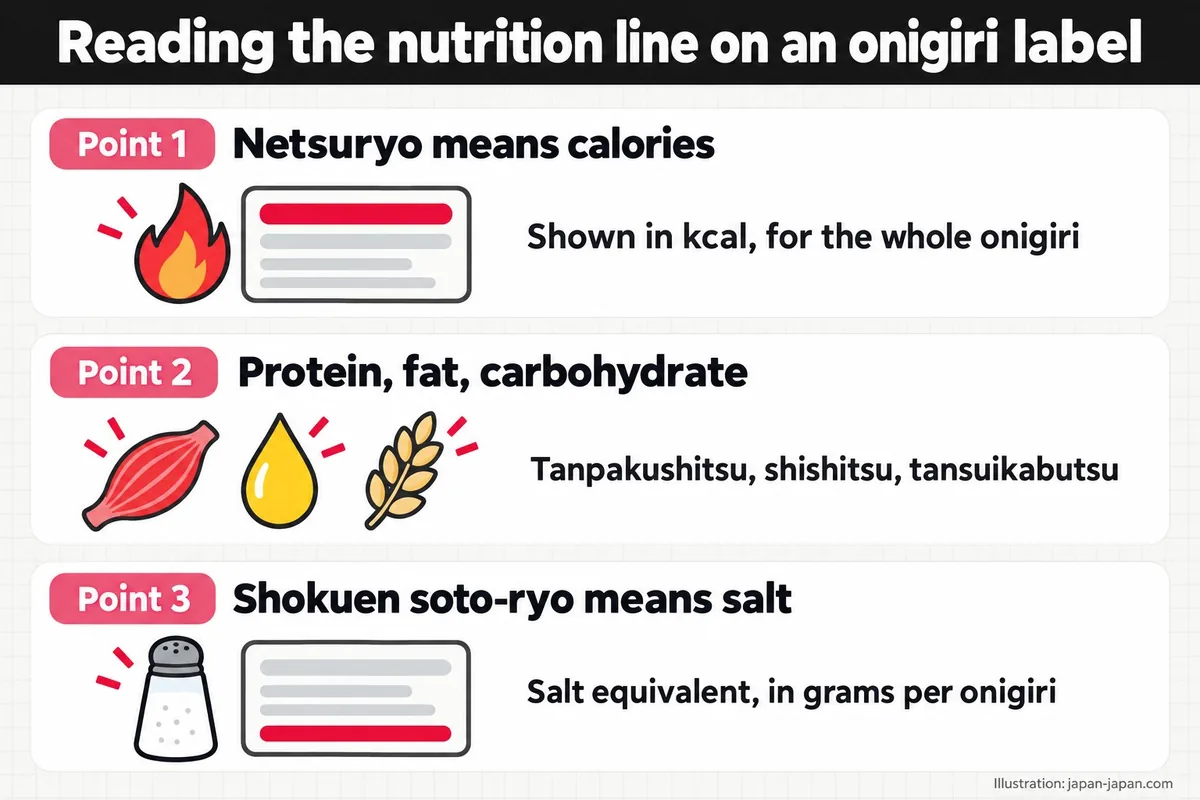
The illustration shows the words you will meet on that line. Here is what each one means:
- 熱量 (netsuryo): calories, in kcal.
- たんぱく質 (tanpakushitsu): protein, in grams.
- 脂質 (shishitsu): fat, in grams.
- 炭水化物 (tansuikabutsu): carbohydrate, split into 糖質 (toshitsu, sugar) and 食物繊維 (shokumotsu sen’i, fibre).
- 食塩相当量 (shokuen soto-ryo): salt equivalent, in grams.
Here is a real example. The Seven-Eleven Japan tuna mayonnaise hand-rolled onigiri page prints this line: 熱量:258kcal、たんぱく質:5.2g、脂質:10.6g、炭水化物:36.5g(糖質:34.6g、食物繊維:1.9g)、食塩相当量:1.2g.
Protein
Protein runs from 2.6 g in the plain salt rice ball to 8.3 g in the large chashu mayo omusubi. Most onigiri land between 3 g and 5.2 g. Only two pass 6 g: the tonkotsu rice omusubi with egg at 6.4 g and the chashu mayo at 8.3 g.
The large chicken and burdock omusubi follows with 5.9 g. Among regular-size onigiri, the chicken mixed-rice omusubi has 5.2 g and the hand-rolled spicy cod roe has 5.1 g.
Fat
Fat runs from 0.8 g to 10.6 g. Five onigiri share the low of 0.8 g: pickled plum, kelp, both spicy cod roe versions and the yaki onigiri.
The fattiest four all contain mayonnaise or pork. The hand-rolled tuna mayonnaise onigiri has 10.6 g and the chashu mayo has 8.8 g. The tonkotsu rice omusubi has 7.6 g and the Ginshari Musubi tuna mayonnaise has 6.9 g.
Carbohydrate
The two barley omusubi have the least. The tuna, cod roe and mayo barley omusubi has 34.3 g, and the salted kelp and edamame one has 34.4 g.
The large chashu mayo omusubi has the most, at 65.5 g. The large chicken and burdock omusubi has 52.1 g, and the sekihan omusubi has 50 g.
Salt
Salt equivalent stays between 0.71 g and 2 g. The sekihan omusubi has the least at 0.71 g. The red salmon onigiri has 0.89 g and the charcoal-grilled salmon onigiri has 0.92 g.
The fried rice (chahan) omusubi has the most, at 2 g. The maitake rice omusubi and the large chicken and burdock omusubi both have 1.8 g.
Seven-Eleven Japan adds that nutrition values can differ by product and asks shoppers to check the label on the pack. Treat the table as a guide and the wrapper as the final word.
Hand-rolled onigiri vs Ginshari Musubi
7-Eleven Japan sells two main onigiri lines. 手巻おにぎり (temaki onigiri) is the hand-rolled type.
銀しゃりむすび (Ginshari Musubi) is a second line. Ginshari is a Japanese word for plain white rice. We have 6 onigiri from each line in our database.
| Type | Onigiri | kcal | Fat (g) |
|---|---|---|---|
| Hand-rolled | Pickled plum (ume) | 166 | 0.8 |
| Hand-rolled | Hokkaido kelp (kombu) | 171 | 0.8 |
| Hand-rolled | Spicy cod roe (mentaiko) | 173 | 0.8 |
| Hand-rolled | Charcoal-grilled red salmon | 174 | 1.8 |
| Hand-rolled | Charcoal-grilled salmon | 182 | 2.7 |
| Hand-rolled | Tuna mayonnaise | 258 | 10.6 |
| Ginshari Musubi | Plain salt | 173 | 0.9 |
| Ginshari Musubi | Spicy cod roe | 173 | 0.8 |
| Ginshari Musubi | Green onion miso | 179 | 1.1 |
| Ginshari Musubi | Grilled salmon | 179 | 1.6 |
| Ginshari Musubi | Minced chicken | 192 | 2.4 |
| Ginshari Musubi | Tuna mayonnaise | 227 | 6.9 |
The table shows calories and fat side by side. In both lines, tuna mayonnaise has the most fat. The hand-rolled version has 258 kcal and 10.6 g of fat. The Ginshari Musubi version has 227 kcal and 6.9 g of fat.
Both tuna mayonnaise onigiri list egg and wheat among the 8 required allergens. Our page on the hand-rolled tuna mayonnaise onigiri has its price and sale area.
The same fillings appear in both lines. Spicy cod roe has 173 kcal in each. The hand-rolled spicy cod roe has 5.1 g of protein and 0.8 g of fat. The Ginshari Musubi spicy cod roe has 3.9 g of protein and 0.8 g of fat.
The Seven-Eleven Japan spicy cod roe hand-rolled onigiri page lists none of the 8 required allergens for the hand-rolled version.
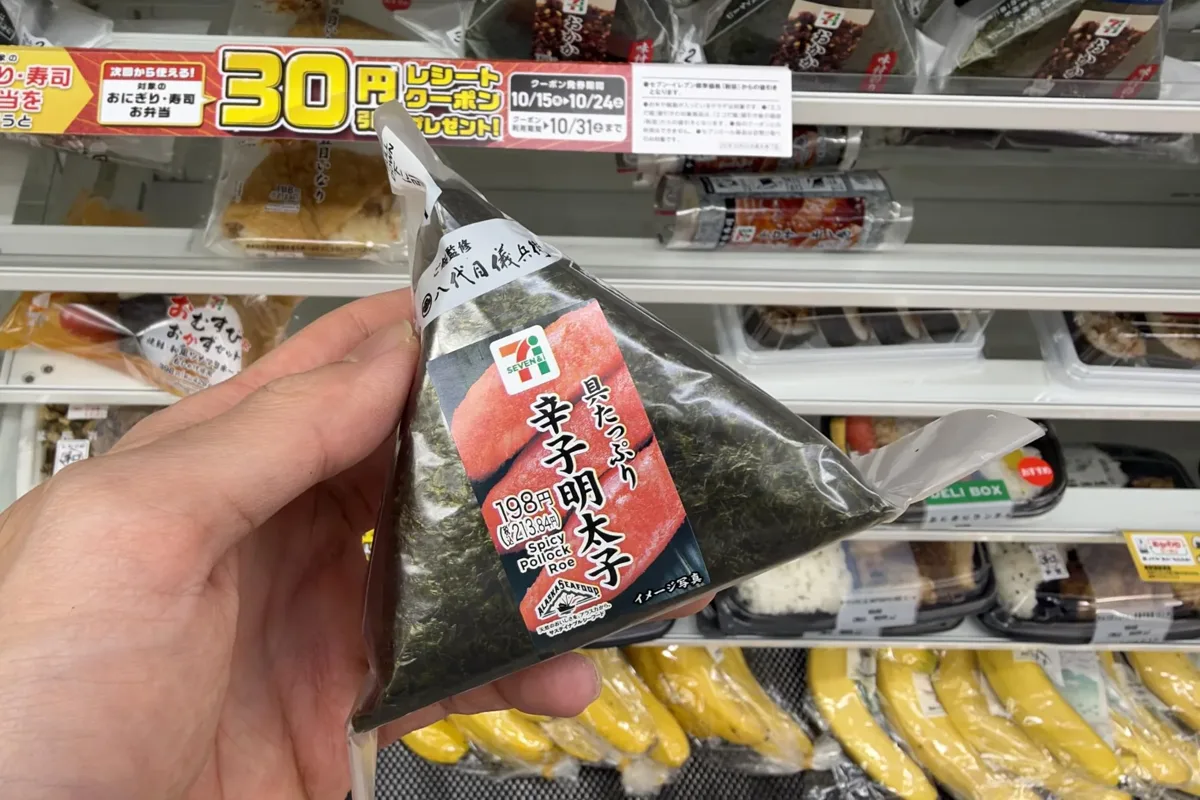
The Seven-Eleven Japan charcoal-grilled salmon onigiri page lists 182 kcal, 4.5 g of protein and 2.7 g of fat. The Ginshari Musubi grilled salmon has 179 kcal and 1.6 g of fat.
Price differs between the lines too. Hand-rolled pickled plum, kelp and tuna mayonnaise cost 182 yen before tax, and salmon and spicy cod roe cost 198 yen. In the Ginshari Musubi line, plain salt costs 135 yen. Green onion miso, minced chicken and tuna mayonnaise cost 148 yen, and spicy cod roe and grilled salmon cost 168 yen.
Onigiri vs sandwiches, bento and cup noodles
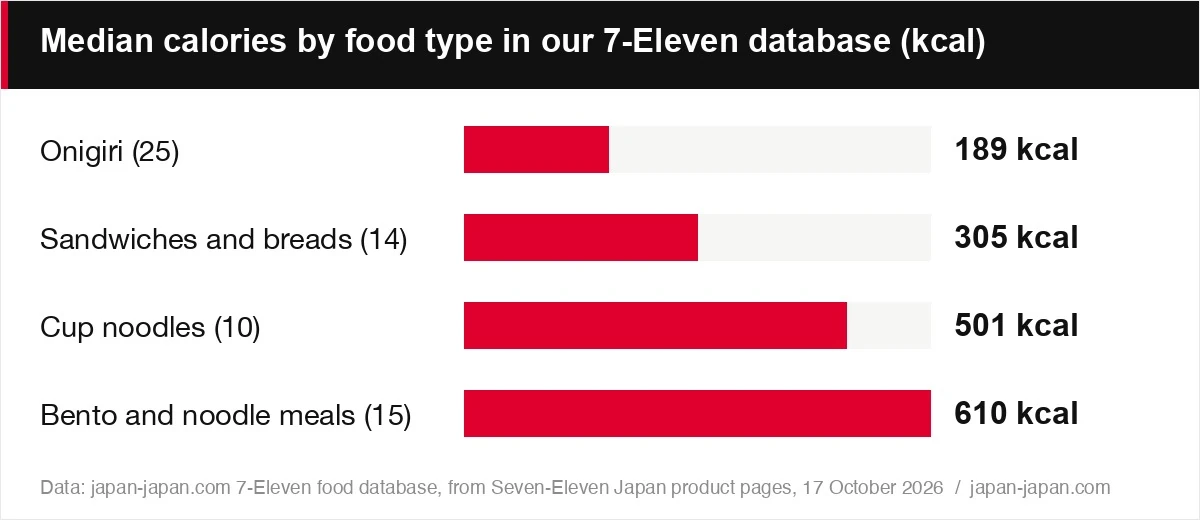
Our 7-Eleven food database also covers sandwiches, bento and cup noodles. The chart below compares the median calories of each group, using the same official product pages.
| Item | Value |
|---|---|
| Onigiri (25) | 189 kcal |
| Sandwiches and breads (14) | 305 kcal |
| Cup noodles (10) | 501 kcal |
| Bento and noodle meals (15) | 610 kcal |
The median is 189 kcal for 25 onigiri. It is 305 kcal for 14 sandwiches and breads, 501 kcal for 10 cup noodles and 610 kcal for 15 bento and noodle meals.
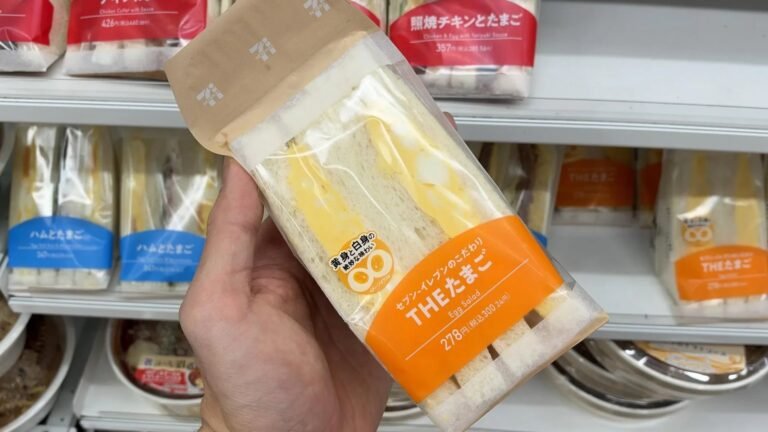
A sandwich is the next step up. Our article on the 7-Eleven egg sandwich covers THE Egg Sandwich, with its price on the Tokyo list.
Cup noodles carry far more salt than onigiri. The Santouka Asahikawa tonkotsu salt cup noodle has 513 kcal and 7 g of salt equivalent. The Seven Premium clam broth salt ramen has 278 kcal and 5.2 g. No onigiri in the list goes above 2 g.
Prices and calories for the full cup range are in our guide to cup noodles at 7-Eleven.
The median for bento and noodle meals is 610 kcal.
Our guide to 7-Eleven bento and noodle meals lists all 15 with their prices.
Where the numbers come from
Every value in this article comes from Seven-Eleven Japan’s product pages for the Kanto area. We checked them on 17 October 2026 and copied the per-onigiri values as printed.
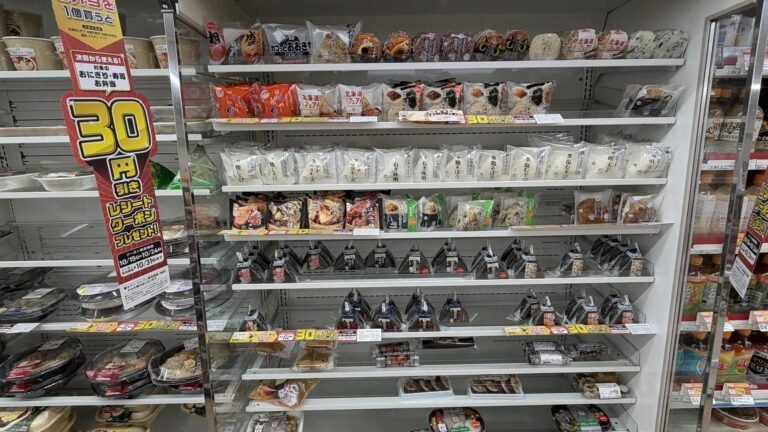
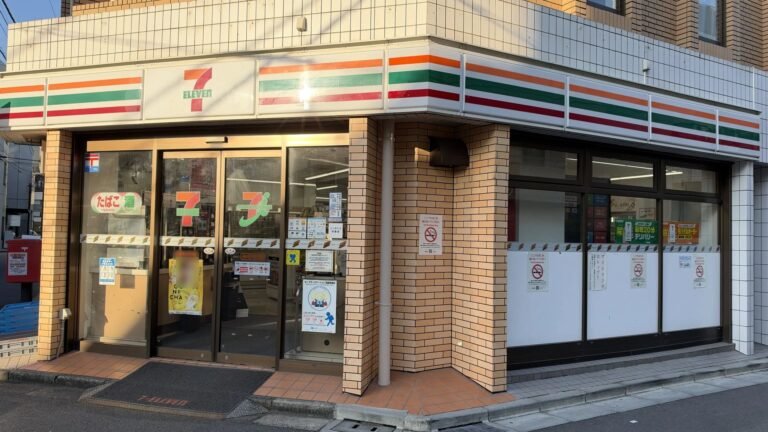
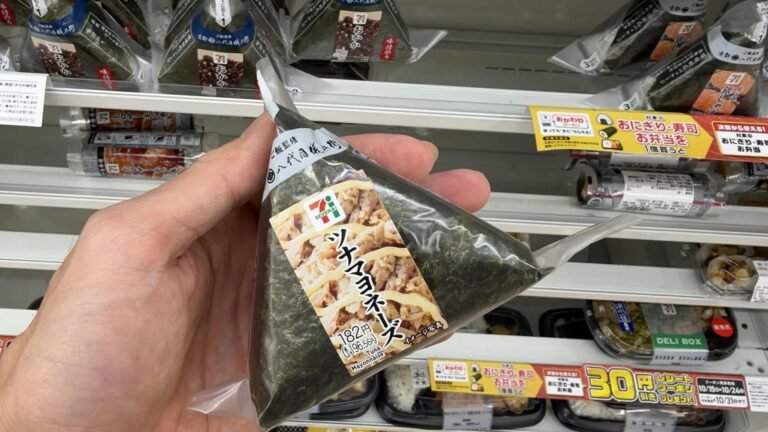
We also visited a 7-Eleven store in Tokyo on 20 October 2026 and photographed the front labels of three hand-rolled onigiri. The tuna mayonnaise onigiri showed 182 yen before tax (196.56 yen with tax). The charcoal-grilled salmon and spicy cod roe onigiri each showed 198 yen (213.84 yen with tax).
All three matched the Kanto list. The front label shows the name and the price. We did not photograph the back of the wrapper, so the calories here come from the official pages.
The back label on the pack is the final answer. Products change, and Seven-Eleven Japan notes that the values can differ by product. If a number on the pack differs from our table, trust the pack.
The allergen line on each page covers only the 8 required allergens, called 特定原材料8品目 (tokutei genzairyo) in Japanese. It does not tell you whether an onigiri is halal or vegan. For that, read the ingredient list on the back or ask the staff.
Our guide to vegetarian, vegan and halal food in Japan explains the hidden fish stock and how to ask about it.
The full 7-Eleven Japan food database lists 120 items with price, area, allergens and calories. It includes all 25 onigiri used here.
Onigiri calories FAQ
How many calories are in a 7-Eleven onigiri?
A 7-Eleven onigiri in Japan has a median of 189 kcal, across the 25 onigiri we checked on 17 October 2026. Most have between 165 and 200 kcal. Only 3 of the 25 go above 250 kcal.
Which 7-Eleven onigiri has the fewest calories?
The salted kelp and edamame barley omusubi has the fewest, at 165 kcal. The pickled plum (ume) onigiri follows at 166 kcal. The Hokkaido kelp onigiri has 171 kcal.
How many calories are in a tuna mayo onigiri?
The hand-rolled tuna mayonnaise onigiri has 258 kcal and 10.6 g of fat. The Ginshari Musubi tuna mayonnaise version has 227 kcal and 6.9 g of fat. Both list egg and wheat as allergens.
How much protein is in a 7-Eleven onigiri?
Protein runs from 2.6 g in the plain salt rice ball to 8.3 g in the large chashu pork and mayo omusubi. Most onigiri have between 3 g and 5.2 g. The tonkotsu rice omusubi with egg has 6.4 g.
About the author