
In Japan diving gear is allowed in carry-on and checked bags, with conditions.
Checked against the official page on · Report a correction
Carry-on: The list restricts two parts of a dive kit. Dive lights: yes if the heat source and the battery can be separated; a lithium-ion battery must be 160Wh or less. Air cylinders: no. Checked baggage: Dive lights: on the same condition, with a removed lithium-ion battery carried in the cabin. Air cylinders: only if no gas is left inside.
Diving gear on flights in and from Japan
The rule for diving gear comes from the Civil Aviation Bureau's list of restricted items and is the same on domestic and international flights.
| Where | Allowed? | What applies |
|---|---|---|
| In the cabin | Yes, within limits | The list restricts two parts of a dive kit. Dive lights: yes if the heat source and the battery can be separated; a lithium-ion battery must be 160Wh or less. Air cylinders: no. |
| In checked baggage | Conditions | Dive lights: on the same condition, with a removed lithium-ion battery carried in the cabin. Air cylinders: only if no gas is left inside. |
Dive lights, cylinders and spear guns: the parts with rules
Lists name only a few parts of a dive kit: the light, the cylinder and, in several countries, the spear gun.
- Dive lights are filed with heat-producing tools
- Japan's list sets scuba diving lights directly after soldering irons and glue guns, and CASA uses the label heat-producing articles for diving lamps, underwater blowtorches and soldering irons. The lithium-ion row in Japan's list is for batteries of 160 Wh or less. The note gives examples of a light whose heat source and battery can be separated: the battery comes out of the body, or the circuit to the heat source can be cut off.
- A battery taken out of the light stays in the cabin
- Once the lithium-ion battery is removed from a dive light, Japan's list handles it like a spare: protected against short circuit and carried in the cabin only, not checked. For lights that run on other batteries the note asks that the heat-producing part and the battery be kept apart and the battery protected against short circuit. CASA asks for the same separation and adds approval from the airline.
- Cylinders are judged by the gas left inside
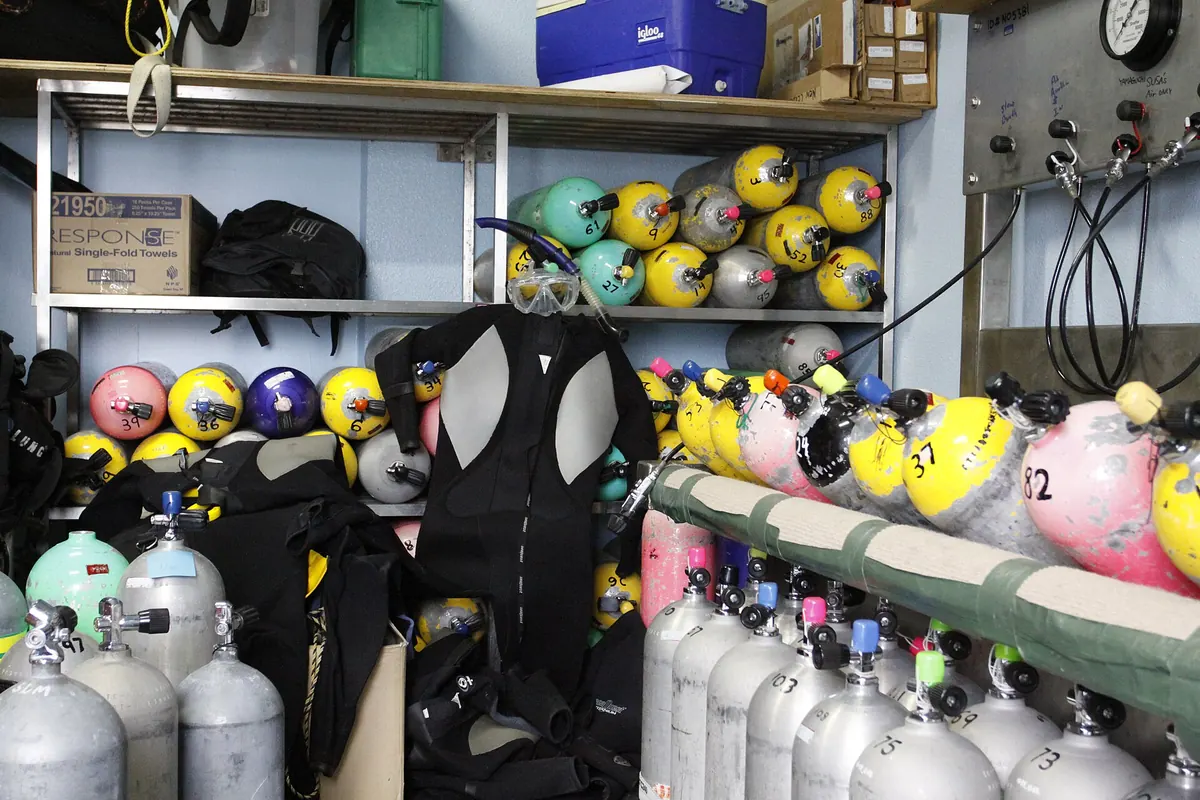
- The list calls them oxygen cylinders (air cylinders) and splits them by purpose. Medical ones are accepted up to 5 kg each. All others, the group a scuba tank belongs to, are barred from the cabin and may be checked only when no gas remains. Narita Airport's FAQ answers a question about a sports oxygen canister in the same spirit: not permitted in carry-on or checked baggage.
- Spear guns have rows of their own abroad
- No row in Japan's list mentions spear guns, but lists abroad do. GOV.UK shows a harpoon or spear gun as not allowed in hand luggage, with the hold left to the airline. The EU's cabin baggage list names harpoon guns and spear guns. The TSA keeps Spear Guns out of carry-on and accepts them in checked bags, and CASA flags a spear or fishing speargun the same way.
Diving gear: the rule country by country
The carry-on answer for diving gear is the same in all 2 other places we checked. The limits themselves are not identical, so read the row for the country you fly from.
| Flying from | Carry-on | Checked bag | What the authority says |
|---|---|---|---|
| JapanCivil Aviation Bureau | With limits | With limits | The list restricts two parts of a dive kit. Dive lights: yes if the heat source and the battery can be separated; a lithium-ion battery must be 160Wh or less. Air cylinders: no. Source |
| United KingdomUK Government | With limits | With limits | Check with your airline before you travel. This applies to both hand luggage and hold luggage. Source |
| AustraliaHome Affairs, CASA | With limits | With limits | Scuba tanks must be empty to be carried on or checked in. Diving lamps (battery-powered heat-producing articles) need airline approval, with the heat-producing component and the battery packed separately.CASA Pack Right entry: Scuba tanks, Heat-producing articles such as underwater blowtorches, soldering irons and diving lamps Source |
Each row comes from that authority's own page. Airlines can be stricter, and the screening officer has the final say.
If security in Japan will not let diving gear through
- What to do
- Move diving gear to the bag you check in before you reach security, within the checked-baggage limits above. Narita Airport states that anything given up at the checkpoint is discarded and cannot be returned.
Frequently asked questions
Can you take diving gear on a plane?
On flights in and from Japan: The list restricts two parts of a dive kit. Dive lights: yes if the heat source and the battery can be separated; a lithium-ion battery must be 160Wh or less. Air cylinders: no. In checked baggage: Dive lights: on the same condition, with a removed lithium-ion battery carried in the cabin. Air cylinders: only if no gas is left inside.
Can you fly with a scuba tank if it is empty?
Yes as checked baggage from Japan, never in the cabin. The list bars air cylinders other than medical ones from carry-on and lets them be checked only when no gas remains inside. CASA attaches a single condition to scuba tanks, that they must be empty, and flags them as items that can be checked in or carried on.
Can you take a dive light in carry-on luggage?
Yes in Japan when the heat source and the battery can be separated. The lithium-ion row covers batteries of 160 Wh or less, and a battery taken out of the light travels in the cabin only. CASA lists diving lamps as heat-producing articles that may be carried on or checked in with airline approval, the lamp part and the battery packed separately.
Is a spear gun allowed in checked baggage?
Yes under the TSA: Spear Guns are a checked-bag item there and a No for carry-on. GOV.UK bars a harpoon or spear gun from hand luggage and says to check with the airline before travelling with one in the hold. Hong Kong's CAD names harpoon guns and spear guns among the articles kept out of cabin baggage.
Can you take diving gear in hand luggage in the UK or Europe?
The United Kingdom: Check with your airline before you travel. This applies to both hand luggage and hold luggage.
Can you put diving gear in checked luggage?
Dive lights: on the same condition, with a removed lithium-ion battery carried in the cabin. Air cylinders: only if no gas is left inside.
What is the rule for diving gear on flights from Australia?
Australia: Scuba tanks must be empty to be carried on or checked in. Diving lamps (battery-powered heat-producing articles) need airline approval, with the heat-producing component and the battery packed separately.
Read more
- Madarao Mountain Resort 2026-27: 12 Tree Runs, Opens 12 DecMadarao Mountain Resort opens 12 Dec 2026 with 12 official tree runs. A 1-day pass for …
- Aomori Spring Ski Resort Opens Mid-December, ¥4,000 a DayAomori Spring Ski Resort opens from mid-December to the beginning of April. An adult da…
- Naeba Ski Resort 2026-27: Kids Ski Free, Adults ¥9,800Naeba Ski Resort runs 18 Dec 2026 to 4 Apr 2027. Adults pay ¥9,800 a day, kids up to el…
- Snowboarding in Japan 2026-27: Hirafu Snow Peaks at 400 cmSnowboarding in Japan 2026-27: the top of Niseko Grand Hirafu averages 400 cm of snow i…
Sources for this page
- Japan Civil Aviation Bureau (MLIT) — Items restricted in carry-on and checked baggage (updated 24 April 2026)
- Narita International Airport — FAQ: prohibited items
- GOV.UK — Hand luggage restrictions: Sports equipment
- CASA — Pack Right: Scuba tanks
- European Commission — List of prohibited articles in your cabin baggage
- Civil Aviation Department (Hong Kong) — Packing Tips for Air Passengers
- GOV.UK — Hand luggage restrictions at UK airports
- TSA — What Can I Bring? (complete list)