Japan Departure Tax Increase 2026: 3,000 Yen and Who Pays
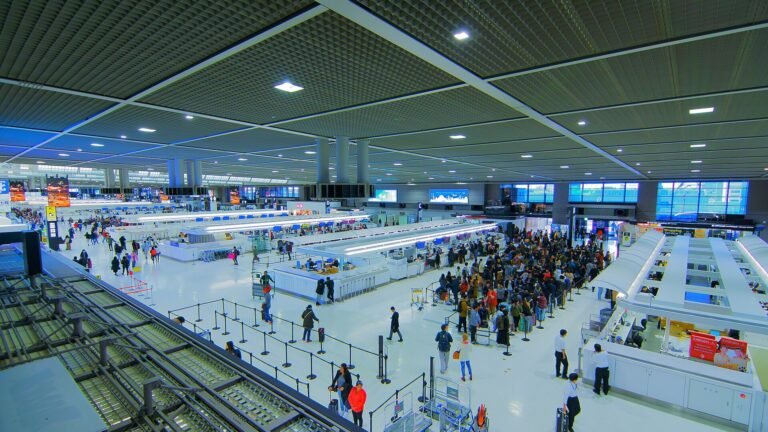
Japan departure tax increase: the short answer
The official name is the International Tourist Tax. In Japanese it is 国際観光旅客税. The National Tax Agency summary sets the rate at 3,000 yen for each departure from Japan. That figure applies to departures on or after 1 July 2026.
You do not queue anywhere to pay it. The airline or shipping company collects the tax from you by the time you board. It then pays the money to the government for you. In most cases the tax is simply part of the price you see when you book.
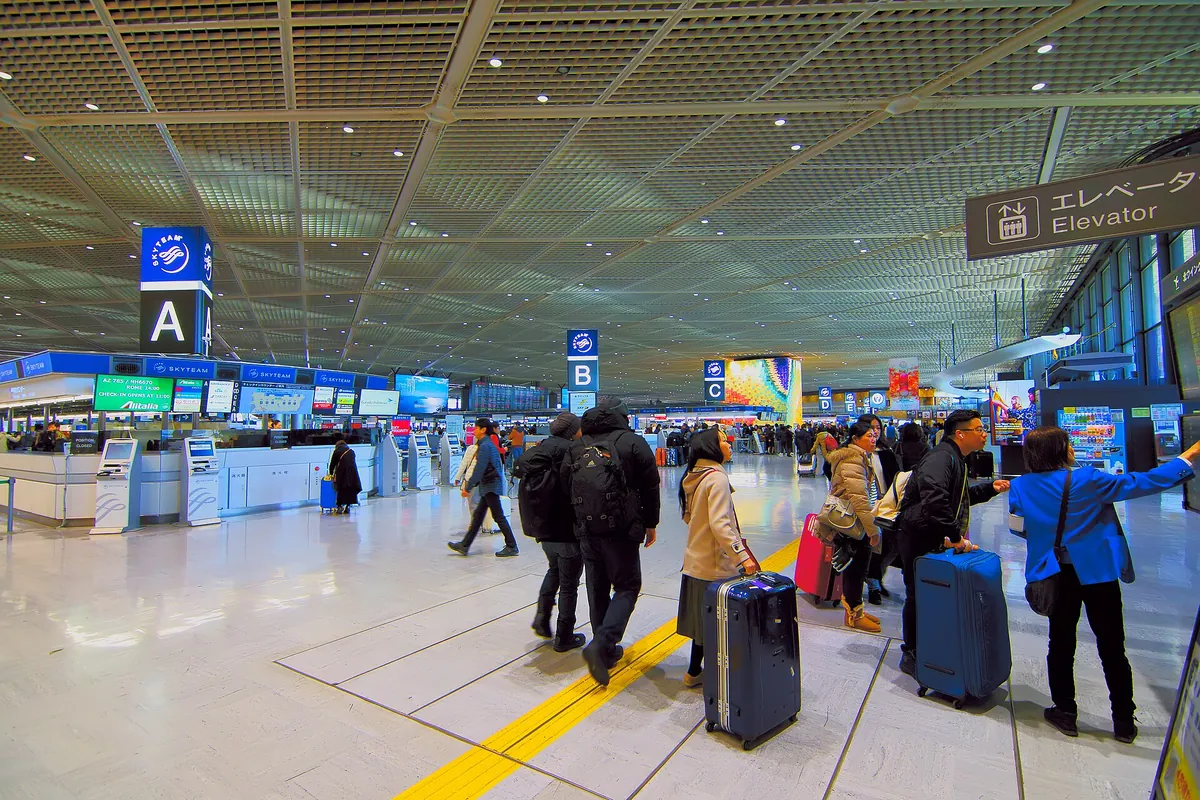
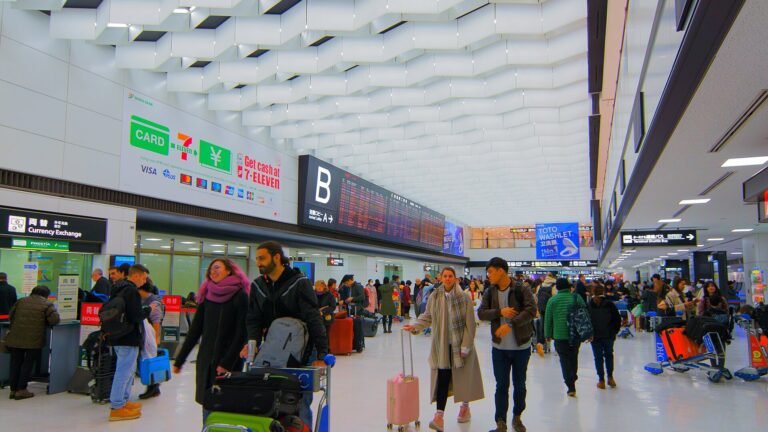
The photo above shows a departure lobby at Narita Airport. Nothing in that hall is set up to take the departure tax from you. You check in, drop your bags and go through security as usual. The tax has already been paid inside your fare.
Three quick facts cover most trips:
- Rate: 3,000 yen per person, per departure from Japan, from 1 July 2026.
- How you pay: the carrier adds it to your ticket and collects it before you board.
- Who skips it: children under 2, transit passengers who leave within 24 hours of entering Japan, and crew, among others.
The tax is per departure, so it does not depend on how long you stay. A week in Tokyo and a month across the country cost the same 3,000 yen at the end. If you leave Japan twice on one trip, for example to visit Seoul and come back, you pay it each time you leave.
From 1,000 yen to 3,000 yen on 1 July 2026
Japan created the International Tourist Tax in 2018, and the first leaflets for departing travellers date from June 2018. For years the rate stayed at 1,000 yen per departure. The National Tax Agency English page now flags a tax rate revision effective July 2026.
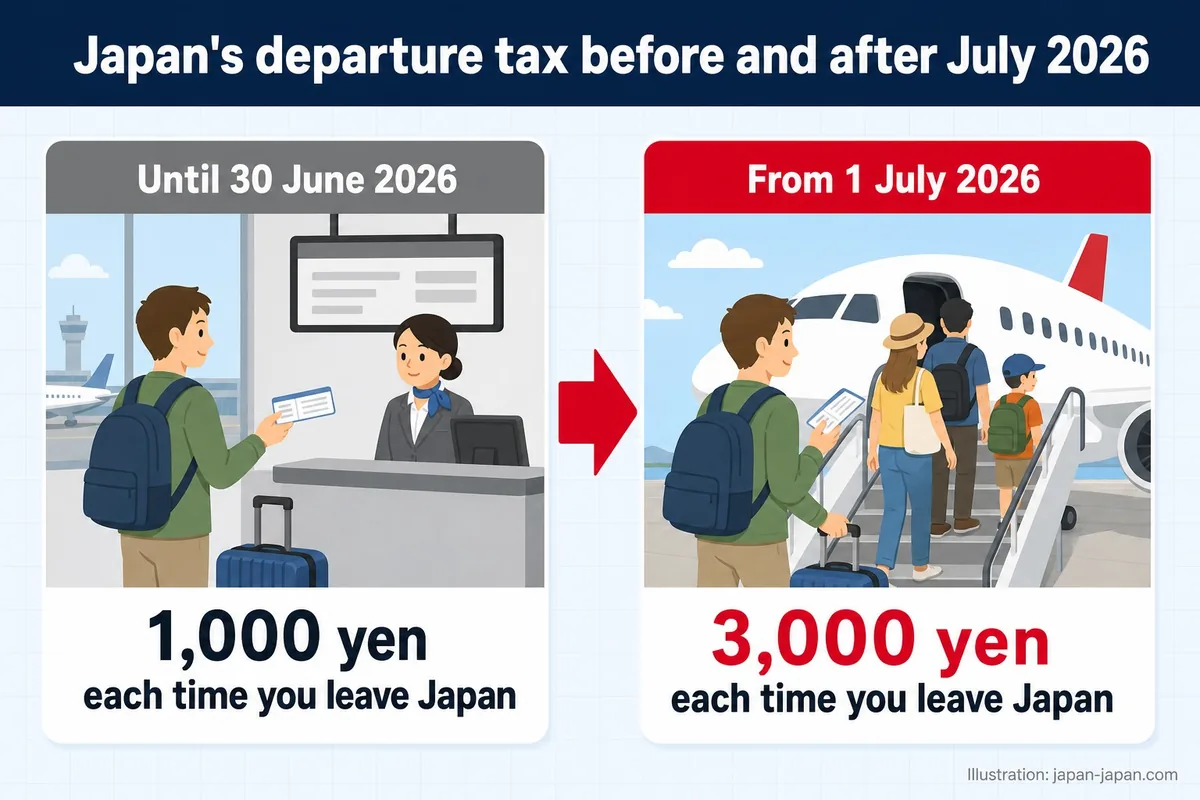
The illustration sets the two periods side by side. Until 30 June 2026 each departure cost 1,000 yen. From 1 July 2026 each departure costs 3,000 yen. In both periods the tax sits inside the price of your plane or ship ticket.
The Japan Tourism Agency published a leaflet in five languages for people leaving Japan. Its English title is The International Tourist Tax will be increased to JPY 3,000. The same page links the Japanese, simplified Chinese, traditional Chinese and Korean versions.
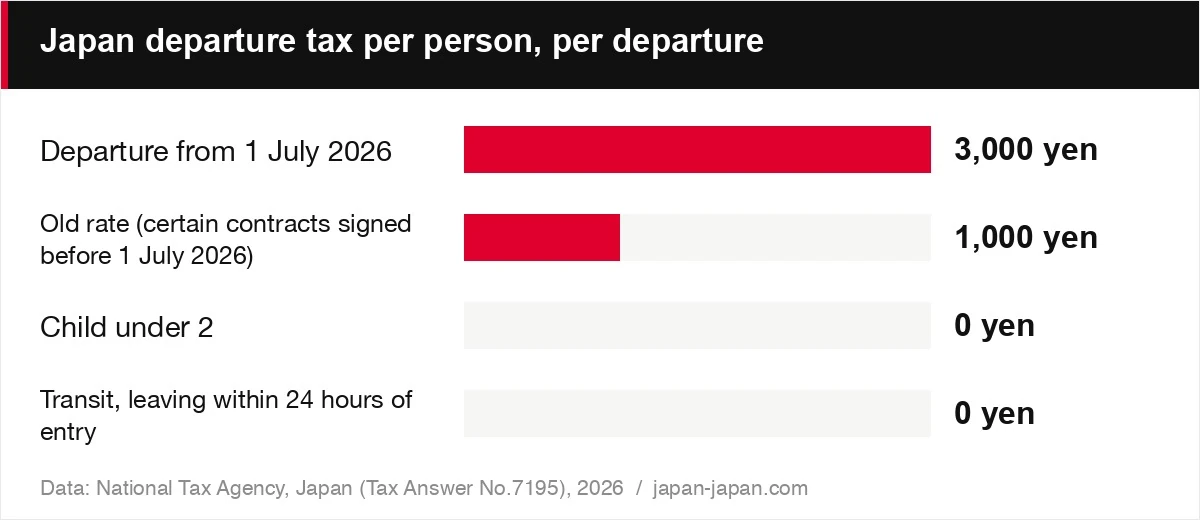
| Item | Value | Note |
|---|---|---|
| Departure from 1 July 2026 | 3000 yen | |
| Old rate (certain contracts signed before 1 July 2026) | 1000 yen | |
| Child under 2 | 0 yen | Exempt |
| Transit, leaving within 24 hours of entry | 0 yen | Exempt |
The chart compares what one traveller pays in four common cases. A departure under the new rate costs 3,000 yen. A departure that still qualifies for the old rate costs 1,000 yen. A child under 2 and a transit passenger leaving within 24 hours pay 0 yen.
For a family the sum grows quickly. Take two adults and one child aged 3 flying home after 1 July 2026. Each of the 3 travellers pays 3,000 yen. A baby under 2 travelling with them pays nothing. Under the old rate the same three people paid 1,000 yen each, so the increase adds 2,000 yen per person.
Japan departure tax increase: which rate applies to your ticket
The general rule is simple. If you leave Japan on or after 1 July 2026, the rate is 3,000 yen. The National Tax Agency lists one exception: for certain transport contracts signed before 1 July 2026, a departure on or after that date still uses the 1,000 yen rate.
In plain terms, the date you bought the ticket can matter as much as the date you fly. A ticket bought well before the change may carry the old rate. A ticket bought after it always carries the new one.
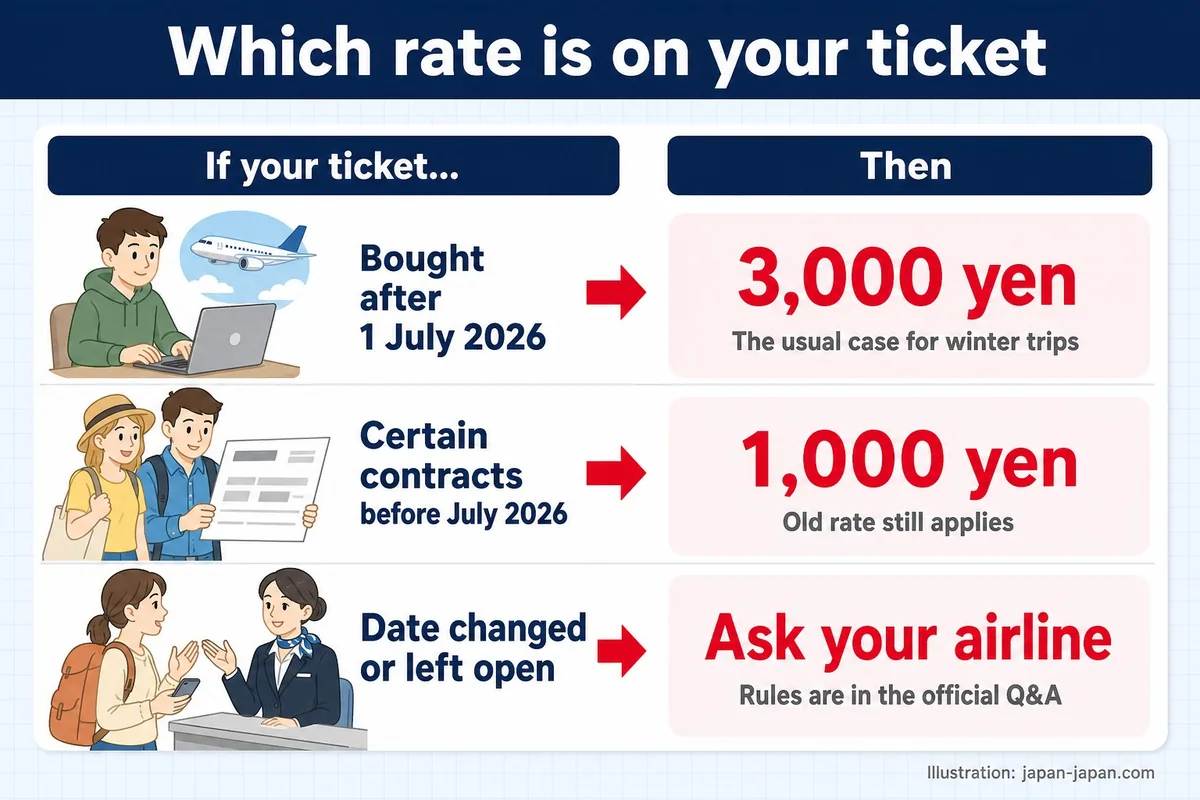
The lookup chart above walks through the common cases. Use it as a first check, then confirm with your airline. The exact conditions for the old rate are set out in the National Tax Agency Q&A on the tax rate revision.
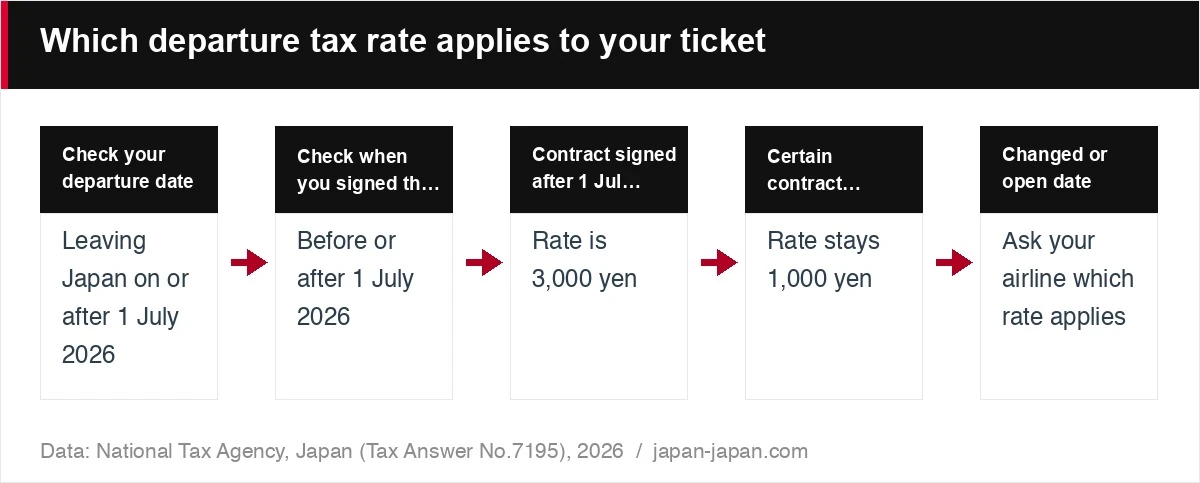
The flow chart shows the same decision as a set of steps. Start with the day you leave Japan. Then look at when you signed the contract for that trip. Then check how the airline handles the tax on your booking.
For winter trips the answer is almost always 3,000 yen. Most people flying in December or February book their tickets well after 1 July 2026. Their tickets fall under the new rate from the start.
Some cases need a closer look:
- You bought an open-date ticket before July 2026. Ask the airline whether your contract counts as one that keeps the old rate.
- You changed your travel date after 1 July 2026. Ask the airline whether the change creates a new contract and a new tax amount.
- You booked through a travel agent. Ask the agent for the tax line on your receipt or e-ticket.
When you ask, give the Japanese name of the tax. Say or show: 国際観光旅客税 (kokusai kanko ryokyaku zei), which means international tourist tax. Airline staff in Japan will know the term at once.
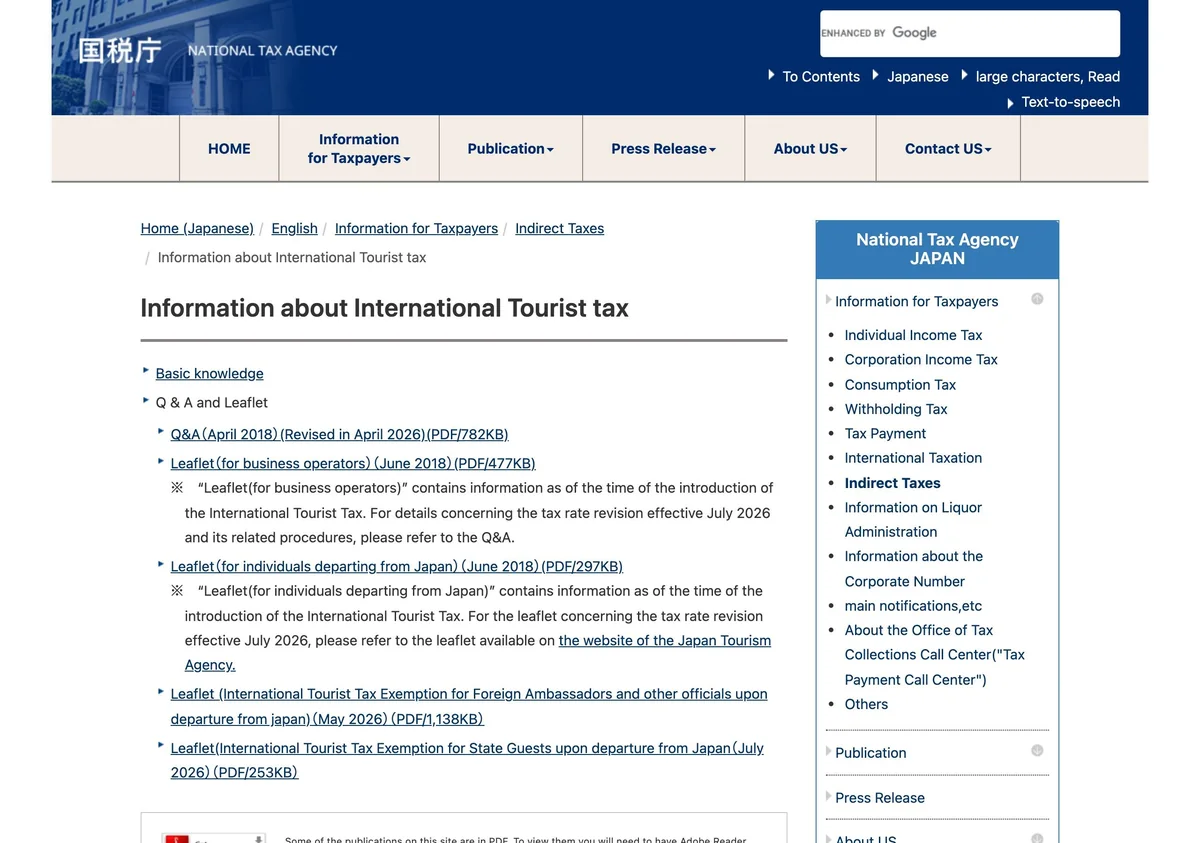
The screenshot shows the National Tax Agency English page on the tax. It lists a Q&A from April 2018, revised in April 2026, and notes that the older leaflets date from the start of the tax. For the July 2026 revision, the page points you to the Q&A and to the Japan Tourism Agency leaflet.
Who pays and who is exempt
The tax applies to passengers who leave Japan by ship or aircraft. The National Tax Agency says the purpose of the trip does not matter. Tourists pay it, and so do people travelling for business, official duties, work, study or medical care.
Nationality does not matter either. The tax covers anyone who must go through departure procedures under Japan’s immigration law. That includes Japanese citizens heading abroad and foreign visitors flying home.
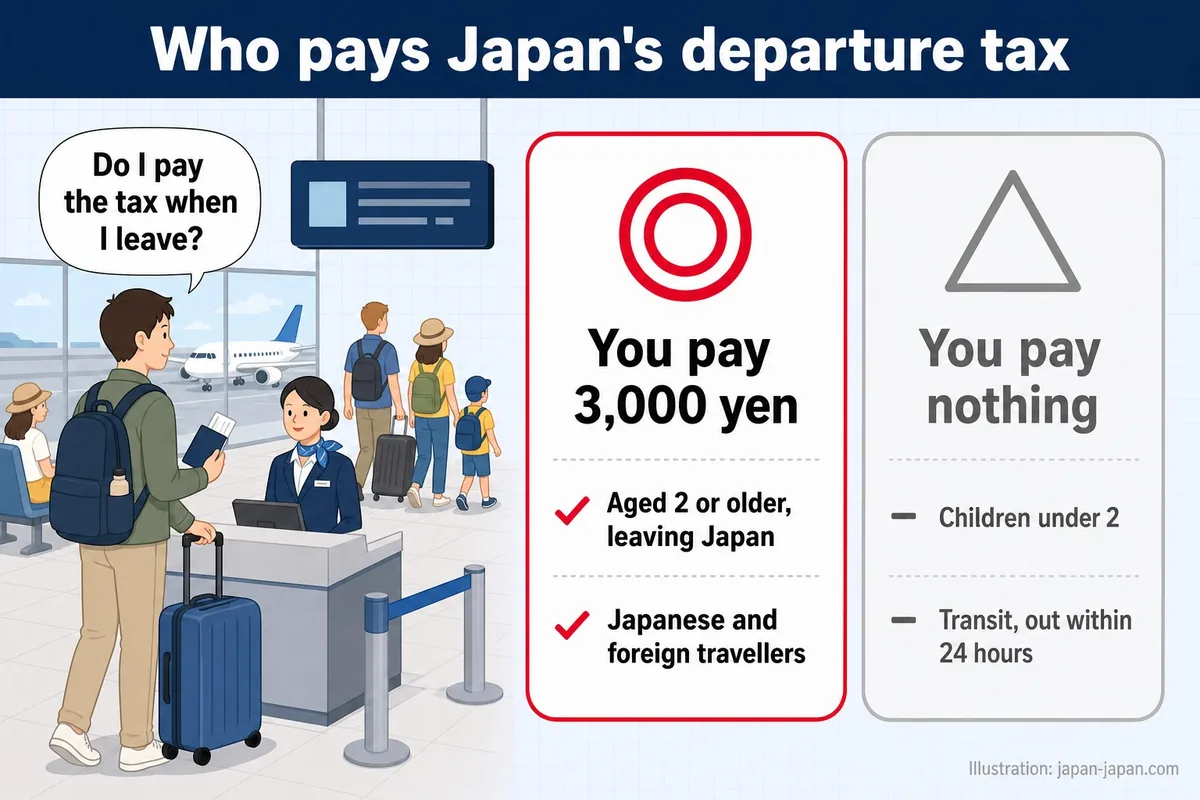
The illustration splits travellers into two groups. On one side are people who pay: departing passengers aged 2 or older, Japanese or foreign. On the other side are the main groups who do not: children under 2, transit passengers leaving within 24 hours of entry, and crew.
| Traveller | Pays the tax? | Rule |
|---|---|---|
| Adult leaving Japan (any nationality) | Yes, 3,000 yen | Passenger leaving by ship or aircraft |
| Child aged 2 or older | Yes, 3,000 yen | Same rate as an adult |
| Child under 2 | No | Under-2 exemption |
| Transit passenger leaving within 24 hours of entry | No | Transit exemption |
| Ship or aircraft crew | No | Crew exemption |
| Passenger who returned to Japan because of weather | No | Unavoidable return |
| Diplomats and consular officials (official business) | No | Official exemption |
| Passenger leaving on a private jet | Yes, paid at customs | Direct payment by the passenger |
The table lists the full set of exemptions in the official summary. Ten groups do not pay:
- Crew of ships or aircraft.
- People removed from Japan by deportation and similar orders.
- People leaving on government aircraft or ships.
- People who left Japan but came back because of weather or another unavoidable reason, without stopping in another country.
- Transit passengers who leave within 24 hours of entering Japan.
- People on international ships or aircraft that stopped in Japan because of weather or another unavoidable reason.
- Children under 2.
- Diplomats and consular officials posted to Japan, on official business.
- State guests and people treated in the same way.
- Members of the US forces and UN forces, on official business.
For most visitors only two of these matter: the under-2 rule and the 24-hour transit rule. A baby flying home with you pays no tax. A traveller who lands at Haneda Airport and leaves on another flight within 24 hours of entry also pays nothing.
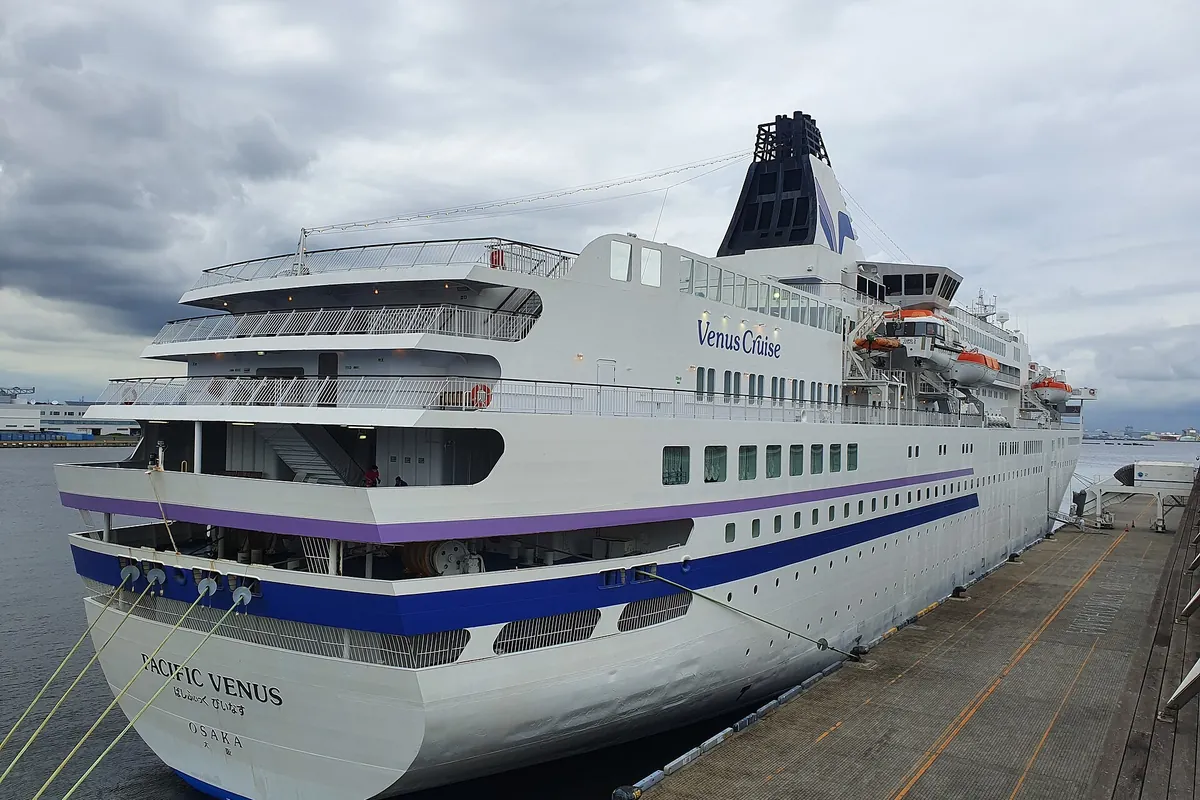
Cruise passengers are covered by the same law, because the tax applies to departures by ship. The photo shows the Osanbashi passenger terminal in Yokohama, where large cruise ships dock. Our guide to connecting flights and cruises explains the separate tax-free shopping rules for ship passengers.
One more case catches people out. If you fly from abroad, change planes in Japan and continue abroad, you count as a taxable passenger in principle. The exception is a trip where the airport before Japan and the airport after Japan are the same, such as a round trip that only touches Japan on the way.
How the tax is collected by airlines and cruises
The law makes the carrier the tax collector. An international passenger carrier, airline or shipping company, must collect the tax from you by the time you board. It then pays the tax to a tax office or to customs on your behalf.
The usual method is to add the tax to the ticket price. That is why you will rarely see a separate charge at the airport. When you book, the fare breakdown on the airline site or your receipt normally lists taxes and fees, and the departure tax is one of them.

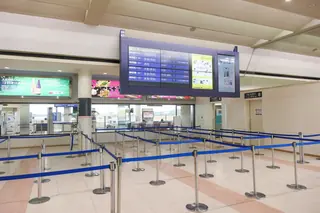
The photo shows the departure hall at Haneda Airport Terminal 3, the international terminal in Tokyo. Passengers here have paid the tax through their tickets before they reach the counter. Japan’s two biggest carriers, JAL and ANA, both collect it this way on flights out of Japan.
Foreign airlines flying out of Japan do the same. Our airline guide lists the carriers that fly to Japan, with baggage rules for each one. The departure tax is the same 3,000 yen whichever airline you choose.
There is one exception to carrier collection. If you leave Japan on a private jet, no airline collects the tax for you. You must pay it yourself at the customs office for the port or airport you leave from, before you board.
Here is how the process looks for an ordinary traveller:
- You book a flight or cruise that leaves Japan.
- The carrier adds the departure tax to your ticket price.
- You pay the full amount when you buy the ticket.
- The carrier pays the tax to the government.
- At the airport or port you check in as usual, with nothing extra to pay.
Where the 3,000 yen goes
The Japan Tourism Agency says the revenue goes to three areas:
- Building a stress-free, comfortable environment for travel.
- Making it easier to find information about Japan’s many attractions.
- Developing tourism resources based on each region’s own culture and nature.
The agency also links the money to overtourism. It plans to use the tax to help each region act steadily and to a plan. The measures it names include work on heavy crowding and bad manners, and the groundwork needed to spread visitors across more regions.
The agency describes these as steps to prevent and curb overtourism, and it plans to strengthen them and roll them out across the country. So part of the higher rate is aimed at the crowded spots that many visitors already know.
For you as a traveller, the use of the money is out of your hands. The amount you pay does not change with where you went or how long you stayed. It is a flat 3,000 yen each time you leave.
Other costs when you leave Japan
The departure tax is only one item on the way out. If you shopped tax-free, plan time for the customs check at the airport. Our page on the tax-free customs check at the airport explains the steps.
You do this check in the international departure lobby, before you check in your bags. You scan your passport at a tax-free procedure terminal, and the screen shows the result in a few seconds. A green result means you are finished. A red result means a customs officer inspects the goods.

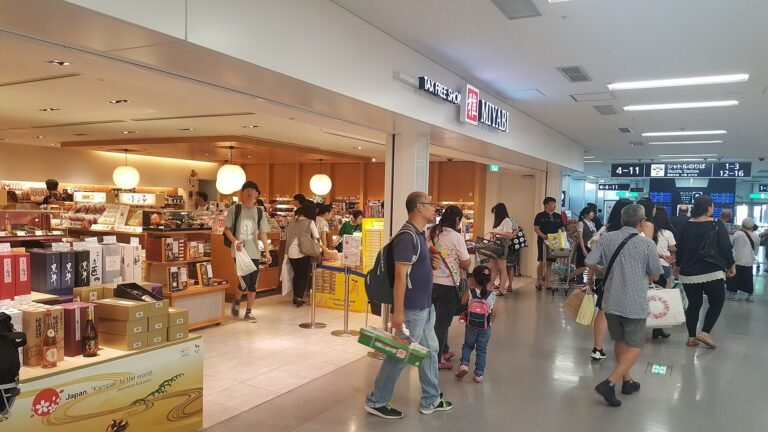
The photo shows Kansai Airport, near Osaka. It is one of 7 airports where you can also use Visit Japan Web for the tax-free check, along with Narita, Haneda, Chubu, Fukuoka, New Chitose and Naha. The full rules for shoppers are in our guide to tax-free shopping in Japan.
Timing matters too. Holidays in Japan change how busy airports and trains are. Check our New Year holiday calendar before you pick a flight date, and leave extra time for check-in and the tax-free check.
None of these steps involve paying the departure tax again. That money is already inside your ticket. At the airport you only deal with your bags, security, passport control and any tax-free goods.
FAQ
Do I have to pay the Japan departure tax at the airport?
No. The airline or cruise line collects it by the time you board, usually as part of the ticket price. The only travellers who pay it themselves are people leaving on a private jet, who pay at customs.
Does a baby or child pay the 3,000 yen departure tax?
Children under 2 are exempt and pay nothing. A child aged 2 or older pays the same 3,000 yen as an adult for each departure from 1 July 2026.
I bought my ticket before 1 July 2026. Which rate do I pay?
It depends on your contract. For certain transport contracts signed before 1 July 2026, a departure on or after that date still uses the 1,000 yen rate. Ask your airline which rate is on your ticket, especially if you changed the date.
Do transit passengers pay Japan’s departure tax?
Transit passengers who leave Japan within 24 hours of entering are exempt. If you stay longer than 24 hours, you pay 3,000 yen when you leave. A change of planes is also taxable in principle, unless the airport before and after Japan is the same.
About the author

Photo: Departure lobby of Tokyo-Narita Airport Terminal 2.JPG by Nanashinodensyaku (CC BY-SA 4.0, cropped), via Wikimedia Commons.


.jpg)
