Does Japan Celebrate Lunar New Year? 2027’s Busiest Days
Japan celebrates its own New Year on 1 January, with shrine visits and closed banks. Our guide to New Year in Japan explains how that works. In February 2027 the bigger change is the crowd. Visitors from Taiwan, Hong Kong and Korea arrive in the same week. Lunar New Year events run in Nagasaki, Kobe and Yokohama, and the Sapporo Snow Festival falls in the same days.
The calendar below lines up every holiday and event from 4 to 23 February 2027. Read across a row to see what is on while you are off work.
| Date | Taiwan / Hong Kong / Korea | Japan holiday | Events in Japan |
|---|---|---|---|
| Thu 4 Feb | Taiwan break starts | – | Sapporo Snow Festival opens |
| Fri 5 Feb | Taiwan off | – | Nagasaki Lantern Festival opens |
| Sat 6 Feb | New Year’s Day in Taiwan and Hong Kong; Korea break starts | – | Snow Festival, lanterns |
| Sun 7 Feb | Seollal in Korea; all three off | – | Nankinmachi day 1, Mazu procession |
| Mon 8 – Tue 9 Feb | All three off | – | Snow Festival, lanterns |
| Wed 10 Feb | Taiwan break ends | – | Snow Festival, lanterns |
| Thu 11 Feb | – | National Foundation Day | Snow Festival last day, Nankinmachi |
| Sat 13 – Sun 14 Feb | – | – | Nankinmachi, Emperor’s Parade (13), Mazu procession (14) |
| Sat 20 – Sun 21 Feb | Jeongwol Daeboreum in Korea (21) | – | Emperor’s Parade (20), lanterns end (21) |
| Tue 23 Feb | – | Emperor’s Birthday | – |
2027 Lunar New Year holidays in Taiwan, Hong Kong and Korea
All three governments have already fixed their 2027 dates. We checked on 16 October 2026 that each official page still shows the dates below.
Taiwan: 7 days, 4 to 10 February
Taiwan’s Directorate-General of Personnel Administration announced the 2027 calendar on 21 May 2026. The DGPA Taiwan 2027 government office calendar announcement gives a 7-day Lunar New Year block, from Thursday 4 February to Wednesday 10 February. The first and second days of the lunar year, 6 and 7 February, fall on a Saturday and Sunday. So Taiwan gives substitute days off on Tuesday 9 and Wednesday 10 February.
This calendar covers government employees. Private companies follow the Labor Standards Act under the Ministry of Labor, so your own office or shop may set different days. Ask your employer before you book a 7-day trip.
Hong Kong: 6, 8 and 9 February
The GovHK general holidays for 2027 page lists Lunar New Year’s Day on Saturday 6 February. The third day is a holiday on Monday 8 February and the fourth day on Tuesday 9 February. The government explains why the fourth day is off: the second day falls on Sunday 7 February, so the fourth day replaces it. With Sunday 7 February, that makes 4 days in a row for anyone who gets the general holidays.
Korea: 4 days, 6 to 9 February
Korea’s 설날 (Seollal) falls on Sunday 7 February 2027, one day later than in Taiwan and Hong Kong. The Korea AeroSpace Administration 2027 calendar standard announcement, published on 29 June 2026, lists a 4-day break from Saturday 6 to Tuesday 9 February. That block counts the Saturday, Seollal and its holidays, and one substitute holiday. Jeongwol Daeboreum, the first full moon of the lunar year, falls on Sunday 21 February.
The picture below puts the three breaks side by side, so you can compare the number of days and the start date.

Is Lunar New Year a holiday in Japan?
No. The Cabinet Office national holidays list has no Lunar New Year day. February 2027 has two national holidays: National Foundation Day on Thursday 11 February and the Emperor’s Birthday on Tuesday 23 February. Our February public holidays page shows both days for 2026 and 2027. February 2027 has no three-day weekend at all.
Japan has 17 days off in 2027, and you can see every one on our Japan public holidays 2027 calendar. For long weekends and the busiest travel days across the year, start from the public holidays hub.
Where can you see Lunar New Year in Japan? In the Chinese communities of Nagasaki, Kobe and Yokohama. Nagasaki turns its old Chinese New Year festival into 17 days of lanterns. Kobe’s Nankinmachi holds a 春節祭 (shunsetsu-sai, “Spring Festival celebration”) with lion dances. Yokohama Chinatown has held its own Chunjie since 1986. Look for the characters 春節祭 on posters and street banners.
You can watch this kind of show in Nagasaki every day of the festival.
Why Kobe’s new year starts one day later
Kobe’s Nankinmachi opens its festival on Sunday 7 February 2027. That is lunar New Year’s Day on the Japanese calendar. China’s 2027 Lunar New Year falls on 6 February. Nankinmachi explains the gap: a new lunar month starts on the day of the new moon, and Japan is one hour ahead of China. When the new moon falls just after midnight in Japan, the dates split.
What overlaps in February 2027 and the busiest days
Japan’s events line up closely with the three breaks. Here is what each holiday block covers, based on the official dates.
- Sapporo Snow Festival (4-11 February): all 7 days of Taiwan’s break and all 4 days of Korea’s break.
- Nagasaki Lantern Festival (5-21 February): 6 of Taiwan’s 7 days (5-10 February) and all 4 of Korea’s.
- Hong Kong’s 6, 8 and 9 February: all three fall inside Taiwan’s break and inside both festivals.
- Kobe Nankinmachi (7 and 11-14 February): includes the Japanese holiday on 11 February and the weekend of 13-14 February.
Taiwan’s break ends on Wednesday 10 February, the day before Japan’s National Foundation Day. The picture below sorts the overlaps by the holiday you have.
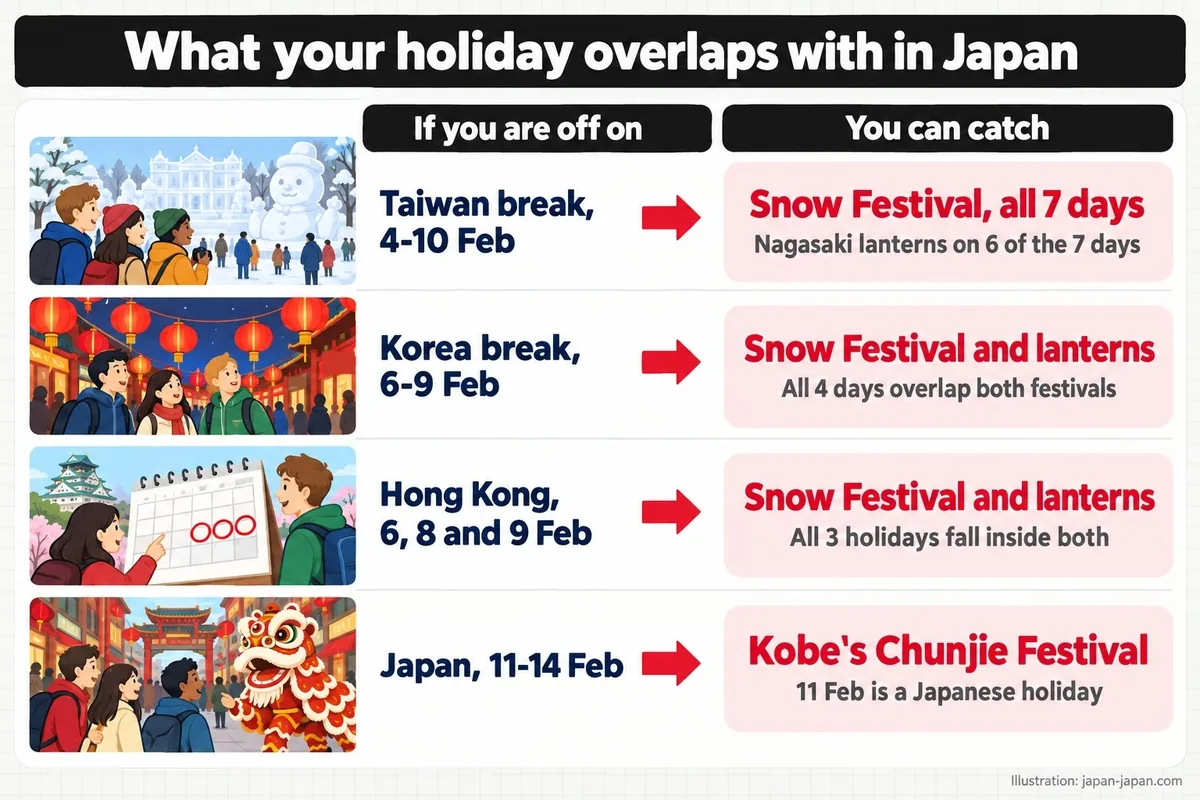
The busiest days
Judging by the dates alone, three windows stand out.
- Saturday 6 to Tuesday 9 February: Taiwan, Hong Kong and Korea are all off at once. Both festivals are running.
- Thursday 11 February: National Foundation Day, so Japanese families travel too. It is also the last day of the Snow Festival.
- Saturday 13 and Sunday 14 February: a weekend with Nankinmachi’s festival days and Nagasaki’s Emperor’s Parade on 13 February.
If you can choose, go after Sunday 14 February. From Monday 15 February no Taiwan, Hong Kong or Korea holiday overlaps until Japan’s Emperor’s Birthday on 23 February.
Sapporo Snow Festival 2027
The Sapporo Snow Festival 2027 dates announcement sets the 77th festival for Thursday 4 to Thursday 11 February, 8 days. The festival has three sites. Odori runs from West 1-chome to West 11-chome, with five large snow sculptures at its centre. Tsudome is the city’s sports hall, and Susukino spreads along Ekimae-dori from South 4 to South 6. A linked event, Sapporo Snow Sports Park 2027, follows at Daiwa House Premist Dome from 12 to 14 February.
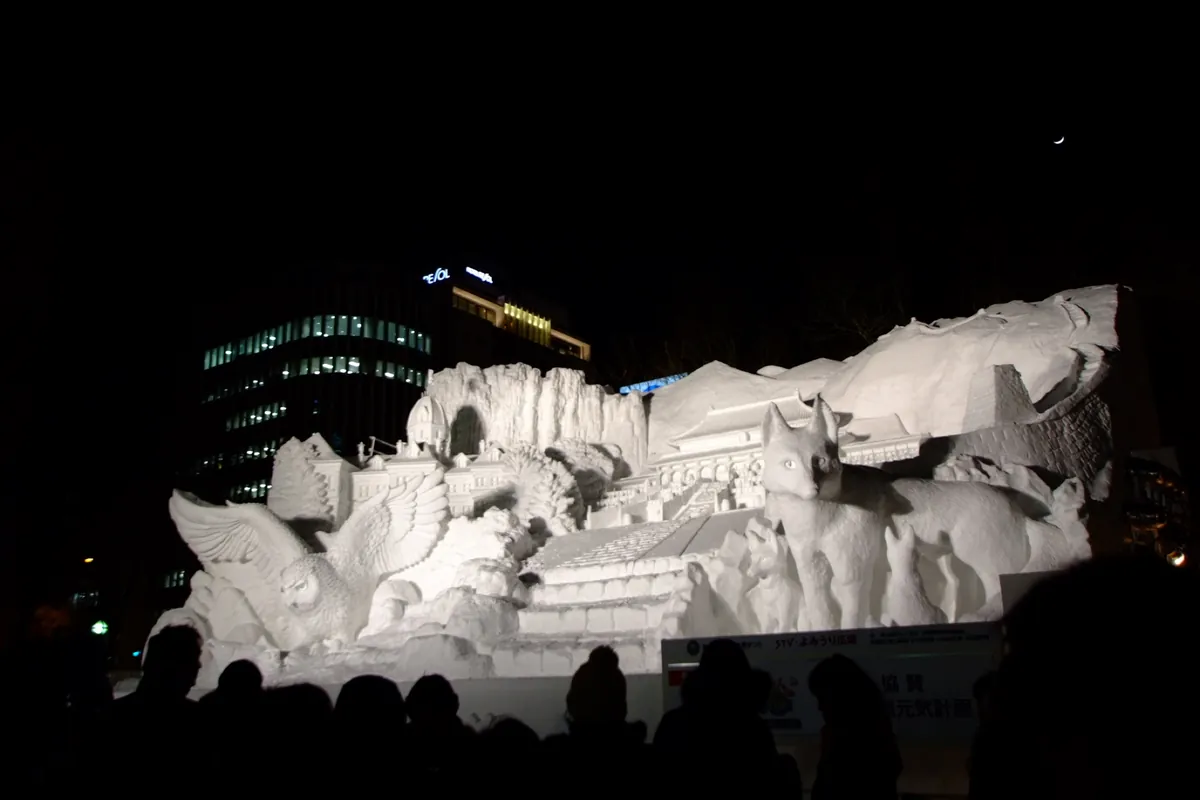
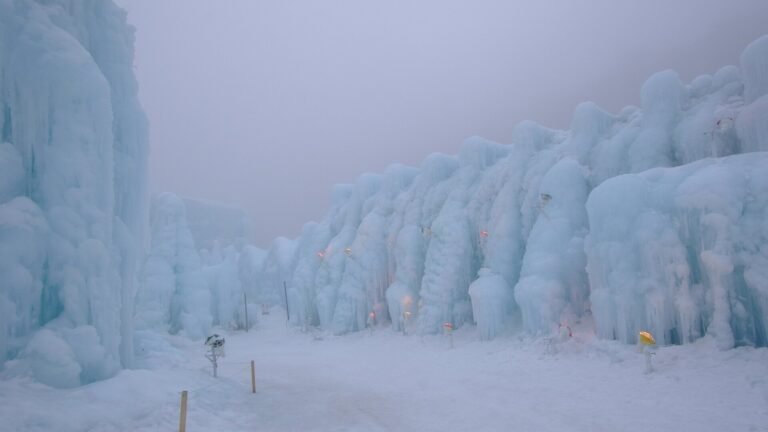
The large sculptures in the photo stand in Odori Park and are lit after dark. For site hours, transport and clothing, read our Sapporo Snow Festival 2027 guide and the Sapporo in February page. From Osaka, flights from Itami to New Chitose take 1 h 45 min, with 10 a day on our Osaka to Sapporo route page.
Nagasaki Lantern Festival 2027: dates and events
The 2027 Nagasaki Lantern Festival runs from Friday 5 to Sunday 21 February, 17 days. The organisers announced the dates on 21 May 2026. The festival grew out of the Spring Festival that Nagasaki Shinchi Chinatown held for Chinese New Year. Today about 15,000 Chinese lanterns light central Nagasaki, from Chinatown to the Hamanmachi and Kanko-dori arcades.
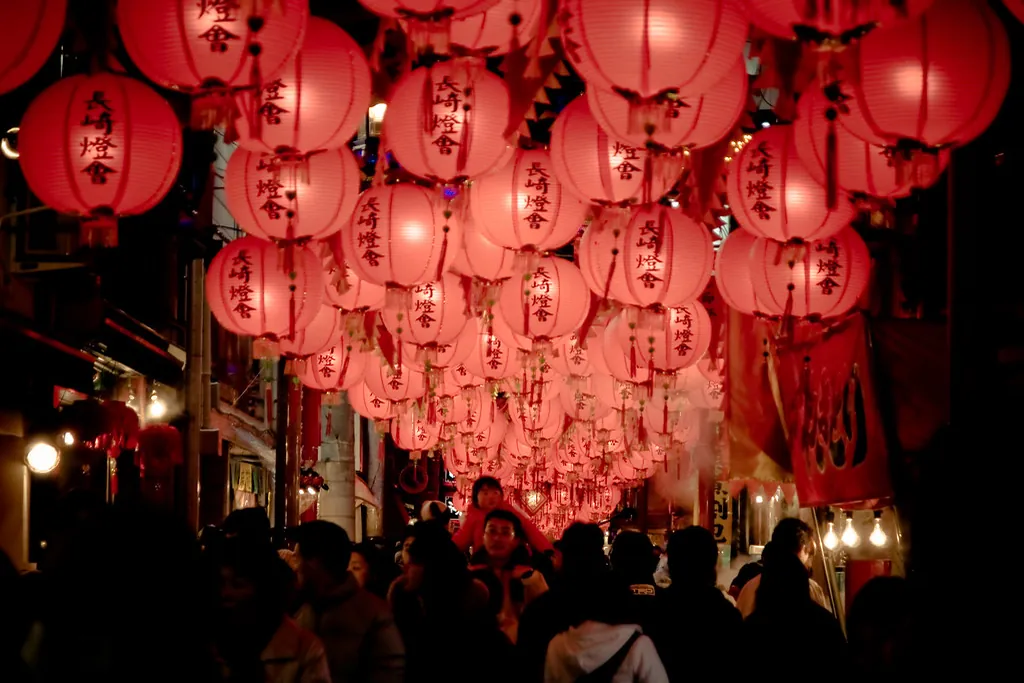
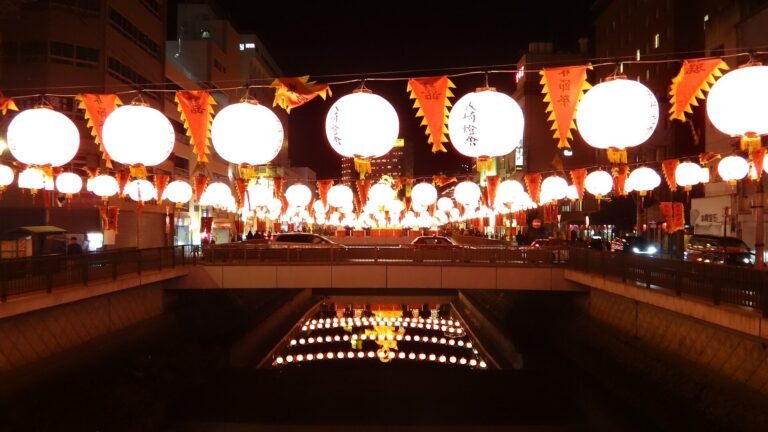
The photo shows rows of red lanterns at night, the scene you get on any evening of the festival. The Nagasaki Tabinet 2027 Lantern Festival page gives the lighting times. Lanterns glow from 17:00 to 22:00 each night. Shinchi Chinatown and Hamanmachi switch on from 12:00, so you can see colour by day there. The opening lighting ceremony starts at 18:00.
Events and dates
The Travel Nagasaki Lantern Festival page lists the 2027 programme. The Emperor’s Parade on Saturday 13 and Saturday 20 February re-creates a Qing-era emperor and empress greeting the New Year with their people. About 150 people in Chinese costume walk with the royal palanquins and a flag squad.
The Mazu procession, on Sunday 7 and Sunday 14 February, re-creates a walk by Chinese sailors in the Edo period. They carried the sea goddess Mazu to a temple shrine for safe voyages. The dragon dance runs every day, with performers moving a dragon body about 20 metres long. The largest festival objects stand about 10 metres tall.
| Event | Dates in 2027 | Time or note |
|---|---|---|
| Lantern lighting | Every night, 5-21 Feb | 17:00-22:00 |
| Shinchi Chinatown and Hamanmachi | Every day | Lit from 12:00 |
| Opening lighting ceremony | Fri 5 Feb | 18:00 |
| Mazu procession | Sun 7 and Sun 14 Feb | Re-creates Chinese sailors’ walk |
| Emperor’s Parade | Sat 13 and Sat 20 Feb | About 150 people in costume |
| Dragon dance | Every day | Dragon body about 20 m |
| Confucius Shrine | Every day | 9:30-18:00, last entry 17:30 |
The Mazu procession on 7 February falls inside the Taiwan, Hong Kong and Korea holidays. Both Emperor’s Parades come after all three breaks have ended. If the parade matters most to you, plan for 13 or 20 February.
Venues, prices and the Confucius Shrine
Each venue has its own lantern colour. Lanterns near Megane Bridge are yellow, and those along the Doza River are pink. Chuo Park has many animal objects plus play equipment and benches, and the official portal recommends it for families with children. At the Bernard Kanko-dori Arcade, a special “red thread” charm for finding love costs 100 yen.
Nagasaki Confucius Shrine opens from 9:30 to 18:00 during the festival, with last entry at 17:30. Entry costs extra: 880 yen for adults, 550 yen for high school students and 440 yen for elementary and junior high students. Inside, you can visit the decorated main hall for a Lunar New Year prayer. For questions, call the Nagasaki City Call Center (Ajisai Call) on 095-822-8888.
| Place | Nagasaki Lantern Festival |
|---|---|
| Price | Lantern venues: no fee listed. Confucius Shrine: adults 880 yen, high school 550 yen, elementary and junior high 440 yen |
| Hours | 5-21 February 2027. Lanterns lit 17:00-22:00; Shinchi Chinatown and Hamanmachi from 12:00 |
| Access | Venues across central Nagasaki: Shinchi Chinatown, Kanko-dori Arcade, Chuo Park and more |
| Official site | Travel Nagasaki Lantern Festival page |
To get there, our Tokyo to Nagasaki route page lists flights from Haneda at 1 h 50 min, 15 a day. From Shin-Osaka, the Sakura, the Relay Kamome and the Kamome take 3 h 59 min on our Osaka to Nagasaki route page. If you fly in, see Nagasaki Airport to Nagasaki Station for the airport bus. Other February events in the city are on our Nagasaki in February page.
Kobe Nankinmachi Chunjie Festival and Yokohama Chinatown
The 2027 festival runs on Sunday 7 February and from Thursday 11 to Sunday 14 February. That makes 5 days in total. Nankinmachi has announced the dates only. The programme changes from day to day and is not announced yet. Nankinmachi has held this festival since 1987.
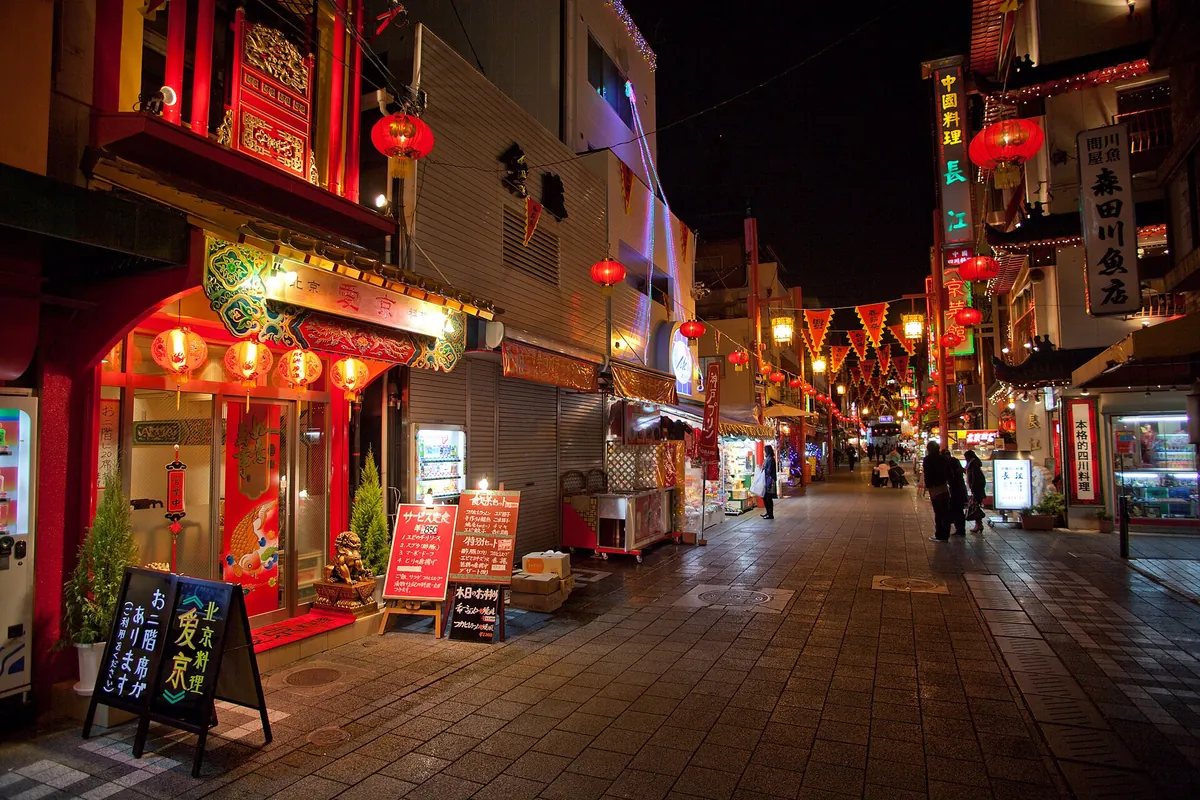
The photo shows the main street of Nankinmachi hung with red lanterns. The Kobe Nankinmachi 2027 Chunjie festival dates notice gives the days, and the Kobe Nankinmachi Chunjie festival page gives the way in.
- JR or Hanshin Motomachi Station: about 5 minutes on foot, heading south.
- Hankyu Kobe-Sannomiya Station: about 10 minutes on foot, heading southwest.
- Kyu-Kyoryuchi-Daimaru-mae Station (Kaigan Line): about 2 minutes on foot, heading west.
Nearby car parks fill up during the festival, and Nankinmachi asks visitors to come by train. From Osaka, the JR Special Rapid reaches Kobe in 21 minutes on our Osaka to Kobe route page.
What the 2026 festival looked like
In 2026, the festival ran from 17 to 23 February, with stage shows in Nankinmachi Square. The 2026 programme had face-changing opera and acrobatics on New Year’s Day, 17 February. A dragon parade started at 16:00 that day from the Motomachi shopping street. Lion dancers visited shops on 21 to 23 February, and the Guan Yu altar charged 200 yen for an incense stick. Schedules can change or stop without notice in bad weather. More Kobe events are on our Kobe in February page.
Yokohama Chinatown: dates for 2027 still to come
Yokohama Chinatown has not announced its 2027 schedule. In 2026, its 40th Chunjie started with a countdown at Yamashita-cho Park around midnight before the 17 February new year. The Shukumai Yuko parade set off at 16:30 on Saturday 21 February 2026. Stage shows with lion dances, dragon dances and acrobatics followed on 22 and 23 February. Front seats were paid and the back rows free.
In 2026, Yokohama’s events were called off if it rained, and the association asked visitors to check its official X account before going. See our Yokohama in February page for the month’s other events.
Japan weather in February: what to pack
Japan weather in February is cold, yet Tokyo, Osaka, Nagasaki and Fukuoka stay mostly above freezing. Daily means run from 6.1°C in Tokyo to 8.1°C in Nagasaki. Sapporo is the exception, with a mean of -2.7°C and deep snow.
These figures are the Japan Meteorological Agency’s 1991-2020 normals, the same numbers our monthly city guides use.
- Tokyo: mean 6.1°C, high 10.9°C, low 2.1°C, rainfall 56.5 mm.
- Osaka: mean 6.6°C, high 10.5°C, low 3.2°C, rainfall 60.5 mm.
- Nagasaki: mean 8.1°C, high 12.0°C, low 4.5°C, rainfall 84.0 mm.
- Fukuoka: mean 7.8°C, high 11.6°C, low 4.4°C, rainfall 69.8 mm.
- Sapporo: mean -2.7°C, high 0.4°C, low -6.2°C.
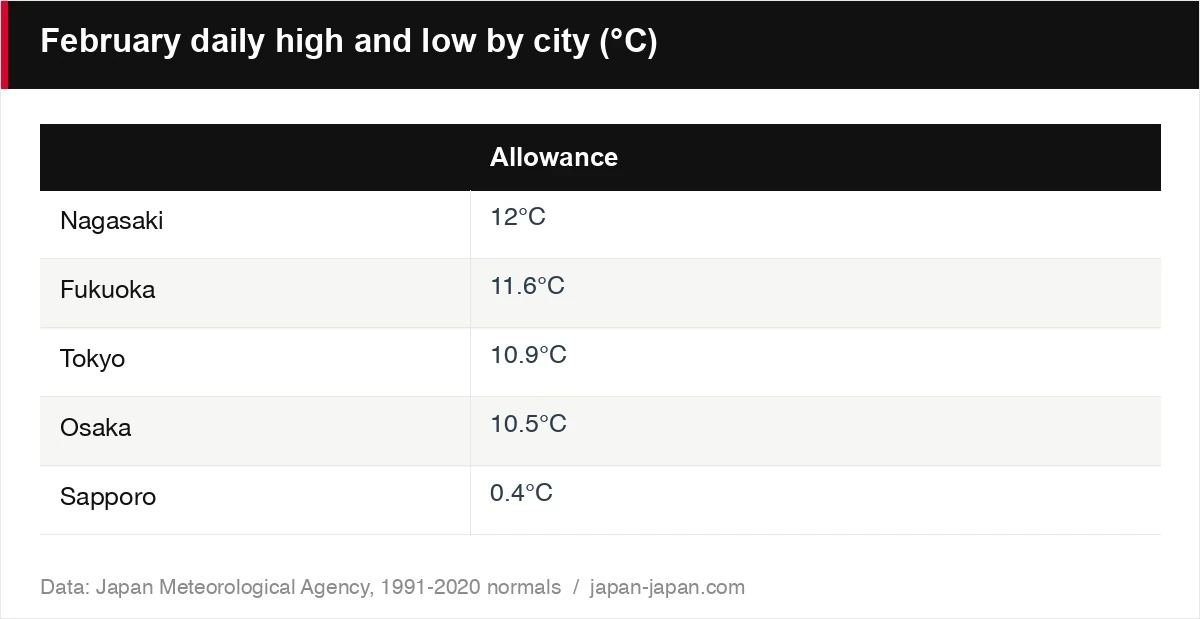
| Item | Value | Note |
|---|---|---|
| Nagasaki | 12 °C | Low 4.5°C |
| Fukuoka | 11.6 °C | Low 4.4°C |
| Tokyo | 10.9 °C | Low 2.1°C |
| Osaka | 10.5 °C | Low 3.2°C |
| Sapporo | 0.4 °C | Low -6.2°C |
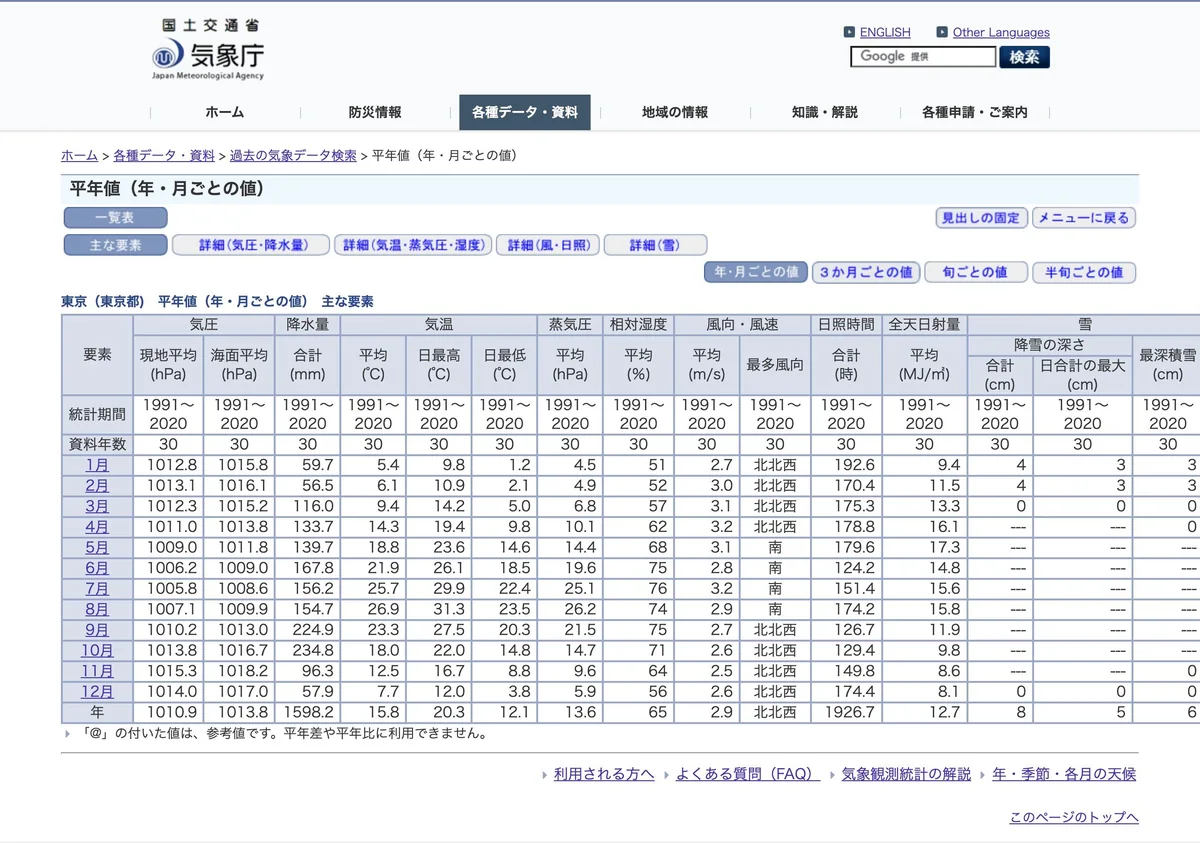
The chart compares the average daily high in each city. Nagasaki is the mildest at 12.0°C, and Sapporo barely rises above zero. The JMA Tokyo climate normals table is the page shown below. Find the 2月 (February) row to read the same figures for Tokyo.
The JMA Sapporo climate normals table shows 116 cm of snowfall in February and a deepest snow cover of 95 cm. Pack for that if you go to the Snow Festival.
- Sapporo: a down coat, gloves, a hat and boots with grip, because lows reach -6.2°C.
- Tokyo and Osaka: a warm coat and layers, as nights drop to 2.1°C in Tokyo.
- Nagasaki and Fukuoka: a coat and a small umbrella, since Nagasaki gets 84.0 mm of rain.
Evening lantern walks in Nagasaki run until 22:00, well after dark, so wear your warmest layer at night. Our Tokyo in February, Osaka in February and Fukuoka in February pages list each city’s events and weather.
Tax-free shopping and departure tax for a February 2027 trip
A February 2027 trip falls under Japan’s new tax-free system. From purchases on 1 November 2026, you pay the tax-inclusive price in the shop. You then get the consumption tax back after customs confirms the export when you leave Japan.
The Japan Tourism Agency tax-free refund method page sets these rules.
- Minimum: 5,000 yen or more (before tax) per day at the same shop.
- Deadline: show your passport at the airport or port kiosk within 90 days of purchase.
- Timing: do the check before you drop your bags, with every item in hand.
- Online option: Narita, Haneda, Kansai, Chubu, Fukuoka, New Chitose and Naha, 7 airports in all, also accept Visit Japan Web in the departure lobby.
- Refund: paid by the shop or its refund company, so ask the shop how it pays.
If you eat the snacks or use the cosmetics before you fly, you cannot claim the refund for them. Tell the customs staff at the counter instead of using the kiosk. For the steps in order, read our tax-free shopping guide and the tax-free refund rules explained.
Japan’s departure tax is 3,000 yen per departure from 1 July 2026, according to the Japan Tourism Agency departure tax leaflet. Tickets issued by 30 June 2026 keep the old rate of 1,000 yen. Children under 2 pay nothing. The airline adds the tax to your ticket price, so you do not file anything. A family of four with one child under 2 pays 9,000 yen in total.
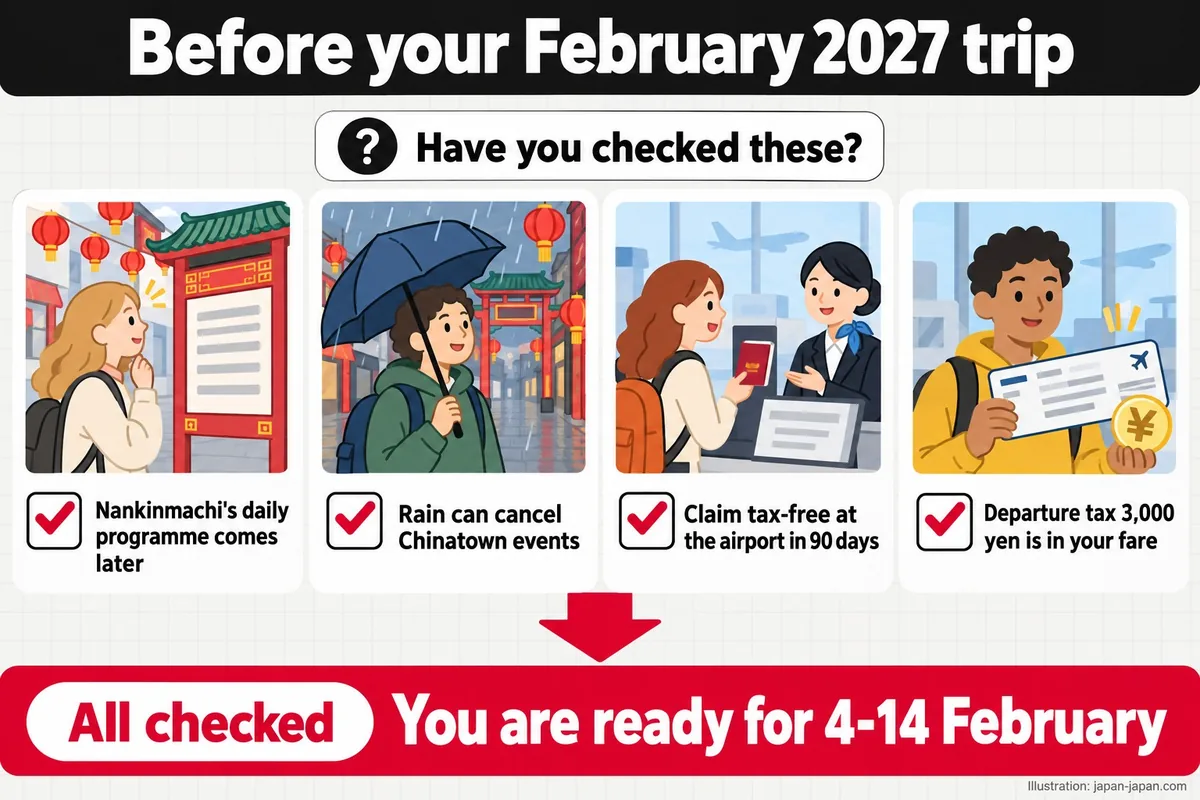
The checklist above covers the festival programmes, rain, the refund deadline and the tax in your fare.
FAQ
Is Lunar New Year celebrated in Japan?
Yes, but only in a few places. Japan follows the solar calendar, and Lunar New Year is not a national holiday. You can join the celebrations at the Nagasaki Lantern Festival (5-21 February 2027), Kobe’s Nankinmachi (7 and 11-14 February 2027) and Yokohama Chinatown.
Is Japan crowded during Lunar New Year?
The busiest days in 2027 should be 6 to 9 February, when Taiwan, Hong Kong and Korea are all on holiday. February is still a quiet month overall: 3,258,491 visitors arrived in Japan in February 2025, the lowest of the 12 months. Expect queues at the Snow Festival sites and on Nagasaki’s lantern streets in the evening.
Is Japan cold during Lunar New Year?
Yes. Tokyo’s February mean is 6.1°C and Osaka’s is 6.6°C, with lows of 2.1°C and 3.2°C. Sapporo averages -2.7°C with 95 cm of snow at its deepest. Bring a warm coat everywhere and snow boots for Hokkaido.
Why is Kobe’s Lunar New Year one day later than China’s?
A new lunar month starts on the day of the new moon, and Japan is one hour ahead of China. In 2027 that puts the lunar New Year’s Day on 7 February in Japan and 6 February in China. Kobe’s Nankinmachi follows the Japanese date, so its festival starts on Sunday 7 February.
About the author