Setsubun in Japan 2027: Where to See Bean-Throwing
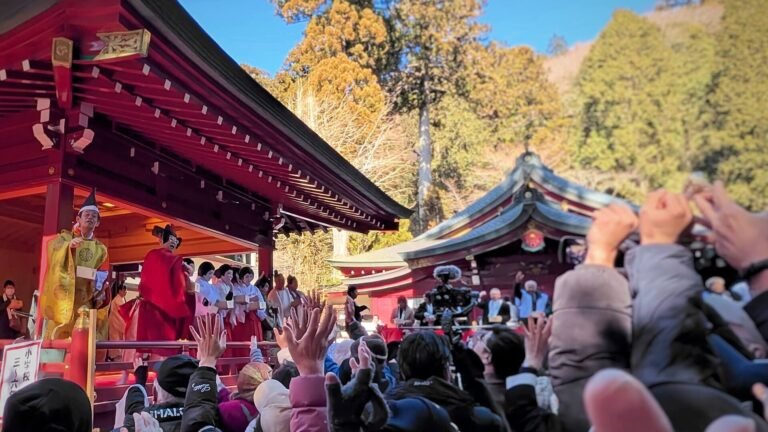
We built this Setsubun guide from pages published by Taito City, the Kyoto City Tourism Association, GO TOKYO and JNTO, plus our own February guides and holiday calendar. Shrines and temples set their times year by year. The times below are the 2026 ones, so use them as a guide for 2027 and check again in late January.
What happens on Setsubun day
The word Setsubun means the division of seasons, according to the Kyoto City Official Travel Guide Setsubun Festival page. Spring was once seen as the start of the year. Its arrival was celebrated much like New Year’s Day, so most Setsubun rituals ward off bad luck and invite good fortune for the year ahead. Each shrine and temple runs the day in its own way.
The core ritual is mamemaki, the scattering of roasted soybeans. At home, people throw beans out of the front entrance. At shrines and temples, they throw them at performers dressed as oni, the demons of Japanese folklore. Everyone shouts the same line as the beans fly.
Listen for 鬼は外、福は内 (Oni wa soto, fuku wa uchi). It means Devils out, fortune in. Taito City in Tokyo writes the line the other way round, 福は内、鬼は外 (Fuku wa uchi, oni wa soto). The city says people have chanted it since around the Muromachi period. They scattered beans to drive off disaster before the new spring.
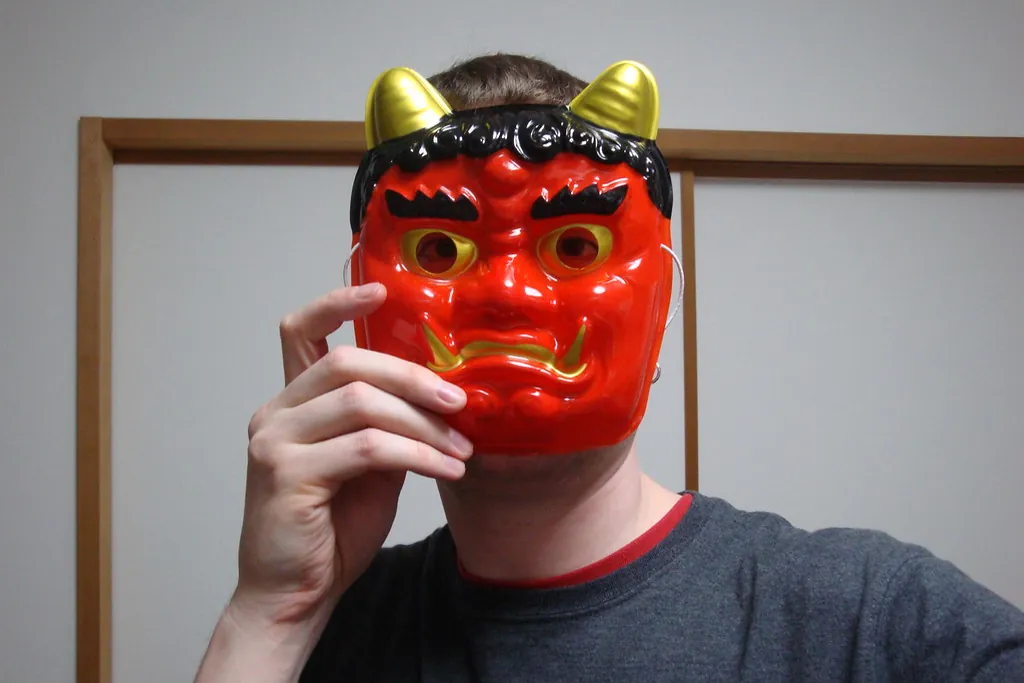
The history goes back a long way. The Kyoto guide says the custom of warding off evil, called yakubarai, reached Japan’s Imperial Court from China in the Heian period (794-1185). Ritual bean-throwing then became popular with ordinary people around the Muromachi period (1336-1573). Oni-yarai, the demon-expelling rite you still see at some shrines, also traces back to Heian court ceremonies.
Why beans? The Kyoto City page on why beans are thrown at Setsubun gives several answers. Japan has long scattered grains, salt and sand to purify places, and soybeans are one of the five grains. A Chinese classic says soybeans kill demon poison. There is wordplay too: mame, beans, sounds like 魔目, the demon’s eyes, and like mametsu, destroying evil. People roast the beans because iru, to roast, sounds like iru, to shoot. Some areas now throw peanuts instead.
The Kyoto travel guide adds a legend from Kibune. In it, an ogre was beaten by beans thrown at its eyes. After the throwing, people eat roasted beans too. The custom is to eat one more bean than your age and wish for a year without illness.
Not every temple shouts the demon half. Senso-ji in Asakusa calls out 千秋万歳、福は内 (Senshu banzei, fuku wa uchi), a wish for lasting fortune, and leaves out Oni wa soto. The Taito City tourism guide Senso-ji Setsubun page explains the reason: there are no demons in front of Kannon, the Buddhist deity of the temple.
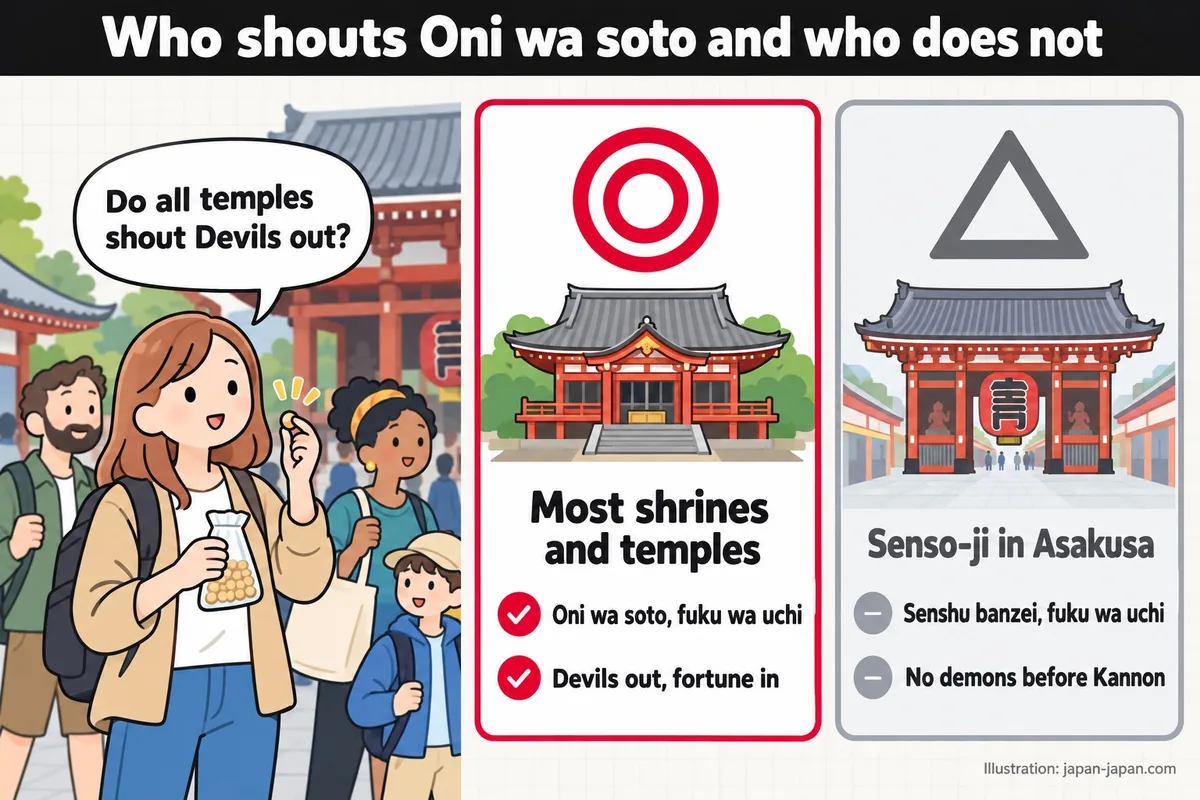
The illustration puts the two versions side by side. At most shrines you shout both halves. At Senso-ji you shout only for good fortune.
Tokyo: Senso-ji, Kanda Myojin and Okunitama
Senso-ji was the first temple in Edo, the old name for Tokyo, to hold Setsubun on a large scale. On the day, toshiotoko scatter lucky beans from the main hall and from a stage on its east side. These are people born in the current zodiac year. You can also get lucky beans at the temple’s amulet counter. The beans thrown by the toshiotoko are the ones the crowd wants, and many visitors come each year to catch them.
After the bean-throwing, the temple performs Fukuju no Mai, the Dance of the Seven Lucky Gods. It is one of the three great dances of Senso-ji. Children from the temple kindergarten and TV entertainers also throw beans in the grounds later on.
To get there, walk about 5 minutes from Asakusa Station on the Tokyo Metro Ginza Line, Toei Asakusa Line, Tobu Skytree Line or Tsukuba Express. Toei buses stop at Nitenmon, about 2 minutes away. From October to March the main hall opens at 6:30 and closes at 17:00. Coming from the airport, our Narita Airport to Asakusa transfer guide compares the ways in.
| Place | Senso-ji |
|---|---|
| Hours | Main hall 6:00-17:00; opens at 6:30 from October to March |
| Access | Asakusa Station (Ginza, Toei Asakusa, Tobu Skytree, Tsukuba Express), about 5 min walk; Nitenmon bus stop, 2 min |
| Official site | Taito City tourism guide Senso-ji Setsubun page |
Other shrines in the same ward hold rites too. The Taito City Setsubun event page lists Setsubun on 3 February 2026 at Senso-ji, Torigoe Shrine, Shitaya Shrine, Gojo Tenjinsha and other sites. It notes that many shrines and temples now invite famous people to throw beans as toshiotoko. Torigoe Shrine is 6 minutes on foot from Kuramae Station on the Toei Asakusa Line. Shitaya Shrine is 2 minutes from Inaricho Station on the Ginza Line, and Gojo Tenjinsha is 3 minutes from JR Ueno Station.
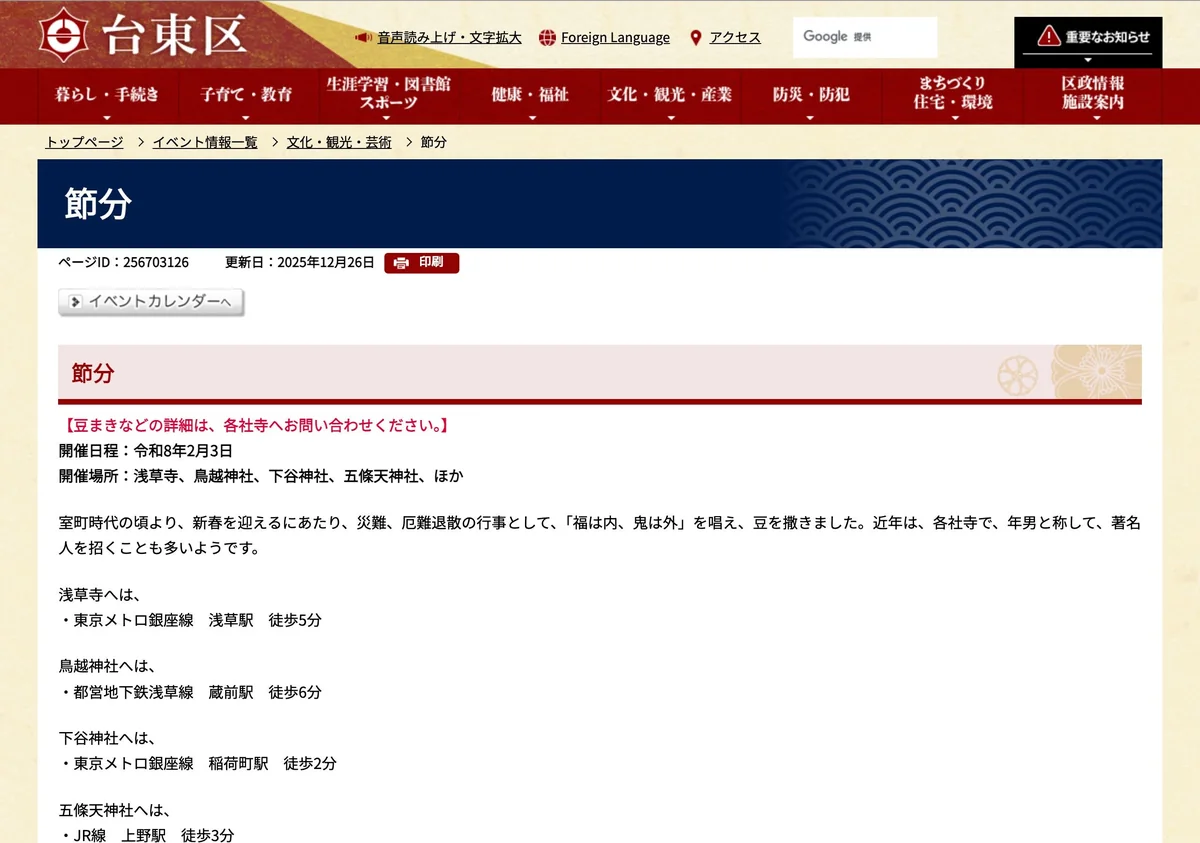
The screenshot is Taito City’s own Setsubun page in Japanese. The red line at the top asks you to contact each shrine or temple for bean-throwing details. Below it you see the 2026 date, the named sites and the walk from each nearest station.
Kanda Myojin is a shrine with close to 1,300 years of history. The GO TOKYO Kanda Myojin Setsubun Festival page says its Setsubun opens with a parade. Red and blue demons, the deities Daikoku and Ebisu, and people scattering beans all take part. Before the bean-tossing, priests dressed as ancient warriors perform the Meigen-no-Gi ritual. They pretend to shoot arrows toward the northeast and southwest, called the Devil’s Gate and the Rear Devil’s Gate.
The shrine guarded the northeast gate of Edo Castle, a direction long thought unlucky, which is why the arrows matter here. Men and women born in the zodiac year then throw beans from a specially built walkway. In 2026 the festival was on 3 February and started at 14:00. Walk 5 minutes from Ochanomizu Station or from Exit B1 of Shin-ochanomizu Station, or 7 minutes from Akihabara Station.
| Place | Kanda Myojin |
|---|---|
| Hours | Setsubun 2026: 3 February, event from 14:00 |
| Access | Ochanomizu Station 5 min, Shin-ochanomizu Station Exit B1 5 min, Akihabara Station 7 min on foot |
| Official site | GO TOKYO Kanda Myojin Setsubun Festival page |
For the biggest names, go west to Fuchu. The GO TOKYO Okunitama Shrine Setsubun Festival page says sumo wrestlers, TV personalities, athletes and Fuchu’s mascot have all thrown beans at Okunitama Shrine. The festivities last all afternoon, and a parade along the main approach tosses beans as well. When the beans fly, everyone shouts Fuku wa uchi to wish for luck all year.
In 2026 Okunitama held its throws at 11:00, 14:00, 16:00 and 18:00 on 3 February. Fuchu Station on the Keio Line is 5 minutes away from the South Exit. Fuchuhommachi Station on the JR Nambu and Musashino lines is also 5 minutes on foot.
Kyoto: Yoshida Shrine and other rites
Kyoto runs its own Setsubun circuit across several shrines and temples. At Yoshida Shrine, a performer in a golden, four-eyed mask drives away rampaging ogres in the oni-yarai rite. Our Kyoto in February guide lists the Setsubun Festival at Yoshida Shrine as the main event of the month, next to the Kyoto Marathon.
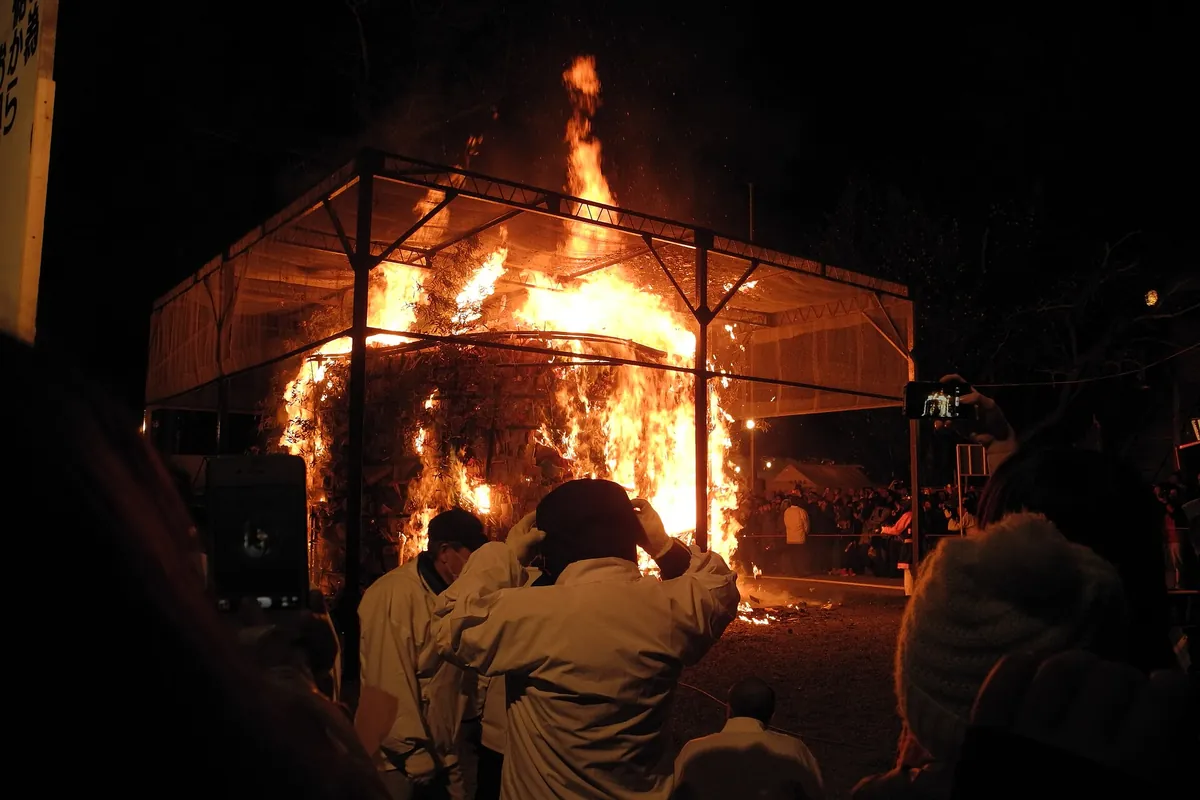
In Kyoto lore the northeast is the direction of the demonic gate. Legend says ogres that flee Yoshida Shrine end up trapped at Fukube Shrine, a branch of Kitano Tenmangu.
That legend gives Kyoto a popular custom: visiting four places where demons are said to have appeared. The four are Yoshida Shrine, Mibu-dera Temple, Fushimi Inari Taisha (or Yasaka Shrine instead) and Kitano Tenmangu.
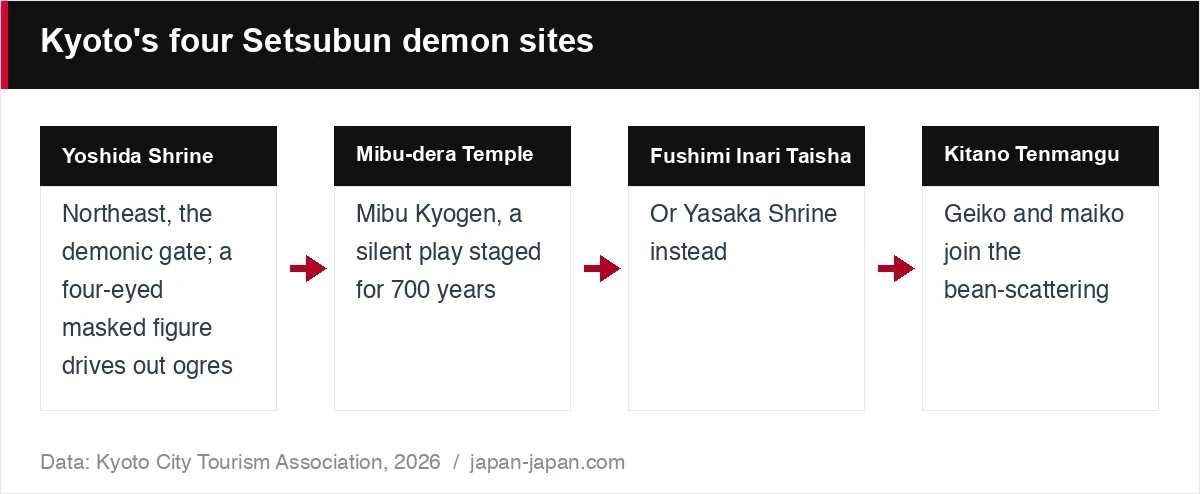
The chart lists the four stops in the order the Kyoto guide gives them, with what to look for at each. You can split them over the Setsubun day or pick the one closest to your hotel.
Mibu-dera has staged Mibu Kyogen for 700 years. The plays use only movement and gesture, with no spoken lines. Performances run three times a year, in spring, in autumn and at Setsubun. The Setsubun play teaches the value of hard work. Mibu Kyogen is an Important Intangible Folk Cultural Property, and Mibu-dera is the only place to see it, so many visitors gather there every year.
Rozan-ji Temple is known for Oni Odori, a demon dance. Red, blue and black demons dance and disrupt the ceremony inside the temple before priests drive them out. At Kitano Tenmangu, local geiko and maiko join the bean-scattering. At Iwashimizu Hachimangu, ogres are beaten back with beans.
To reach Kyoto from Kansai Airport, the limousine bus to Kyoto Station costs 2,800 yen. It runs 48 times a day between 06:45 and 23:20, and you need no reservation when leaving the airport. See our Kansai Airport limousine bus fares page, or compare it with the train on Kansai Airport to Kyoto.
Nara, Nagoya, Hakone and Fukuoka
Nara has the quietest and most striking Setsubun. Each year on 3 February, Kasuga Taisha lights over 3,000 stone and brass lanterns with candles for Setsubun Mantoro. The JNTO Setsubun Mantoro at Kasuga Taisha page says the shrine then looks much as it must have almost 1,000 years ago. The lantern festival has taken place for over 800 years.
Local residents and business people donated many of the lanterns. Some bear the names of famous samurai from the Warring States period (1467-1603). The festival is also tied to wishes. Visit the smaller shrines beside the main shrine to pray for yours. You can buy dried beans and charms at the shrine.
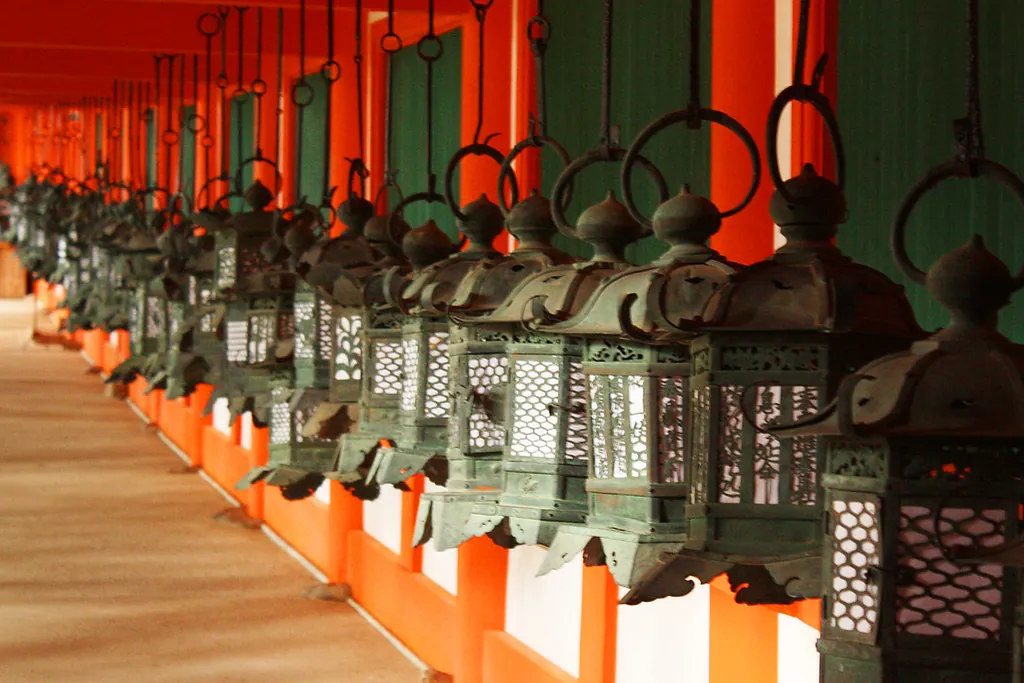
The photo shows the rows of lanterns along the approach to Kasuga Taisha. Some paths stay dark where lanterns are fewer. Carry a flashlight, as local people do; souvenir and discount shops near the station sell cheap ones.
Buses from JR Nara and Kintetsu Nara stations stop at the Kasuga Taisha Honden bus stop, a short walk from the event. You can also walk from Kintetsu Nara Station in about 20 minutes. From Kyoto, our Kyoto to Nara route guide compares the trains. From Kansai Airport, the limousine bus to Nara costs 2,400 yen. Our Nara in February guide covers the rest of the month.
| Place | Kasuga Taisha |
|---|---|
| Hours | Setsubun Mantoro every year on 3 February, lanterns lit with candles |
| Access | Bus from JR or Kintetsu Nara Station to Kasuga Taisha Honden stop; about 20 min walk from Kintetsu Nara Station |
| Official site | JNTO Setsubun Mantoro at Kasuga Taisha page |
Our February city guides cover three more cities. Nagoya in February features Setsubun-e at Osu Kannon. Hakone in February features the Setsubun Festival at Hakone Shrine. Fukuoka in February features the Setsubun Grand Festival at Kushida Shrine and at Tochoji Temple, plus the Maizuru Park Plum Festival. Open the guide for the city where you sleep on Setsubun night.
How to watch: times, costs and manners
Start with the time. Times differ by site and by year. In 2026 Kanda Myojin began at 14:00, while Okunitama held throws at 11:00, 14:00, 16:00 and 18:00. Kasuga Taisha’s lanterns are an evening sight. Taito City asks visitors to contact each shrine or temple for bean-throwing details, so read the official page of your pick before you set out.
| Shrine or temple | City | What you see | Date and time |
|---|---|---|---|
| Senso-ji | Tokyo (Asakusa) | Toshiotoko throw beans, then the Seven Lucky Gods dance | 3 February 2026 |
| Kanda Myojin | Tokyo | Demon parade, Meigen-no-Gi arrows, beans from a walkway | 3 February 2026, from 14:00 |
| Okunitama Shrine | Fuchu, Tokyo | Sumo wrestlers and TV names throw beans | 3 February 2026, 11:00, 14:00, 16:00, 18:00 |
| Yoshida Shrine | Kyoto | A four-eyed masked figure drives out ogres | Setsubun day |
| Mibu-dera Temple | Kyoto | Mibu Kyogen silent play | Setsubun day |
| Rozan-ji Temple | Kyoto | Oni Odori demon dance | Setsubun day |
| Kitano Tenmangu | Kyoto | Geiko and maiko scatter beans | Setsubun day |
| Kasuga Taisha | Nara | Over 3,000 lanterns lit with candles | 3 February every year |
The table puts the main Setsubun sites side by side, with the 2026 dates and times from their official pages. Use it to pick one rite for the afternoon and one for the evening.
Expect crowds where famous people throw. Taito City says many shrines and temples now invite famous people as toshiotoko. At Okunitama the guests have included sumo wrestlers and TV personalities. At Senso-ji, many visitors come every year just for the beans the toshiotoko throw.
The beans come down from above. At Senso-ji the toshiotoko throw from the main hall and the stage beside it. At Kanda Myojin they throw from a specially built walkway. Stand facing the platform, keep your bag closed and hold out open hands. Shout Fuku wa uchi with everyone else, and at Senso-ji leave out the demon half.
Most of what you see happens in open shrine grounds and along the approach paths. The things you buy are the ones you take home. Senso-ji offers lucky beans at its amulet counter, and Kasuga Taisha sells dried beans and charms. Check the shrine’s page if you want to enter an inner area or join the throwing itself.
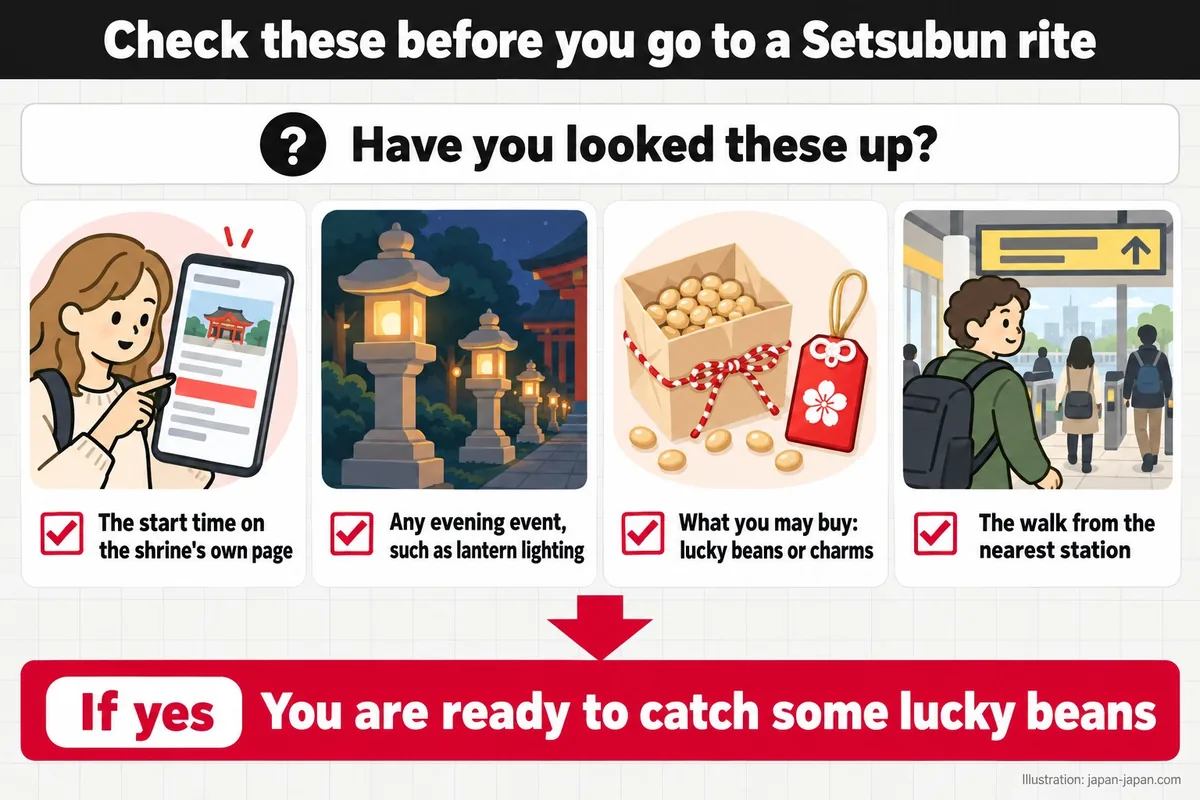
The checklist covers four things to look up before you go. They are the start time, any evening event, what you might buy and the walk.
The walk from the station is short at most sites. Senso-ji, Kanda Myojin and Okunitama are all 5 minutes from a station. Shitaya Shrine is only 2 minutes from Inaricho. Kasuga Taisha is the longest walk, at about 20 minutes from Kintetsu Nara Station.
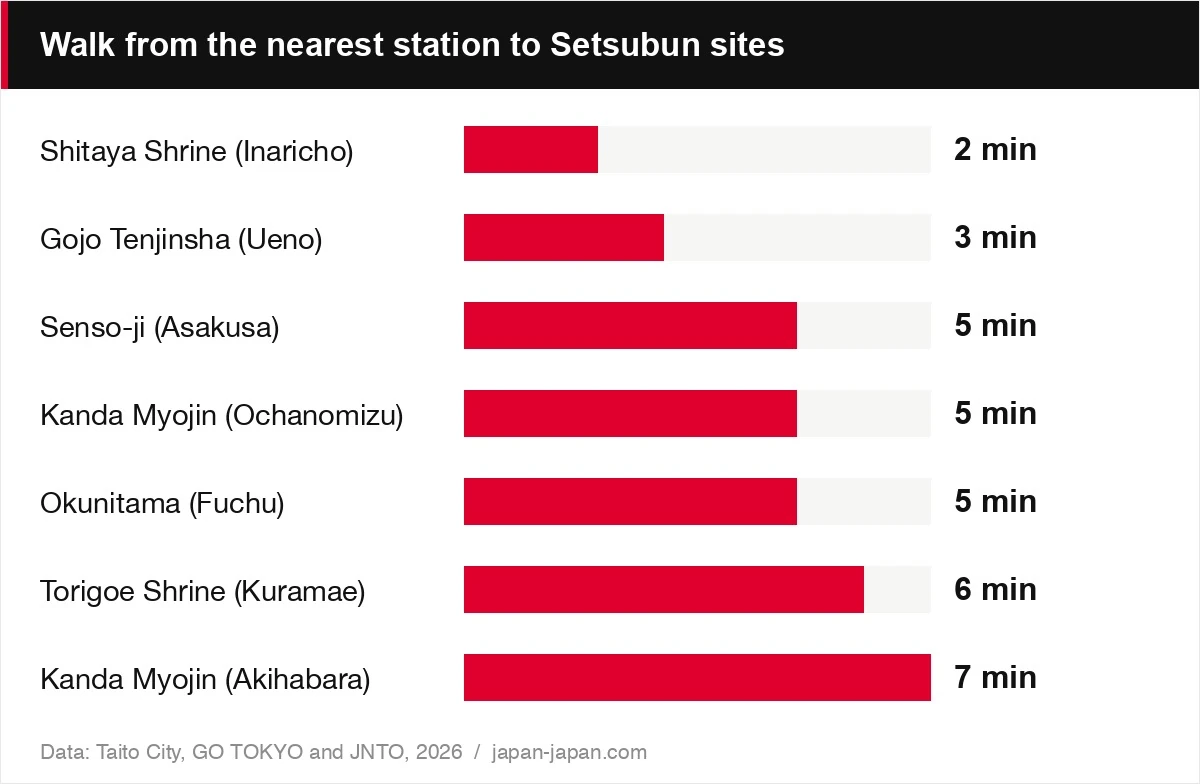
| Item | Value |
|---|---|
| Shitaya Shrine (Inaricho) | 2 min |
| Gojo Tenjinsha (Ueno) | 3 min |
| Senso-ji (Asakusa) | 5 min |
| Kanda Myojin (Ochanomizu) | 5 min |
| Okunitama (Fuchu) | 5 min |
| Torigoe Shrine (Kuramae) | 6 min |
| Kanda Myojin (Akihabara) | 7 min |
| Kasuga Taisha (Kintetsu Nara) | 20 min |
The chart compares the walking times from the official pages. Add time on Setsubun itself, when crowds slow the last stretch to the gate.
Planning a February 2027 trip around Setsubun
Setsubun is not on Japan’s list of public holidays. February 2027 has two. They are National Foundation Day on Thursday 11 February and the Emperor’s Birthday on Tuesday 23 February, as our February public holidays in Japan page shows. Japan has 17 days off in 2027 in all; the 2027 public holiday calendar lists every date with its weekday.
February is a quiet month for travel to Japan. 3,258,491 visitors arrived in February 2025, the lowest of the 12 months that year. If you land at the start of the month, Setsubun comes first and the 11 February holiday follows about a week later.
A simple plan is to start in Tokyo for Senso-ji or Kanda Myojin, then move on to Kyoto and Nara. A 7-day Japan Rail Pass costs 50,000 yen for adults and 25,000 yen for children. It covers JR trains, including the Shinkansen except the Nozomi and Mizuho, as our Japan Rail Pass guide explains. If you fly into Kansai instead, base yourself in Kyoto and take the train to Nara for the lanterns.
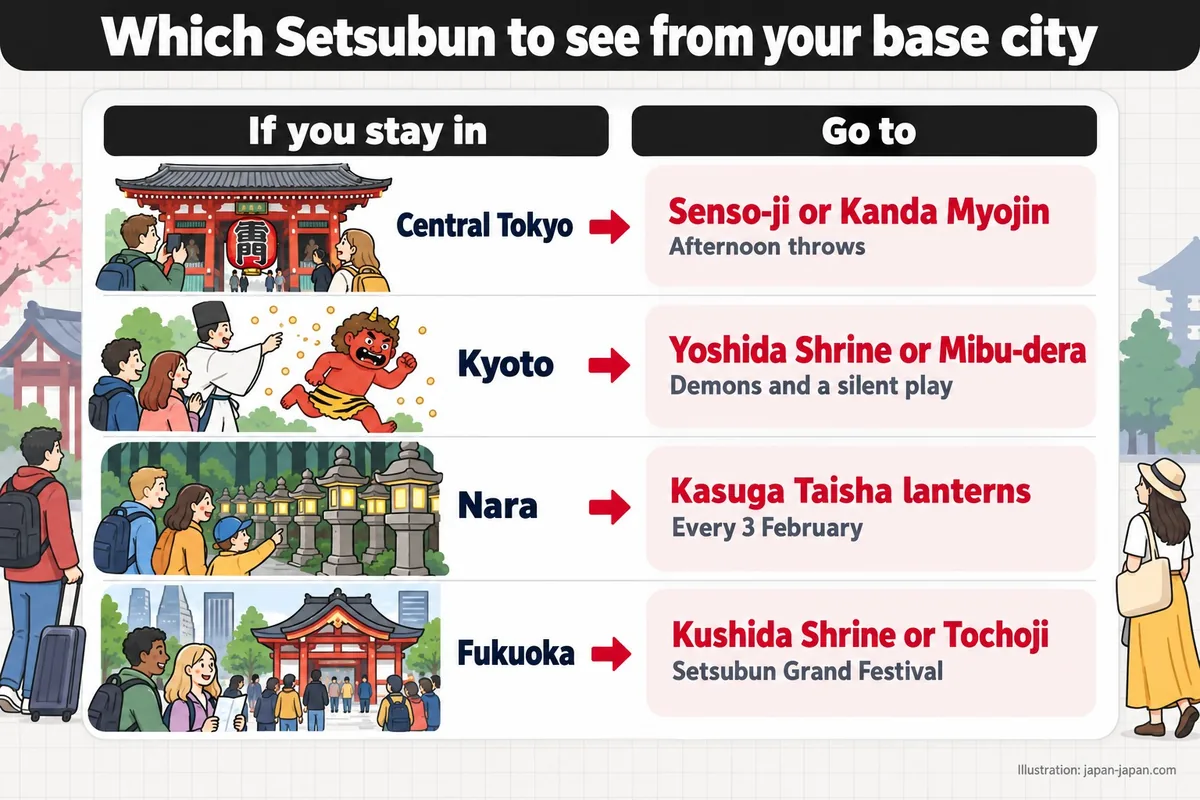
The lookup picks a Setsubun for each base city. Choose the one where you will be on the evening before, so you can reach the rite in the morning or afternoon.
For a Tokyo base, Taito City’s page for the Senso-ji Setsubun-e lists the 2026 date and four train lines to Asakusa Station. The walk is 5 minutes from the Ginza Line, Tobu Skytree Line and Tsukuba Express, and 7 minutes from the Toei Asakusa Line.
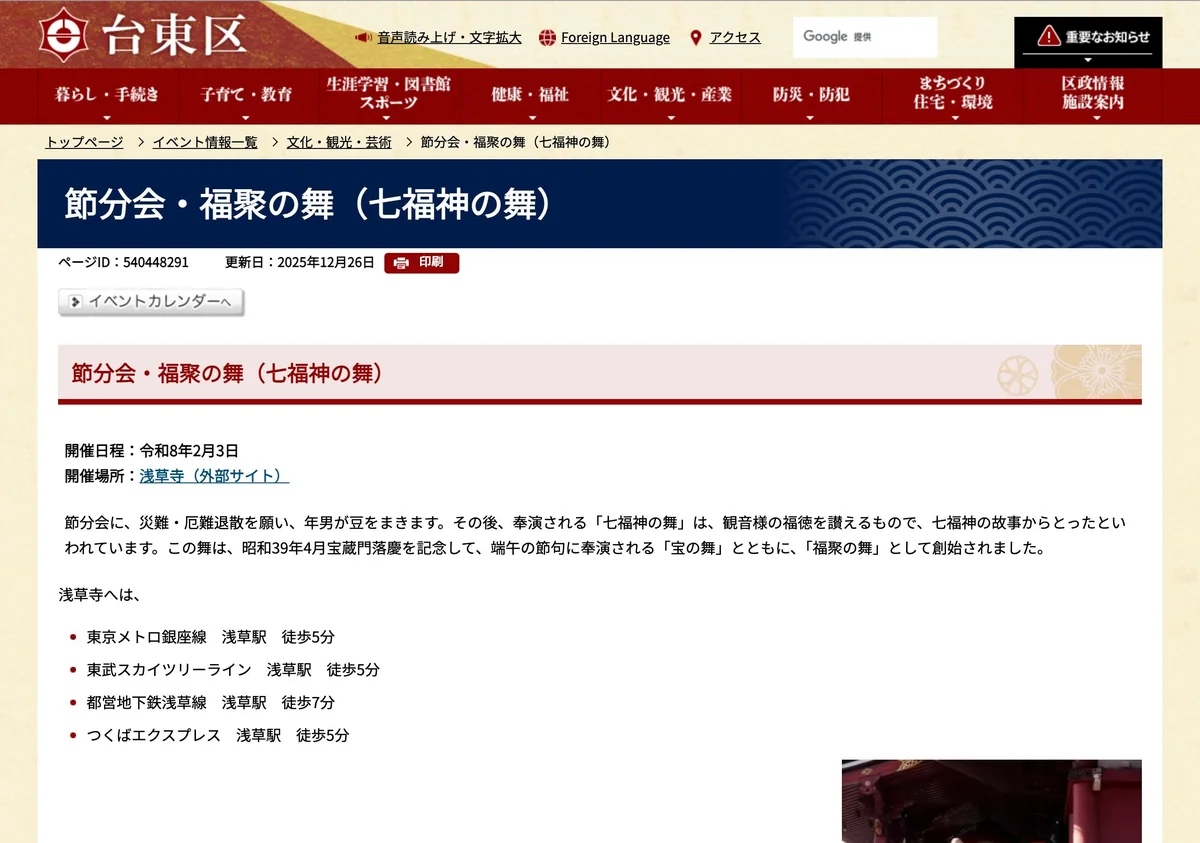
The screenshot is the Taito City Setsubun-e and Fukuju no Mai page. It says the toshiotoko scatter beans to drive away disaster, and that the Seven Lucky Gods dance that follows praises the virtue of Kannon.
For the rest of the month, our Japan in February guide and Tokyo in February guide list the other events. One is the Emperor’s Birthday public greeting at the Imperial Palace. For more winter trips, read Places to Visit in Japan in Winter.
FAQ
When is Setsubun in 2027?
Setsubun falls on the day before Risshun, the start of spring, which is usually 2 or 3 February. Kasuga Taisha in Nara holds Setsubun Mantoro every year on 3 February. Shrines and temples set their own times each year, so check the page of the one you plan to visit.
Is Setsubun a public holiday in Japan?
No. Japan’s February holidays in 2027 are National Foundation Day on Thursday 11 February and the Emperor’s Birthday on Tuesday 23 February. Setsubun is a festival day at shrines and temples, held on a regular working day.
Do you have to pay to watch Setsubun bean-throwing?
Most people watch from the open shrine grounds and the approach paths. What you buy is what you take home, such as lucky beans at the Senso-ji amulet counter or dried beans and charms at Kasuga Taisha. Check the shrine’s own page for inner areas or for joining the throwing.
Why do people throw beans on Setsubun?
To drive out evil and invite good luck before spring. Japan has long scattered grains, salt and sand to purify places, and soybeans are one of the five grains. The word mame, beans, also sounds like the words for a demon’s eyes and for destroying evil.
About the author



4.JPG)