Japan Visa Photo Size: 45 x 35 mm, Paper Form vs eVISA
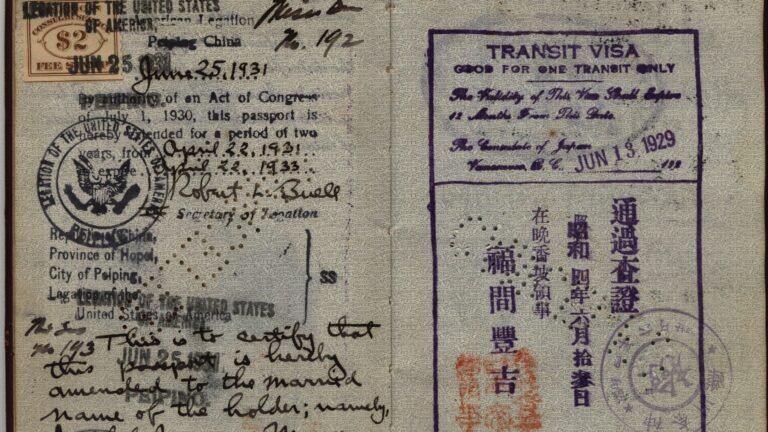
The photo is one item on the foreign ministry’s checklist for a single-entry tourist visa. Our Japan tourist visa requirements guide lists all six documents and the extra outlines for some nationalities.
The exact wording comes from the embassy that takes your application. The MOFA visa information page says requirements can vary with the local situation and the purpose of your visit. Read the page of the embassy or consulate that covers the place where you live. Our guide to applying for a Japan visa shows which office that is.
The 45 x 35 mm rule and what the photo must show
Embassy pages spell the rule out. The Embassy of Japan in Australia temporary visitor visa page is a clear example. Its list for holidays and visits to friends asks for “a 45mm ×35mm (or approximate size) ID/ passport photograph taken in the last 6 months”.
The same item asks for “evidence of when the photograph was taken such as a receipt”. Ask the photo shop or booth for a receipt, and file it with the photo.
The photo travels with the rest of your documents. For a holiday, it also asks for your passport, a copy of its photo page, an itinerary with hotel details and flight details. It also wants a three month bank statement, no older than 1 month, showing enough money for the trip. The embassy asks you not to staple anything, and it offers no printing service.
“Approximate size” gives a little room, but the safe target is exactly 45 mm × 35 mm. Japan uses that size for its own passports too, where MOFA describes the photo as 45 mm tall and 35 mm wide. For a clean result, copy the rest of the passport standard: no border, a plain background, face to the front and no hat.
The size also matches the form. Our tourist visa checklist gives the photo space on the application form as 45 mm × 35 mm. A print of that size fills the box. The MOFA visa information page offers the application form as a PDF in English, simplified and traditional Chinese, Korean, Portuguese and Spanish. MOFA says to fill it in and print it with Adobe Acrobat Reader.
The photo below shows an automatic ID photo booth. Before you pay, check that the booth or shop prints 45 mm × 35 mm and gives you a receipt.

Japan visa picture size for eVISA uploads
JAPAN eVISA swaps the printed photo for a file. You create an account with your email address, fill in the form online and upload your documents, including a facial photo. The JAPAN eVISA FAQ page sets the photo rule in Q30.
Q30 asks for a photo “taken within the last six months, against a plain, untextured background”. The whole face must be “clearly centered horizontally”. The answer also links to a YouTube video on how to apply, posted on the MOFA eVISA page.
Uploading has its own answers in the same FAQ. Q60 covers what to watch for when you upload files. Q62 is for people who cannot upload 2 or more files even though each one is under 2MB. Q63 is titled “I cannot upload my facial photo”. Read those before you retake the picture.
Timing matters for an eVISA photo too. FAQ Q11 lets you apply at the earliest 3 months before your planned travel date. Q5 says the eVISA is valid for 3 months after issue. Take the photo shortly before you apply, and it sits well inside the 6-month limit.
Families can apply from one account. Q32 says the account holder adds each family member, then uploads the required documents for that person. Plan on one facial photo for each person. The fee for a single-entry eVISA is the equivalent of 15,000 yen, according to Q7. Some nationalities pay less or nothing under reciprocal arrangements.
The image below shows the top of the JAPAN eVISA FAQ page, where the questions are listed by number.
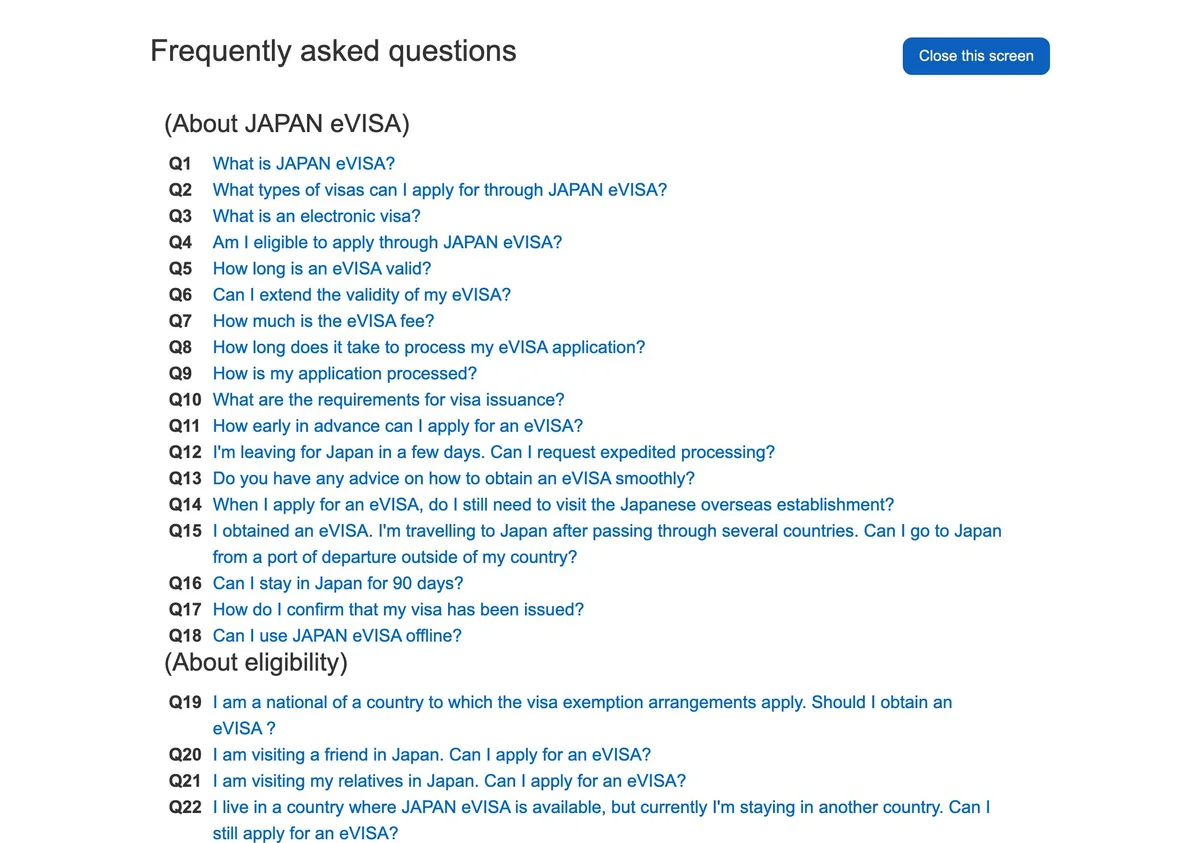
Not everyone can use it. The MOFA JAPAN eVISA system page lists the places whose residents can apply online themselves. As of May 15, 2026, they are Australia, Brazil, Cambodia, Canada, Saudi Arabia, South Africa, Taiwan, the United Kingdom and the U.S.A. People exempt from short-term visas do not need one.
The eVISA covers one thing: a single-entry short-term stay visa for tourism, for up to 90 days. If you are visiting friends or relatives, FAQ Q20 and Q21 send you to the embassy with a paper application. Only ordinary passport holders can use the system.
The visa itself is electronic. You get no visa sticker in your passport. At check-in, you show the “visa issuance notice” on a phone or tablet with an internet connection. The MOFA eVISA page says PDF data, screenshots and printed copies will not be accepted. If you have no mobile device, FAQ Q25 suggests a paper application instead. Our JAPAN eVISA guide walks through the whole online process.
How many photos you need, by country
Most applicants need one photo. The Embassy of Japan in Australia lists one completed application form and one 45 mm × 35 mm photo for a holiday visit. Its list then adds: “Nationals of Russia, CIS countries and Georgia need to submit 2 visa application forms and 2 photos”.
At that embassy, a Russian citizen applying on paper brings two forms and two photos. Our Japan visa page for Russian citizens covers the rest of that application.
Some countries send applications through agencies. In China, applications go through travel agencies accredited by the Japanese mission. Chinese nationals living in China receive eVISAs with a period of stay of 15 days or 30 days. Our Japan visa page for Chinese citizens has the fee and the documents.
Filipino nationals in the Philippines and Vietnamese nationals in Viet Nam apply through designated travel agencies as part of a packaged tour. Their eVISAs carry a 15-day stay. Read our Japan visa page for the Philippines or our Japan visa page for Vietnam before you book a tour.
In India, you submit through VFS, and you do not need an appointment. The Embassy of Japan in India visa page says eVISA started in India on 1 April 2024. It also warns about fraud: the only payments are the visa fee and the service charge listed on that page.
The diagram below follows one photo from the camera to the issued visa, on paper and on eVISA.
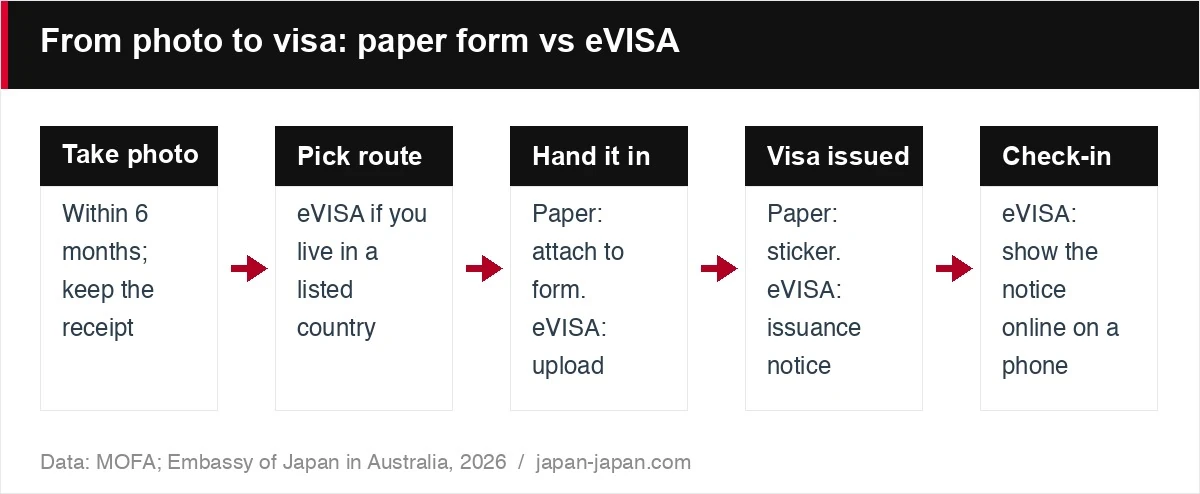
A paper visa ends with a sticker in your passport. An eVISA ends with a notice on your phone, and the embassy may still ask you to come in for an interview.
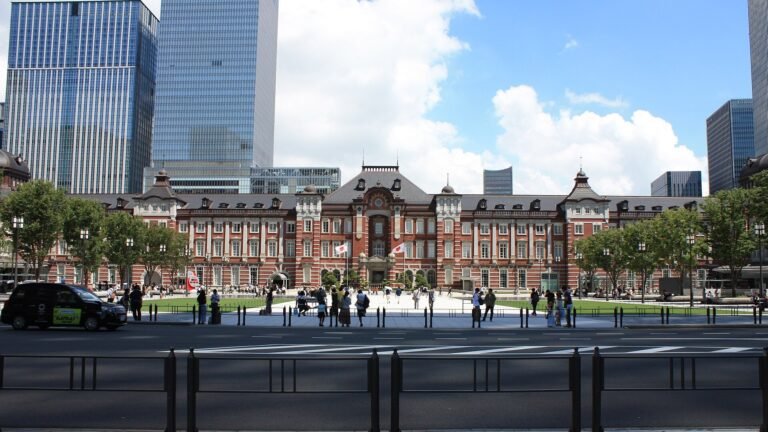
The photo below shows the Embassy of Japan in Canberra. Canberra residents can walk in on weekdays, 9:00-12:00 or 14:00-16:30, without an appointment.
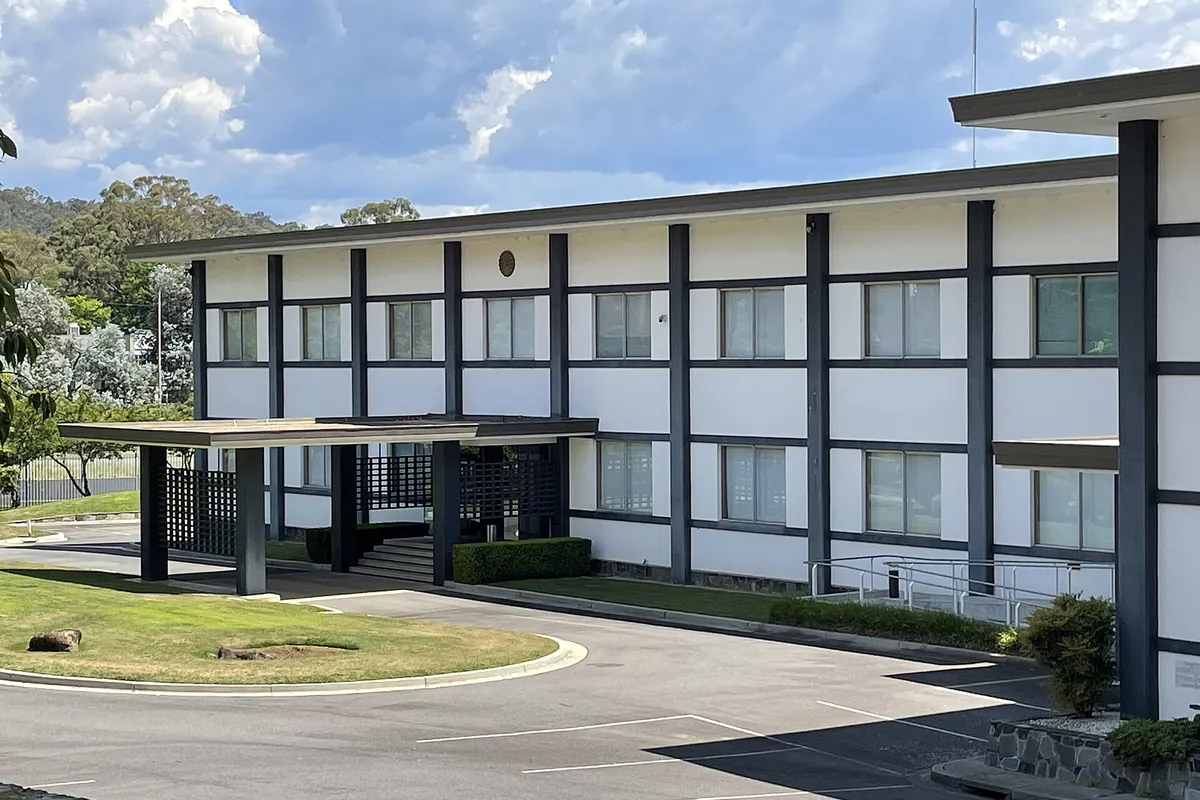
That embassy gives a minimum processing time of one week (5 working days). The visa is valid for entry for 3 months from issue, so you can apply up to three months before your trip.
This list is written for people living in Australia on another country’s passport. Australian passport holders do not need a visa for tourism, business or transit visits of less than 90 days. Applicants must also show a valid Australian long-term visa, such as permanent residency or a student visa. Fees rose on 1 July 2026: a single-entry visa went from 31 AUD to 156 AUD.
Japan passport photo size vs visa photo
Japan uses the same size for its own passports. The MOFA Japanese passport application documents page asks Japanese citizens for one photo, 45 mm tall and 35 mm wide, with no border. The background should be plain, and MOFA recommends white.
The passport rules go further than the visa list. The photo must be taken within 6 months before the application date. You face the front with no hat. The distance from the top of your head to your chin must be 34 mm, plus or minus 2 mm. Applicants write their name on the back, pressing lightly so the ink does not show through.
So the Japan passport photo size and the Japan visa photo size are the same: 45 mm × 35 mm. The passport rules belong to a Japanese citizen’s passport application, which is a separate procedure. A visa applicant follows the embassy page or the JAPAN eVISA FAQ. A print that meets the passport standard still makes a safe model for a paper visa.
The table below puts the three sets of rules side by side.
| Rule | Paper visa | JAPAN eVISA | JP passport |
|---|---|---|---|
| Photo | 45 x 35 mm print, or approximate size | File uploaded in your account | 45 mm tall, 35 mm wide, no border |
| Taken within | Last 6 months, with proof such as a receipt | Last 6 months | 6 months before applying |
| Background and face | Follow your embassy’s list | Plain background, face centred | Plain background, white advised, no hat |
| Per application | 1 photo; 2 for Russia, CIS, Georgia | Facial photo file | 1 photo, name on the back |
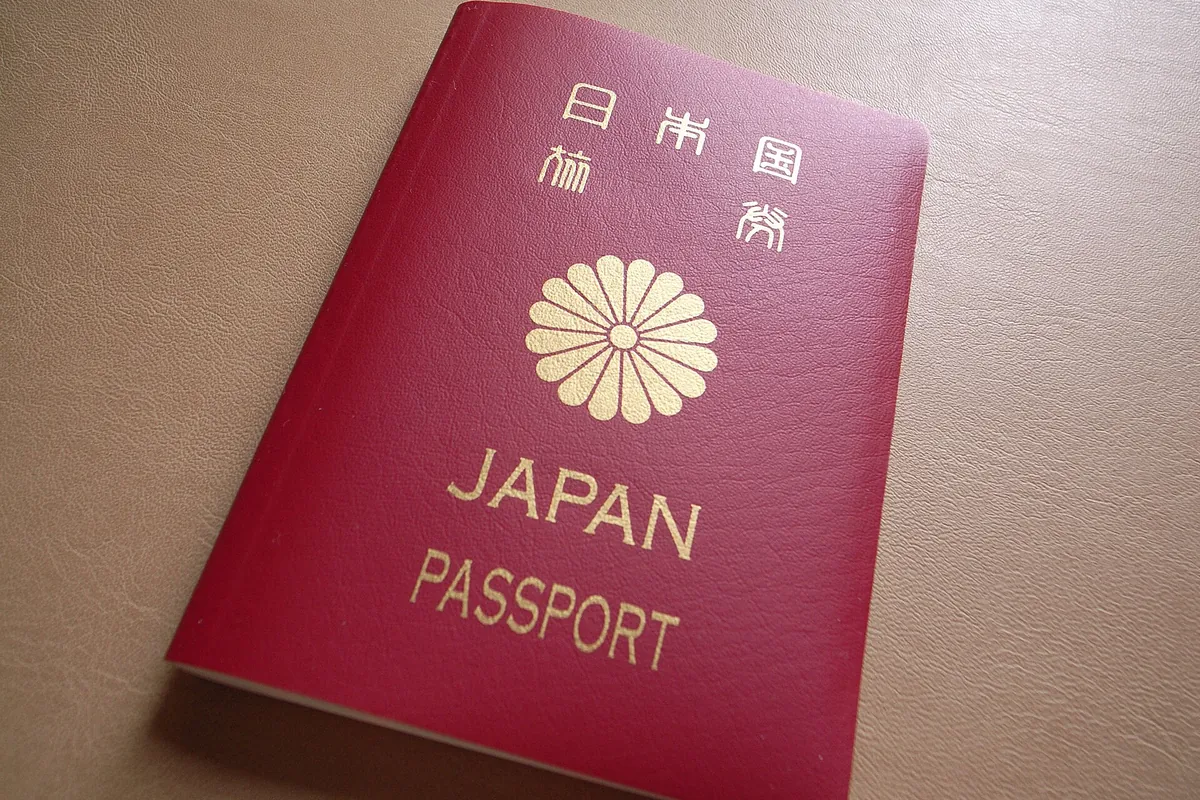
Your own passport photo may use different measurements. Measure the print with a ruler before you reuse it for Japan. The photo below shows the cover of a Japanese passport.
Common reasons a photo gets sent back
Check five details before you submit. Each one comes from an official page quoted above.
- Old photo: it must be from the last 6 months, on paper and on eVISA.
- No proof of the date: the Embassy of Japan in Australia asks for evidence such as a receipt.
- Patterned background: eVISA FAQ Q30 asks for a plain, untextured background.
- Face off centre: Q30 wants the entire face clearly centred from left to right.
- Wrong size or a border: aim for exactly 45 mm × 35 mm, and leave off the border as the passport standard does.
A bad file costs time on eVISA. The MOFA eVISA page warns: “If your application is incomplete, we will cancel it without processing”. Once it is cancelled, you have to apply again. Uploading wrong documents can also delay the examination.
The clock starts only when the application is complete. FAQ Q8 says an embassy normally takes 5 working days to examine and issue a visa after it receives a complete application. Our Japan visa processing time guide explains what else slows it down.
Paper applications face the same check. The MOFA visa FAQ page lists “some errors or omissions in the submitted documents” among the reasons an application may not be accepted.
After the visa: the face photo taken on arrival
Japan takes one more photo when you land. The Immigration Services Agency landing procedures page says foreign nationals applying for landing must give the immigration officer their fingerprints and a face photo. Only people exempted by law skip this step.
The officer takes this photo at the counter, so you bring nothing for it. A person who refuses is sent to a special inquiry officer for an oral hearing.
A visa is one requirement for landing, and it does not promise entry. The MOFA visa FAQ calls it “no more than one of the requirements” for the application to land. An eVISA also becomes invalid once you use it to apply for landing. You must enter Japan within 3 months of issue.
Before you fly, make your Visit Japan Web QR code. Our Visit Japan Web QR code guide shows how to set it up. For the wider picture, our Japan visa requirements guide covers who needs a visa and the current fees.
The photo below shows the arrival immigration counters at Narita Airport.
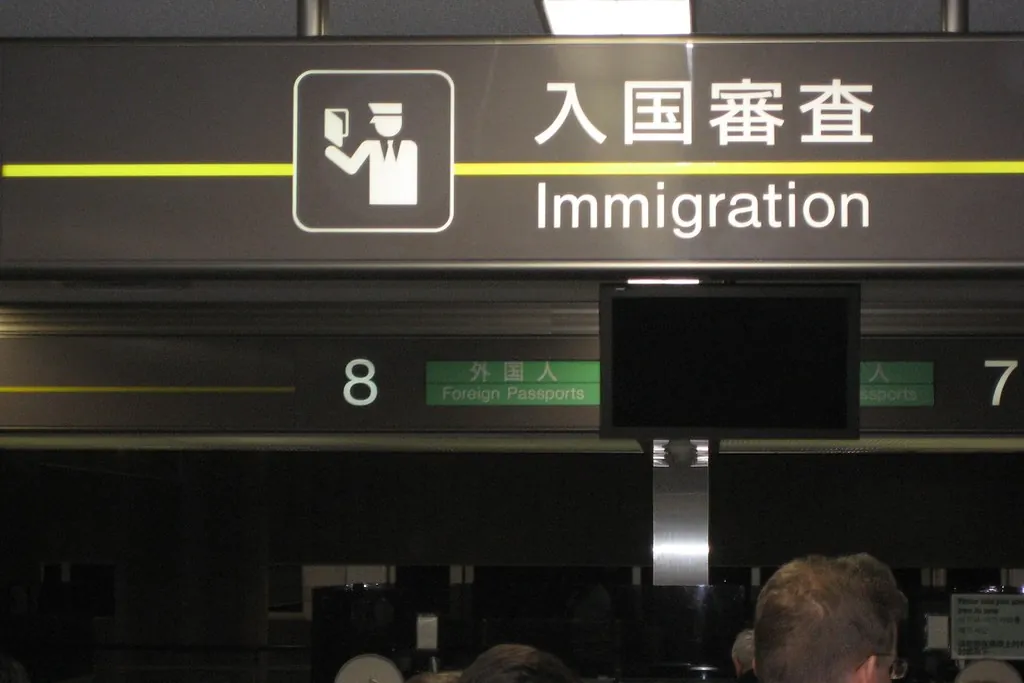
If you land at Narita Terminal 1, our Narita Airport Terminal 1 guide shows the way to Narita Airport Station on B1F. Our Narita Airport transfer guide compares trains and buses into Tokyo.
FAQ
What size is a Japan visa photo in inches?
Japanese embassies give the size in millimetres: 45 mm × 35 mm. Set your photo app or printer to millimetres rather than converting. Then measure the print with a ruler before you attach it.
Can I use the same photo for my Japan visa and my passport?
Yes, if the print is 45 mm × 35 mm and was taken within the last 6 months. Japan’s own passport photo uses that size, with no border and a plain background. Photos cut for other countries’ passports may use other measurements, so measure yours first.
Does a Japan eVISA application need a printed photo?
No. You upload a facial photo as a file in your JAPAN eVISA account. FAQ Q30 asks for a photo from the last six months, a plain background and a centred face. At check-in, you show the visa issuance notice on your device.
How old can my Japan visa photo be?
Up to 6 months. The Embassy of Japan in Australia asks for a photo taken in the last 6 months, with evidence such as a receipt. JAPAN eVISA FAQ Q30 uses the same six-month limit.
About the author