Taking Japanese medicine home: South Korea, Taiwan, mainland China and Hong Kong
Each place sets its own limits on medicine in a traveller's baggage, and some ingredients common in Japanese medicine are controlled. This page puts the official customs and health pages of South Korea, Taiwan, mainland China and Hong Kong side by side.
The four places side by side
Only Taiwan and South Korea give a number for medicine. Mainland China and Hong Kong say 'reasonable quantity for personal use'.
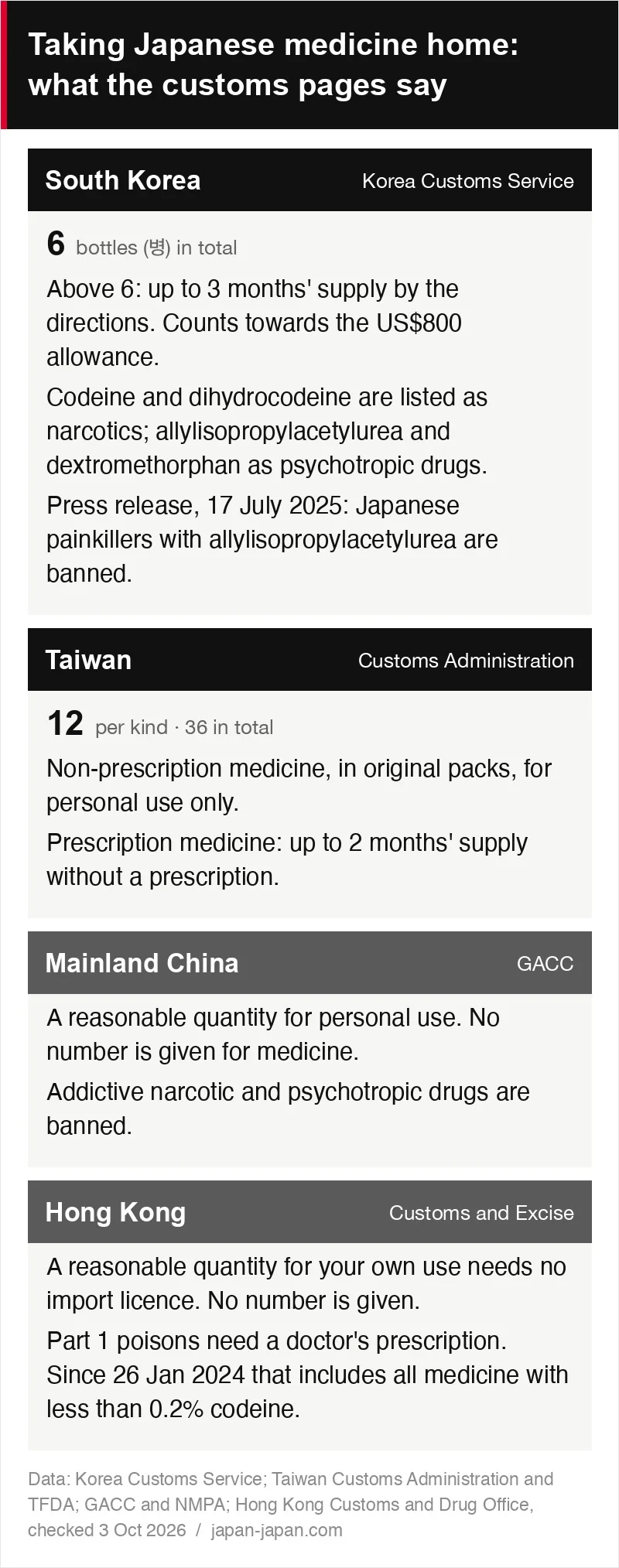
Chart: japan-japan.com, from the customs pages of South Korea, Taiwan, mainland China and Hong Kong.
| Going to | What the customs page says about medicine |
|---|---|
| South Korea | Medicine for your own use: 6 bottles (병) in total. Above 6, up to 3 months' supply by the directions. Gifts count as your own use, and the medicine counts towards the US$800 duty-free allowance. |
| Taiwan | Non-prescription medicine: up to 12 bottles (boxes, cans, bars, sticks) of one kind and 36 in total, counted in original packs, for personal use only. |
| Mainland China | Baggage is limited to a reasonable quantity for personal use: the normal quantity for the purpose of the trip and the length of stay. Gifts for relatives or friends count as personal use. No number is given for medicine. |
| Hong Kong | Medicine in your personal baggage, in a reasonable quantity for your own use, is exempt from the import licence. No number is given. |
South Korea
- Medicine for your own use: 6 bottles (병) in total. Above 6, up to 3 months' supply by the directions. Gifts count as your own use, and the medicine counts towards the US$800 duty-free allowance.
- The Korea Customs Service lists codeine and dihydrocodeine as narcotics, and allylisopropylacetylurea, bromovalerylurea and dextromethorphan as psychotropic drugs.
- It warns that medicine containing narcotic-class ingredients can be punished under the Narcotics Control Act when brought in from abroad, even if it was sold there.
- Anyone entering Korea with narcotic-class medicine for their own treatment needs approval from the Ministry of Food and Drug Safety first, whatever their nationality.
- Single-ingredient medicines containing ephedrine, norephedrine or pseudoephedrine need a requirement check even within the 6-bottle allowance.
- Narcotics, psychotropic drugs and medicines that may be misused are on Korea's list of goods to declare.
- Herbal medicine materials have separate limits: ginseng 300 g, deer antler 150 g, other materials 3 kg each.
Japanese painkillers with allylisopropylacetylureaThe Korea Customs Service's press release of 17 July 2025 gives, as examples, Japanese painkillers containing the psychotropic drug allylisopropylacetylurea, US cold medicines containing dextromethorphan and supplements containing melatonin, and says these medicines and foods are banned from being brought into Korea.
Source: Incheon Airport Customs, Korea Customs Service — Traveller's goods: medicine for personal use (자가사용 의약품) · Korea Customs Service (National Law Information Center) — Notice on import clearance, Annex 11 (수입통관 사무처리에 관한 고시 별표 11), in force 17 December 2025 · Korea Customs Service — Narcotics and psychotropic ingredients (마약류 성분 목록) · Korea Customs Service — Check the ingredients of medicine you bring in (의약품 성분 확인) · Korea Customs Service — Press release, 17 July 2025 (보도자료) · Ministry of Food and Drug Safety (MFDS), Korea — Approval for carrying narcotic medicines for your own treatment · Korea Customs Service — Goods to declare (신고대상)
Taiwan
- Non-prescription medicine: up to 12 bottles (boxes, cans, bars, sticks) of one kind and 36 in total, counted in original packs, for personal use only.
- If a medicine is prescription-only in Taiwan but sold without a prescription where you bought it, the non-prescription limit applies.
- Prescription medicine: up to 2 months' supply without a prescription, and with one, the amount it states up to 6 months' supply.
- Controlled drugs need a prescription or doctor's document, only for your own treatment, up to 6 months' supply.
- Taiwan's Food and Drug Administration asks travellers to avoid buying and bringing back medicine containing ingredients that are controlled drugs in Taiwan.
- Its schedule of controlled drugs lists codeine and dihydrocodeine preparations by their content per 100 millilitres or 100 grams.
- Above these limits you need a permit for medicine for personal use from the TFDA and must declare it at the red-line counter.
- Medicine brought in is for your own use only; selling it can be fined NT$30,000 to NT$2 million.
- Chinese medicine preparations: up to 12 bottles (boxes) of one kind and 36 in total. Herbal materials: up to 1 kilogram of one kind and 12 kinds.
- Foods in tablet or capsule form have their own limit: 12 of one kind and 36 in total.
Source: Ministry of Finance (Laws & Regulations Database of the R.O.C.) — Regulations on luggage of inbound passengers, annex (入境旅客攜帶行李物品報驗稅放辦法 附表), amended 30 January 2026 · Taipei Customs, Customs Administration, Ministry of Finance — Medicine carried by passengers (旅客攜帶藥品) · Taiwan Food and Drug Administration (TFDA) — TFDA news, 25 June 2025 · Taiwan Food and Drug Administration (TFDA) — Controlled drugs: schedules and items (管制藥品分級及品項) · Taiwan Food and Drug Administration (TFDA) — TFDA news, 3 July 2024 · Ministry of Finance (Laws & Regulations Database of the R.O.C.) — Regulations on luggage of inbound passengers (入境旅客攜帶行李物品報驗稅放辦法)
Mainland China
- Baggage is limited to a reasonable quantity for personal use: the normal quantity for the purpose of the trip and the length of stay. Gifts for relatives or friends count as personal use. No number is given for medicine.
- Duty-free value for personal articles: up to RMB 5,000 for residents and up to RMB 2,000 for non-residents (for all articles, not only medicine).
- Opium, morphine, heroin, cannabis and other addictive narcotic and psychotropic drugs are banned.
- Narcotic and class 1 psychotropic medicines for your own treatment: with a medical diagnosis certificate and ID, up to the largest amount on one prescription.
- China's catalogue of narcotic drugs (2013 edition) lists codeine and dihydrocodeine, including their salts and single-ingredient preparations.
- Dextromethorphan has been a class 2 psychotropic drug in China since 1 July 2024.
- With nothing to declare, use the green channel; with goods to declare, the red channel.
- Chinese herbal materials of animal origin are banned in passengers' baggage.
Source: General Administration of Customs of China (GACC) — Passenger baggage: service guide (旅客行李物品 办事指南) · General Administration of Customs of China (GACC) — Passenger baggage rules (English site) · National Medical Products Administration (NMPA) — Regulations on narcotic and psychotropic drugs, article 44 (麻醉药品和精神药品管理条例) · National Medical Products Administration (NMPA) — Catalogue of narcotic drugs, 2013 edition (麻醉药品品种目录) · National Medical Products Administration (NMPA) — Notice adding dextromethorphan to class 2 psychotropic drugs (7 May 2024) · Ministry of Agriculture and Rural Affairs / GACC — Animals and plants banned from entry, Announcement No. 470
Hong Kong
- Medicine in your personal baggage, in a reasonable quantity for your own use, is exempt from the import licence. No number is given.
- Medicine classed as a dangerous drug, an antibiotic or a Part 1 poison needs a doctor's prescription to be carried in or out.
- Since 26 January 2024, all medicines containing less than 0.2% codeine are Part 1 Schedule 1 poisons.
- Visitors bringing dangerous drugs for personal use need written permission from the Drug Office before arriving; processing usually takes 10 working days.
- Use the red channel if you carry prohibited or controlled items; the green channel means you have none.
Proprietary Chinese medicine: two official pages
Two Hong Kong government pages describe proprietary Chinese medicine in baggage differently. Both are quoted here as published.
- It defines proprietary Chinese medicine as a product made solely of Chinese medicine materials as active ingredients, in a dosage form, for treating or relieving illness.
- The maximum penalty for selling, importing or possessing unregistered proprietary Chinese medicine is a fine of HK$100,000 and two years in prison.
Source: Customs and Excise Department, Hong Kong — Controlled imports: pharmaceutical products and medicines (進口管制) · Customs and Excise Department, Hong Kong — Press release on medicines carried by passengers, 6 January 2023 · Drug Office, Department of Health, Hong Kong — Drug Office: frequently asked questions (常見問題) · Chinese Medicine Regulatory Office, Department of Health, Hong Kong — Purchasing proprietary Chinese medicines (購買中成藥須知) · Department of Health, Hong Kong — Press release, 18 July 2025 · Customs and Excise Department, Hong Kong — Passenger clearance: frequently asked questions
Frequently asked questions
How much medicine can I take back to Taiwan?
Non-prescription medicine: up to 12 bottles (boxes, cans, bars, sticks) of one kind and 36 in total, counted in original packs, for personal use only.
How much medicine can I take back to South Korea?
Medicine for your own use: 6 bottles (병) in total. Above 6, up to 3 months' supply by the directions. Gifts count as your own use, and the medicine counts towards the US$800 duty-free allowance.
Can I take Japanese painkillers to Korea?
The Korea Customs Service's press release of 17 July 2025 gives, as examples, Japanese painkillers containing the psychotropic drug allylisopropylacetylurea, US cold medicines containing dextromethorphan and supplements containing melatonin, and says these medicines and foods are banned from being brought into Korea.
Is there a limit on medicine for mainland China?
Baggage is limited to a reasonable quantity for personal use: the normal quantity for the purpose of the trip and the length of stay. Gifts for relatives or friends count as personal use. No number is given for medicine.
Is there a limit on medicine for Hong Kong?
Medicine in your personal baggage, in a reasonable quantity for your own use, is exempt from the import licence. No number is given.
Related items
Sources for this page
- Incheon Airport Customs, Korea Customs Service Traveller's goods: medicine for personal use (자가사용 의약품)checked October 3, 2026
- Korea Customs Service (National Law Information Center) Notice on import clearance, Annex 11 (수입통관 사무처리에 관한 고시 별표 11), in force 17 December 2025checked October 3, 2026
- Korea Customs Service Narcotics and psychotropic ingredients (마약류 성분 목록)checked October 3, 2026
- Korea Customs Service Check the ingredients of medicine you bring in (의약품 성분 확인)checked October 3, 2026
- Korea Customs Service Press release, 17 July 2025 (보도자료)checked October 3, 2026
- Ministry of Food and Drug Safety (MFDS), Korea Approval for carrying narcotic medicines for your own treatmentchecked October 3, 2026
- Korea Customs Service Goods to declare (신고대상)checked October 3, 2026
- Ministry of Finance (Laws & Regulations Database of the R.O.C.) Regulations on luggage of inbound passengers, annex (入境旅客攜帶行李物品報驗稅放辦法 附表), amended 30 January 2026checked October 3, 2026
- Taipei Customs, Customs Administration, Ministry of Finance Medicine carried by passengers (旅客攜帶藥品)checked October 3, 2026
- Taiwan Food and Drug Administration (TFDA) TFDA news, 25 June 2025checked October 3, 2026
- Taiwan Food and Drug Administration (TFDA) Controlled drugs: schedules and items (管制藥品分級及品項)checked October 3, 2026
- Taiwan Food and Drug Administration (TFDA) TFDA news, 3 July 2024checked October 3, 2026
- Ministry of Finance (Laws & Regulations Database of the R.O.C.) Regulations on luggage of inbound passengers (入境旅客攜帶行李物品報驗稅放辦法)checked October 3, 2026
- General Administration of Customs of China (GACC) Passenger baggage: service guide (旅客行李物品 办事指南)checked October 3, 2026
- General Administration of Customs of China (GACC) Passenger baggage rules (English site)checked October 3, 2026
- National Medical Products Administration (NMPA) Regulations on narcotic and psychotropic drugs, article 44 (麻醉药品和精神药品管理条例)checked October 3, 2026
- National Medical Products Administration (NMPA) Catalogue of narcotic drugs, 2013 edition (麻醉药品品种目录)checked October 3, 2026
- National Medical Products Administration (NMPA) Notice adding dextromethorphan to class 2 psychotropic drugs (7 May 2024)checked October 3, 2026
- Ministry of Agriculture and Rural Affairs / GACC Animals and plants banned from entry, Announcement No. 470checked October 3, 2026
- Customs and Excise Department, Hong Kong Controlled imports: pharmaceutical products and medicines (進口管制)checked October 3, 2026
- Customs and Excise Department, Hong Kong Press release on medicines carried by passengers, 6 January 2023checked October 3, 2026
- Drug Office, Department of Health, Hong Kong Drug Office: frequently asked questions (常見問題)checked October 3, 2026
- Chinese Medicine Regulatory Office, Department of Health, Hong Kong Purchasing proprietary Chinese medicines (購買中成藥須知)checked October 3, 2026
- Department of Health, Hong Kong Press release, 18 July 2025checked October 3, 2026
- Customs and Excise Department, Hong Kong Passenger clearance: frequently asked questionschecked October 3, 2026
Compiled by Japan Japan !! · Updated October 3, 2026