Can You Bring Hand Sanitizer and Alcohol Wipes on a Plane to Japan?
Yes. Alcohol wipes sit outside the 100ml liquid rule. Gel and spray go in 100ml containers on international flights, and are capped at 0.5 litres each and 2 litres in total in any bag.
By Shunta Fujii
Can you bring alcohol wipes to Japan? The short answer
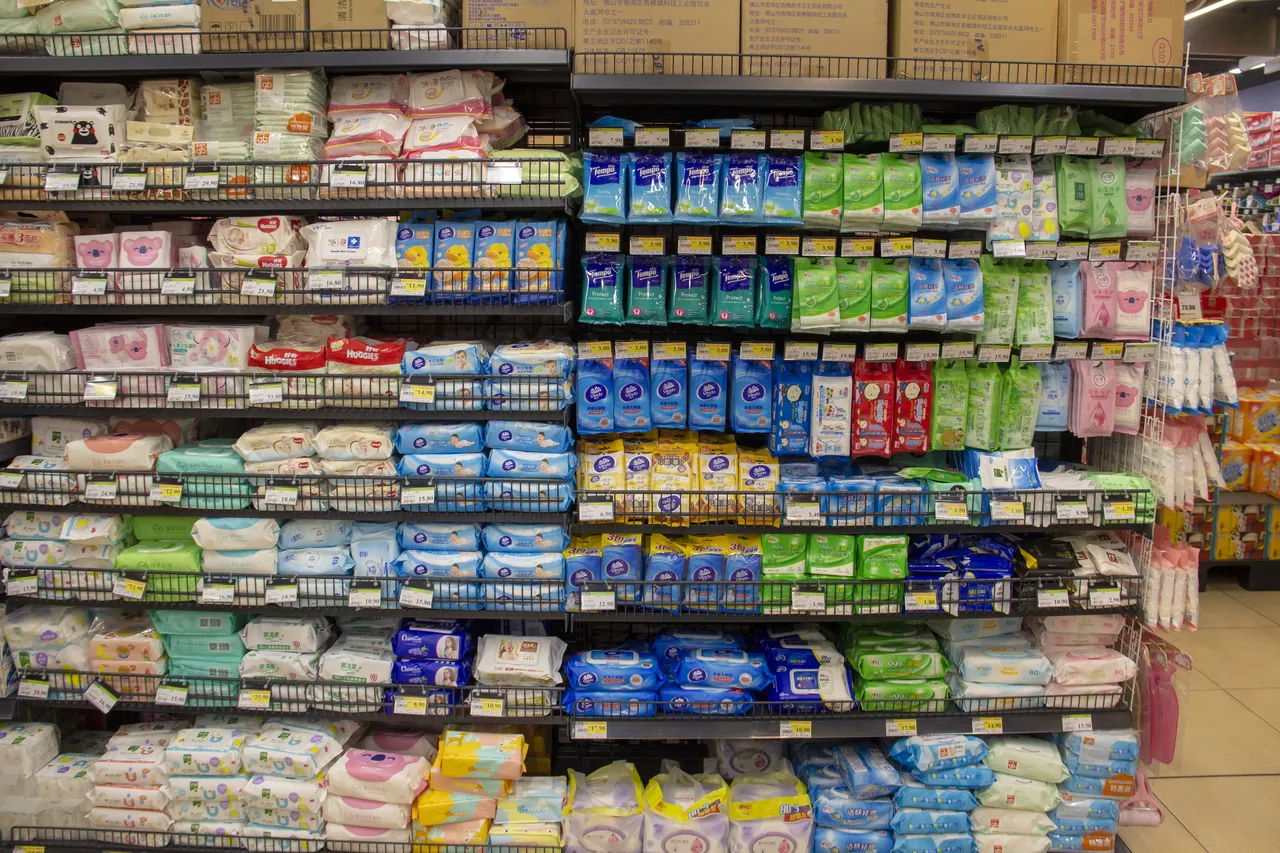
Yes. Alcohol wipes can go in your cabin bag, and you do not need to put them in the clear liquids bag. Narita Airport’s FAQ (in Japanese) says that on international flights, wet tissues and make-up remover sheets are outside the liquid restrictions. You can take them into the cabin without a limit. Gel and spray are different: on international flights they must be in containers of 100ml or less.
The limits start when the alcohol comes as a gel, a liquid, a spray or a bottle. On international flights, each container in your cabin bag must hold 100ml or less and sit inside one clear bag of up to 1 litre. In any bag, sanitising products are capped at 0.5 litres per container and 2 litres per person. Disinfectant stronger than 70% alcohol cannot fly at all, according to our hand sanitiser entry.
Narita’s answer covers wet tissues as one group, without splitting them by what the sheet is soaked in. Keep your wipes in their sealed retail pack, so the screener sees a pack of sheets rather than a bottle. In Japan, each airline runs passenger screening under the Civil Aeronautics Act, and Narita’s liquid rules page notes that each airline may set its own restrictions.
This guide follows the rules at Japanese airports and on Japanese airlines. They cover your flights inside Japan and your flight home. Narita also reminds passengers that they may be screened again at other airports on the trip, so ask your airline what applies where your trip starts.
Customs is a separate check when you land. Wipes and sanitiser packed for your own use count as personal effects. Japan Customs lets clothes, toiletries and other personal effects in free of duty and tax, as long as the amount is reasonable and they are not for sale.
The rest of this guide takes each form in turn: wipes, gel, spray, disinfectant bottles and drinks. Run these five checks when you pack.
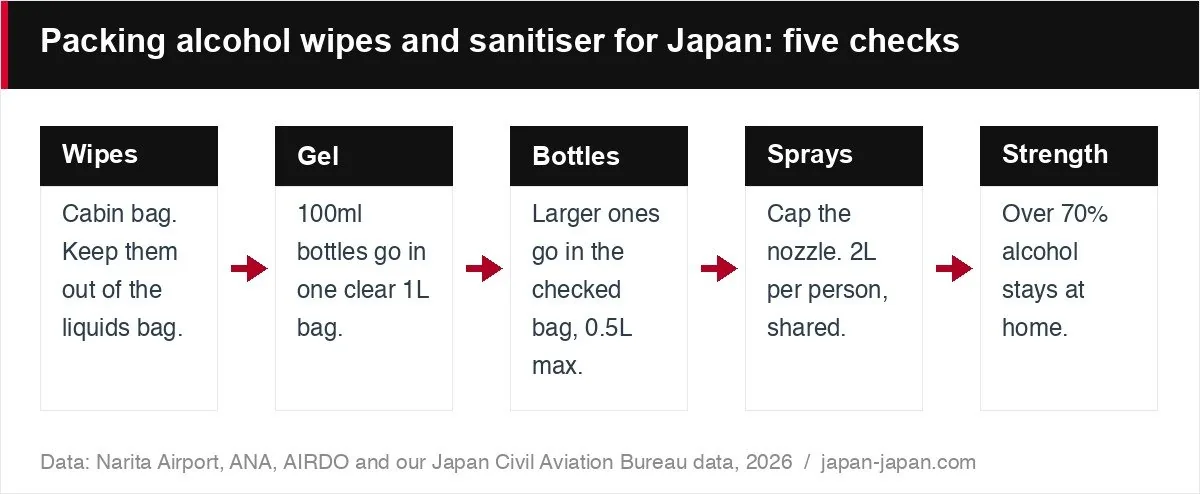
| Check | What to do |
|---|---|
| Wipes | Cabin bag. Keep them out of the liquids bag. |
| Gel | 100ml bottles go in one clear 1L bag. |
| Bottles | Larger ones go in the checked bag, 0.5L max. |
| Sprays | Cap the nozzle. 2L per person, shared. |
| Strength | Over 70% alcohol stays at home. |
Wipes, gel, spray or bottle: how security treats each one
The rules sort alcohol products by form, not by the word “alcohol” on the label. A sheet, a gel and a spray of the same strength meet three different rules. This is how each one is handled at Japanese airports.
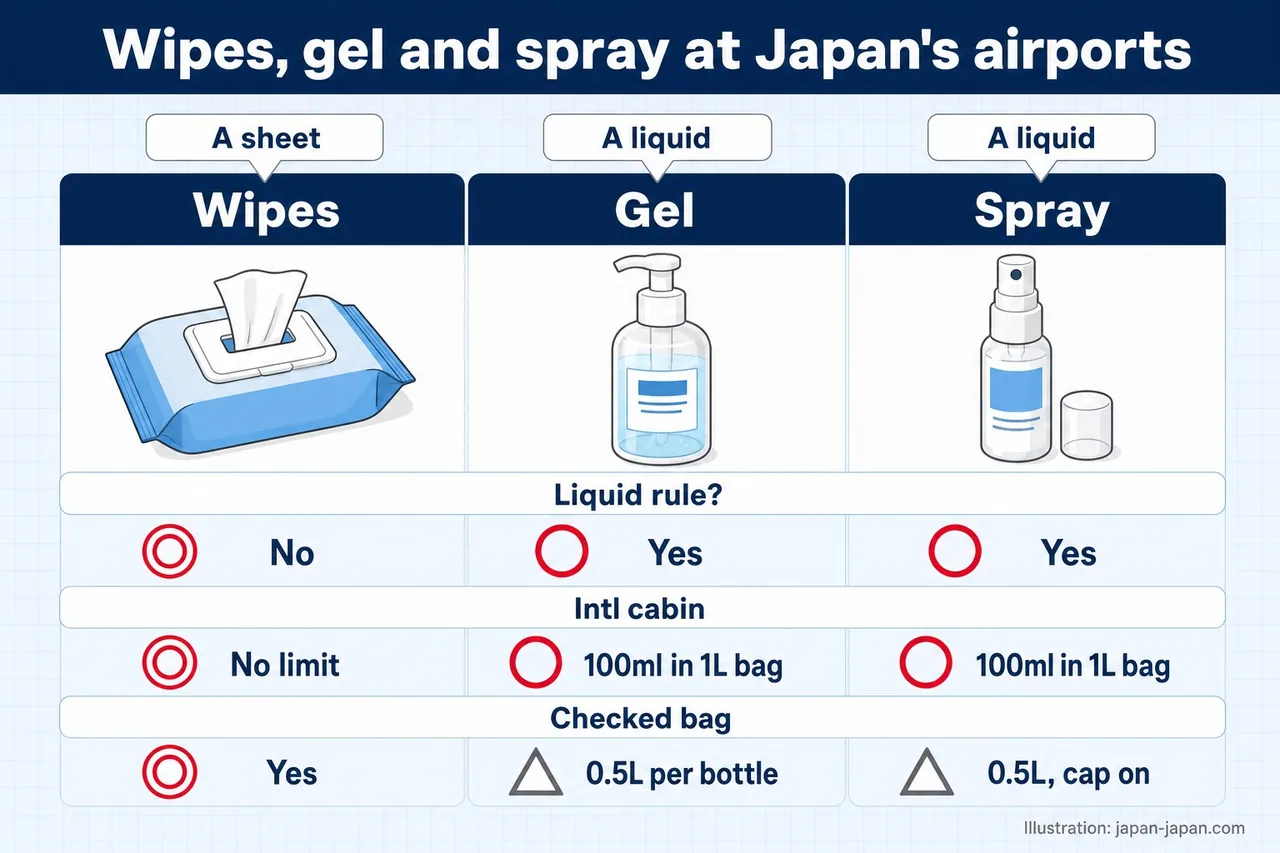
Wipes. A wipe is a sheet, not a liquid. Narita puts wet tissues and make-up remover sheets outside the liquid restrictions on international flights. The FAQ gives the same answer for solid lip balm and lipstick. Put a travel pack of wipes anywhere in your cabin bag and keep it out of the liquids bag. You will want it on the plane anyway, for your hands and the tray table.
Gel and liquid sanitiser. A pump bottle of hand gel counts as a liquid. Narita’s liquid page lists gels and sprays among the items the carry-on liquid rules cover. On an international flight, the bottle must hold 100ml or less and go into your clear bag. Our sanitising gel entry adds the wider cap for every flight: 0.5 litres per container and 2 litres per person, in the cabin or the hold.
Sanitising spray. Japanese airlines class disinfectant sprays as medicinal products. ANA’s domestic page names sterilisation and disinfection sprays, and AIRDO’s page names antibacterial and sanitizing sprays. Both allow up to 0.5kg or 0.5 litres per container and 2kg or 2 litres per person, with the nozzle protected by a cap. Our deodorising and sanitising sprays entry puts alcohol-based sanitising sprays under the same limits. On an international flight, a spray in the cabin also has to meet the 100ml rule.
Disinfectant bottles. A bottle of alcohol disinfectant follows the hand sanitiser rule in our database, which comes from the Japan Civil Aviation Bureau list. Up to 70% alcohol, it can go in the cabin or the hold within 0.5 litres per container and 2 litres per person. Over 70%, it cannot go in either bag. On an international flight, only a bottle of 100ml or less can ride in the cabin. Read the percentage on the label before you pack.
Bleach and chlorine cleaners. These are not alcohol, and the rule is stricter. ANA’s international page treats bleach as a corrosive or oxidising substance and refuses it in both bags. If you disinfect with bleach at home, pack an alcohol product for the trip instead. Our detergent and bleach entry shows which household cleaners can still fly.
Drinks. Sake, whisky and other drinks follow their own strength bands. The last section before the FAQ covers them.
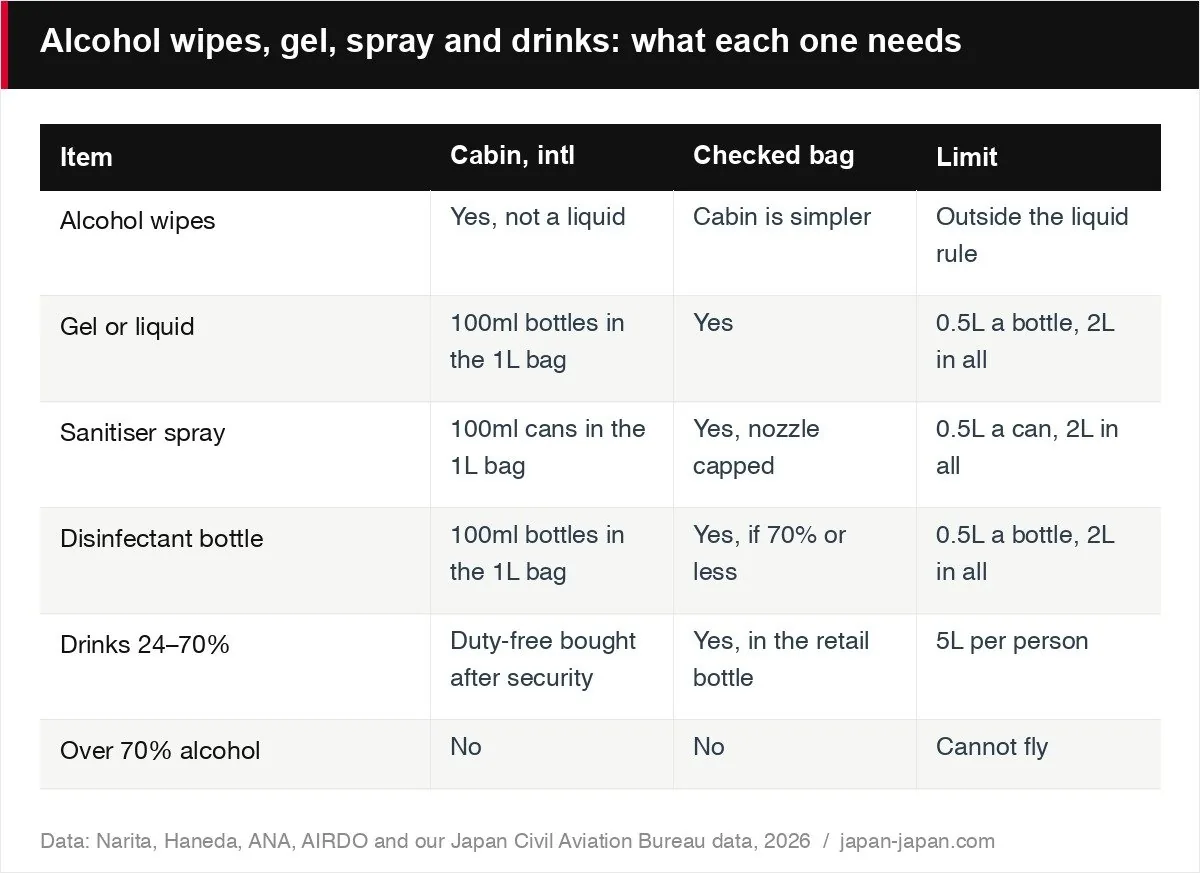
| Item | Cabin, intl | Checked bag | Limit |
|---|---|---|---|
| Alcohol wipes | Yes, not a liquid | Cabin is simpler | Outside the liquid rule |
| Gel or liquid | 100ml bottles in the 1L bag | Yes | 0.5L a bottle, 2L in all |
| Sanitiser spray | 100ml cans in the 1L bag | Yes, nozzle capped | 0.5L a can, 2L in all |
| Disinfectant bottle | 100ml bottles in the 1L bag | Yes, if 70% or less | 0.5L a bottle, 2L in all |
| Drinks 24–70% | Duty-free bought after security | Yes, in the retail bottle | 5L per person |
| Over 70% alcohol | No | No | Cannot fly |
The 100ml liquid rule on international flights
Narita and Haneda describe the liquid rule for international flights in the same terms:
- Each container holds 100ml (or 100g) or less. Narita gives the US equivalent as 3.4 ounces.
- All the containers go into one transparent, re-sealable plastic bag of up to 1 litre.
- Narita recommends a bag no more than 20cm long and 20cm wide. Expandable bags are not accepted.
- Each passenger can carry one bag, and the items must fit in it completely.
- A small bottle cannot ride loose in your cabin bag. Narita turns it away if it is not in the clear bag, even when it holds less than 100ml.
Hand gel, sanitiser spray and liquid disinfectant all go into that bag. Alcohol wipes do not need to. Save the space for the things that count as liquids, such as toothpaste, shampoo and hair cream, which Narita lists by name.
Anything over 100ml goes in the suitcase you check at the counter. Narita’s page says liquids over 100ml can travel that way. If a larger bottle is still in your cabin bag at security, you have to surrender it at the checkpoint.
Bring your own bag. Narita says passengers buy their own clear bags, and that convenience stores and DIY stores sell them. If you forget, the airport’s list of shops has a tag for stores selling transparent re-sealable bags. Our zip-lock bag entry sets out the size rule in one line.
The recommended size is not a hard line. Narita’s FAQ accepts a zip bag of 24cm × 17cm, because its sides add up to about 40cm. Printed bags pass too, as long as the bag is clear enough to see what is inside. Narita still asks for a bag with as little printing as possible, to keep the check quick.
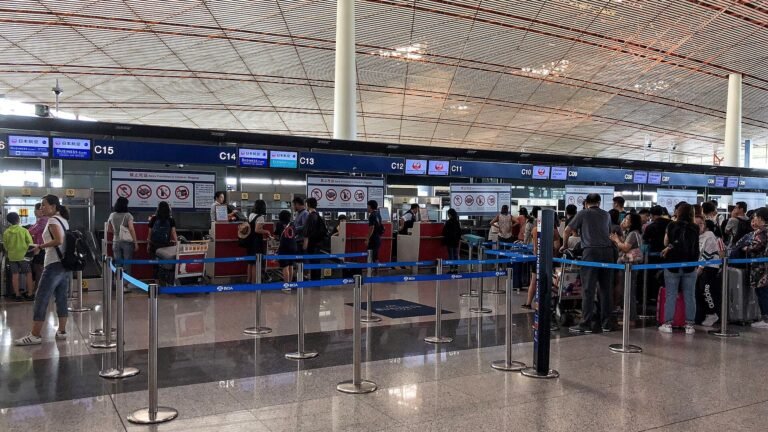
Haneda describes the check itself. You put your jacket, phone, computer and bags on a tray for the X-ray machine, then walk through the metal detector. If something shows up, staff may open your bag. Pack the liquids bag at the top of your cabin bag, so you can hand it over quickly if they ask.
0.5 litres per container, 2 litres per person
The 100ml rule covers only the cabin on international flights. Japanese airlines also apply dangerous-goods limits to cosmetics and medicines, and those limits hold in the cabin and in the checked bag. Sanitiser sits inside them on every flight.
ANA’s domestic page gives the numbers. Cosmetics, medicines and sprays for sport or daily use, including sterilisation and disinfection sprays, can travel in containers of up to 0.5kg or 0.5 litres. The total per person is 2kg or 2 litres. AIRDO uses the same figures and names antibacterial and sanitizing sprays in its list.
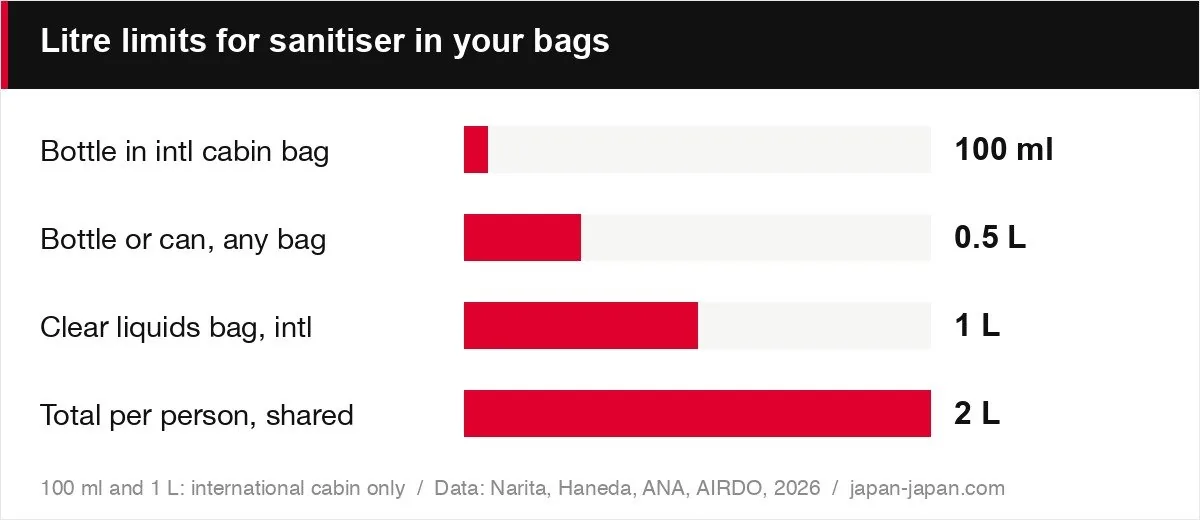
| Limit | Amount |
|---|---|
| Bottle in intl cabin bag | 100 ml |
| Bottle or can, any bag | 0.5 L |
| Clear liquids bag, intl | 1 L |
| Total per person, shared | 2 L (Shared with cosmetics and sprays) |
The 2 litres is one shared allowance, not 2 litres for each type. ANA says the combined amount of cosmetics, medicines and sprays must stay within 2kg or 2 litres. That pool also holds your perfume and cologne, your deodorant and cooling sprays, hairspray and other cosmetic and household aerosols, and your nail polish remover.
Four full containers of 0.5 litres use up the whole allowance, whatever mix of sanitiser, perfume and hairspray they hold. Add up the sizes printed on each bottle and can before you close your suitcase.
Sprays need one more step. Both ANA and AIRDO ask for the nozzle to be protected by a cap, or by another method that stops the contents leaking out by accident. Keep the original cap on, and tape it down if it comes off easily.
Not every spray qualifies. ANA refuses sprays for sport or daily use that contain flammable gas, such as lubricating oil, paint and dust-proof spray, in both bags. Its international page lists dust-proof sprays among the banned compressed gases. Household sprays fit the 0.5-litre rule only when they contain no flammable or toxic gas.
The 70% strength line sits on top of these caps. Sanitiser or disinfectant stronger than that cannot go in the cabin or the hold, however small the bottle.
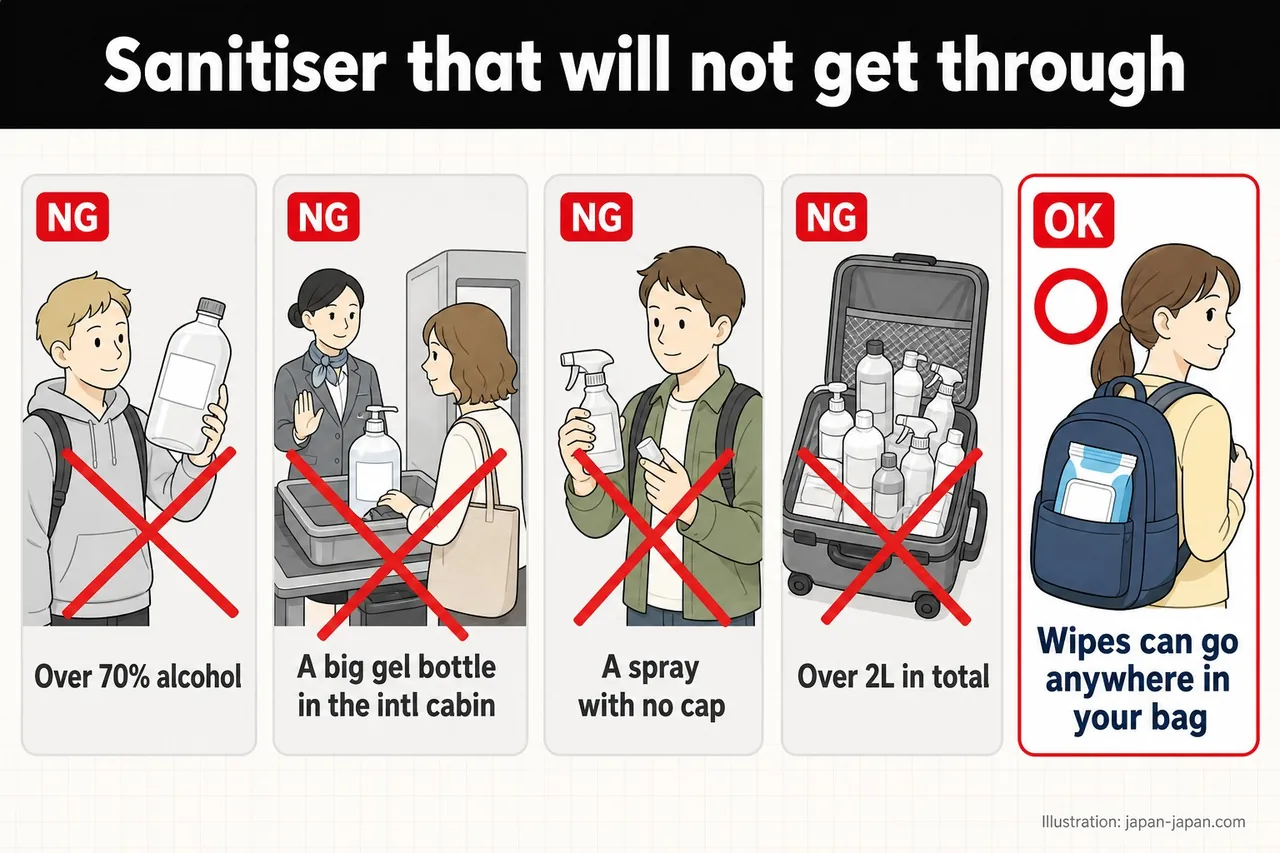
These rules carry weight. AIRDO notes that carrying items the law bans from aircraft can lead to a fine of up to JPY 500,000. If security stops something you packed, AIRDO gives you two choices. Put it in the bag you check at the counter, or throw it away in the disposal box in the security area. ANA asks you to leave dangerous goods in the box for abandoned property in front of the checkpoint.
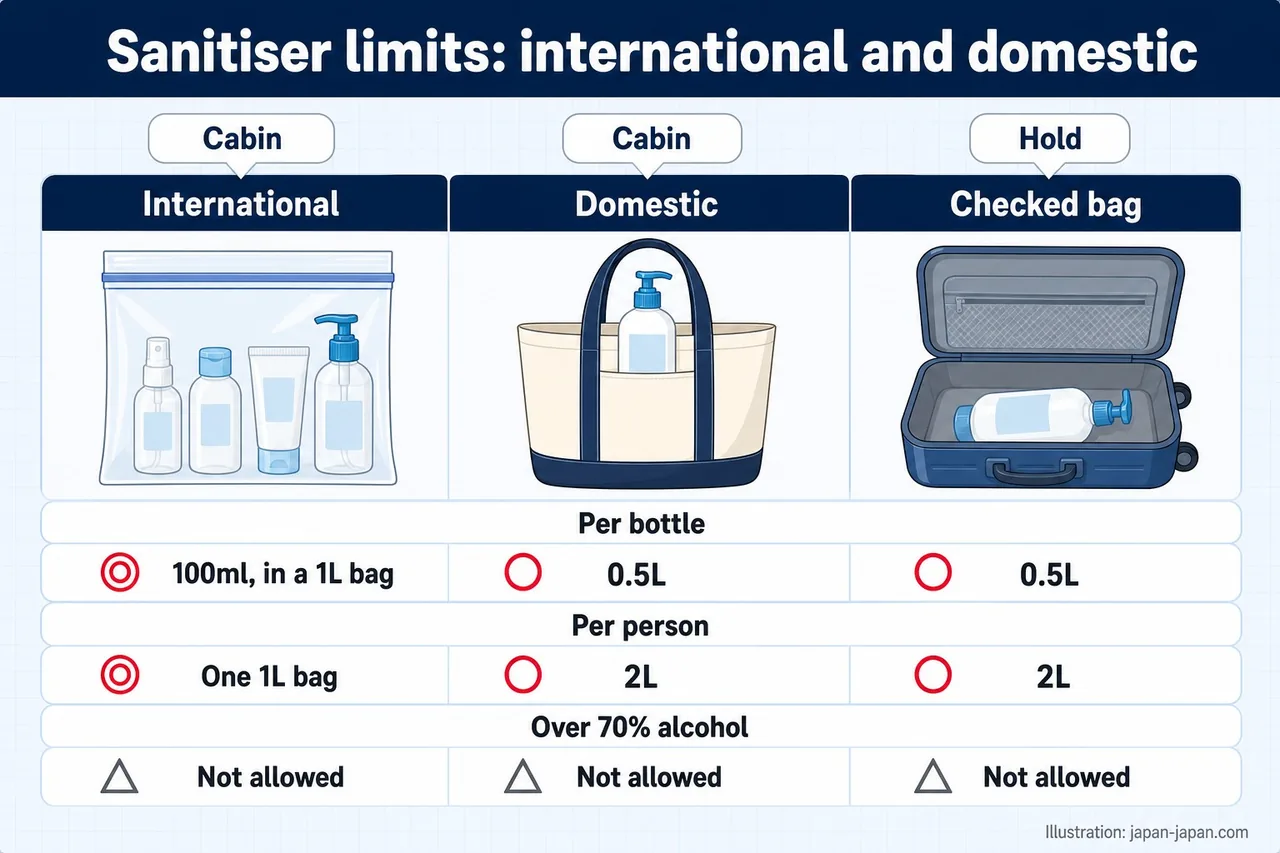
Domestic flights inside Japan: no 100ml rule, same caps
Flights inside Japan drop the 100ml rule. Haneda’s FAQ says drinks can go on board on domestic flights. Lotions and cosmetic liquids can too, up to 500ml or 0.5kg per container and 2 litres or 2kg per person. You do not need the clear 1-litre bag.
That changes how you pack sanitiser. A bottle of hand gel too big for the international bag can ride in your cabin bag, as long as it holds 0.5 litres or less. A sanitising spray can go in the cabin too, with its cap on.
The dangerous-goods caps stay the same. ANA and AIRDO, which flies to and from Hokkaido, both apply the 0.5-litre container limit and the shared 2-litre total to cosmetics, medicines and sanitising sprays. The nozzle cap and the 70% strength line still apply.
You meet this switch when you connect. Say you land at Narita or Haneda on an international flight and fly on to Sapporo or Okinawa. You clear immigration and customs at the first airport you land in, then go through domestic security for the next flight.
Whether you collect your checked bags in between depends on the airline, Haneda’s FAQ says, so ask when you check in. If you do collect them, use the moment to move a larger bottle of gel into your cabin bag for the domestic leg.
At Haneda, ANA, AIRDO and Solaseed Air run their domestic flights from Terminal 2. JAL, Skymark and StarFlyer fly domestic routes from Terminal 1. Terminal 3 handles international flights only, and Terminal 2 also has ANA’s international flights. The international and domestic terminals are a free shuttle bus apart. From Narita, the trip to Haneda takes 90 minutes across Tokyo, so that connection needs a long gap.
On the way home, pack for the strictest leg. If your checked bag goes straight through to your international flight, keep only 100ml containers in your cabin bag from the start. The liquids bag rule applies again at the international security check.
Connecting flights and duty-free shops
A connection adds a security check, and the liquid rule applies again there. Three rules decide what happens to liquids in transit.
International to international at Narita. If you arrive on an international flight and leave on another without entering Japan, the liquid limits apply at the transfer checkpoint. Narita’s FAQ says you must dispose of liquid beyond the limit there. A bottle of gel that passed at your first airport can still be taken from you at Narita. The rule does not apply if you enter Japan and can put the liquid in a checked bag.
The connecting country’s rules. Haneda’s FAQ says the rules of the connecting country apply to liquids, including duty-free items. It tells passengers to ask their airline which country’s rules apply. ANA adds that on a codeshare or a flight run by another airline, that airline’s baggage rules may apply. Some countries also add restrictions of their own.
Duty-free in sealed bags. Liquids from an overseas airport’s duty-free shop can pass the Narita transfer check if they are sealed in a Security Tamper-Evident Bag (STEB). Staff screen them with liquid inspection equipment, and only items that pass can go on board. Leave the bag sealed until you reach your final airport.
On your flight home, the duty-free shops after departure procedures are the exception. Narita’s liquid page says liquor, cosmetics and other liquids bought there can go on board regardless of the 100ml rule. If you buy a liquid over 100ml at the airport’s duty-free shop and carry it on to your destination, it has to go in a STEB.
For sanitiser, the safe order is simple. Pack large bottles in the bag you check at your first airport. Keep only 100ml containers in the cabin through every connection. Narita tells transit passengers to buy liquids at the final connecting airport, so if you run out, buy more there or after you land.
If you meant alcoholic drinks: strength limits and customs
Some people searching for “alcohol” mean a bottle of sake or whisky, not sanitiser. Drinks follow strength bands that apply in the cabin and in the checked bag. AIRDO and ANA set them out the same way:
- 24% alcohol or less: no limit.
- Over 24% and up to 70%: up to 5 litres per person.
- Over 70%: not allowed in either bag. ANA’s international page counts these drinks as flammable substances.
ANA also asks you to keep drinks in the container they were sold in. Our sake and spirits entry adds that pouring a drink into a hip flask is not accepted. On an international flight, a bottle bought before security falls under the 100ml rule, so it goes in the checked bag. Narita confirms that canned beer can travel in a checked suitcase. Drinks you buy at the duty-free shops after departure procedures can go into the cabin.
Customs sets a second limit when you land. Japan Customs lets each adult bring in 3 bottles of alcohol duty free, with a bottle counted as about 760cc. Our duty-free alcohol entry notes that you must be 20 or over. Above three bottles, a simplified rate applies in most cases: 800 yen per litre for whisky and brandy, and 200 yen per litre for wine and beer.
If you are over the allowance, take the red channel at customs and pay at the bank in the customs inspection area. Bottles are heavy, so weigh your suitcase before you leave. Our Japan Airlines checked baggage guide covers the weight limits and the fees for going over.
FAQ
Do alcohol wipes count as a liquid at airport security in Japan?
No. Narita Airport’s FAQ says that on international flights, wet tissues and make-up remover sheets are outside the liquid restrictions and can go into the cabin without a limit. Leave them out of your clear 1-litre bag. Gel and spray sanitiser do count as liquids, so those go in the bag in containers of 100ml or less.
Can I bring hand sanitizer on a plane to Japan?
Yes, within limits: on international flights, Japanese airports allow sanitiser in the cabin only in containers of 100ml or less, inside one clear 1-litre bag. Bigger bottles go in your checked bag, within 0.5 litres per container and 2 litres per person, and products over 70% alcohol cannot fly. On domestic flights inside Japan, the 100ml rule does not apply.
Can I bring isopropyl alcohol to Japan?
Check the strength on the label first. Our database applies the hand sanitiser rule to alcohol disinfectant: up to 70% alcohol, it can go in the cabin or the hold within 0.5 litres per container and 2 litres per person. Over 70%, it cannot go in either bag. On international flights, a bottle for the cabin must also hold 100ml or less and go in the clear bag.
Can I pack a sanitizing spray in my checked bag?
Yes. ANA and AIRDO accept sanitising and disinfection sprays in checked bags as medicinal products, in containers of up to 0.5kg or 0.5 litres and 2kg or 2 litres per person in total. That 2-litre total is shared with your cosmetics and other sprays, and the nozzle must be protected by a cap. Sprays for daily use that contain flammable gas, such as dust-proof sprays, are refused in both bags.
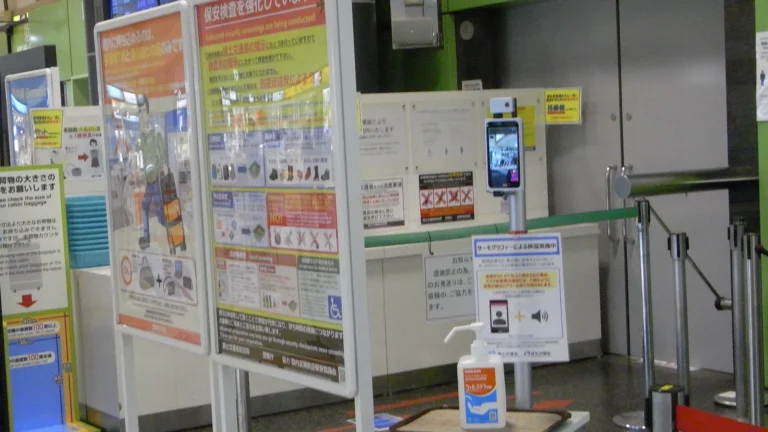
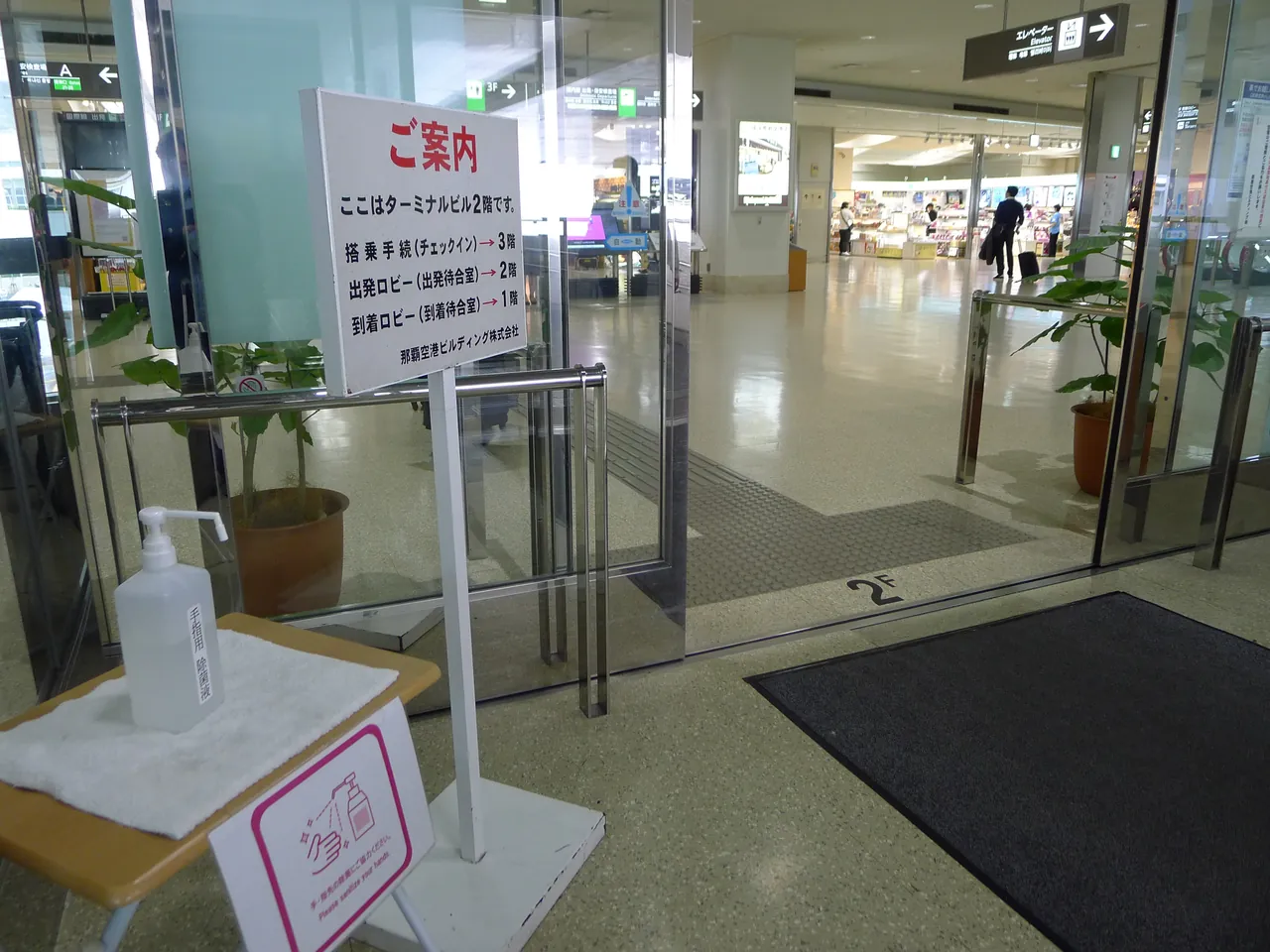
Photo: Hand sanitizer in Nagasaki Airport.jpg by 出島商人 (CC BY-SA 4.0), via Wikimedia Commons.